

A buyer approaching a range of this size usually wants one of two things, and they are opposites. The first is a catalogue: a list of every model, every row, every option, so that nothing is missed. The second is a map: a way to get from a use to the handful of models that could serve it, so that the catalogue is not the first thing that has to be read. Our catalogue is very good at the first and deliberately unhelpful at the second, because a catalogue cannot know what a buyer is trying to buy. This page is the map, and it is built from the published rows rather than from the product names — because in this range the names tell a buyer very little and the rows tell a buyer almost everything.
Smart eyewear range product range overview: from a use to the models that can serve it
The range divides into use-based lines, and the lines are easier to recognise by what they do than by what they are called. The audio line covers frames built around a Bluetooth connection and a speaker pair, and it holds the LC-105-2 and the G07, the LC-105-1 and the YK12, the K01 and the D11, and the K02 and the D12. The camera line covers frames with a camera and a viewfinder, and it holds the CY03 and the V03 Pro, the CY05 and the V06, the V03 and the L2 Utral, the MT5 and the S7, the L1 Pro and the MT6, and the KY06. The sport line holds the YKC02, the D17 and the ZH12, all published as 运动眼镜. The children's line holds the A05, the A06 and the A07. Alongside those sit a small number of entries published without a model name at all, including an AR entry, an AI electrochromic entry and a bone-conduction entry, and a buyer reading a range page has to know that those entries exist rather than discovering the gaps later.
That map is the useful part, and it is deliberately not a hierarchy. Nothing in our published material makes one line more advanced than another, and a buyer who reads a range page as a ladder will look for a top of the range and will not find one, because the published data does not contain a ranking. What it contains is a set of lines with different technical profiles, and the choice between them is a choice about the use and about the rows, not about quality.
The map also answers the question a buyer asks first, which is whether the range holds anything for a use that is not obvious. It does, and the entries that are easiest to overlook are the ones published without a model name. A buyer who is looking for a frame with a display, or for one with an electrically driven tint, or for one that carries sound through the bone rather than through the air, will find those positions occupied in our catalogue even though no model code appears against them. The practical consequence is that a shortlist built only from the model-named entries is an incomplete shortlist, and the fix is procedural rather than technical: a buyer should ask for the range position by description as well as by model code.
Three points in the map are worth stating explicitly, because they are the ones that get misread.
- The camera line and the children's line are not the same thing, even where a product's name suggests a camera, because the three children's models publish no camera specification at all and their designations name a different use.
- The sport line is identified by its product designation and by two of its three models publishing the shorter charge ceiling; it is not identified by a camera, and none of its three models publishes one.
- Entries published without a model name cannot be quoted, shortlisted or configured, because there is no code to quote; a buyer who needs one of those positions has to ask for it by description and for the model code that goes with it.
The second thing the map has to carry is what a buyer cannot get from it. Within every line, the majority of the operational questions are open. There is no published price, minimum order quantity, delivery lead time, sample price, warranty term or per-model certification record anywhere in this range, and no published frame weight for any model except one. The lines therefore differ in their published rows and are otherwise operationally equivalent as far as our material is concerned, which means that a range page can tell a buyer what to shortlist and cannot tell them what to sign. The second half of the work belongs in a supplier conversation, and the page below is written to make that conversation efficient rather than to avoid it.
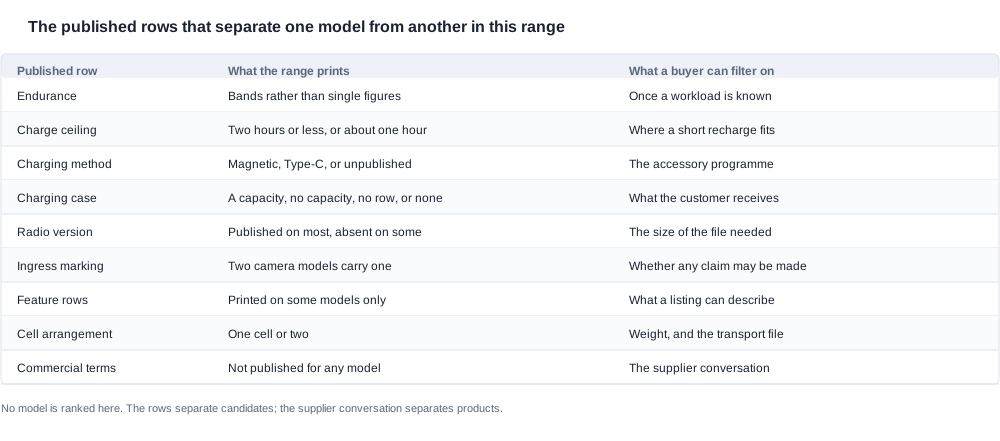
The published rows that actually separate one model from another
The table above sets out the rows on which the range genuinely varies, and the way to read it is as a set of filters rather than as a table of products. A buyer who has already decided on a use needs two or three of these rows and nothing else; a buyer who has not yet decided on a use needs the whole set, because the first row that happens to match is usually the one that decides the line.
The endurance rows are the most commonly quoted and the least decisive, because they come in bands rather than in figures. The published values across the range are approximately six hours, approximately seven hours, approximately eight hours, a five-to-eight-hour range, a six-to-eight-hour range, approximately twenty hours and approximately one hour for the charge ceiling of the two shortest-charge models. A rating of this kind is a manufacturer figure with no workload definition, no start state and no end criterion attached, and a buyer who compares two models on a rating alone is comparing two numbers whose conditions differ by an unknown amount.
The charging method is the row that separates models more often than the endurance row does, and it is worth reading carefully because it comes in three forms rather than two. Magnetic charging covers the largest part of the range. Type-C charging covers a smaller part, including the two sport models that also publish the shorter charge ceiling. And a third form is simply absent: four camera models print their cell, their charge ceiling, their endurance figure and their case capacity, while saying nothing at all about the way they are charged. For those models, a written answer is required before a buyer can describe how the product is charged, and a buyer who fills the gap from a neighbouring model has written a factual error.
The charging-case rows are the subtlest, because the range uses three different treatments. Five models publish a case with a capacity. Two publish a case and no capacity. And four publish no case row at all, which leaves the item unstated rather than absent — no model in the set carries a positive statement of absence, so the case position for those four is a question to put to the supplier rather than one a buyer can rely on. The distinction between a row that is missing and a row that says the item is not there is the single most useful piece of catalogue literacy a buyer can acquire before ordering.
The radio versions separate the range in a way that is easy to miss because the versions are close together. Most of the audio and children's lines publish a version, the audio pair at the centre of the range publishes an earlier one, and the camera line and the two protection children's models publish none at all. For a buyer whose product connects to a phone, that is the difference between a documented radio and an undocumented one, and it decides what has to be requested. The ingress rows are narrower still: two camera models publish an IP54 marking and nothing else in the range carries one, which is worth stating plainly because the sport line and the children's line are exactly where an ingress question gets asked and exactly where the catalogue is silent.
How a buyer should walk the range without a catalogue PDF
The practical sequence for moving from a use to a shortlist has four steps, and the order matters more than the detail. The first step is to write the use down in terms that a published row can answer, because a use described as "outdoors" or "for a child" is a use no row can settle, while a use described as "a full shift of audio with one recharge" is a use the endurance rows can be compared against.
The second step is to select the line. This is much easier than buyers expect once the use is written down, because the lines are separated by what the product is for rather than by specification. Audio frames carry a radio and a speaker and no camera. Camera frames carry a camera, and the two protection children's models are the only entries in the range that publish a set of indicator rows. The sport line is distinguished by its product designation and by the fact that two of its three models publish the shorter charge ceiling, and that is a distinction a buyer can use.
The third step is to narrow inside the line on the rows that differ, and the order of preference is: the charging method first, because it determines the accessory programme and the aftersales line; the case rows second, because they determine what the customer receives; the radio version third, because it determines the size of the conformity file; the endurance rows last, because they are the least comparable. The fourth step is to write down what is still open, and the value of the fourth step is that it is the step that makes a supplier conversation productive, because a list of open items is a request, while a general request is a conversation that ends without an answer.
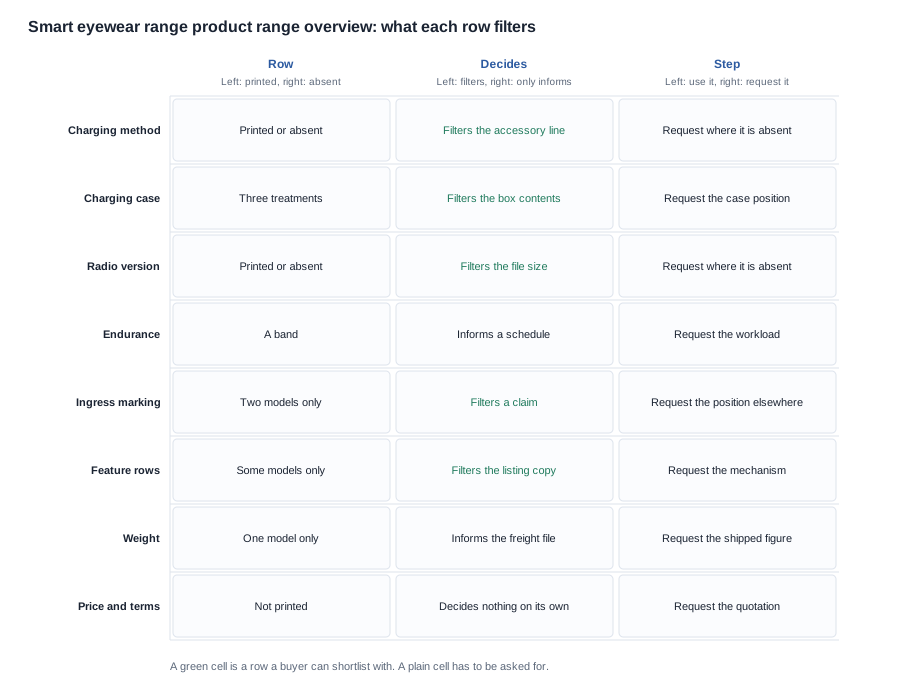
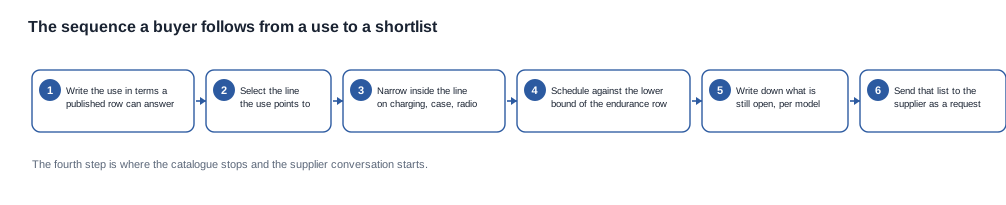
The sequence above is also the fastest way to find out which model in a line is worth the effort. In practice one or two models in a line have a published row set that already answers most of what the buyer needs — a case that is published, a charging method that is published, a radio version that is published — and the rest of the work is concentrated on the models where those rows are missing. A buyer who has read the range in this order knows which model to spend the supplier conversation on, and that is the difference between a range evaluation that takes a fortnight and one that takes a quarter.
It is also worth naming what this sequence cannot do, because the temptation to push it further is strong. It cannot produce a recommendation, and the reason is that our published material contains no price, no lead time and no defect data for any model in the range. A shortlist built by this method is a shortlist of candidates for a commercial conversation, and it becomes a decision only when the commercial terms arrive. A page that tried to close that gap would have to invent the terms, and inventing terms is how a range page becomes a liability for whoever ships against it.

The open questions the range does not answer
Read across the whole range rather than down any one line, and the pattern of what is missing is more informative than the pattern of what is present. The range publishes hardware with unusual consistency: a cell, a rated endurance, a charge ceiling, a charging method, a radio version where one is published, a set of feature notes where a model has them, an ingress marking on two camera models, a colour list on a few camera models, and a case row on some camera models. Everything else is open, and it is open consistently enough that a buyer can plan around it.
The consistent gaps are these. No frame weight is published for any model in the range apart from one, and that one is stated as a whole-body figure rather than as a frame figure, so it cannot be borrowed. No lens material, thickness, tint or coating is published for any model. No ingress marking is published for the sport line, for the children's line or for most of the camera line. No control method and no pairing procedure is published for any model. No charging-case capacity is published for the models that publish a case without one. And no commercial term of any kind — no price, no minimum order, no lead time, no warranty, no per-model conformity record — is published for any model in the range.
It is worth adding one more observation, because it changes how a range evaluation is budgeted. The open questions are not evenly spread across the range. In some lines, a single published row settles most of what a buyer needs to know, and the remaining work is a short conversation about a configuration. In other lines, the same number of open questions has to be answered before any of them can be asked, because the first one determines the shape of the rest — a model whose charging method is unstated cannot have its accessory programme discussed, and a model whose case position is unstated cannot have its box contents discussed. A buyer who sequences the enquiries in dependency order rather than in a fixed order will find that some models clear in a day and others need a fortnight, and that the two are separated by which rows the catalogue happens to print rather than by anything to do with the products themselves. That is a real finding about how this range is documented, and it is the kind of finding that changes a launch plan.
There is a second class of open question that is not about the products at all, and it is the one that catches buyers out. A range page is read as a complete description of what is available, and our material is complete about hardware and silent about everything else. The honest description of this range is therefore: a well-documented set of product configurations, with the commercial and the operational file to be assembled separately for each model that a buyer selects. A buyer who understands that at the outset will spend their time on the models that are actually being taken forward. A buyer who expects the range to be self-sufficient will find out at the quotation stage that the range was never going to answer those questions, and the delay will be the buyer's.
That is also the reason the open questions have to be asked per model rather than per range. A file for a range is not a file for a product, and a request that names a range is a request that will be answered with a range. The practical instruction to a supplier is short: the model, the configuration, the market, and the documents. Everything else in this page is arranged to make that instruction easy to write.
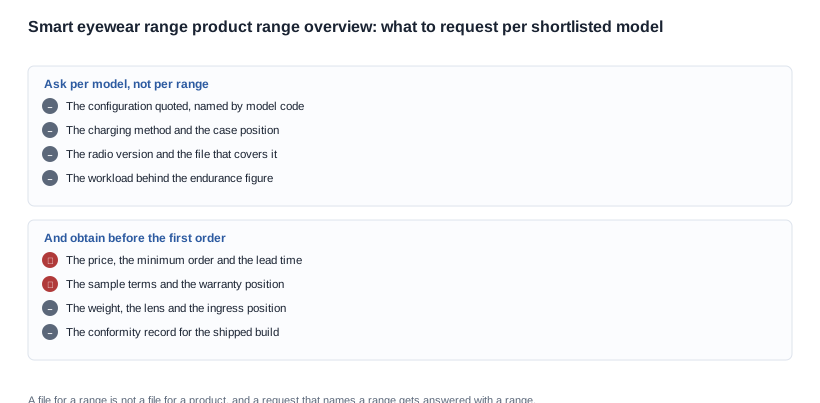
The items on that list are the same for every model in the range, which is a useful thing for a buyer to know in advance: the difference between a model that answers most of them from the catalogue and one that does not is the difference between a short supplier conversation and a long one, and the range is legible enough to predict which is which before the enquiry is sent.
What this range is for, and how we will use it with a buyer
On this range, our position is simple and worth stating because it is unusual for a manufacturer to state it. We publish the rows we can stand behind, we do not publish the commercial terms we have not been asked to hold, and we do not publish a ranking of our own products. What we do publish is enough for a buyer to build a shortlist on evidence rather than on a brochure, and the rows in the table above are the whole of that evidence.
The practical offer is that a buyer sends us the use they are buying for, the rows they have already narrowed on, and the copy they intend to publish, and we will tell them which models in the range the published rows actually support for that use, which questions are still open on each of them, and which of the open questions are the ones that decide the programme rather than the ones that can wait. For a buyer building a line rather than a single product, the starting point is the platform and range planning material rather than a single model page, and the way that work is scoped is set out in building a product line from this range.
What we will not do is convert a range evaluation into a recommendation we cannot support. There is no published price in this catalogue, there is no published lead time, and there is no published evidence that one model is better suited to a use than another beyond the rows themselves. A buyer who asks us which model to choose will get the rows for the models that fit the use they have described, the open questions attached to each, and an honest statement of what the catalogue does not settle. That is a slower answer than a recommendation, and it is the one that survives contact with a customer.


