

A product line built by starting with a list of models ends up with three packaging SKUs, two applications and no shared engineering. A product line built by starting from the published rows ends up with tiers that differ on something a customer can actually see. The order of those two decisions is the whole difference, and it is the sequence we would work through.
This is a method, not a proposal. We do not publish unit prices, minimum order quantities or lead times, so we cannot tell you what a line will cost — but we can tell you which rows in our catalogue are strong enough to carry a tier, which are not, and what has to be arranged before a second model becomes cheap to add.

Building the line from published rows rather than model names
The catalogue has 28 models, and they cluster
The smart eyewear range covers 28 published models, and the first thing to understand is that they are not 28 equal options. They group into families with shared rows, and those groupings are where a line can be cut.
The camera models number eleven and split on imaging tier, cell capacity and case configuration. The audio models number eight and split on cell arrangement, charging method and how many feature lines each carries. The sport models number three, the children's models number three, and the remaining published entries cover an AR frame, an electrochromic frame and a bone-conduction frame.
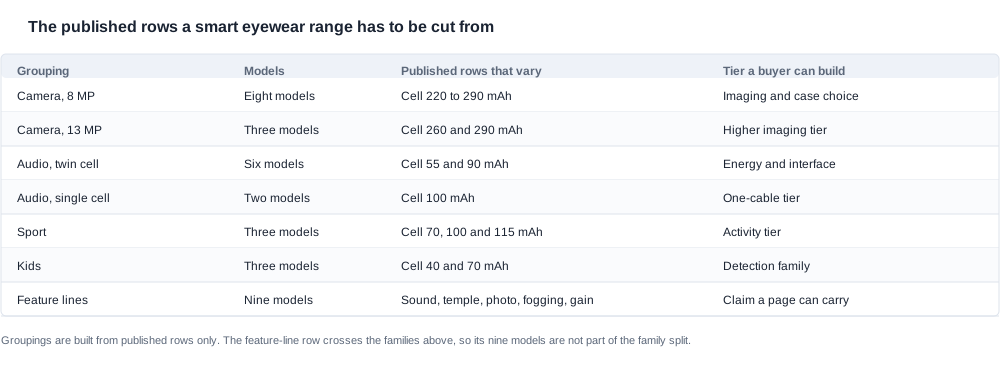
Two groupings carry most of the commercial weight for a first line. The camera family gives a range an imaging story that a competitor with audio-only products cannot match. The audio family gives it a lower entry price point with a simpler parcel. A line built on those two groupings covers the two purchase occasions that actually exist in this category — a camera purchase and an audio purchase — without opening a third set of compliance work.
What a grouping saves you
The reason to work from groupings rather than models is the fixed cost structure underneath them. A third grouping is a second application, a second accessory family, a second certification file and a second set of packaging, and none of those is free. A fourth model inside a grouping you already run is close to free by comparison, because the underlying engineering and documentation work has already been done.
So the arithmetic that matters is not how many models you sell. It is how many groupings you operate. Two groupings with four models each is a healthier position than one grouping with eight models, because it gives the buyer a step-up at every price point without giving the supplier a second platform to qualify.
Choosing the two groupings and writing down why
The selection criteria for a grouping are simple: enough published variation to support at least two distinct tiers, and enough commonality that one platform file can cover the models inside it. Read against the catalogue, that rules in the camera family and the audio family, and it rules against opening with the kids family or the bone-conduction frame, where the published variation is thin and the compliance surface is heaviest.
The model readiness overview maps where shared rows sit across the range, and the scaling up piece covers what each additional grouping actually costs to operate.
Write the reason down at the point of selection. A buyer who cannot articulate why two groupings were chosen will not be able to defend the decision to a colleague reviewing the range six months later, and the most likely outcome of that review is a proposal to add a third grouping for no stated reason.

Cutting tiers so that each one is a real tier
The published differences that can carry a tier
This is the discipline that decides whether a line has tiers or merely has packaging. Looking across the published rows, the differences that genuinely exist are: camera resolution, cell capacity, charging method, charging case configuration, colour list, temple design, and whether the product carries a camera at all.
Everything else a buyer might want to split on — endurance, weight, sound quality — is either not published or not comparable. Endurance is the clearest example: the catalogue publishes about eight hours as the top figure and it appears on several model groups at once, with no test condition published for any of them, so it cannot separate one tier from another.
The test a tier has to pass
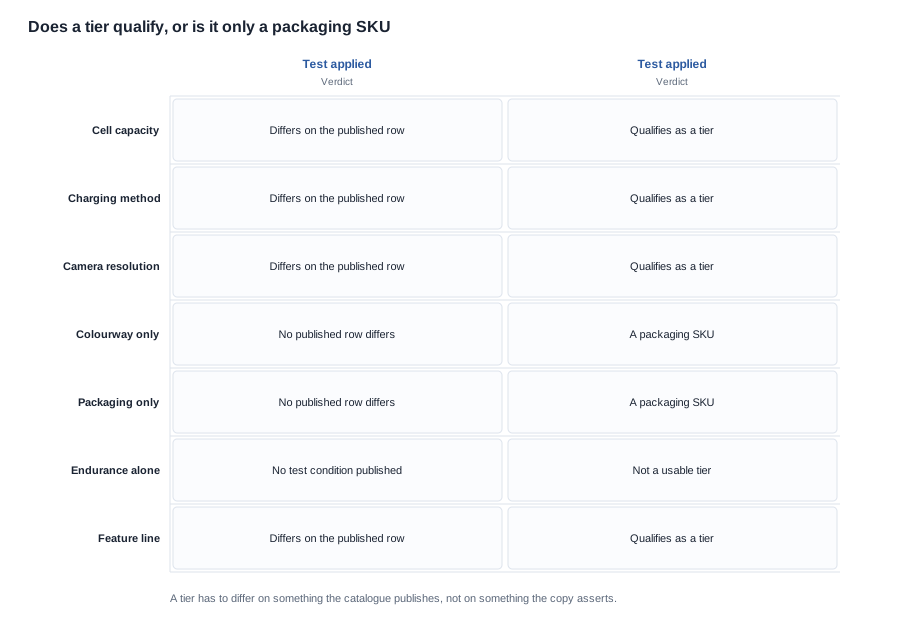
A proposed tier passes if it differs on a published row and that difference is something a customer can see or a buyer can verify. It fails if the only difference is colour, packaging, or an endurance figure without a condition.
The practical consequence of failing this test is not aesthetic. A tier that fails the test has to be justified in the listing copy, and the copy then has to survive a customer asking why the cheaper model does not have the same feature. If the answer is a colour, the tier is a merchandising device rather than a product difference, and that is a legitimate thing to have — but it should be recognised as one rather than presented as a capability step.
Working through the camera family as the worked example
Inside the camera family the published rows support three tiers without any invented distinctions.
The imaging tier is the cleanest. Eight of the camera models publish an 8 MP row and three publish a 13 MP row, and that is a published difference a buyer can verify on the specification sheet.
The energy tier is the cell capacity: the camera models publish cells at 220, 260, 265 and 290 mAh. These are published values, not derived totals, so they can go on a specification table as they stand.
The case tier is where the documentation needs care, because there are three different states and only one of them is a simple answer. Five camera models publish a charging case capacity — three at 1400 mAh, one with a choice of 900 or 1400 mAh, and one with a 1200 mAh folding case. Two more have a case whose capacity is not published. Four publish no charging case row at all, which means the catalogue is silent rather than stating that there is no case, and the box contents for those four have to come from the supplier. A buyer who writes "no charging case" for the four silent models is asserting something the catalogue does not say, and the correct position is to ask the supplier.
The AI camera glasses model selection piece covers the model-level decision inside that family, and the charging case options analysis covers the accessory states in detail.
Working through the audio family
The audio family splits less cleanly, which is itself useful information for a buyer planning a range.
The cell arrangement gives one usable step: four models publish twin cells of 55 mAh, two publish twin cells of 90 mAh, and two publish a single 100 mAh cell. That produces a low-energy tier, a high-energy tier and a one-cable tier.
The feature lines give another, but a thinner one. Three of the eight audio models publish a feature row of some kind — a sound descriptor on the D11 and the YK12, a temple treatment on the G07 — and the other five publish none. Nine models in the catalogue publish a feature row, and they sit across the families rather than forming one of their own: a fogging unit on the two children's models, a flexible temple on the V03 Pro, a detachable temple on the G07, a slim temple on the YK12, a surround row on the D11, the YK12, the D17 and the ZH12, a remote shutter on the D17 and the ZH12, and a gain row on the bone-conduction frame. The useful split is between a model that carries a claim a page can be written around and a model that carries only electrical rows.
What does not work is splitting by endurance. The top published runtime figure appears on several audio models at once, and no test condition is published for any of them.

Setting the accessories, packaging and platform file once
The accessory decision is the delivered-cost decision
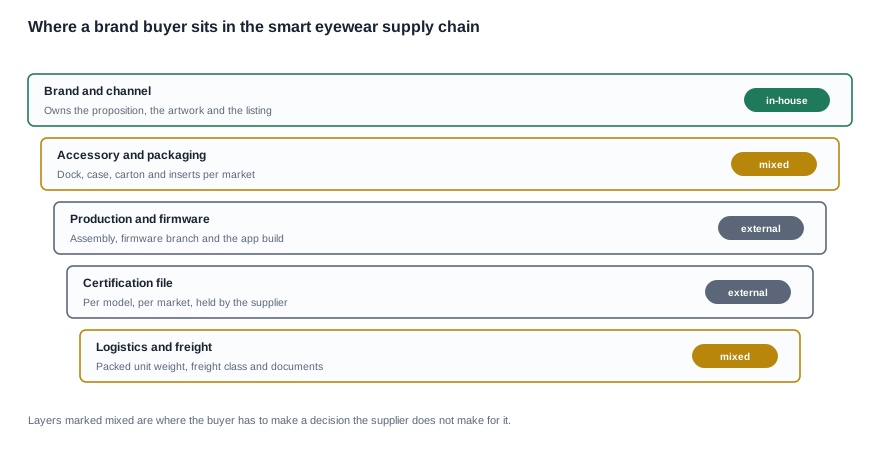
Accessories are where the range's unit economics are actually decided, and the decision is much cheaper to make once across the whole line than per model. A magnetic charging frame implies a dock in the carton; a Type-C frame implies a cable. A case is a second lithium cell in every unit, which changes the packed weight, the freight class and the transport documentation.
The audio charging options analysis and the camera charging case options analysis set out the positions model by model, and the shipping weight breakdown covers the parcel arithmetic where case capacities are published.
Packaging structure follows the tier, not the model
One box design per tier. Each colourway inside a tier gets an insert or a label rather than a new carton. Each market gets a print version of the same structure rather than a new structure. This is where a range quietly triples its packaging cost, and the packaging design reference covers fixing the artwork before any of it is produced.
The platform file is what makes the next model cheap
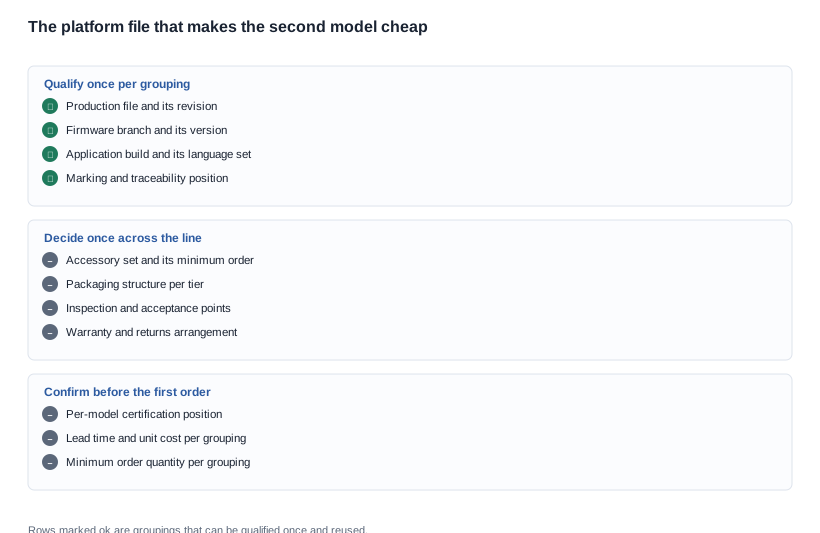
Qualify the platform once per grouping and the fourth model in that grouping is genuinely cheap to add. The platform-level assets are the production file, the firmware branch, the application build, the marking and traceability position, the accessory set, the packaging structure, the inspection and acceptance points, and the warranty and returns arrangement.
Two of these are worth singling out. The inspection and acceptance points should be defined before the first order, because they are what turns a specification dispute into a routine procedure. And the warranty and returns arrangement has to be agreed as a platform-level term, because a returns policy agreed model by model will produce two different policies inside one range.
The export documentation checklist covers the file that travels with the goods, and the warranty setup piece covers the arrangement that has to be in place before the first order.
The launch check, and the mistake it prevents
Before any page goes live, look at the tiers side by side as a customer would and ask whether each one has a reason to exist that a competitor's tier at the same price does not. If two tiers are indistinguishable on the published rows, merge them or re-cut them on a row that does differ.
The mistake this check prevents is the range that looks like a range on a spreadsheet and behaves like one product on a shelf. A buyer who discovers that after launch has already paid for the artwork, the packaging, the listing pages and the certification file.
The new against established models piece applies the same discipline to a single decision, and the category trends piece lists the published rows that give a tier something to differ on.
The sequence, and what each step costs to reverse
The order of the steps matters because several of them are expensive to reverse and others are not. Publishing a certification file and locking artwork are close to irreversible once the application names a model. Naming a grouping in a range plan is not.
That asymmetry is why the recommendation is to settle the groupings, the tiers and the accessory decision first — they are cheap to change and they determine everything that follows. A tier cut wrong is a repackaging job. A certification file opened against the wrong model is a re-application.
How the tiers should be priced against each other
The brief's constraint on this page is that we do not publish prices, so what follows is a structure rather than a set of numbers — and the structure is the part that survives a negotiation.
Do not price a tier gap by the size of the hardware difference. The temptation is to take the cell capacity difference as the tier step, but capacity is not what a buyer feels and it is not even what our catalogue can substantiate as a runtime difference, since no test condition is published. A tier gap built on an unprovable row is a gap a competitor can undercut with a copy rather than with a product.
Price a tier gap on what the buyer can verify and the customer can see. The imaging step between an 8 MP and a 13 MP published row is verifiable on the specification sheet. The case configuration difference is visible in the box. The charging method difference is visible in the cable or the dock. These are the differences that survive a comparison a customer performs themselves, and they are the ones a tier price can rest on.
Let the unprovable rows sit inside the tier rather than between tiers. Endurance, weight, sound quality and comfort sit within a tier, because the catalogue does not let them be separated and because a buyer who splits on them will be asked to defend the split. Within a tier, a difference in these rows is a sourcing choice the buyer can make quietly; between tiers, it becomes a promise the buyer has to keep.
Decide where the range stops before the launch, not after. A range needs an explicit answer to the question of which model a customer ends up on when they buy the cheaper one, because that is the return and the review risk. If the cheap model is a genuine alternative rather than a compromised one, say so on the pages. If it is compromised, it should not be in the range at all — and that decision is much cheaper to make on a spreadsheet than after the listings are live.

The commercial conditions that a range has to be built around
A range plan that survives contact with a supplier's quotation is one that already knows which terms will be negotiated and which will not. For this catalogue, that means four areas.
Unit price, volume tiers and the accessory minimum
Unit price at volume tiers is the term a buyer expects to negotiate and the one a range plan has to be built to absorb. The complication is the accessory set: a dock or a case has its own minimum order quantity, and the line is as constrained by the smaller of the two minimums as by the frame minimum itself. A range that needs one dock per unit cannot be ordered in smaller increments than the dock minimum, however flexible the frame terms are.
The question to ask at quotation stage is therefore not only what the unit price is at a given volume, but what the minimum order is on the full delivered configuration — frame plus the accessory that ships with it — and how that minimum changes the cost per unit at the volumes the channel will actually order.
Delivery splitting and the first order
Delivery splitting is more valuable to a first range than it is to a mature one, because the first order is where the returns data does not exist yet. A buyer who commits to a single large first shipment is committing to a demand forecast that no one can validate.
The practical approach is to split the first order across two or three delivery dates, sized so that the first shipment tests the proposition and the later shipments follow the measured result. The terms worth negotiating are the split itself, the price basis for each part, and whether a date can move inside a stated window rather than being fixed.
Payment nodes against inspection
Payment against inspection is the term that protects a buyer whose documentation is thin, and this catalogue's documentation is thin in exactly the places that matter — weight, case capacity, per-model certification, and the test conditions behind every endurance figure. The risk of paying in full on dispatch is that a specification gap is discovered after the money has moved.
The clause to write is that a stated percentage is retained against the inspection points, and that those points are named in the agreement rather than left to a delivery conversation on the day. The acceptance points come from the platform file, which is why that file has to exist before the first order rather than after it.
Certification and tooling are not commercial variables
Two cost lines in this category behave differently from everything else, and buyers who treat them as negotiable end up negotiating the wrong thing. Certification cost and its timeline follow the process and the testing body, and they are per product family rather than per order. Tooling is frequently amortised across an initial order instead.
Ask which of the two you are being quoted, because the two are frequently bundled into a single line that hides which one carries the volume. A buyer who reads a bundled line as one number will misjudge which cost scales with the range and which cost scales with the order.
Where CYNRIN stands on building a smart eyewear range
The platforms come first and the models second, and a line built the other way round is the most common way a range ends up with more packaging than product. We will not present a model as ready for a configuration it does not document, and where our own documentation is incomplete — minimum order quantity, lead time, unit cost, and the certification numbers for specific models — we will say it is incomplete rather than offer an estimate that becomes a commitment.
We will also not invent a tier. If a proposed tier differs from another only in colour or packaging, we will say that is what it is, and if it differs on endurance without a test condition, we will say the endurance row cannot separate them. The smart eyewear range overview covers the category structure, and the brand guidelines piece covers the identity side of the same programme.
Six items to settle before the line is designed
- The two groupings, and the reason for choosing them over the alternatives.
- The tier structure, with each tier differing on a published row.
- The accessory and case decision, made once across the line.
- The packaging structure: one box per tier and one print version per market.
- The platform-level file: production, firmware, application, marking and inspection points.
- The side-by-side check that the tiers are genuinely distinguishable to a customer.
Related reading
- Which models share a grouping — OEM ready platforms which models are ready
- The cost of each additional grouping — OEM ready platforms scaling up
- The commercial structure around the line — OEM ready pricing tiers
- Choosing a category rather than a range — smart eyewear range switching categories
Send us the segments you want to cover, the markets and the expected volumes, and we will tell you which two groupings carry the line and how many packaging SKUs it implies.


