

AI features on a wearable are a service wrapped in a product, and the checklist below is structured around that fact. Every row asks for something that has to be answered in writing by a specific party, because none of it is discoverable from a datasheet or from a demonstration.
Our catalogue lists an AI voice assistant across the camera models and references AI translation on the K01. We publish no specification behind those: no model list, no on-device or cloud statement, no subscription terms, no data location, no offline capability, no latency and no accuracy figure. So for smart glasses ai features smart glasses buying checklist, treat every row as a question to be answered by the manufacturer rather than by us.
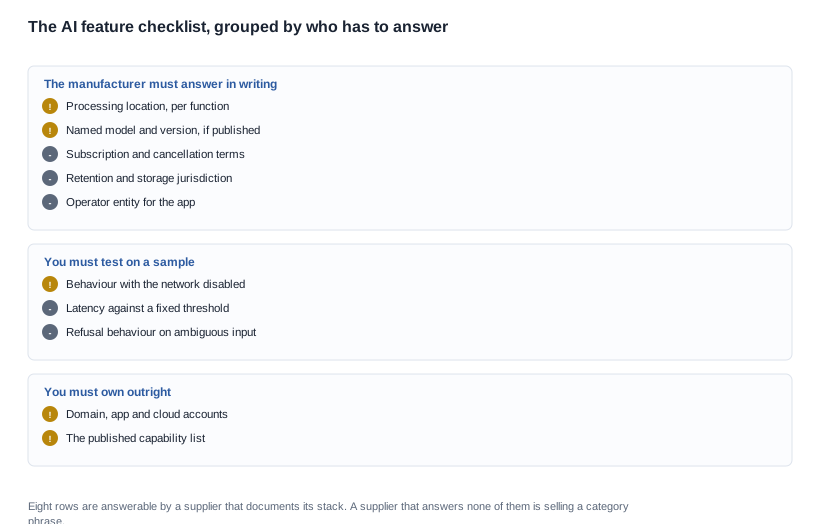
Smart glasses AI features: eight rows, eight owners
The grouping in the chart is the important part of this checklist, not the individual rows. Seven of the eight rows are answered by a party other than the factory — the software house, the backend operator, or the component supplier. Only one is yours to close without anyone else's cooperation.
That single fact explains most of the failures in this category. A buyer who sends a checklist to the factory and waits for eight answers is waiting for answers the factory does not hold, and the delay has nothing to do with the factory's responsiveness. A buyer who sends the same checklist to the party that actually implements the assistant gets answers in a day.
So the operational instruction for the checklist is: route each row to its owner before you send it, and ask each supplier to name the party who answers the rows they cannot answer themselves.
Row one: processing location, per function
On-device, server, or a stated split. This determines the data story, the privacy exposure and the offline story, and every other answer depends on it — so it is the first row and it is asked in the first email.
The answer that closes it is a written architecture statement per function, not per product. A product with three AI-assisted features may run one of them locally, one on a server and one on the phone, and a single statement covering the product will hide that. On-device processing keeps data local and removes a recurring cost, at the price of capability on constrained hardware. Cloud processing does the reverse. Neither is better; the question is which one you have been sold.
Row two: the model and version behind the claim
"Supports leading large language models" is a category phrase. "Supports model X, version Y" is a specification, and only the second one can be held to.
The reason the distinction matters commercially is update risk. If the product depends on a third-party model that is retired or changed, the behaviour of your product changes without your involvement — and if you are marketing the AI capability, that change lands on your product and on your packaging.
The row closes with the named model, the version, the update policy, and the notice period before a change. A supplier who cannot name the model is describing a category rather than a product.
Row three: the subscription, and what happens at cancellation
A per-unit or per-user recurring cost changes the business model of the product you are building. It is the row most often discovered after launch, and it is the one that creates a problem with your own customers rather than with the supplier.
Two things have to arrive in writing: the commercial terms, and the behaviour of the feature if a customer stops paying. That second part is the one that is usually missing, and it is the one that matters. A feature that degrades to a limited mode is a support-script question. A feature that disappears is a contract question, a refund policy question and a warranty question.
If there is no subscription, get that in writing too — a verbal assurance is exactly the thing that evaporates when the feature becomes popular.
Row four: the offline behaviour, tested rather than described
Frequently the deciding question for travel and for markets with inconsistent connectivity, and almost always assumed rather than tested. The answer that closes it is a demonstration with the network disabled, not a statement of capability.
An online-only feature is a legitimate product with a real limitation. It should be sold as one, which is a materially different proposition from one your customers believe works anywhere. The test itself is quick: turn the network off on a sample and enumerate what still works — capture, calls, playback, the assistant — and write the list down. That list is the product your customer has when the service is down.

Four further rows that decide whether the feature is a product or a dependency
Row five: where the data sits, and how long it stays
Two questions, and both need specific answers rather than a posture. Which jurisdiction the storage sits in — because that determines your own disclosure obligations in the markets you sell into. How long the data is retained — because an indefinite default is an absence rather than an answer, and you cannot write a privacy statement around an absence.
"Secure servers" is not an answer to either question. Both belong in an agreement rather than on a policy page, because both are commitments rather than descriptions, and a policy page can change without notice to you.
Row six: who owns the app, the domain and the accounts
Domain names, developer accounts, cloud credentials and store listings should be registered to you from the first day.
This is the most common post-mortem finding in consumer hardware launches, and it is entirely avoidable at the start. An account registered to a supplier's company email is an account you may not be able to recover if the relationship ends badly, and an account held by the software house means the assistant — and therefore the product's differentiator — leaves with them.
The row closes with the registration details, not a promise. Names, addresses and the credentials handed over, acknowledged in the agreement.
Row seven: what the manufacturer says the feature does not do
A supplier who lists limitations accurately is giving you information you can use. A supplier who claims total capability is giving you a marketing position.
This row predicts the rest of the relationship better than any other, because it tells you whether the supplier is managing your expectations or selling to them. And it is the row most often skipped, because nobody asks a supplier to describe their own product's weaknesses. What to ask for specifically is the unsupported inputs, the languages not covered, the situations where the feature refuses, and the conditions under which it degrades.
There is a commercial reason to want this row specifically. If the supplier's stated limitations are written down, you can use them as the source for your own listing, your instructions and your support script — and you are protected when a customer says the feature did something the page never promised. If they are not written down, every limitation you discover becomes a dispute you have to win on your own, using a test result that the supplier has already forgotten.
Row eight: the firmware build and the update path
The build identifier that shipped on the units you received, and the mechanism by which a shipped unit is updated. This row exists for a practical reason: it is the only way to tie a behaviour you observed on a sample to the behaviour your customer will experience on a unit in a warehouse six months later.
Paired with it, ask who can push a build and whether a version can be pinned for a channel. If a fleet has to behave identically, that is a requirement, and it has to be asked for before the first order rather than discovered when a fleet splits across two builds.
What to do with a row the supplier cannot answer
Four of the eight rows above will occasionally come back as "not published" or "we will confirm later". That is a normal answer and it should not end the row. What matters is the next step, and the next step depends on which kind of row it is.
A row that changes what you are buying — the processing location, the subscription, the account ownership — cannot be closed by a test, so it has to be closed by a clause or it has to be closed by a decision. A decision means you accept the risk explicitly and price it: an unknown service cost goes into your margin model as a worst case, and an unowned account goes into your launch checklist as an item you resolve before you ship.
A row that changes how you describe the product — the offline behaviour, the language coverage, the stated limitations — can be closed by a test on a sample, and it then becomes the source of your copy. A narrow, measured description is defensible; a broad, unmeasured one is not.
A row that is simply absent — a latency figure, a retention period, an accuracy method — is a row to be written as a requirement. "The assistant response must complete within a fixed time on a stated connection, measured on a sample supplied by the manufacturer" is a requirement. It is not what you get; it is what you specify, and specifying it converts an absence into something a supplier can be held to.
The pattern to avoid is leaving the row open and writing the listing as though it had been answered. That is how an open row becomes a return, and it is much cheaper to close eight rows in an email than to close one row in a dispute.
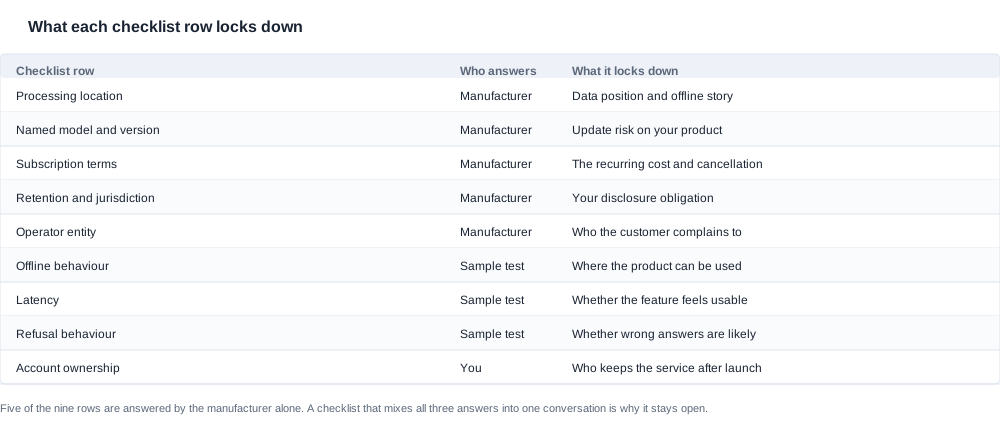
How to phrase a row so the answer is usable
The wording of the request does as much work as the content. A row phrased as a topic produces a description; a row phrased as a condition produces a commitment. The difference is visible in the reply.
"Tell us about offline capability" produces "It works well offline" or "Basic functions still work without internet". Neither of those can be written into a specification, and neither tells your support team what to say to a customer on a train.
"For the configuration we are ordering, list the functions that continue to work with no network available, and the functions that stop" produces a list. A list can be put into the instructions, into the listing, and into the acceptance criteria for a sample.
The same pattern applies across the whole set. "What is your data retention policy" produces a policy document. "For audio, images and text captured by this configuration, state the storage jurisdiction, the retention period, and who inside your organisation can access it" produces three values you can use. The second phrasing is longer, and it is the length that does the work — it names what is covered, which is what prevents a general answer being offered.
Two habits help more than anything else. Ask for the answer in writing rather than by call, because a call produces an answer you cannot file. And ask the question twice, in the same form, to two different people at the supplier, because a mismatch between the two replies identifies exactly which rows were given as a considered position and which were given as a guess.
Turning the completed rows into a specification you can enforce
From a checklist to a dated, attributable document
A checklist that lives in a spreadsheet is a list of intentions. The conversion happens in three steps, and each one is simple.
Turn the completed rows into a written specification section, dated and attributable. Each row gets the answer, the name of the party who gave it, and the date. Rows that came from a verbal answer are marked as such and stay open.
Decide, for every open row, whether it can be closed by a test. Three of the eight rows in this checklist — offline behaviour, latency and refusal behaviour — cannot be closed by any document and have to be closed by a measurement on a sample. Everything else either arrives in writing or does not exist.
Set a verification point against the first production units. When the first production batch arrives, check the product against the same rows, particularly the offline behaviour, the model list and the account ownership. Specifications that were never verified become assumptions within one production cycle, and assumptions are cheaper to test than defects.
The commercial terms this checklist governs
The subscription structure is the most consequential commercial term attached to an AI feature, and the parts worth negotiating are what happens on cancellation, whether the feature degrades or disappears, and whether a service tier is bundled with the hardware or sold separately. Minimum order quantity is negotiable. Packaging and insert design, including the market labels, the subscription disclosure and the language of the documentation pack, is a low-cost negotiation. Delivery splitting against a documentation-review milestone is often granted more easily than a price concession, and that milestone should be the completion of this checklist rather than the shipment of the samples.
Payment points sit in a standard area: a deposit at the point of order, a balance released when the goods pass inspection, and a retention released when the paperwork arrives protects the buyer on the failure that costs most.
What is not a commercial lever is the certification cost or the certification elapsed time — the fee is per product family and the elapsed time is set by the test laboratory and the review queue — nor the regulatory treatment, which follows from the functionality and the wording and which no commercial term can move.
The AI feature claims that need a file behind them
The inference architecture per function. The named model and version, with the update policy and notice period. The subscription terms, including the cancellation behaviour. The offline function list. The data path, the operator entity and the storage jurisdiction. The retention period. The account registration details. The firmware build identifier and the update mechanism. The manufacturer's stated limitations. The certificate numbers with the issuing body and the validity dates.

Running the checklist across a shortlist
The checklist earns its name when there is more than one supplier, because the value is not in the answer but in the comparison.
Score the answers by whether they carry a condition
A completed row is not a full answer. A completed row that carries a condition is a full answer; a completed row without one is half an answer, and it is worth less than an unanswered row that openly says the information is not published.
Three grading levels are enough, and they map cleanly onto the row set above:
- Answered with a condition — the answer states what it applies to, and you can rely on it.
- Answered without a condition — the answer is true but unbounded, and it cannot be relied on when conditions change.
- Not published — the row is explicitly open, and you now know it needs a test or a contract clause.
A supplier with many level-1 rows is not necessarily the better supplier for your channel. A supplier with many level-3 rows in the rows that matter to you is worse, because it means the gap will be closed by your own customer instead.
Keep the two measurement rows identical across suppliers
For the three rows that have to be closed by a test — offline behaviour, latency and refusal behaviour — use the same script, the same content set and the same thresholds for every supplier on the shortlist. A test run differently against two suppliers produces two anecdotes rather than a comparison, and you will end up making the decision on something else.
The content set is fifty sentences resembling what your customer will actually say, including proper nouns, numbers, units and deliberately ambiguous phrases. The method is in how to measure smart glasses AI features.
Watch for the supplier who answers everything
Be careful here, because it is not the good news it appears. A supplier who can answer all eight rows in detail usually depends on a third party for the AI stack — which is a normal and often better commercial arrangement, but it means you are buying a dependency rather than owning a capability.
The useful follow-up question is: what happens to the product if that relationship ends? A supplier with a genuine answer has thought about the end of the arrangement, not just its beginning. And if the answer is that a different provider takes over, the rows you were sold may need to be re-closed, which is a cost that belongs in your evaluation of the row-2 answer.
The AI rows we can answer from our own catalogue
More on the service side is under AI features in smart glasses, and the ownership question sits in smart glasses OEM IP protection.
We can tell you what our catalogue states and what it does not, and the second half is longer than the first.
What we state. An AI voice assistant across the camera model group. AI translation referenced on the K01, which is an audio model — so we treat that as an observation from our own marketing material rather than as a specification. Twenty of our 28 catalogue entries carry the AI designation in the name, split across 11 camera models and 8 audio models plus one electrochromic entry with no camera.
What we do not state. No inference architecture. No named model or language count. No latency figure. No accuracy figure. No processing location. No subscription terms. No data retention policy or storage jurisdiction. No app operator entity. No per-model certificate number.
We also publish only one weight in the whole catalogue — 158 g for the MT6 camera platform, excluding its foldable charging case — and no model publishes a weight for an AI-equipped configuration specifically.
Our position is that we will not describe any product as supporting a named model or a named language count unless the manufacturer states it and we can source it, and we will not claim offline capability or state where processing occurs. We also decline briefs asking us to position AI features in a way that implies capability we cannot evidence — a vague claim is commercially weaker than a precise one and legally riskier.
Tell us the AI function your channel depends on and we will say what we can confirm.
Related reading
Tell us the AI function your channel depends on and we will say what we can confirm and what is not published.


