

Smart glasses AI features: measured on a build, not on a unit
An AI feature is measured in rates, latencies and accuracies, and none of them is measured by watching a demonstration. A demonstration is a best case: a prepared phrase, a quiet room, a known-good network and a unit that has been configured for the occasion. Smart glasses ai features smart glasses how to measure is about turning a capability into a set of numbers that a buyer can put in a specification and another buyer can reproduce. The reason to do it properly is that AI claims are the easiest to overstate and the hardest to defend, and the ones that fail tend to fail in public.
The short answer: an AI feature is eight measurements, and two of them are not performance measurements at all — offline behaviour and the data path, which together decide what you may say in a listing and what your privacy statement has to describe. Fix your own acceptance thresholds before you start, run every rate on several units and several speakers, and record the firmware build number with every result, because an AI feature changes between builds and a measurement without a build number cannot be reproduced.
The buyer deciding whether an assistant belongs in the product
A buyer here is usually deciding whether an AI voice assistant belongs in the product at all, or which of two suppliers' implementations to carry. They will hold samples, a feature list, and a channel in mind — creators, field workers, or everyday assistants. What they will not hold is any performance data, because in this category the data is generated by the model provider and the assistant stack rather than by the factory, and it changes with the build rather than with the hardware.
That last point changes how a buyer should think about the decision. An AI feature is not a property of the product you are buying once; it is a relationship between the product, a model provider, a network and a region. The buyer's real question is not "is this good" but "can I measure it, can I hold it to a threshold, and what happens to it when the provider changes something".
Three things are being managed at once and they pull in different directions. The first is the claim: a product page sentence has to survive a customer trying it in a meeting, and the sentence that survives is usually narrower than the one a marketing team wants. The second is the dependency: the party that operates the model may be a third party the brand has no contract with, which is a procurement exposure rather than a technical one. The third is the drift: an assistant that changes under the customer between two shipments is a support problem that arrives without a product fault and therefore without a return reason.
The buyer is also usually the person who will have to answer a complaint about the feature months later, in a market where the complaint will be in a language the support team does not speak. That is why the measurement sheet has to be written in a form that survives a staffing change: a threshold, a denominator, a build number and a date, rather than a description of how it felt.
What an AI feature costs to keep, and who really controls it
The cost of an AI feature is not a hardware cost. It is a running dependency, and the parts of it that appear on a purchase order are the smallest part.
The inference is either on the device or off it, and the two have completely different commercial shapes. On-device inference is bounded by the hardware you bought and is therefore stable and private by default, and it is limited to what the chip can do. Off-device inference is bounded by nothing you own, and it is what makes a genuinely capable assistant possible — and it brings a network dependency, a latency, a region question and a party you do not control.
The operator of the runtime is the single most important commercial fact on the sheet. A supplier who says the model is provided by a partner has told you that a third party can change the behaviour of your product, in your market, without a purchase order being amended. That is a different kind of exposure from a component substitution, because a component substitution can be written into a change-control clause and a model change cannot.
The update path is a procurement question, not a technical one. A feature that changes through over-the-air updates changes without a new order, without a new sample and without any notice obligation, unless one is written. For a brand that has spent a marketing budget on the capability, an unannounced change is not a technical event; it is a commercial one. The supplier's ability to name a build number and an update mechanism is therefore the first thing to establish, because a supplier who cannot name the build cannot tell you what you measured.
The data path is a compliance question with a fixed framework. From 1 August 2025 the cybersecurity requirements of the Radio Equipment Directive are a mandatory part of CE marking, described by the EN 18031 series of harmonised standards, covering secure communication, encryption, secure storage, user consent and the process for handling identified vulnerabilities. A voice feature is squarely inside that scope, and the evidence a brand will eventually be asked for is not the feature's accuracy but the data path behind it.
What none of this costs is money on the invoice, which is precisely why it gets skipped. The negotiating room is in the commitment structure rather than the price: the notice obligation on a firmware change, the definition of the degraded state offline, the right to require a copy amendment, the duration over which the measured build is the shipped build, and the number of units in the evaluation batch.

The eight measurements, their thresholds, and the denominator rule
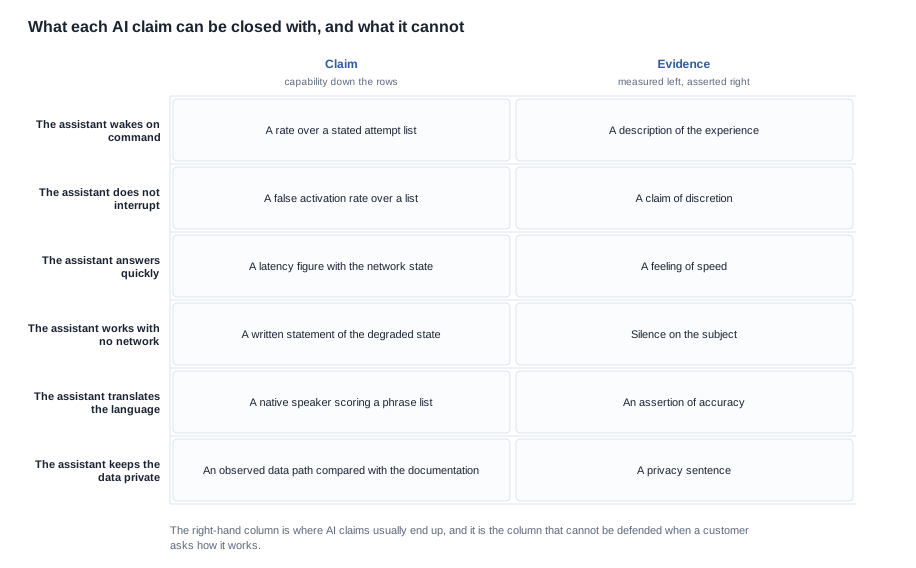
Ask for the rows below in writing before the samples are tested. The right-hand column separates a supplier who has measured the shipped build from one who is describing a capability.
Wake rate, with the test conditions. A percentage over a stated number of attempts, in a stated environment. "Highly responsive" is a soft answer, and it is the answer most often given.
False activation rate. A percentage over a stated number of attempts, in a stated environment. This is the measurement that decides whether the feature is usable in public, and it is the one almost never reported. A device that interrupts a conversation is a product that gets taken off, regardless of how well it works when it does activate.
Command success rate, on a fixed list. A percentage against a list the buyer supplies. "Understands natural speech" is a soft answer, and the phrase list has to be the one your customer uses, not the one the demo uses.
Latency, with the network state. A figure with a fixed threshold and the network condition named. "Very fast" is a soft answer. Latency is the difference between a feature that feels responsive and one that feels broken, and it varies with network conditions, which is why the network state has to be part of the measurement.
Recognition accuracy by condition. A figure for a quiet room and for the real environment. "High accuracy" is a soft answer. Accents, background noise, an unusual vocabulary and a quiet voice all change it, and the one that matters is whichever your customer has.
Translation accuracy, judged by a native speaker. A judgement on the phrases the customer needs. "Accurate translation" is a soft answer, and a translation that handles greetings and fails on a product description fails for a buyer.
Offline behaviour. A written statement of what happens with the network removed. Silence on the subject is the answer most often given, and it settles the most common dispute in this category: whether the product does what its documentation says when the network is not there.
Data path and consent mechanism. A description of what leaves the device and how consent is handled. "Data is handled securely" is a soft answer and means nothing.
Firmware build and update mechanism. The build identifier and how a shipped unit is updated. "Updates over the app" is a soft answer.
Model designation. A published designation for the exact configuration. A series name only is a soft answer, and it means two configurations can be compared without either of them being identifiable.
A rate without an attempt count is not a rate. Every percentage in this list needs a denominator, a list of attempts, and an environment. "98% wake rate" measured over ten attempts in a quiet office is a worse number than "85% wake rate" measured over three hundred attempts on a street, and only one of them predicts anything. This is the single most common error in this category and it is invisible without a denominator.
The false activation rate is the usability gate, not a technical footnote. The threshold a buyer sets for it is a product decision about where the product can be sold — a meeting room and a street are different markets for the same device.
The build number is the column that makes the results worth keeping. An AI feature changes between builds, and a measurement without a build number cannot be reproduced or defended. If a supplier cannot name the build, they cannot tell you what you measured.
One warning applies to every row: these figures are not directly comparable between suppliers. Two implementations will use different phrase lists, different networks, different attempt counts and different definitions of a successful activation. Before you build a table, decide which column is your own measurement and which is a supplier's number, and never mix the two in one row without a note.
Running the sheet twice, on several units, in two environments
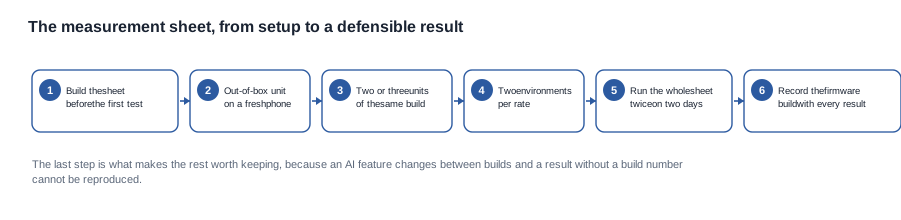
1. Build the measurement sheet before the first test. Five columns and no more: the test, the condition, the number of attempts, the result, and the date with the firmware build number. A sheet with more columns will not be filled in, and a sheet that is not filled in produces a demonstration.
2. Test two or three units of the same build where the feature is load-bearing. A feature that works on one sample and fails on another has a yield problem, and a yield problem is invisible in a single-unit test.
3. Test a unit out of the box with a fresh phone, not the demonstration unit. A demonstration unit has the accounts linked, the language set, the region configured and the network known to work. The out-of-box unit is the product the customer receives, and the difference between the two is the most common cause of a feature that works in a meeting room and not in a customer's kitchen.
4. Test in two environments and report both. Every rate has a value in a quiet room and a value on a street, and only the second predicts the customer experience. Reporting one of them without the other is a choice about which customer you are selling to.
5. Use the phrases a customer would use, not the phrases you use. Changing the script between runs makes the two rounds incomparable, and this is the most common form of the error. Keep the phrase list with the results.
6. Run the whole sheet twice, on different days. Treat a large difference between the two runs as a finding rather than as noise. A feature whose success rate moves by twenty points between runs is not stable, and a product built on it is a product whose customer experience is a lottery.
7. Verify the data path rather than measure it. Observe the network behaviour, compare it with what the documentation claims, and record the comparison. This belongs in the due diligence file rather than in the lab, because it is a comparison against a document rather than a number.
8. Repeat the sheet on the build that will actually ship. The measurement that matters commercially is the one taken on the build in the customer's hand, and if that build arrives after your sample, the sheet has to be run again on it.
Four ways an AI feature programme fails, and the terms that move
The feature is announced in a listing and fails in a customer's meeting. Root cause: the false activation rate was never measured, only the wake rate. Prevention: measure both, and set the false activation threshold before the product page is written.
The customer reports that the assistant stopped working after an update. Root cause: the measurement was tied to a build, and the build changed without a re-test. Prevention: record the build number with every result, and re-run the sheet against the build that will actually ship.
A translation claim is made and the target-language reviewer rejects it. Root cause: the accuracy was assessed by someone who is not a native speaker of the target language, on greetings rather than on working phrases. Prevention: have a native speaker of the target language score the phrases the customer needs, and record the phrase list.
The product works in the demo country and fails in the launch market. Root cause: the measurement was made in one region on one network. Prevention: run the sheet in the launch market, on the networks the customer will use, and report both sets of results.
An AI feature programme spends proportionally more on evaluation units than a hardware programme does, because the feature is the product and the sample count is the confidence interval. The terms worth negotiating time on:
- Minimum order quantity, and the number of evaluation units, which has to be larger here than in a hardware category because the sample count is the confidence interval.
- Packaging and insert design, including the market labels, the language of the documentation pack and the consent wording, which in this category is a compliance artefact rather than an insert.
- Delivery splitting against a sample-approval milestone, which is often granted more easily than a price concession.
- The payment breakpoints: a deposit on signature, a balance payable when inspection is signed off, and a retention on the document package.
- The warranty period with a stated response, and the returns policy, which has to account for a feature that can change without notice.
Two costs in a feature programme are quoted but not negotiated. Certification cost and certification lead time follow the process and the testing body rather than your order size, and for a connected product they include the cybersecurity requirements of the Radio Equipment Directive. Tooling is often amortised across the first order. Two things follow from that: the volume the charge is spread across, and where the tool sits if the programme is discontinued. Below both sits the update path: a supplier who cannot name a build number and an update mechanism is telling you the feature can change without a contractual notice to you, and that is a larger commercial exposure than the unit price.
The file to request before the deposit is: the firmware build identifier and the update mechanism; the certificate numbers with the issuing body and validity dates; the declaration of conformity for the exact model designation; a written description of the data path and the consent mechanism; and the model designation written on the quotation.
The contract clauses that protect an AI feature claim are these: the model designation as a line item, with the certificate numbers attached; the acceptance criteria for the sample, referencing the measurement sheet and the fixed thresholds; a clause requiring notice before a firmware change that affects the assistant behaviour, so the buyer can re-test, and a defined period over which the measured build is the shipped build; and a clause on who bears the cost when the sample does not meet the acceptance criteria.
A field-service assistant measured, and the limit of what we can publish
Consider a hypothetical scenario rather than a real client project. Assume a brand-side buyer adding an assistant to an existing camera product line for a field-service channel, where the end user works in a noisy environment, may be wearing gloves, and will use the product with a partner who is also talking.
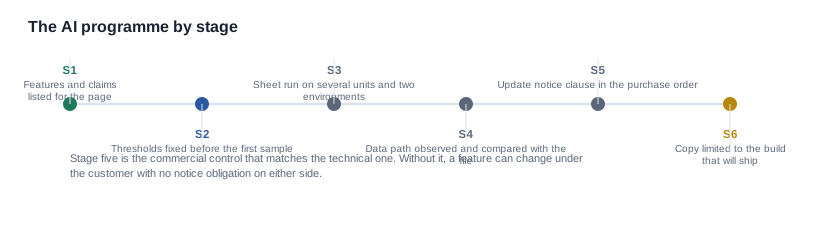
Step one: the requirement. The assistant is wanted for voice note capture during a site walk, in a noisy place, with a partner talking nearby. That single sentence sets the thresholds: the false activation rate has to be low enough that the partner's conversation does not trigger the device, the wake rate has to be measured with the phrase list a site worker would actually use, and the recognition accuracy has to be reported in the noisy condition rather than in the quiet one.
Step two: the sheet. The buyer builds the sheet with five columns, fixes the thresholds before the samples arrive, and asks the supplier for the build number and the update mechanism in the same message. The supplier returns a wake rate with no denominator and no build, and a "highly responsive" description of the false activation behaviour. Both answers go into the file as findings rather than as results.
Step three: the units. Three units of the same build are tested, on an out-of-box unit with a fresh phone, in a quiet room and on a street. The wake rate is materially lower on the street than the supplier's figure, which had been taken in a quiet room, and one of the three units produces a false activation that the other two do not. The unit-to-unit difference is the more important finding, because it is a yield problem rather than a product problem, and it changes the question from "is this good" to "is this consistent enough to put on a product page".
Step four: the repeat. The whole sheet is run again two days later, on the same units, and the wake rate moves by a large margin. That is the finding that ends the discussion about publishing a wake rate at all, and it redirects the buyer towards a claim the product can actually sustain: the assistant exists, it responds to the phrase list, and it is measured on a named build.
Step five: the commercial structure. The buyer writes the notice obligation on assistant-affecting firmware changes into the purchase order, defines the degraded state offline as an accepted behaviour rather than a defect, ties the copy to the build that ships, and splits the first delivery against a sample-approval milestone. The result is a feature that is claimed at the level the evidence supports, rather than one that is claimed at the level a demonstration suggests and fails in public.
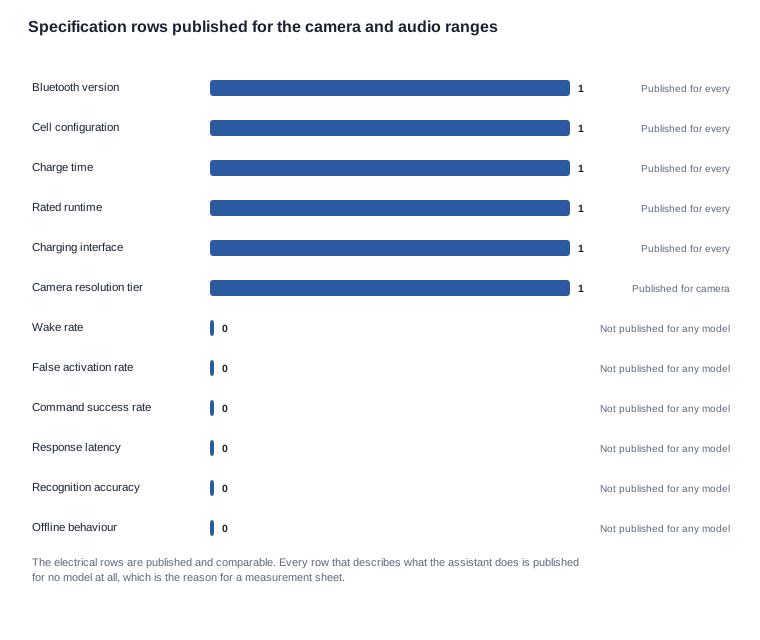
Our own position is that we publish the AI capabilities our documentation supports and mark the rest as open, and that we would rather a buyer run these measurements than believe a description of them. Our catalogue names an AI voice assistant among the key technologies for the AI camera glasses family, and our independent site describes AI translation on the K01, which is an audio model, so we treat that as an observation from our own marketing material rather than as a specification. We publish no wake rate, no false activation rate, no command success rate, no latency figure, no recognition accuracy, no translation accuracy and no offline behaviour for any model, and we will not estimate any of them. We will also not put a number in a listing that was measured on a demonstration unit, because a number that cannot be reproduced is a claim that cannot be defended when the customer is standing in front of you.
What we will do is supply units with a known firmware build, and work through the measurement sheet with you rather than send a demonstration. The protocol is covered in testing AI features before ordering, the supplier questions in AI supplier verification, the claim mistakes to avoid are in AI common mistakes, and the background is in AI features.
What to do next. List the features you intend to publish, the environment they will be used in, and the phrases the customer will actually say. Fix the thresholds before the samples arrive. Run the sheet on three units, out of the box, in two environments, twice, and record the build number with every result. Then decide, with the numbers in front of you, which of the features is worth putting on the page and which one is not.
Related reading
- The test protocol for a sample — testing AI features before ordering
- The questions to ask a supplier first — AI supplier verification
- The claim mistakes to avoid — AI common mistakes
Tell us the features you intend to publish and the environment, and we will write the measurement sheet with you.


