

Smart glasses ai features smart glasses compatibility is four separate questions wearing one word, and the reason compatibility claims go wrong is that a buyer checks one of them and assumes the other three follow. They do not, because four different parties own them: the factory owns the radio, the application publisher owns the platform, the service operator owns the assistant, and nobody owns the accessory set until it ships with a product.
That last one is worth a moment. The radio version is published for the models that have a published row, and it is durable — it does not change between two units of the same model. The platform, the service and the ecosystem answers are different in kind: they depend on a partner's schedule, on a phone you do not control, and on an accessory that only exists in the box.
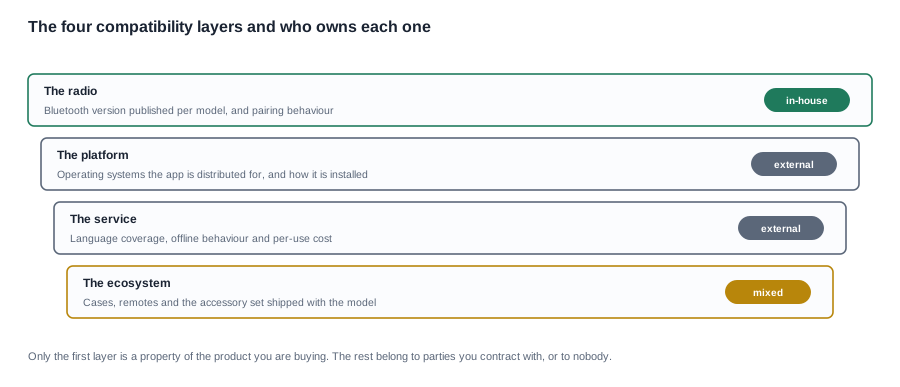
The practical consequence is that a compatibility claim has to be separated into the part you can publish and the part you have to test. A buyer who publishes a fact they have not verified, in either direction, converts a technical question into a returns problem — and the one they are most likely to get wrong is the claim they did not check because the radio version was on the spec sheet.
Smart glasses AI features: the radio layer we publish per model
The radio version is the one compatibility fact in this category that belongs to the product itself, and it is the one most often stated too broadly. So it needs to be stated exactly.
What the catalogue publishes. Bluetooth 5.3 is published on the K01 and the K02, the two AI audio models at the entry of the audio range. Bluetooth 5.4 is published on the AR glasses row, on the A07 children's audio model, and on the D11, the D12, the LC-105 pair, the D17 and the ZH12, the G07 and the YKC02, and the YK12, and the photochromic model.
What the catalogue does not publish. The Bluetooth version for the camera tier is not published for any of the eleven camera models — the KY06 and the CY05, the CY03 and the V03, the L1 Pro and the MT6, the V03 Pro and the MT5, the V06 and the L2 Utral, and the S7. It is also not published for the A05 and the A06 children's protective rows, and not for the bone conduction model. A page that states a radio version for those rows is stating something the catalogue does not support, and the error is common because the camera tier is where most buyers start.
That gap is the reason this article exists. It is a real gap, it is visible on the spec sheet as a missing row rather than as a wrong value, and it is closeable with a sample — which is exactly the kind of gap worth spending an afternoon on rather than a quarter.
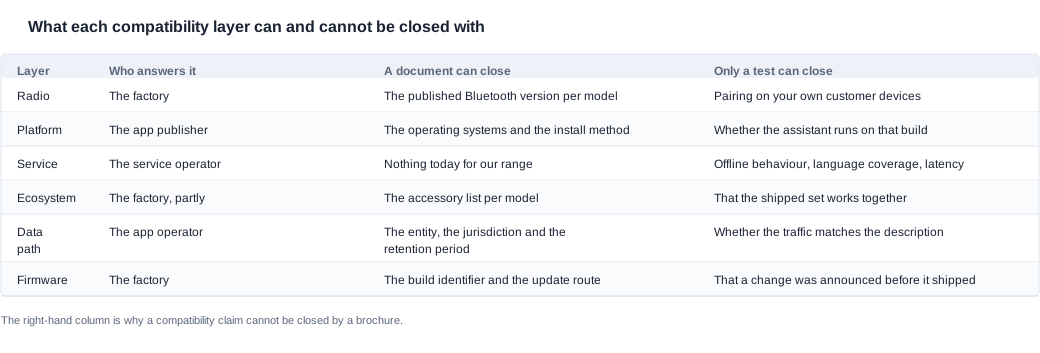
Two more radio facts are worth keeping separate from the version number, because they are the ones that decide whether a pairing attempt succeeds.
Pairing is a behaviour, not a version. A Bluetooth version tells you the radio class; it does not tell you how many devices the frame remembers, whether it reconnects automatically after a phone change, or whether it re-pairs when the battery is flat. Those are testable in fifteen minutes and are not published for any model in this range.
The verification route is a separate document from the product. For a radio product sold under a brand's own name, the question of who is accountable for the software that ships alongside the radio is handled separately from the radio itself, and the responsible person requirement is where that sits. The radio rows themselves are under Bluetooth connectivity.
So the radio layer has this shape: a published version for fourteen of the twenty-eight rows in the catalogue, a missing row for the camera tier and three other rows, and a set of pairing behaviours that only a sample answers.
One practical note on reading the published rows: they are the radio class, and the radio class is the ceiling rather than the floor. A device that pairs with a 5.4 radio will pair with a 5.3 radio, and the practical consequence for a buyer is that the version tells you which devices are known to work, not which devices are known to fail. The rows we publish are therefore most useful as a floor — a way to exclude the obviously incompatible — and the sample is what establishes the rest.
That is also why the camera tier gap is not a serious obstacle for a buyer, even though it looks like one on the spec sheet. The camera models are the ones most often bought in volume for a channel that has already standardised on a phone, and the question that matters is whether the assistant runs on that phone. A single sample answers it. The missing row is an inconvenience for a product page and a non-event for a procurement decision.
The ecosystem layer: accessories are where a product becomes unusable
The ecosystem layer is the one buyers skip, because it is the only layer where a customer can be given a product that works perfectly and cannot be used. A frame that pairs, records and plays, sitting next to a case that does not charge it, is an incompatible product in the customer's hand. The radio says nothing about it.
What the catalogue publishes is per model, and the coverage is uneven in a way that has to be handled on the product page rather than discovered in a review.
Charging cases. The CY03 and the CY05, and the L1 Pro are published with a 1400 mAh charging case. The L2 Utral is published with a 900 or 1400 mAh case, which is a configuration choice rather than a single figure and has to be written as one. The MT6 is published with a 1200 mAh folding case. The KY06 and the MT5 are published with a magnetic charging case, but the case capacity for those two rows is not published. The V03 and the V03 Pro, and the S7 and the V06 are published with magnetic charging and no case.
Remote control. The D17 and the ZH12 are the two rows published with a remote shutter. A remote is a second device with its own pairing, its own battery behaviour and its own firmware interaction, and a claim about the D17's photography has to be matched with the accessory that exists for it.
Charging interfaces. Type-C appears on the V03 Pro, the L2 Utral, the D11, the D12, the D17, the ZH12 and the bone conduction model. Magnetic charging covers the AR glasses row, the A05 and the A06, the K01 and the A07, and the K02, the LC-105 pair, the YK12 and the YKC02, the MT5 and the KY06, the S7 and the V06, and the G07, and the V03 and the photochromic model. The MT6 and the L1 Pro, and the CY05 and the CY03 publish no charging interface at all.
The accessory set as shipped. This is the part that is not published as a single fact for any model, because it depends on what is in the box on a given order. The test that closes it is straightforward: charge the product from the accessory in the box, not from a third-party cable, on a unit that has been fully discharged.
The questions to ask a supplier about the ecosystem layer are narrow and answerable: which accessories are included, which are optional, which have a published capacity, which models take a remote, and whether the packaged combination has been tested as a set. The red flags are a "compatible accessories available" answer, and a case listed without a capacity, because the second one is a physical number that a customer will notice.

The platform and service layers: the two a sample cannot fully close
The platform and service layers are governed by parties outside the transaction, and they are the two layers where a sample gives you evidence rather than closure.
The platform layer is the question of whether the assistant works on the operating system the customer actually has, and whether the application is distributed in a way they can install. A named list of operating systems and a distribution method would close it. We publish neither: the supported operating systems, the installation route and the device matrix are not published for any model in this range. What a sample gives you is the behaviour on the phone in your hand, which is a real result on one device and a weak one on the rest of your customer base. The compliance side of the same dependency is in AI certification requirements.
The service layer is where every published gap in this range sits. The language coverage of the assistant, its offline behaviour, its per-use cost, its latency and its accuracy are not published for any model. The reason is structural rather than evasive: these are properties of a service operated by a third party, and the operator can change them after a sample has been tested. A test closes the behaviour of the service on the day you ran it, and a document closes nothing at all today.
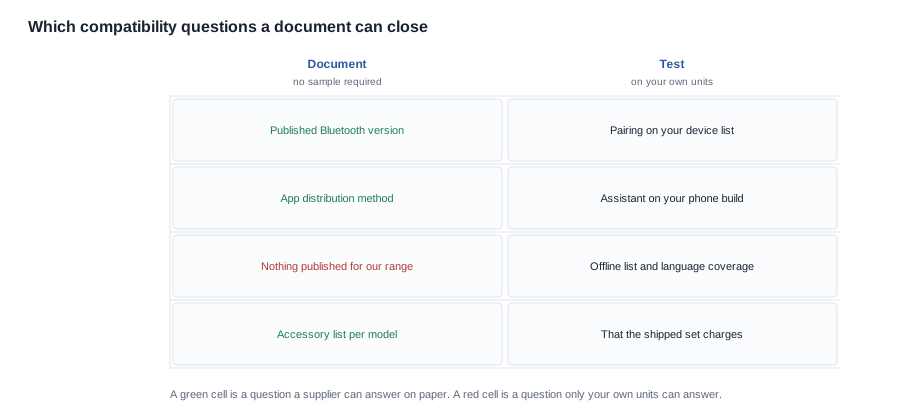
The two layers are also linked in a way that catches buyers out. A platform that changes its supported operating system list is a service-layer problem that arrives as a platform-layer symptom: a customer with an older phone can no longer install the application, and the feature stops working on a product whose radio never changed.
What a document can and cannot close, in one view. The radio version, the app distribution method and the accessory list are the three facts that survive publication. The offline behaviour, the language coverage, the latency and the accuracy are the four that only your own units can answer, and even then only for the day you answer them.
There is a fifth question that belongs to neither layer and is frequently the one that decides the order: whether the service is free, metered, or subscription-based, and what the product does when the plan ends. We publish no subscription position for any model in this range, and that is a gap you should close in writing before you order rather than discover from a support queue.
One further asymmetry between the platform and service layers is worth putting in front of a buying committee, because it changes who you negotiate with. The platform layer has an identifiable counterparty: the application publisher, whose release cycle and store review you can plan around once you know the dates. The service layer does not, in the same way. Its behaviour can change without a release you can see, and the change is often invisible to you until a customer reports it. That is the difference between a dependency you can schedule and a dependency you can only describe.
The practical consequence is that a compatibility claim about the service layer should always be written as a dated observation, while a claim about the platform layer can be written as a commitment with a notice period attached. Writing both the same way — as a flat statement of what works — is what turns a dependency into a liability.
Building the device list from your own customers
The compatibility failure in this category is always in the oldest or the cheapest device in the customer's hands, and the flagship is the one every demonstration uses. So the list you build is the list of devices your own customers already own, taken from your own order history, not a marketing category list of "modern smartphones".

Step one: build the list from your own customers. Pull the actual device mix from your support system or your order data, and sort it by age rather than by popularity. You are looking for the bottom decile, not the top one.
Step two: test the radio and the assistant separately. A successful pairing tells you the radio works. It says nothing about whether the assistant runs once paired, whether the application installs, or whether the answer comes back. Two tests, two results, two records — because conflating them is how a device gets onto a compatibility list by accident.
Step three: run the same test on the second and third device. Record the failures per device rather than as an average. An average across a good phone and a bad one is a number that describes neither of them, and the bad one is the one that generates the review.
Step four: turn the network off and enumerate what survives. This is the condition that reveals a service dependency the way a laboratory never does. The list that comes out of it is your degradation claim, and it is the only wording you can safely use for the offline behaviour.
Step five: publish the three durable facts and date the rest. The radio version per model, the application distribution method, and the accessory list are the three things that stay true. Everything else is a test result with a date on it, and publishing it as a dated fact rather than a permanent guarantee is what keeps the page honest between updates.
How to evaluate the answers, and what to do with the gaps. The evaluation criteria are simple: a published fact attached to a model designation, a tested behaviour attached to a device and a date, and a written answer attached to a contract clause. Where a supplier cannot give any of the three, that is not automatically a disqualification — it is a decision to make, with the risk priced. The pitfalls to avoid are narrow: treating a pair of a device and a model as a compatibility list, treating a successful pairing as a compatibility result, and treating a compatibility claim as permanent when the operator behind it can change.
The sample route is the practical version of all this, and it is described under sample evaluation.
The compatibility acceptance checklist
The five steps above produce observations. This is the checklist that turns them into something a buyer can sign, and the criteria are deliberately narrow enough that a supplier can meet them without a research project.
- Radio, per model designation: the published Bluetooth version where the catalogue publishes one, and a sample result where it does not. A missing row is a test, not a guess.
- Pairing behaviour, per device: whether the frame pairs, whether it reconnects, and whether it re-pairs after a flat battery, recorded per device model rather than as a pass rate.
- Application install: the distribution route and the operating systems you tested, with the failures listed rather than summarised.
- Service behaviour: the functions that survive with no network, the languages actually attempted, and the date the test was run.
- Accessory set: the packaged combination, charged from its own case or cable on a fully discharged unit, with the case capacity recorded where it is published.
- Commercial terms: a notice period before a firmware or model change alters the supported device set, a written commitment to maintain the accessory list, and a decision on who bears the cost when the sample fails the agreed criteria.
Two of these are negotiable and should be negotiated before the order rather than after the first complaint. The accessory list maintenance commitment and the device-change notice period are the two most commonly absent, and both are cheap to obtain in writing at a point when the supplier wants the order. The rest are either facts we publish or tests you run.
The pitfall to avoid is treating the checklist as a gate that must be entirely green before the first order. It is not. It is a way to convert the unknown parts of a product into known parts, and the order of the work matters more than the completeness: the radio, the pairing and the accessory set can all be closed in an afternoon with a sample, and those three are where the compatibility complaints actually come from.
What we will answer without a test, and what we will not guess
Here, compatibility with an AI feature is a chain of four links, and only the first of them is a property of the product we build. We will publish the radio version per model, we will supply a sample for device testing, and we will be explicit that the service layer's language coverage, offline behaviour, latency and cost are not published for any model in this range.
We do not publish a verified device list for any model, and we will not produce one retrospectively from memory, because a compatibility list is only useful if it is accurate at the moment it is read. We also do not publish the Bluetooth version for the camera tier, because that row is not published in our documentation, and a buyer who needs it should treat it as a question for the sample rather than as a value we have omitted by accident.
What we can do with a device list is run the compatibility test with you, on the devices you name, and report per device rather than as an average. Send us the list, the model designations you are considering and the market you are launching into, and we will tell you which rows are published, which close with a sample, and which need a written answer from a partner before you order. The background is under AI features, the compliance side is in AI certification requirements, the sample route is sample evaluation, and the radio rows are under Bluetooth connectivity.
Where the four layers come from
Send us your customer device list, and we will run the compatibility test with you.


