

An AI feature does not have its own certification. It inherits a set of obligations from four questions — where the processing happens, whether it works with no network, whether there is a subscription, and who operates the app and where the data sits. Smart glasses ai features smart glasses certification requirements is therefore less a list of documents than a method for finding out which documents your product actually needs.

Smart glasses AI features: four obligations, four questions
The answer in three sentences
Smart glasses ai features smart glasses certification requirements is decided by four AI questions, and every other answer depends on them. Where the processing happens determines whether data leaves the device and therefore whether a transfer, consent and disclosure question exists at all. Whether it works offline determines what the listing may say. Whether there is a subscription determines the commercial model the customer buys into. And who operates the app, and where the data sits, determines who the counterparty actually is when something goes wrong.
The buyer who arrives at this question
A buyer working through this is usually a compliance lead or a product manager with a product that has an AI feature, a market list, and a deadline. What they will not hold is a map from the AI feature to the obligations it creates, and the map is short enough to hold in one page.
The reason it matters is timing. The AI feature arrives late in most programmes. The radio approval, the safety file and the packaging are usually underway before anyone asks where the assistant's audio actually goes. At that point the answer can be a surprise, and a surprise in the data path is the one thing that changes the file, the privacy statement and the listing disclosures all at once — because it is the only answer in this category that can add work rather than collect it.
Four failures this question is trying to prevent
A product that appears to work and does not, because the network is not there. A feature that degrades entirely offline is a materially different product from one that stops working, and a buyer who assumes offline capability is included will find out otherwise in front of customers.
A subscription attached to a hardware feature. A recurring fee changes the commercial model, the listing disclosures, and the terms under which a customer owns what they bought.
An unknown counterparty. The legal entity operating the backend, and the jurisdiction where data is stored, are both things a European buyer will eventually ask you, and the second one is a question you cannot answer after the launch.
A claim about a language count or a model name. We will not describe a product as supporting a named model or a named language count unless the manufacturer states it and we can source it, and that rule applies to our own pages as much as to anybody else's.

The map from AI question to document
The table that does most of the work
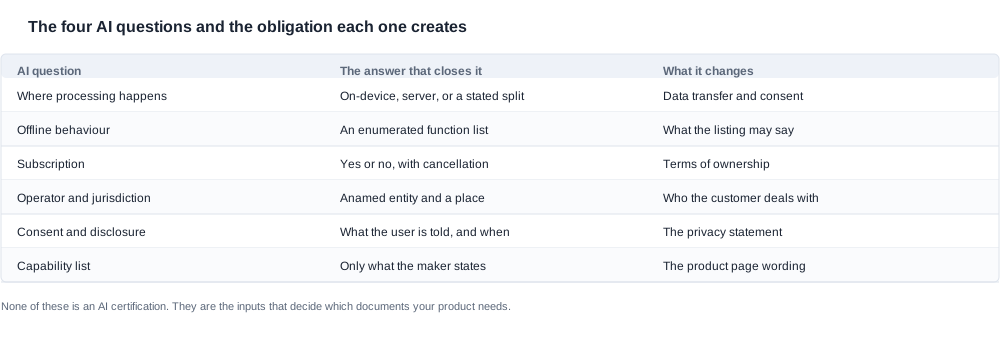
| AI question | The answer that closes it | What it changes |
|---|---|---|
| Where processing happens | On-device, server, or a stated split | Data transfer and consent |
| Offline behaviour | An enumerated function list | What the listing may say |
| Subscription | Yes or no, with cancellation | Terms of ownership |
| Operator and jurisdiction | A named entity and a place | Who the customer deals with |
| Consent and disclosure | What the user is told, and when | The privacy statement |
| Capability list | Only what the maker states | The product page wording |
None of these is an AI certification. They are the inputs that decide which documents your product needs.
What each answer actually commits you to
Where processing happens is the foundational answer. On-device processing keeps audio on the hardware and removes the transfer question, the consent flow and the retention policy in one step. Server-side processing means data leaves the device, which introduces a transfer question and, in most markets, a consent and disclosure expectation. A split answer — some functions local, some remote — is the most common real answer and the one that most often gets written as a general statement, so it should be resolved function by function.
Offline behaviour is a product characteristic, not a fallback. A feature that degrades entirely offline is a materially different product from one that stops working. The answer that closes the row is an enumerated list of functions, and that list is what belongs in the instructions.
A subscription changes the terms under which a customer owns what they bought. It has to be disclosed in the listing rather than discovered in a support ticket, and the cancellation behaviour has to be written down, because that is the part that becomes a refund policy question.
The data path is the one answer that can add work. Everything else on the list is a document to collect; the data path is a question whose answer can create a file, a disclosure and a consent flow that did not exist when you planned the launch.
The radio, the enclosure and the material axes that run alongside it
Three axes that are separate from the AI feature
The AI feature creates a documentation layer. It does not replace the documentation layers that already existed, and confusing the two is the most common structural error in this category.
The radio axis. A Bluetooth radio has its own qualification route — FCC Part 15 in the United States, RED 2014/53/EU in the European Union, and Bluetooth SIG qualification for the protocol itself. Those are product-level documents tied to a model designation, and they are entirely independent of whether the product has an AI feature. The connectivity rows are under Bluetooth connectivity.
One practical note on our own catalogue: the eleven camera models do not publish a Bluetooth version, while the eight AI audio models do. That is a publication gap rather than a technical difference, but it has a consequence for a buyer — the radio row has to be requested for a camera configuration rather than read out of a catalogue. We would rather publish an honest blank than a value we cannot evidence.
The enclosure axis. If the product is sold into an outdoor or industrial channel, the ingress rating becomes a marketed and therefore checkable claim. IP54 appears on exactly two models in our catalogue — the V06 and the S7, both AI sport and photo models — and it appears nowhere else. A rating you have not been given is a rating you may not claim, and the claim is checked at the listing review rather than at the factory. The ingress question is under IP ratings.
The material and transport axis. The cell in a model determines its transport documentation under UN 38.3, and the restrictions on substances in the assembled product determine its RoHS and REACH position. Both are tied to the fitted cell and the assembled configuration, so a change of cell or a change of supplier changes the file. We publish cell capacities for our models — 220 mAh on the V03 and the V03 Pro, 290 mAh on the CY03 and the L2 Utral, and the CY05 and the L1 Pro, 265 mAh on the MT6, 260 mAh on the S7 and the KY06, and the V06, 100 mAh on the dedicated colour-change entry — and that published capacity is what a transport summary is built from.
Why the axes have to be kept separate
Keeping them separate is not administrative tidiness. Each axis has its own validity period, its own scope, and its own failure mode. A radio document covers a radio. An ingress rating covers a specific product and specific test conditions. A transport document covers a specific cell in a specific configuration. An AI feature's application-layer obligations cover a specific operating arrangement.
The practical consequence is that a change in one axis does not carry the others with it. A supplier who changes the cell to extend the runtime invalidates the transport position without touching the radio position. A firmware change that moves processing to a server invalidates the privacy statement without touching the conformity file. A buyer who treats the documentation as one bundle will find that a single change forces a review of everything — which is expensive, slow, and the reason some programmes get stuck.

The verification order that stops a file being reopened
Six steps, each with a completion test
Verification in this category is mostly documentary and it is fast once you know which document answers which question. The order below matters, because each step assumes the previous one passed.
Step one: ask for the certificate numbers rather than the certificates. A number is the only part of a compliance document that a broker, a marketplace reviewer or your own compliance team can check later. A PDF attachment is a claim; a reference number with an issuing body and a validity date is a record. Cost: one email.
Step two: look the numbers up and check the model string. In the issuing body's register, confirm that the model designation on the document matches the model you are ordering, that the document covers the functions and the radio band you are shipping, and that the validity date has not passed. Do the model comparison character by character. In a family where several models share their electrical rows, this is the check that catches a substitution, and a mismatch here is a stop condition rather than a query.
Step three: ask for the test conditions behind every quoted figure, and treat a figure without conditions as absent. For an AI feature this applies to latency, to any accuracy statement and to any processing claim. If the supplier cannot state the conditions, the figure is not usable in a specification, and it should be removed from the comparison table rather than propagated into it.
Step four: run your own check on a sample, on a fixed protocol, and record it as your measurement. For an AI feature that means the network-off run and the capability check. Write the protocol down before you take the first reading, because a protocol designed afterwards is a description.
Step five: write the privacy statement from the data path you have been given, not from a template. The two should agree, and a mismatch between them is the kind of thing that surfaces publicly.
Step six: put the criteria and the measurement into the purchase order. In a category with no published standard, the contract is the standard. If the criteria are only in an email, they are not binding; if they are in the purchase order, they are the acceptance standard and a lot that fails them is a lot you can refuse.
The commercial terms this verification governs
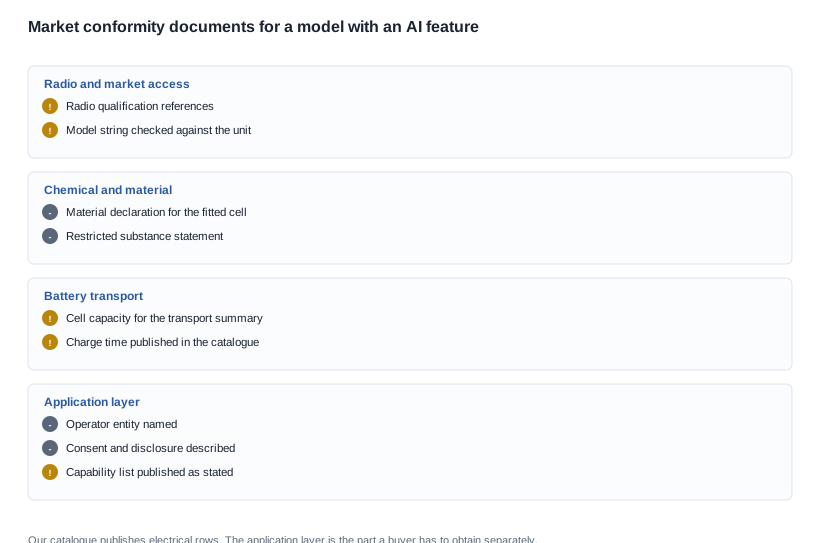
Before the deposit, the documents to request are the inference architecture per function; the data path, the operator entity and the storage jurisdiction; the retention period; the subscription terms, including the cancellation behaviour; the offline function list; the radio qualification reference numbers for the exact model designation; the material and transport documentation for the fitted cell; the consent and disclosure description; and the certificate numbers with the issuing body and the validity dates. In the purchase order, the clauses that matter are the data path and the operator entity as fixed terms; a clause stating the behaviour of every feature when the service is unreachable or the subscription ends; a clause requiring notice before a firmware or model change that alters the assistant behaviour; a clause requiring the marketing wording to match the manufacturer's stated capability list; a clause requiring the documentation pack to be reissued when a configuration changes; and a clause on who bears the cost when a sample does not meet the acceptance criteria.
The subscription terms are negotiable in structure — what happens on cancellation, whether the feature degrades or disappears, whether a service tier is bundled with the hardware — and they are the single most consequential commercial term attached to an AI feature. Minimum order quantity is negotiable. Packaging and insert design, including the market labels, the subscription disclosure and the language of the documentation pack, is a low-cost negotiation. Delivery splitting against a documentation-review milestone is often granted more easily than a price concession, and the milestone should be the completion of step six rather than the shipment of samples.
Payment terms can be tied to the compliance milestones rather than to the shipment date: a deposit against the specification, a balance against the documentation pack being complete for the exact model designation, and a final retention released against the certificate references being verifiable in the issuing body's register. On a product with an AI feature, that third node is worth more than it looks, because the failure it protects against — a product that ships with a file that does not cover it — cannot be fixed by the customer and cannot be fixed quickly.
What is not a commercial lever is the certification cost or the certification elapsed time. The fee is per product family and the elapsed time is set by the test laboratory and the review queue, so pressing on either produces a longer schedule rather than a shorter one. The one-off tooling cost is usually amortised across the first order, so the useful questions are over what volume it is amortised and what happens to it if the programme is discontinued. And the regulatory treatment is not a variable at all: it follows from the functionality and from the wording, and no commercial term can move it.

A compliance walk-through for a camera platform with AI
This is a hypothetical scenario, not a client project, and it is written to show the sequence rather than to report a result.
Assume a brand-side compliance lead with a camera platform that carries an AI voice assistant, three markets to enter, and a launch date eight weeks out. The radio documentation is in hand. The safety file is in hand. The packaging is at the artwork stage.
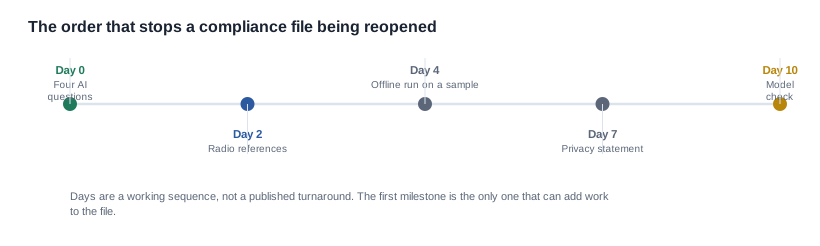
Day zero: the four AI questions go out. The lead asks, for this model and this firmware build: does any audio or image data leave the device, and if so where does it go and how long is it kept; what is the operator entity for the app and the storage jurisdiction; is there a subscription and what happens to the feature if a customer stops paying; and which functions remain with no network. The lead also asks, on the same email, for the radio qualification reference numbers for the exact model designation.
Day two: the radio references come back and are checked. The model string on the document is compared character by character with the model on the box artwork. It matches. The lead notes that the camera group's catalogue row does not publish a Bluetooth version, so this had to be requested rather than read, and files the reference number against the model.
Day four: the network-off run happens on a sample. The lead enumerates what still works with the connection disabled: capture, calls and playback survive, the assistant does not. That list becomes the limitation paragraph in the instructions and the listing, and the lead marks the assistant as an enhancement rather than a dependency.
Day seven: the privacy statement is drafted from the data path as given. It names the jurisdiction and the retention period. It matches the answer received on day zero, and the lead files the supplier's reply with the draft so the two can be compared later if the answer changes.
Day ten: the capability list is checked against what will be published. The manufacturer has stated an assistant and a translation capability. The brand's copy says exactly that and no more — no named model, no language count, no latency claim. The listing reviewer accepts it, because the claim is narrower than the evidence.
The important observation about this sequence is that none of the six steps added a document to the radio or safety file. The AI feature added an application layer — a privacy statement, a limitation paragraph, a subscription disclosure and a set of contractual criteria — and that layer sits alongside the existing axes rather than inside them.
The certification scope we can and cannot state
We will name the AI capabilities our documentation supports and mark the rest as open, and we would rather a buyer removes a claim than publishes one it cannot defend.
What we publish. An AI voice assistant across the camera glasses family, and AI translation referenced on the K01, which is an audio model — so we treat that as an observation from our own marketing material rather than as a specification. We publish no architecture, model list, latency figure, cost or data policy.
What we publish about the hardware. Resolution class, cell capacity, charge time, rated runtime and charging interface for the camera models; Bluetooth version, charge time, cell capacity, runtime and charging mode for the audio models; and an ingress rating on exactly two models, the V06 and the S7. One weight appears in the catalogue, 158 g for the MT6 platform excluding its foldable charging case.
What we cannot state. Our catalogue carries an export certification statement at company level. It carries no per-model certification row, and we will not infer a per-model position from a company-level capability — a document that covers the organisation is not a document that covers your configuration, your cell and your market. Certificate numbers per model have to come from the supplier for the specific configuration being bought.
We will also say plainly that the data path is the question to ask first, because it is the one whose answer can add work. Everything else on the list is a document to collect.
What we can do is tell you which of the four AI questions our documentation answers and which have to come from the manufacturer, and help you write the brief that gets the answers. The background is under AI features, the connectivity rows are under Bluetooth connectivity, the risk factors are in OEM risk factors, the camera side is in camera technology, and the measurement method is in how to measure AI features.
Where the requirements come from
Send us the four AI questions and we will tell you which of them our documentation can answer.


