
"AI features" is a phrase that covers at least four different products, and a buyer comparing two smart glasses platforms on "the AI" is usually comparing two different things and calling it a specification. The useful question is not whether a product has AI. It is where the AI runs, what it is allowed to do, who pays for it, and where the data goes — because those four answers determine whether the feature is a selling point or a liability.
There is a second comparison in this article that buyers skip more often, and it is the more important one: smart glasses with an AI feature, against the alternatives a customer could buy instead. A phone in a pocket answers a question. An action camera on a helmet records a first-person video. A headset with a voice assistant answers hands-free. Each of those already exists, each is cheaper, and each is what your customer is actually comparing you against on the product page.
In our range, the AI features published are an AI voice assistant across the camera tier and the audio tier, and an AI translation capability recorded for the K01, which is an audio model. Everything else a buyer would want to compare — the model, the language count, offline capability, subscription, data location — is not published, and that absence is the subject of this article rather than a gap in it.
Smart glasses ai features: four ways in
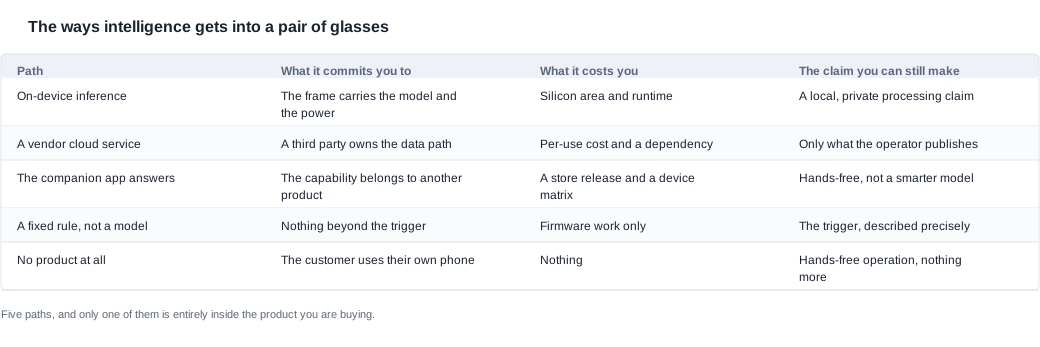
First: on-device inference. The assistant runs on the glasses' own processor. The customer's data never leaves the device, which is the strongest possible answer to a data-handling question, and it is also the answer that demands the most from the silicon and the battery. A camera product in this range carries a cell between 220 mAh and 290 mAh, and a published runtime of five to eight hours, so on-device inference is a significant power budget against a fixed envelope. Whether the AI is on-device is not published for any model in our range.
Second: cloud inference through the vendor's service. The device streams audio or a transcript to a server and returns an answer. This is the cheapest way to add a capable assistant, and it creates the data-handling obligation: where the audio is processed, how long it is retained, whether the vendor's terms allow a brand to put its own name on the service, and what happens to the service if the vendor changes it. None of that is published for our models.
Third: the phone does it. The glasses are a microphone, a speaker and a camera; the companion application does the recognition and the answering. This is the most common commercial arrangement in this category, and it has a particular consequence for a private-label brand: the AI capability is the phone's, and the phone's application is a different company's product. A brand listing an AI capability on this basis is dependent on somebody else's app and somebody else's terms, and that dependence should be visible in the commercial terms rather than discovered later.
Fourth: a rule-based feature, not AI at all. A wake word, a gesture trigger, a timer, a fixed reminder. Many of the things sold as "AI features" in this category are this, and they are genuinely useful — but they carry none of the data, cost or subscription obligations, and a brand that treats a fixed rule as an AI feature creates a claim it will have to qualify.
And a fifth path that is not a product at all: the phone's own assistant. A customer can already ask their phone a question. The value a glasses product adds over the phone is hands-free operation, not a smarter model — an easier claim to defend, and a claim that does not require you to control anyone's service.
The table above sets the five paths against what each one commits you to, what it costs, and the claim you can still make. The row that decides most private-label briefs is the third one, because it is the one where the capability you are marketing is not yours.
The category against its non-glasses alternatives
The second comparison is the one a product page is actually competing in. A customer looking at a smart glasses listing is not choosing between two smart glasses platforms — they are choosing between a product that does something new and a phone or a camera they already own.
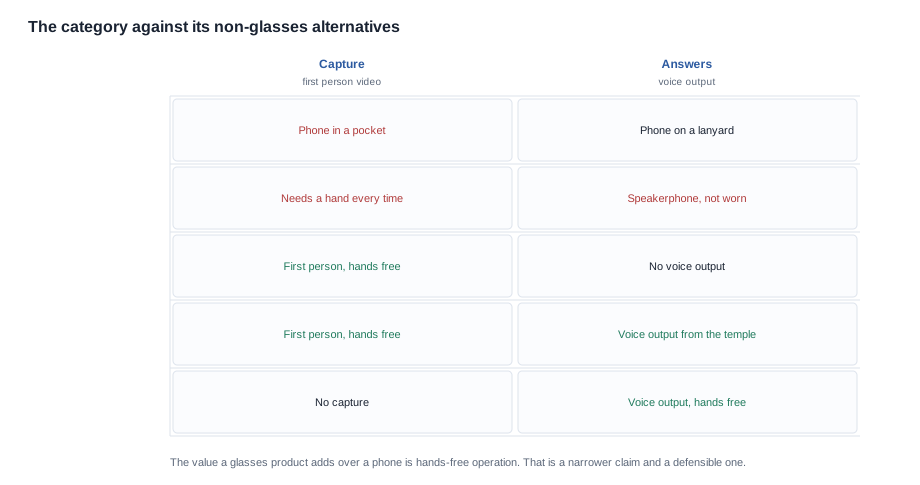
A phone in a pocket captures nothing and answers nothing hands-free. It is the cheapest alternative and the one that wins on every price comparison. Its strength is that it already exists, works, and does not need recharging. A glasses product has to justify itself against a device the customer is carrying anyway, which is why the hands-free capture is usually the stronger claim.
A phone on a lanyard or a clip captures a third-person video rather than a first-person one, and it still needs a hand. It is the alternative a buyer should think about hardest, because it is the same camera quality for a fraction of the price with none of the new obligation. A first-person camera is the differentiator it cannot match.
An action camera on a helmet or a chest mount does first-person capture well, with a much wider field of view and a far better battery, and it has no assistant, no microphone pickup at ear level, and no hands-free voice interface. This is the alternative that the voice assistant is the real answer to — and it is a stronger answer than it looks, because the action camera needs a hand or a mount and the glasses need neither.
Earbuds with a voice assistant answer hands-free and do nothing else. They are usually lighter, cheaper and better at audio. If your proposition is voice interaction and nothing else, this is the alternative that beats you, and the honest conclusion is that the glasses need a camera to have a reason to exist.
A headset sits in the same place as the glasses and can carry a similar assistant, with a much better speaker and a much heavier frame. It is the closest competitor in spirit and the one that wins on comfort and on audio.
The criteria this comparison produces are simple. If the proposition is hands-free capture, the alternatives that matter are the phone and the action camera, and the camera tier wins on both. If the proposition is voice interaction alone, earbuds and headsets win, and the glasses should not be in the comparison. If the proposition is a recording with a spoken record — an inspection, a walk-through — the comparison is with the action camera, and the microphone at ear level is the difference.
When the right answer is that you do not need smart glasses
One comparison result is worth stating plainly, because it is the one a buyer is least willing to reach. Some propositions do not survive this exercise, and the honest ones to name are the ones where the glasses add nothing the customer can already do.
A voice assistant that is not hands-free is a phone. If the customer's hands are free, the phone answers faster, and the phone is already paid for. The glasses earn their place in a comparison only when the hands are busy, the screen is inconvenient, or the environment makes a phone impractical.
A capture proposition without a first-person camera is a camera. If the product records with a phone on a lanyard, it is producing third-person video at a lower price, and no amount of AI changes that.
A product whose only differentiator is a feature name is a commodity. A page whose only distinguishing line is "AI-powered" is competing on a word that every competitor can also use, and it is competing on the weakest possible evidence.
The criteria for knowing when you are in one of those three situations are simple and they are worth applying before the sample arrives. Does the workflow occupy the hands? Does the product need to be worn rather than held? Does the proposition depend on the microphone being at ear level? If all three answers are no, the product is a phone accessory with a camera on it, and the cost of making one is not justified by anything in the AI feature.
None of this is an argument against building in this category. It is an argument for building the right thing in it, and the first step is knowing which of the four paths the product uses, because two of them — on-device and a fixed rule — make the product easy to own, and two of them make the product a dependency.
The four questions that separate a real comparison from a marketing one
Whether the two options are both smart glasses platforms, or one platform and one non-glasses alternative, the four questions below decide the comparison. They are asked of the alternative and of the product in the same order, and an answer you cannot get is itself an answer.
- Where does the inference run — on the device, in a vendor's cloud, or in the phone application? Everything else follows from the answer, and it is the question your own legal reviewer will ask first.
- What does it cost the customer? A subscription, a data allowance, a requirement for a particular phone, or nothing at all. The third option, "nothing", is a real competitive position and it should be valued as one.
- Where does the audio go, and how long does it stay there? For a product with a microphone and a camera, this is the question that determines whether the product can be sold into a market with data-handling expectations, or into any channel involving children.
- Who owns the service, and what happens to it if the vendor changes it? A brand that has promised an AI feature on a platform it does not control is carrying a risk it cannot manage, and the risk arrives as a support ticket rather than as a decision.
And a fifth that is not technical. Does the feature work in the conditions the product is sold into? A translation feature that needs a network is not a feature on a ride through a tunnel. The AI features guidance sets out the general version, and the answer is often that the feature is real and the use case is narrower than the marketing.
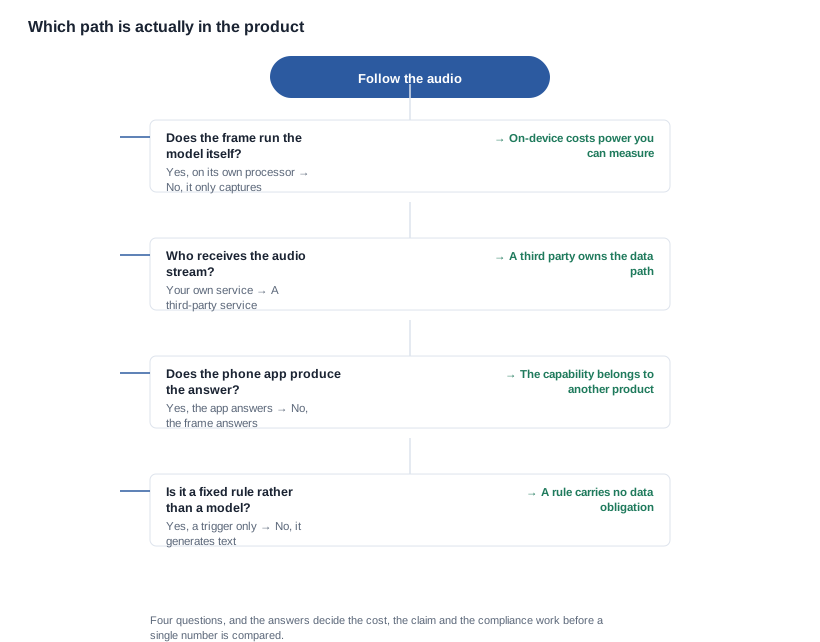
The fork at the top of that diagram matters because the four questions invalidate different comparisons. If the assistant runs on a third-party service, question one is about a data path you do not own, and the comparison against an action camera is a comparison against a product with no obligations at all. If it runs on the device, the comparison becomes a hardware comparison, and the published runtime and the cell capacity become the numbers that decide it.
The red flags in this comparison are worth naming, because they are the shape of a bad decision rather than a bad product. Comparing a glasses platform with an earbud on the basis of "AI capability" as a single axis. Comparing unit prices while the cost structure is unknown. Accepting "works with everything" as a compatibility answer. And running the comparison before anyone has established which of the five paths the product actually uses.

What the radio and the connected-device obligations add to the decision
Any product with a radio and a network connection is a connected device, and the security expectations around it are moving. The EN 18031 series is scheduled to become a mandatory component of CE marking for radio equipment from 1 August 2025 — which is after this article's publication date, so it is not a requirement today. What a buyer can do now is ask what the manufacturer's position is on vulnerability handling and security documentation, because that is what the requirement will ask for, and asking now is cheap.
For a private-label brand there is a second layer. The economic operator, the technical file, the labelling and the listing information are the brand's responsibility, covered in the GPSR route. An AI feature that streams a customer's audio to a service adds a data-handling question on top of a product-safety one, and both have to be answered before launch.
The connected-device question changes which alternative is a competitor. A product with no radio, no application and no cloud dependency is a product with a much shorter compliance path. That is a genuine commercial advantage of an action camera over a connected glasses product, and it is worth pricing rather than ignoring.
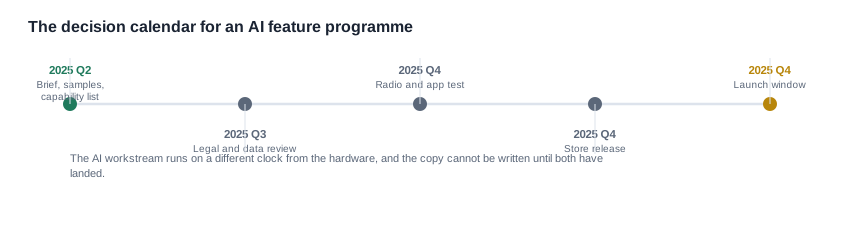
The calendar above is the practical version of that point. The radio, the application, the store release and the legal review run on four different clocks, and the copy cannot be written until the capability list and the data path have both landed. A buyer who has scheduled an AI feature as if it were a firmware option will find the feature shipping a quarter after the product, with a product page that describes a capability the shipped units do not have.

The comparison criteria, and what they cost to check
The criteria below are the ones we would use to evaluate a comparison, and they are listed with what it costs to apply them, because the cost of a criterion is part of the criterion.
- The path is established in writing. On the device, a vendor's service, the phone application, or a fixed rule. Cost: one question.
- The data path is known. Entity, jurisdiction, retention period, and whether the answer is the same in every market. Cost: one written answer, and a legal review that cannot be compressed by asking urgently.
- The offline behaviour is enumerated. Which functions survive with no network. Cost: one test with the network off, on a sample.
- The failure behaviour is defined. What the customer sees and what the support script says. Cost: a design decision, and the cheapest item on the list.
- The claim ownership is settled. Who may change the behaviour, and with what notice. Cost: a clause.
- The unit economics are written down. One-time engineering against recurring operating cost, per option. Cost: a meeting, and the discipline of putting the recurring lines in the model.
- The alternative has been priced. What the customer buys instead, at what price, and what it does not do. Cost: an afternoon, and it is the criterion most often skipped.
The pitfalls, in the order they bite. Starting with a competitor's feature list instead of with the job. Comparing on the word "AI" rather than on the four questions. Assuming the alternative is worse because it is less integrated, when the customer's own phone is already the alternative and is already in their hand. And building a proposition around a capability the brand does not control, which is a decision to accept a dependency rather than a decision about a product.
What can be negotiated and what cannot. The path, the data path, the offline enumeration, the failure behaviour, the notice period, the acceptance criteria, the minimum order quantity, the packaging and insert design including the market labels, and the way the invoice is staged — a deposit staged up front, a balance payable at the inspection point, and a retention against the documentation file. Certification cost and certification time are not a commercial lever, because the fee is per product family and the elapsed time belongs to the test laboratory and its review queue. Tooling is a one-off, and the useful questions are over what volume it is amortised and what happens to it if the programme stops. The service layer itself is not negotiable, because it is the one part of the chain nobody in the transaction controls.
What we will and will not claim, and what we can close
Concretely, "AI features" is not a comparison axis, it is a set of four decisions, and a buyer who has those four answers can compare two platforms properly while a buyer who does not is comparing marketing language.
We will not publish a language count, an offline capability, a subscription term or a data location, because we do not hold them, and we will not convert our own website copy into a specification. The evidence point matters as much as the technical point: our parameter rows come from the product catalogue, and the AI translation capability on the K01 is recorded from our own website copy — it is a claim we make about the product rather than a specification we cite from a manufacturer. That does not make it untrue, and it does mean that a brand restating it carries the same exposure we carry. The platform feature set across the camera family names first-person content capture, everyday stills, hands-free calling, meeting recording and AI translation, and the questions behind those terms are covered in CY03 common questions.
We will not present an AI feature as a clinical, health or safety benefit, and we make no medical or health claim for any product in this range. We will not publish a verified device list either, and we will not produce one retrospectively from memory.
What we can do is take your two options, or your option and the alternative your customer is actually buying, and tell you which of the four decisions each one has already made and which it has left open. Send us the target market, the volume, the channel and the price band, and we will come back with what is published, what we can close for you on request, and what we cannot answer today. The camera family is on our AI camera glasses range page.
Related reading
- The full AI feature position for this range — AI features in smart glasses
- The platform features on the camera models — CY03 common questions
- The market-access sequence for a connected product — GPSR route
Tell us the target market, the volume and the channel, and we will come back with what is published and what we can close.


