

Red flags in the AI glasses category are rarely lies. They are true statements arranged so that the reader draws a conclusion the supplier never actually committed to. A percentage that is correct for a single language pair becomes, in a catalogue cell, a general accuracy claim. A count of forty languages becomes, in a listing, a coverage claim. A demonstration becomes, in a buyer's mind, a tested feature. Each of those steps is a small editorial decision and each of them is expensive when it is later challenged.
The useful way to treat smart glasses ai features smart glasses red flags is as a set of observable evidence rather than a set of accusations. A red flag is something you can see in a quotation, in a reply to a written question, or on a bench during a sample session. If you cannot point at the document, you have a suspicion, and a suspicion is not a reason to stop a supplier. The seven below are ordered by how much they cost when they are missed, and each one comes with the question that exposes it and the answer that should end the conversation.
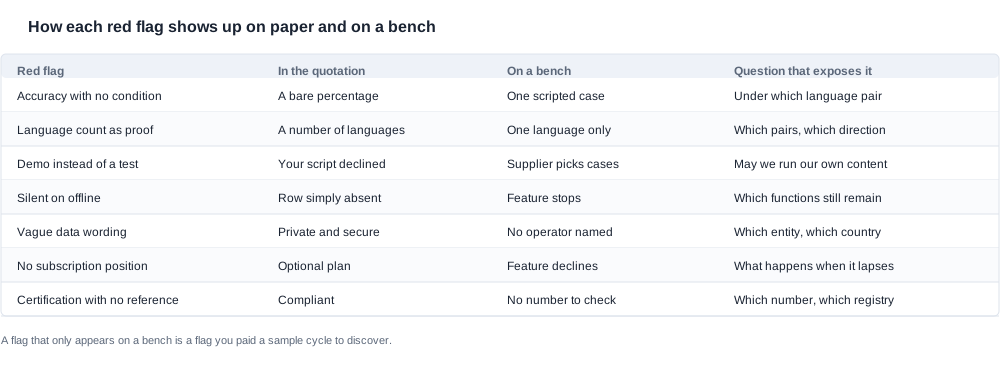
Smart glasses AI features: seven red flags, observed and not guessed
The reason this category produces so many red flags is structural rather than moral. The AI layer sits outside the unit that ships, so the language used to describe it defaults to the language of capability rather than the language of measurement. A factory can publish a cell capacity because the cell is in its hand. It cannot publish a latency figure for a model it does not host. The gap is filled with adjectives, and adjectives are the raw material of every one of the seven flags below.
Ranked by the cost of a late discovery, the order is this. The certification reference and the written data path come first, because a claim you cannot verify is a claim that will be examined by someone other than you. The offline behaviour comes next, because it determines whether your product works in the places your customers actually use it. The accuracy condition and the language pairs follow, because they decide whether the capability survives contact with a real customer. The demonstration-versus-test distinction and the subscription position come last, because they are the two flags a buyer can still correct after the order without a retooling.
The order also tells you where to spend your procurement time. A buyer with three days of evaluation and a sample on the way should spend them on the first two flags in this list, because those are the ones a sample cannot recover. A buyer who has already placed an order and discovered the problem later has lost the cheap stage, and the only remaining action is to bound the exposure.

Each flag, the evidence it leaves, and the question that exposes it
One. An accuracy figure with no condition attached
The evidence is a percentage on a datasheet, a slide or a quotation, with no language pair, no domain, no audio condition and no description of how errors were scored. This is the most common flag in the category because a percentage is easy to obtain and easy to publish.
The question that exposes it: under which language pair, in which acoustic environment, and how were errors scored — by word, by sentence, or by a human judging whether the answer was useful? A supplier who cannot answer has a number they did not measure. A supplier who can answer will give you the conditions alongside it, which is exactly what you need for the claim to survive review.
Two. A language count offered as coverage
The evidence is a number — forty languages, thirty-one languages — with no list attached and no indication of direction. The gap between nominal coverage and usable coverage is routinely an order of magnitude, because a count that mixes input and output languages can represent half as many working pairs.
The question that exposes it: which pairs work, in which direction, and which are listed rather than functioning? Follow it with the second question, which is more revealing than the first: which of these are available with no network? A supplier who has the list will answer in one message. A supplier who has only the count will stall.
Three. A demonstration offered in place of a test
The evidence is a refusal to let you run your own content, usually framed as protecting the demonstration quality, or a demonstration that uses cases the supplier selected. A demonstration shows you the cases that work. Your product will meet the cases your customers bring, and they will not be the same cases.
The question that exposes it: may we run our own script on a sample unit, in our own environment, with our own content? A supplier who agrees has nothing to hide and gains credibility. A supplier who declines for a commercial reason — the script needs a paid account, or the feature is under an access control — is telling you something, and the something is written down.
Four. No answer on offline behaviour
The evidence is an absent row, or an answer that describes the product generally instead of enumerating the functions that continue. This is the flag most often not answered at all, and it is the one with the longest commercial tail, because the operating conditions it affects — a warehouse, a basement, a vehicle, a flight, a market with patchy coverage — are exactly where a product that depends on a service stops being useful.
The question that exposes it: which functions specifically remain when the network is unavailable? The answer should be a list of functions with a state for each one. Capture, playback and the wake word may continue while recognition, translation and summarisation stop, and that partial answer is publishable in a listing. A yes or a no is not.
Five. Vague data-protection language
The evidence is a phrase such as "private and secure", "encrypted end to end" or "data handled in accordance with applicable law", with no operator entity, no jurisdiction and no retention period. Every one of those phrases is a statement of intent, and none of them is an architecture.
The question that exposes it: which legal entity operates the backend, in which country is the processing performed, and how long is the material retained? A supplier who can answer those three has a data arrangement. A supplier who answers "our AI partner handles that" has told you there is a dependency, and the dependency is now on your file.
Six. Silence on the subscription
The evidence is a feature list with no commercial position attached, or the phrase "optional premium plan" with no statement of what happens at the end of it. This flag costs less than the others, because the answer is usually available on request, but it is expensive when it surfaces late, because a customer whose plan lapses experiences a removal of functionality and files it as a defect.
The question that exposes it: is there a recurring fee, who pays it, and what happens to the feature when it lapses? Note that there are two fee questions here — the end customer and your company — and the second is the one that determines whether the unit price you were quoted still holds at volume.
Seven. A certification asserted without a reference
The evidence is the word "compliant", "certified" or "approved" with no reference number, no issuing body and no registry. This applies to radio qualification and to market conformity, and it applies to us exactly as it applies to anyone else writing in this category.
The question that exposes it: what is the reference, and in which registry can it be verified independently? A certification claim you cannot check is an assertion. Note also that this flag has a technical dimension in the European Union: the cybersecurity requirements of the Radio Equipment Directive become a mandatory part of CE marking on 1 August 2025, described by the EN 18031 series of harmonised standards, and a supplier who quotes a generic compliance claim will not have engaged with any of that.
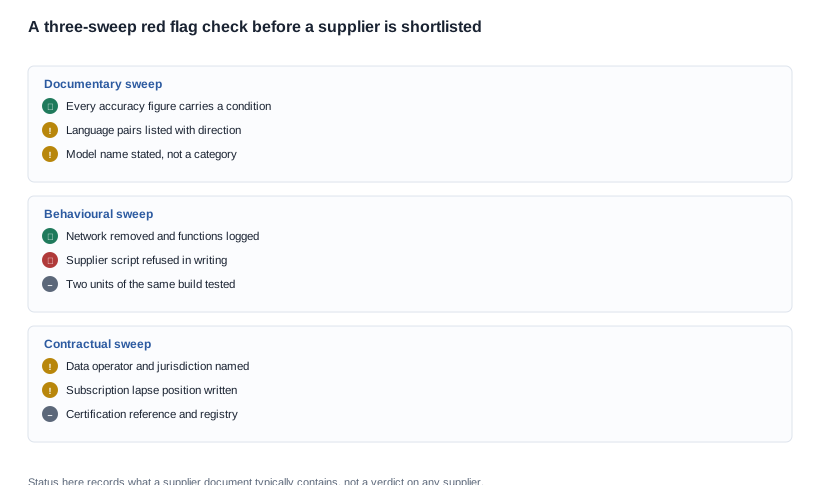
The escalation ladder when the answer does not arrive
Finding a flag is the easy half. The useful skill is deciding what to do with a supplier who does not answer, and the reason this needs a method rather than an instinct is that a non-answer is ambiguous. It can mean the answer is commercially awkward, it can mean the question went to the wrong party, and it can mean nobody inside the company knows.
The ladder has five rungs, and the discipline is to climb one at a time and record what happens at each.
- Ask in writing, with the value demanded. "Under which language pair and with what error scoring?" is answerable in a sentence. "What is the accuracy?" invites a paragraph and returns one.
- Set a date. Not a deadline for the supplier but a point at which your evaluation stops waiting. Without a date, a non-answer quietly becomes a pass, because the evaluation moves on and the quotation sits in a folder.
- Ask again, changing the shape. A second question addressed to a different party inside the organisation — the engineering contact rather than the sales contact — frequently produces a different answer. Three different answers to the same question is itself the finding.
- Treat silence as data. Write down what you know now: the row is open, and no answer arrived by a stated date. This is a fact you can act on, unlike a suspicion about intent.
- Decide and record. Either the supplier stays on the shortlist with the open row written into the order, or they come off it with the reason stated. Either way the file ends up with a decision rather than a drift.
The value of climbing the ladder is that step three produces evidence the other steps cannot. A supplier who answers on the third approach has shown you something a first-time answer would not have: that the answer exists and that the organisation needed to be asked three times to produce it. That is a reasonable basis for a procurement decision, and it is a much better basis than the intuition that something felt off.


Where each flag is usually discovered, and what it costs there
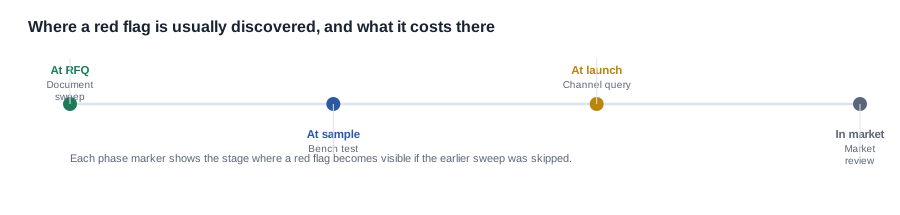
The seven flags do not all appear at the same point in a programme, and knowing the phase tells you which stage of your procurement process you are actually at. A flag caught in the document review costs a question. A flag caught in a bench test costs a sample cycle and a schedule. A flag caught after launch costs a copy rewrite, a support burden and a channel conversation. A flag caught during a market review costs considerably more than that.
The practical consequence is a sequencing rule rather than a list: run the documentary sweep before the sample arrives, and the behavioural sweep before the order is placed. The documentary sweep is free — it is reading documents that already exist — and it removes the flags that a sample cannot recover. The behavioural sweep costs a sample cycle, which is why it should be spent on the flags that only appear when the feature is exercised.
The two flags a sample cannot recover
A certification reference and a written data path cannot be recovered by testing a unit, because neither of them lives on the unit. A sample proves that a feature runs; it does not prove that the supporting documentation names your model, and it does not produce a jurisdiction or a retention period. If a supplier cannot supply those documents, no amount of bench work will change the position, and a buyer who spends their sample cycle discovering that has spent the most expensive part of the evaluation to learn nothing that was not visible on day one.
The other three flags — the accuracy condition, the language pairs and the offline behaviour — are recoverable from a sample, but only if the test is written down before the sample arrives. The reason is obvious once stated: a question asked after a demonstration has been shown to you has already been shaped by the demonstration.
The flag that changes the commercial structure
The subscription position is the only flag on the list that changes the shape of the deal rather than the shape of the claim. A capability billed per active user is a variable cost attached to your brand, and it behaves differently from a per-unit cost at every volume tier. A capability whose price depends on the supplier's own commercial relationship with a model provider cannot be quoted as a fixed margin item, and a buyer who accepts a unit price without understanding the underlying basis will find the price moving at the worst moment.
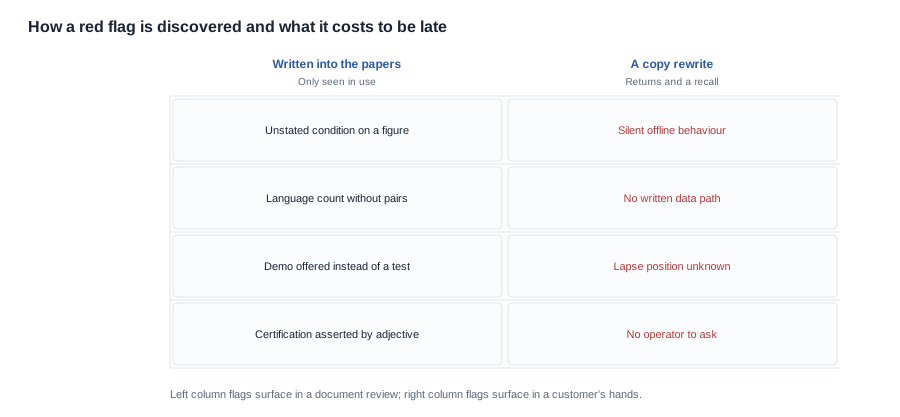
Three combinations that end a programme
A single flag is usually survivable. Three particular combinations are not, and they are worth recognising early because each one has a signature that a buyer can see within the first two exchanges of documents.
The first combination is a certification asserted without a reference and a vague data-protection statement. Read together they say that the supplier's compliance evidence is descriptive rather than documentary. That combination matters more than either flag alone because it removes the possibility of verification for the entire programme rather than for one row, and it cannot be repaired by a sample or by a renegotiated unit price.
The second combination is a demonstration offered in place of a test together with a refusal to enumerate the offline behaviour. It says the supplier's evidence base is a set of selected cases rather than a set of measured conditions. A buyer who accepts it will discover the gap when a customer's own case fails, and the discovery will happen in a channel you do not control.
The third combination is the commercial one: a bundled per-user charge inside a fixed unit price, together with no written position on what happens when the plan lapses. This combination converts a margin item into a variable cost that you do not control, and it does so quietly, because the price you were quoted does not change when the underlying arrangement does.
The response to each combination is the same and it is unglamorous: name it in writing, attach the date, and put the open rows into the purchase order as open rows. A programme that is explicit about its gaps can be managed. A programme that assumes them cannot.

Applying the same list to our own published AI rows
We would be inconsistent writing this article without running the seven flags against our own documentation, so here is the result.
Our catalogue names an AI voice assistant among the key technologies across the camera platform, and it describes AI translation support on the K01, an audio model, recorded as an observation from our own marketing material rather than as a published specification. Against the seven flags, that is close to a complete hit. We publish no accuracy figure, no language list, no latency, no offline behaviour, no processing location, no subscription terms, no application operator, no data jurisdiction and no certification reference.
There is one important difference, and it is the difference between a gap and a hazard. The absence is visible. A buyer can see which rows are empty, ask about them directly, and decide whether the gaps matter for their programme. That is not the same as being handed a figure that later turns out to be wrong. A visible blank costs a question. An invisible error costs a recall.
The failure mode this article describes is the opposite of ours: a plausible figure that gets written into a specification and defended to a customer. We would rather publish empty rows than plausible ones, and we will tell you which of our rows are empty before you spend a sample cycle on them.
What a well-answered question gives you back
A disciplined supplier answering the seven flags produces something a buyer can use: a value, a condition and a document reference for each row. That is a specification, and it is what a purchase order should be built on.
If several of the seven come back empty, the question is no longer whether the product is good. It is whether their documentation practice matches the standard your own programme has to meet. A brand with a compliance function and a published claims policy finds this during the first exchange of documents. A brand without one finds it during a market surveillance question, which is a much more expensive place to find it and a much less useful one, because at that point there is no supplier relationship left to improve.
The move that resolves it fastest is to send the seven questions as a numbered list and ask which ones have answers, with a date attached. A supplier who answers six and marks the seventh as open has told you something you can build on. A supplier who answers none has told you something too, and you have avoided the cost of finding it out later.
Before you send it, one piece of preparation decides how the answers arrive. Ask whoever wrote the list to say, for each question, what a usable answer would contain and what an unusable one would contain. A usable answer to the accuracy question carries a language pair and an error definition; an unusable one carries the word "high". Writing those two columns before the message goes out means you can classify each reply as it arrives instead of evaluating it afterwards, and it removes the most common failure in this kind of exchange, which is accepting a reply that is fluent but carries no value. It also gives the supplier a clear target, and suppliers answer more precisely when they are told what the answer has to contain.
The same preparation decides who the questions go to. In most organisations the AI capability sits with engineering while the quotation sits with sales, and a list sent only to sales will come back paraphrased. Sending the same list to both, with one named contact on each side, is worth doing on the first exchange rather than on the third.
Related reading
- Reading claims in detail — ai features manufacturer claims
- The nine rows to establish first — ai features procurement checklist
- Why claims outlive their evidence — ai features certification requirements
Send us your eight questions to a supplier and we will tell you which of them we can answer today.


