

An AI feature is the easiest part of a smart glasses product to describe and the hardest part to own. The moment a device claims that it translates, that it answers a spoken question, or that it summarises what it heard, the product has acquired a dependency on software, on a service, on a licence and on a data arrangement — none of which is visible on a datasheet and none of which is built by the factory that ships the box. A buyer who verifies only the hardware has verified the part that is easiest to replace.
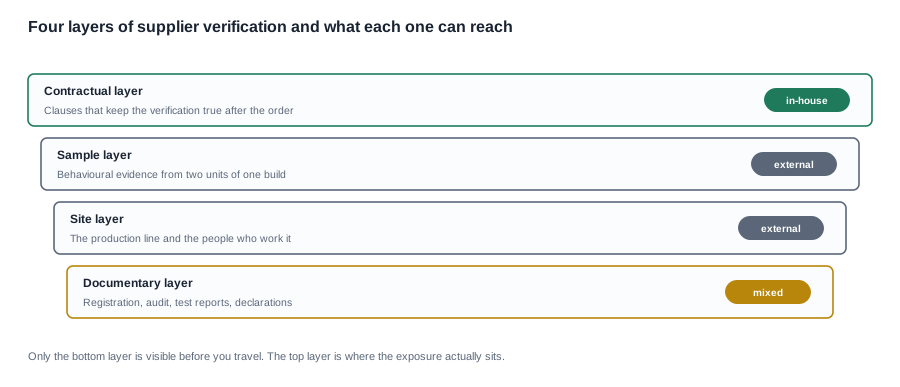
This article is about verifying the supplier itself rather than the product in front of you. It covers four layers of evidence, in the order a serious programme should collect them: the documents, the factory site, the sample as an instrument rather than a demonstration, and the clauses that keep a verified supplier verified once the order is placed. The boundary is deliberate. What happens to a batch after it arrives is a different exercise with different documents, and nothing here depends on it.
Smart glasses AI features: what supplier verification must establish
Supplier verification in this category fails in a predictable place. A buyer confirms that a company exists, that a factory produces units, that a line runs, and that the sample behaves. Every one of those checks is genuine and none of them touches the thing that actually creates the risk: the dependency. The AI layer is delivered by somebody else, on somebody else's infrastructure, under somebody else's contract, and the factory may have no contractual relationship with any of it.
Four questions therefore have to be answered before a supplier can be called verified for an AI programme, and each of them belongs to a different party.
Who performs the inference. A supplier who cannot say whether the capability runs on the device or in a service has not built an arrangement they can describe. The answer determines whether the product needs a network, and the difference between "on the device for the wake word, a remote service for the assistant" and "it is intelligent" is the difference between a plan and a deflection.
Who owns the service underneath. The assistant is very often a third-party capability licensed to the factory, or a platform service. That creates three exposures a buyer should price: the licence may be charged per device, per active user or per volume, and the commercial model is not always the same as the unit price implies; the licence may be terminated or not renewed; and the supported language list, the model behaviour and the feature set can change under you, because the provider decides what the service does.
Where the data is processed. Which legal entity operates the backend, in which jurisdiction, with what retention period. This is the answer that determines what your own privacy statement has to describe and how far your data protection position extends to the product.
What happens on the day it stops. If the answer is that the feature stops working, the buyer needs to know that at the point of purchase, not at the point of renewal. The follow-up is whether the assistant is embedded in the firmware or delivered as a service, because an embedded assistant survives a licence lapse and a service does not.
The document set: what to request and what each document proves
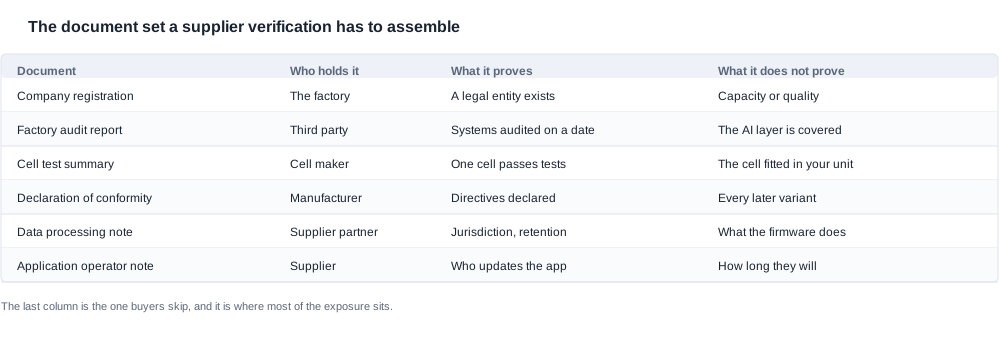
The document request is the cheapest part of the whole verification, because it costs nothing but a message, and it is the part that most often produces the decisive answer. The discipline that makes it work is to ask for each document by name rather than for a compliance pack, and to insist on the model list inside every document that carries one.
The company registration and business scope. This establishes the legal entity behind the quotation, which matters more than it sounds: it is the entity that signs the agreement, that carries the warranty and that has to be traceable when a market surveillance question arrives. A trading name or a group structure is acceptable, provided the contracting entity is named.
The factory audit report, with its scope and date. A third-party audit or a customer audit both count, and both have a scope that is usually narrower than the buyer assumes. A report covering assembly and incoming inspection does not cover firmware build control, and firmware build control is where the AI feature lives. Read the scope before the conclusion.
The cell test summary and the cell part number. The transport test summary covers a specific cell, so the part number has to travel with it. A cell substitution invalidates the document even when the finished product is unchanged, which is why the part number belongs in the file and not just the capacity.
The Declaration of Conformity for the European Union. This is a manufacturer self-declaration covering the applicable directives, and there is no CE certificate number to look up because CE is not issued by an authority. The document that matters is the declaration itself, and it must name your model. Note also that the cybersecurity requirements of the Radio Equipment Directive become a mandatory part of CE marking from 1 August 2025, described by the EN 18031 series of harmonised standards, so an audit whose scope predates that date does not cover the new obligations either.
The data processing description. A paragraph is enough to be useful: the operating entity, the jurisdiction, the retention period and the categories of material retained. A supplier who cannot produce this paragraph has not built the arrangement for the scrutiny it will receive, and the absence is the finding.
The application operator statement. Who publishes the companion application, who signs for its behaviour in each market, and how it is updated. Add the termination question to the same request, because it is the same document.

The factory visit: where the AI dependency is and is not visible
A factory visit is the most credible verification step and the least targeted. It generates a lot of impressions and very little evidence about an AI feature, because the dependency is not on the line. Knowing that in advance is what makes the visit worth the travel.
What the visit can genuinely establish. Whether the line that would build your model is running or is being prepared. Whether the people responsible for firmware flashing and for the build record are identifiable and willing to be named in the agreement. Whether the test equipment exists for the operations you have been promised. Whether the quality control arrangements in the building match what the audit report describes. Whether the supplier's capacity claim is plausible against the volume you intend to order. These are all worth confirming, and all of them are about hardware.
What the visit cannot establish. Whether the assistant is any good. Whether the data path is as described. Whether the licence with the model provider can be relied on for three years. Whether the firmware build on a unit in the warehouse is the same build as the one on the sample table. None of these can be seen by walking a floor, and a buyer who spends the visit trying to see them will come home with an impression rather than evidence.
The one conversation worth having on site. Ask who builds and signs the firmware, and ask to see the build record for the most recent production run. The answer tells you whether there is a version-controlled build process or whether firmware is flashed by whoever is available that week. For a product whose distinguishing feature is software behaviour, that distinction is the most consequential thing on the floor, and it is invisible in every document a supplier will send you by email.
Who to ask. Ask to speak with the person who will own the firmware after the order, not the person who hosts the visit. That person is usually not the most senior person in the building and is usually the one who can answer the build-record question. It also establishes a technical contact for the life of the programme, which matters more than it does at the start.
The audit scope question that settles most factory visits
Most factory visits are spent asking whether the supplier can do something. The more productive question is what a document already states, because the document will have a scope and the scope will tell you where the gaps are without anyone having to admit anything.
Read the scope of the audit report against the three things that actually carry risk in an AI programme: the firmware build and version control, the incoming inspection of cells and components, and the finished-product test regime. A report covering assembly and incoming inspection leaves the first and third open. A report covering the whole system but dated before the cybersecurity requirements of the Radio Equipment Directive entered CE marking on 1 August 2025 leaves the firmware side of the new obligations unexamined. This is not a criticism of the audit, which was never scoped to cover it; it is a statement about what the buyer still has to verify by another route.
The same reading applies to a supplier that presents its own quality system rather than a third-party report. A written system is worth having, because it tells you what happens when something goes wrong, and it is worth reading for the three questions above. What it does not do is give you the independent confirmation, and for a buyer establishing a first relationship that confirmation is usually the point of the exercise.

The sample as a verification instrument rather than a demonstration
A sample is an instrument or it is a demonstration, and the difference is entirely in how it is used. A demonstration shows the cases the supplier chose. An instrument produces a measurement under a condition you specified in advance.
Write the script before the sample ships. A numbered list, each item with a stated condition and a stated pass condition. "The wake word triggers within two attempts in a room at about 60 decibels" is a test. "The voice assistant works well" is not, and the difference between them is the difference between a purchase-order clause and an opinion.
Run it on at least two units of the same build. A feature that works on one unit and fails on another is a yield problem, and a yield problem is invisible in a single-unit test. Two units also tell you something a bench report cannot, which is whether the product is consistent, and consistency is the question a buyer actually cares about.
Test with the network absent. This is the step most brands skip and the step that reveals a service dependency the way no laboratory test does. Record what remains, function by function, and that list becomes your degradation claim. A partial answer — capture and playback continue, recognition does not — is more useful than a complete one because it is publishable.
Test the failure behaviour, not only the success behaviour. What does the customer see when the feature fails? A feature that fails silently is worse than one that fails visibly, and both are better than one that a support agent cannot diagnose because the device publishes no state. Write the failure state into the instructions and the support script.
Check the build, not just the behaviour. Record the firmware build identifier from each unit you test, and compare it against the build on the order. A verification performed on a sample build that is not the production build verifies the sample.

Contractual verification: the clauses that keep a verified supplier verified
Verification is a snapshot, and the reason supplier relationships fail in this category is rarely that the verification was wrong. It is that the conditions changed after the order and nothing obliged anyone to tell you. The clauses below are the ones that convert a point-in-time verification into an ongoing position.
- A named entity and a named contact. The contracting entity and a technical contact, both named in the agreement, so that a problem has a route and a warranty has an addressee.
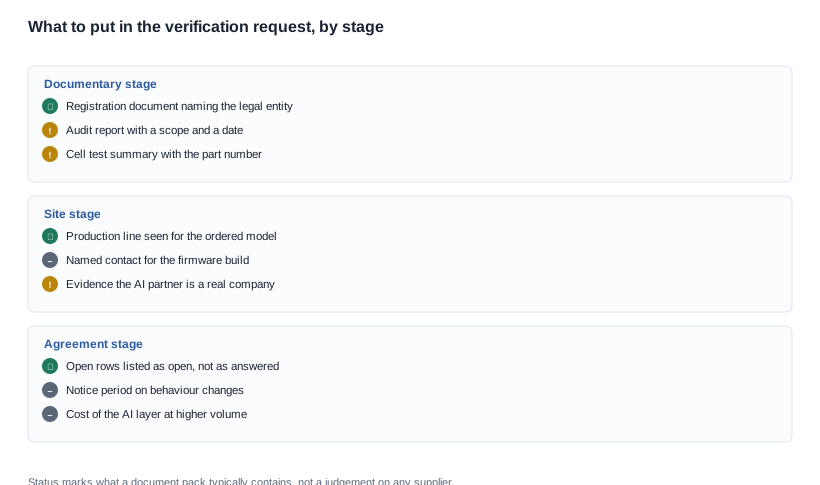
- An open-rows schedule. Every row that the verification left open is written into the agreement as open, with the answer that is acceptable if it never arrives. This is the single most valuable clause in the list, because it converts a gap in the evidence into a known and accepted condition rather than an unknown.
- A notice period on behaviour changes. Anything that alters the assistant behaviour requires notice, with a stated period you can brief a channel around.
- A prohibition on silent cell and firmware substitution. The cell part number is named, and the supplier must notify in writing before any substitution.
- A volume price position on the AI layer. If the capability is charged per device, per active user or per volume, the basis has to be stated, because a fixed unit price over a variable licence is a margin you do not control.
- A documentary update obligation. When the data path, the model provider or the operator changes, the documentation pack and your privacy statement are updated with it.
None of these clauses is unusual and none of them is free. The reason they are worth negotiating is that the alternative to a clause is a discovery, and a discovery at month nine costs a great deal more than the clause costs at month zero.
When the verification produces a conditional result
Most verifications do not produce a clean pass. They produce a mixed result, and the judgement a buyer has to make is whether the mixed result is acceptable for this programme rather than in general. Three patterns recur, and each has a defensible answer.
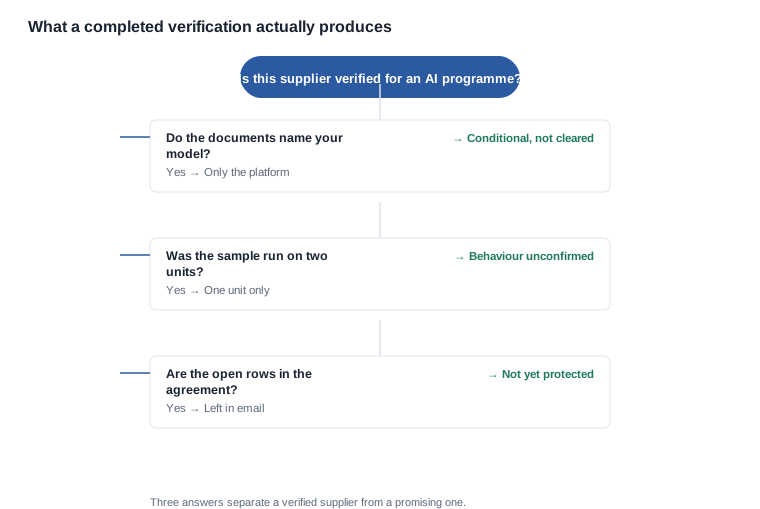
The documents cover the platform but not your variant. This is the normal finding in this category and it is not a failure of honesty; it is how certification systems work. The answer is to ask the manufacturer what a variant requires — a supplementary test, a new declaration, a re-issue naming the new model — and to price the elapsed time into your schedule, because that time is usually longer than the testing itself.
The AI dependency is confirmed but not documented. The supplier knows who operates the backend and has confirmed it informally, but has no written data processing description because the partner holds it. The answer is to require the partner's description as a condition of the first order, with a date, and to record the answer as open until it arrives. Do not accept the informal confirmation as the answer; the whole point of a verification is the document.
The sample behaves and the build record does not exist. The unit on the bench behaves correctly and nobody can say what build it is. This is the finding with the largest downstream cost, because it means there is no way to reproduce a good result and no way to trace a defect to a cause later. The answer is to make a build record a contractual requirement before the order, with the build identifier printed on or recoverable from the unit.
The common thread is that none of these three results is a reason to stop on its own, and each of them is a reason to stop if it is not written down. A conditional verification that is recorded as conditional is a usable position. The same verification recorded as a pass is a liability, because it will be relied on later by someone who was not in the room.
The verification position we can and cannot evidence
It is worth being precise: we will name the AI capabilities our own documentation supports and mark the rest as open, and we will not present a capability as local when the processing happens somewhere else. Our catalogue names an AI voice assistant among the key technologies for the AI camera glasses family, and our independent site describes AI translation on the K01, which is a Bluetooth audio model rather than a camera model. We treat that second one as an observation from our own marketing material rather than as a verified specification.
We do not publish which models process on the device, whether translation works offline, whether a subscription is involved, who owns the companion application, in which jurisdiction data is processed, or the supported language list. Each of those is a real product decision with a real cost attached, and each is a question we would rather be asked than assumed in either direction. We also publish no certificate numbers, issuing bodies or validity dates, which is why we tell buyers to obtain the documentation rather than relying on a catalogue claim — the claim is not the document.
What we will do is take a specific model and a specific claim in your listing, and tell you which of the four verification questions we can answer from our documentation today and which have to come from the engineering and compliance teams. Send us the claim, the target market and the volume, and we will say which of the four it has to be answered against before you order.
Related reading
- The capabilities and the use cases behind them — AI features in smart glasses
- The claim to verify before you publish it — supplier verification
- The protocol for testing it yourself — testing AI features before ordering
- The data and update side of the same question — certification checklist
Send us the claim you want to make and the model behind it, and we will tell you which of the four questions we can answer today and which are still open on our side.


