
Every runtime claim in this category is a number with a condition attached, and the condition is the part that never reaches the page. What reaches the page instead is a phrase, and the phrase is nearly always more flattering than the number it replaced. This is not a criticism of any particular manufacturer. It is a description of how the category works, and like any regular pattern it can be handled systematically.
The handling has two halves. The first is linguistic: recognising a phrase for what it asserts, so that a buyer can ask the question that turns it into a request. The second is procedural: a way of auditing a catalogue, a product page or a supplier's own sales copy so that every runtime claim ends up in one of three columns, and the claims that cannot be substantiated leave the page rather than being softened.
The reason this matters commercially is straightforward and it is not a legal abstraction. A runtime figure is the number a customer tests first, and it is the number they test against the product page the brand wrote. A brand that republishes a supplier's unconditioned figure has made that figure its own claim. When the customer finds the gap, the customer is right, the supplier is not in the room, and the brand is left explaining a number it never measured.
Smart glasses battery life: number, condition and scope in every claim
The useful unit of analysis is a single claim, decomposed into three parts. A number is what the claim asserts. A condition is what the device was doing while the number was being produced. A scope is the boundary of the claim, and there are five of them that matter in this category.
Working time or standby time. A device that is asleep most of the day and wakes occasionally can publish a week of standby and three hours of working time, and both numbers are true. A claim that does not say which one it is is ambiguous, and ambiguity in a product page is resolved by the customer rather than by the brand.
Camera active or camera idle. In the camera tier this is the single largest variable in the budget, and the published rows reflect that. The V03 and the V03 Pro publish a range of five to eight hours and the KY06 publishes a range of six to eight, which is the shape of a figure that was measured with the sensor in two different states. The models that publish a single point, such as the MT6 at roughly seven hours, have picked one state and are not saying which.
Radio connected or not. A connected device holds a link, and a link in poor coverage costs more than a link in good coverage. Whether the published figure includes a connected radio changes what the number describes.
New cell or cycled cell. Every rated figure in this category describes a new cell, because that is what a production sample is. No model in the range publishes a cycle life rating, so the claim has a scope of one by default and the brand inherits it without knowing.
Which configuration. A figure quoted for a model is a figure for whatever configuration was measured. A case in the box, a tinted lens, a different charge interface and a different radio version are all configuration, and all of them change the answer.
The consequence is a publishing discipline that costs nothing: a runtime claim is a number, a condition and a scope, and the brand publishes all three or publishes none. A brand that republishes a number without the condition has converted a rating into a promise, and a promise is the thing a customer holds the brand to.
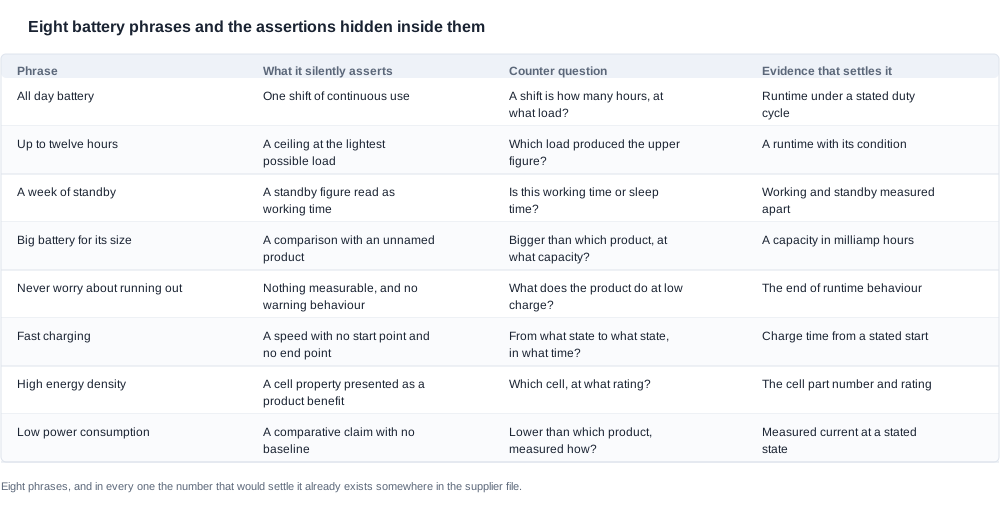
Eight phrases that appear on battery rows, and what each one silently asserts
The phrases below recur across this category, in catalogues, on marketplace listings and in wholesale sheets. Each one is a compression of a real claim, and each one drops something on the way.
All day battery asserts a working shift of continuous use. The counter-question is what a shift is in hours and at what load, and the evidence that settles it is a runtime measured under a stated duty cycle. This is the phrase that does the most damage, because it converts a duty cycle into a working day.
Up to twelve hours asserts a ceiling, and quite possibly the ceiling of the lightest possible workload rather than of continuous use. The word up to is doing real work in that sentence, and a listing that removes it makes a claim the supplier did not make.
A standby that lasts a week asserts a standby figure and invites the reader to treat it as a working figure. The counter-question is whether the number is working time or sleep time, and the evidence is the two measured separately.
A big battery for its size asserts a comparison with an unnamed product. The counter-question is bigger than which product, at what capacity, in which part of the enclosure. The honest version of this claim is a capacity in milliamp hours, which is a number rather than a comparison, and it is the number our catalogue publishes.
Never worry about running out asserts something that cannot be measured at all. The question behind it is what the product does when it does run out: does it warn, which function stops first, is the shutdown clean. That question has a document behind it, and the answer to it is worth more than the phrase.
Fast charging is ambiguous in a way that matters commercially. A charge time can mean a full charge from empty or a partial charge to a usable level, and the second is the much better number for a customer. It can also mean a charge to eighty percent rather than a charge to full. The counter-question is from what state to what state, in what time, and at what source output.
High energy density asserts a cell characteristic, which is a legitimate and measurable property. The question is which cell and at what rating, because energy density belongs to a cell rather than to a product, and a product with a small high-density cell can still have a short runtime because the product draws more than the cell can cheaply supply.
Low power consumption asserts a comparison with no baseline. The counter-question is lower than which product, measured how, at what state of charge. The evidence is a measured current at a stated state, which is a figure a supplier can hold but rarely prints.
Two more appear often enough to name. Built-in rechargeable battery asserts that the cell is not user replaceable, which is true across this range and which the catalogue does not need to claim because no model has a field replaceable cell. And military grade asserts a standard that does not exist for a product of this kind, which makes it a phrase with no document behind it at all.
The counter-questions that turn a phrase into a measurable request
A counter-question is a question whose answer is a number, a document or a measurement. That is the whole test. If the answer is a description, the question was not specific enough, and the right response is to ask it again in the same words.
The set below is the working list, and it is deliberately the same set of questions for every supplier and every model, because consistency is what makes a partial answer visible.
- Is this figure a working figure or a standby figure? A supplier who answers this first, without being asked, is a supplier who has a measurement process.
- What was the device doing during the measurement, specifically whether the camera was recording, whether a phone was connected, and how long each function ran.
- What was the ambient temperature, and was the cell at room temperature or cold?
- Was the figure produced on a new cell or on one that had been cycled, and how many cycles?
- What happens at the end of the runtime — does the product warn, which function stops first, and does it shut down cleanly.
- How many full sessions does the case add, for the models that carry one, and what is the case's own charge time and input.
Two of these are more important than they look. The first is the one that separates a measurement from a catalogue value, and a supplier who has a working and a standby figure has a test bench rather than a marketing department. The fifth is the one that turns a support complaint into a product decision, because a product that warns is a product whose runtime is an expected event rather than a fault.
There is a seventh question that is not about the measurement at all, and it is the one with the largest commercial effect: will you substantiate this claim in writing for our own copy? A supplier who answers that question with a document is offering the brand something worth a unit price reduction, because the brand's own exposure to a claim it cannot evidence is larger than the difference between two quotations.

Auditing a catalogue or a product page, line by line
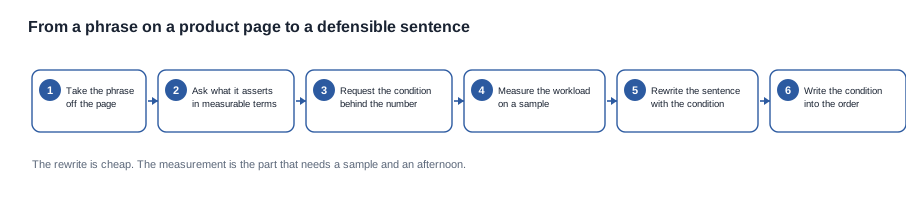
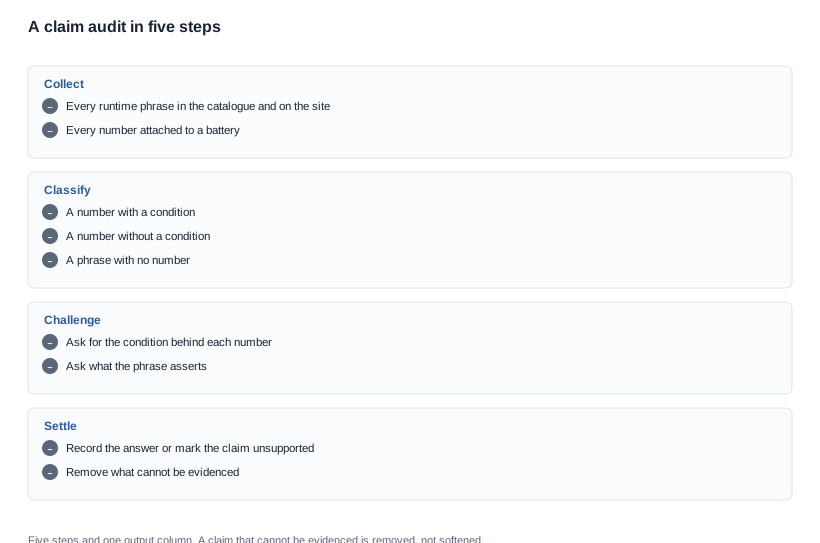
An audit is a procedure with an output, and the output is three columns. The procedure is five steps, and the first two take an afternoon and the last three take a supplier relationship.
Step one, collect. Every runtime phrase and every number attached to a battery, in the supplier's catalogue, on the brand's own product page, on the marketplace listing and in the wholesale sheet. In practice these four do not agree with each other, and the disagreement is itself a finding, because it means somebody wrote each one separately.
Step two, classify. Three classes. A number with a condition, which is usable and needs no change. A number without a condition, which is a ceiling and can be made usable by adding the condition, or removed. A phrase with no number, which cannot be made usable at all and has to be rewritten or cut.
Step three, challenge. Request the condition behind each number, in identical words across all models. Ask what each phrase asserts, in measurable terms. Record the answers against the claim, not against the document.
Step four, settle. Where the answer supports the claim, keep it and attach the condition. Where it does not, mark the claim unsupported. Where the answer is partial, narrow the claim to what is supported, which is almost always a better sentence than the original.
Step five, remove. Take down what cannot be evidenced. This is the step that gets skipped, and skipping it is why the audit produces no change. A softened claim, a claim hedged with the word up to in a place where the supplier did not write it, and a claim moved to a marketing channel that is not covered by the review, are all the same decision: to keep an exposure that the audit was supposed to close.
The flow above is the same procedure seen as a sequence, with the supplier requests and the buyer's own measurement separated. The reason to run the two separately is that they have different failure modes. A supplier request can be answered with a document, and the document may describe a different configuration. A buyer measurement cannot be answered with a document at all, and it is the only one of the two that produces a number the brand can defend.
The audit checklist a brand can hand to a copywriter
The audit works better when it is handed over as a document rather than described in a meeting, and the version below is short enough to circulate to a copywriter, a channel manager and a buyer at the same time.
- List every runtime claim on the product page, the packaging artwork, the marketplace listing, the wholesale sheet and the internal sales material. Red flags that the audit is incomplete: the same figure appearing with different conditions on two different pages.
- Classify each claim into a number with a condition, a number without a condition, or a phrase. A phrase cannot be recovered; a number without a condition can.
- Ask what to ask of the supplier, in identical words for every model, and record the answers in the buyer's own file.
- Decide the final wording from what was established rather than from what was hoped for, and check that the new wording is what the artwork actually says before the artwork is approved.
- Set the criteria for when a claim may be republished by a channel partner, because a claim the brand has bounded and a claim the brand has removed will otherwise be treated the same way downstream.
- Decide before you order whether a measurement is worth funding on the production batch. If it is, specify the protocol and the pass condition in the order, so the result is a contractual acceptance criterion rather than a favour.
When to run the audit is a scheduling question rather than a judgement one. The point at which it becomes expensive is the point at which the artwork is approved, because every claim changed after that point is a reprint. The point at which it becomes useful is the point at which the claim is being written, which is earlier than most brands realise. The trade-off between running it early and running it properly is usually resolved by giving the copywriter the three-column version of the rule rather than the prose version, because the rule is easy to apply and hard to argue with.
Rewriting a claim so it survives a customer's test
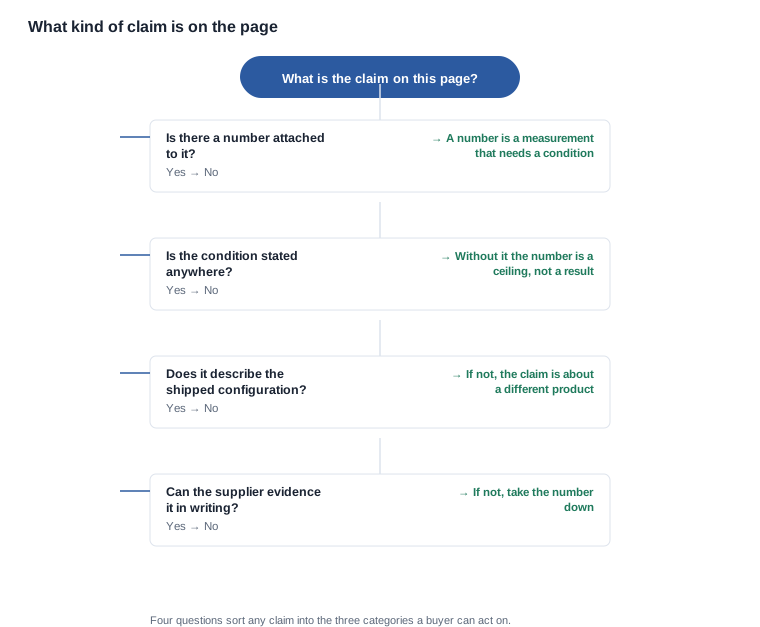
There are three ways to write a runtime claim, and only one of them survives contact with a customer.
The condition-free figure. This is the common one, and it is the one that produces returns. It reads as a property of the product rather than as a result of a measurement, and a customer who exceeds the load is entitled to say the product is faulty.
The figure with its condition. This is defensible, and it is usually shorter than the original claim rather than longer, because the condition replaces the adjective. A claim that says the product runs for five hours with the camera active says something narrower and more useful than a claim that says all day, and it is true in every condition the customer is likely to test.
The routine rather than the figure. This is the strongest form, and it is the one most often available to a brand that has run its own measurement. Instead of a runtime, the page describes what the customer does: charge overnight, use it through the working day, return it to the case. It is harder to falsify, because it describes a practice rather than a performance, and it is the form that survives a customer who misreads the number, because there is no number to misread.
The decision chart above sorts any claim into these three cases, and it is worth running it against the claims the brand already has, including the ones in the internal sales material, because internal copy reaches the customer through the channel partner who receives it.
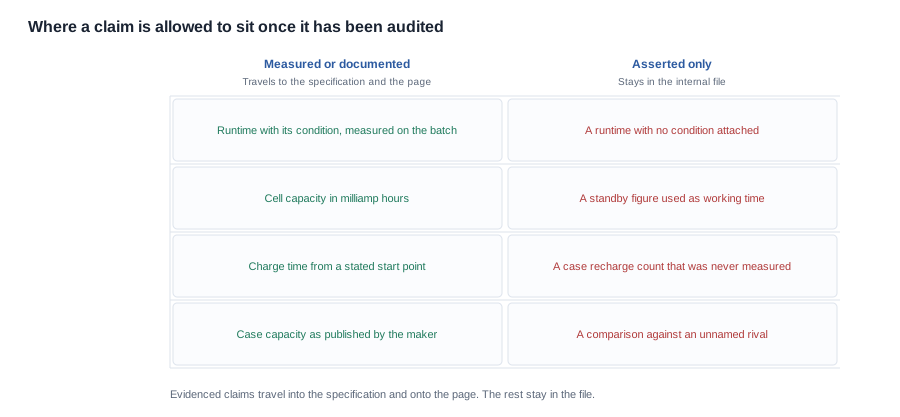
The matrix is the audit's output, and it is worth keeping as a standing document rather than a one-off. The left column is the set of claims that may appear in a specification, on a product page and in a channel listing, and each of them carries its condition with it. The right column is the set that may only exist internally, usually as a negotiating position, and a claim that stays there has not been substantiated and must not be published anywhere the customer can read it. Most catalogues in this category have no such split, which is why the same figure appears with three different conditions across three different pages.
The commercial terms are where the audit becomes enforceable. A clause that the supplier will substantiate any runtime figure used in the buyer's own channels, in the buyer's own name, against a written protocol, converts a marketing problem into a contractual one. It is a modest clause and it is often refused, and the refusal is informative: a supplier who will not commit to the conditions behind a number is telling the buyer how much of the published specification is a document and how much is a habit.
What our own catalogue claims, and what we refuse to write
It is worth being precise: we publish the runtime exactly as the catalogue states it, mark the condition as open, and never convert a rated figure into a working one. Our catalogue publishes the charge time, the rated runtime, the cell capacity, the charging interface and, on the models that carry one, the case capacity. It publishes no test condition behind any runtime, no usable capacity, no cycle life, no charge curve and no thermal figure for any model, and we will not estimate them from typical values.
We do not publish all day battery, up to twelve hours, a week of standby, big for its size, fast charging as a slogan, or high energy density, for any model. Where we publish a number, we publish the number and we say what we do not know alongside it. That is a deliberately unfashionable position, and it is the reason a buyer can check our claims against ours and find them consistent.
The most useful illustration in the range is the children's tier, because it shows what happens when a duty cycle is converted into a working day. The A05 and the A06 publish 40 mAh and roughly twenty hours, and the A07 publishes 70 mAh and roughly twenty hours. Two quite different cell sizes producing one identical figure is only coherent if the number describes a light duty cycle with long idle periods, and it is nonsense read as continuous use. A listing that says twenty hours of use for a reminder-style product is making a claim a customer will test and find false, and the customer will be right.
There is a limit to what we can tell a buyer from a catalogue, and it is worth stating plainly. A claim that has no condition behind it cannot be fixed by a distributor, a retailer or a marketplace listing. It can only be fixed by a measurement, and a measurement needs a sample and an afternoon. Where a brand wants that, the honest route is to measure the production batch, publish the protocol, and let the figure be the brand's own rather than an inherited one.
What a buyer should do with an unevidenced claim it did not write
The awkward case, and the common one, is a brand that has inherited a phrase from a supplier's material and has already printed it on packaging. The claim is now the brand's, whether or not the brand ever examined it, and the cheapest moment to have examined it has already passed.
The recovery has three steps, and the order matters. The first is to establish whether the phrase has a number behind it, and if it does, whether the number has a condition. A phrase with no number cannot be recovered at all, and the decision is simply to remove it, because a phrase that cannot be falsified cannot be defended either. The second is to request the condition from the supplier, using the same six counter-questions, and to record the answer in the buyer's own file even if the supplier's answer arrives late. The third is to decide the final wording from what was actually established, not from what was hoped for.
The total cost of getting this wrong is usually underestimated, because most of it lands outside the buying budget. It lands in the returns column, in the support queue, in the copy that has to be reprinted, and in the case where a marketplace reviewer or a channel partner's technical team asks the brand to evidence a figure the brand repeated. The cost of the audit is a day of somebody's time and a short conversation with the factory.
The shortlist for the phrase itself is short enough to memorise. Any runtime claim on a page the brand controls falls into one of three columns: number with condition, number without condition, or phrase. The first is publishable. The second is publishable once the condition is attached, and the attachment is the brand's own measurement if the supplier cannot supply it. The third is not publishable, and the decision to remove it should be made before the artwork goes to print rather than after the first complaint.
Send us a listing, a draft product page or a supplier catalogue and we will mark every runtime claim on it as a number with a condition, a number without a condition, or a phrase. We will also tell you which of the numbers our published documentation can support today and which need a measurement on a sample. The published rows are at battery life specifications, and the measurement method is at testing battery life.
Related reading
- The published rows and what they omit — battery life specifications
- The variables the field adds — real world performance
- Turning a use case into a target — choosing a runtime target
- The test that settles it — testing battery life
Send the listing and we will mark every runtime claim on it as measurable, conditional or a phrase.


