
A 40 mAh battery in our kids range claims roughly twenty hours of use. A 290 mAh battery in our camera range claims roughly seven. Smart glasses battery life therefore does not track capacity, and any buyer who ranks products by milliampere-hours is reading the wrong column of the smart glasses spec sheet explained here.
That is the short version. The long version is a reading procedure, because a specification sheet in this category is not a table of answers — it is a table of assertions, and the skill is in telling which assertions a line actually makes. Eight lines appear on a battery row in this product family. Three of them are routinely misread, two of them are routinely absent, and the remaining three decide whether the sheet can be used for procurement at all.
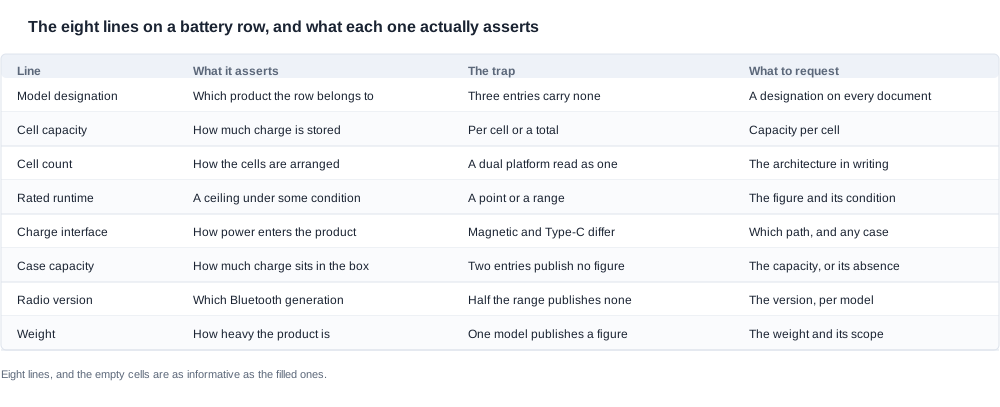
Smart glasses battery life: eight lines, and what each one asserts
Line one, the model designation. It identifies the product the row belongs to, and it is the line that everything else hangs on. Three entries in our catalogue carry no model designation at all: the AR glasses entry, the AI electrochromic entry and the bone conduction entry. A row without a designation cannot be tied to a conformity document, a packaging label or a customs entry, and any comparison built on it is a comparison of unnamed things. The trap is subtler than an obvious blank: a row whose designation differs from the one on your purchase order by a single character is the same failure, and it is the most common substitution finding in this category.
Line two, the cell capacity. It asserts how much charge is stored, and the trap is the unit of comparison. Capacity is a storage quantity, not a duration, and what converts one into the other is the average current the workload draws. The second trap is the multiplication sign. The K01 and the K02 publish ninety milliampere-hours on each of two cells; the YK12 and the LC-105-1, and the LC-105-2 and the G07 publish fifty-five on each of two; the YKC02 publishes seventy on each of two. Read the notation carefully: the doubled figure is an architecture, not a bigger battery of the same kind.
Line three, the cell count and arrangement. It is a separate assertion from the capacity and it is frequently implicit. A dual-cell platform and a single-cell platform with the same total charge behave differently under load, and they behave differently at the end of a discharge, because the cells do not reach the end of their range at the same moment.
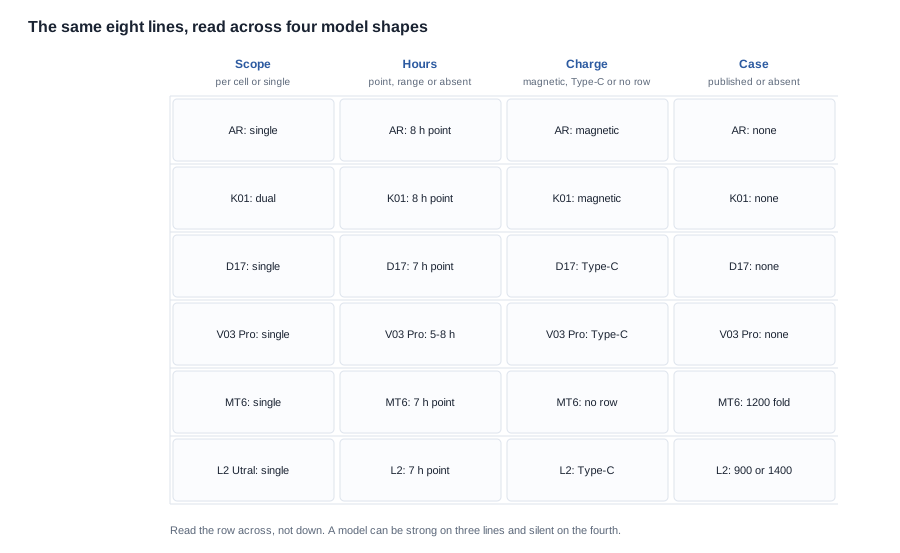
Line four, the rated runtime. It is a ceiling under some unstated condition, and it comes in two shapes. Some entries use a range: the V03 and the V03 Pro publish five to eight hours, the V06 and the S7 publish five to eight, the KY06 and the MT5 publish six to eight. Others use a point figure of roughly six, roughly seven or roughly eight. A range is an honest acknowledgement that the figure moves with conditions; a point figure is a single measurement presented as typical, and the difference matters when you are deciding how to quote it. Every model in the range publishes a figure on this line, so the empty cell has moved: what the line does not carry is the condition, and on the eleven camera platforms that condition is the whole question.
Line five, the charging interface. It asserts how power enters the product, and it is more commercially significant than its single line suggests. In our range seven models use Type-C: the V03 Pro, the L2 Utral, the D11, the D12, the D17, the ZH12 and the bone conduction entry. Seventeen more use magnetic charging, and four camera models — the CY03 and the MT6, and the CY05 and the L1 Pro — publish a case capacity but no charging interface at all, so on those four the line is a question to put to the factory rather than a value to copy. The trap is assuming that a charging row also tells you about charging time, charging temperature or the behaviour of the device at low charge; it tells you about none of them.
Line six, the case capacity. It asserts how much charge sits in the box rather than on the head, and it decides how many sessions a customer gets between charges. The published figures are 1400 mAh on the CY05 and the L1 Pro, and the CY03, 900 or 1400 mAh as a configuration on the L2 Utral, and a foldable 1200 mAh case on the MT6. The KY06 and the MT5 are published with a case and no capacity, and the V03 and the V03 Pro are published without one. The trap is treating a case row as a battery row, which double-counts the charge and hides the number that matters.
Line seven, the radio version. It asserts which Bluetooth generation the module was built to. Fourteen models publish it: 5.3 on the K01 and the K02, and 5.4 on the D11, the D12, the LC-105-1, the LC-105-2, the G07, the YK12, the YKC02, the D17, the ZH12, the A07, the AR entry and the AI electrochromic entry. Fourteen do not, including all eleven camera models. It has no bearing on runtime, and it is on the sheet because it tells you something about the platform generation.
Line eight, the weight. It asserts how heavy the product is, and it exists on exactly one row in the entire range: the MT6 at 158 g, which is the weight of the glasses body including the 265 mAh cell and the camera and excluding the foldable charging case. The case holds 1200 mAh and its own weight is not published. No bare frame weight is published for any model, so a weight quoted without that scope cannot be compared with anything, including another weight from the same supplier.
Unit traps: milliampere-hours, hours, and the arithmetic between them
The most common reading error in this category is treating the capacity column as a duration column. It is a quantity of charge; duration appears only after a draw figure is applied, and the draw figure is set by the workload.
A useful sanity check sits inside our own published data. Four entries carry a 100 mAh cell: the AR entry at about eight hours on magnetic charging, the AI electrochromic entry at about seven hours on magnetic charging, the D11 and the D12 at about seven hours on Type-C, and the ZH12 at about eight hours on Type-C. Same capacity, four different hours figures, and even the charging interface does not settle them: the magnetic pair splits at eight and seven, and the Type-C pair splits at seven and eight. Whatever produces the difference sits inside the platform, which means it cannot be read off the specification row by anyone. A buyer who reads the 100 mAh line as a duration line will conclude that the platform is interchangeable, and it is not.
The second unit trap is the multiplication sign, and it works in both directions. A buyer comparing a 110 mAh total against a 100 mAh single-cell figure is comparing two architectures, and the comparison is meaningless. A buyer comparing a 110 mAh total against a 100 mAh total is comparing a dual-cell platform against a single-cell platform, which is equally meaningless. The only honest comparison is per cell, with the architecture stated.
The third trap is the twenty-hour figure on the A05, the A06 and the A07. Those models publish forty, forty and seventy milliampere-hours and one identical hours figure. Identical hours on different capacities is only coherent as a duty cycle with long idle periods, which is what a posture and distance sensing product does. Read the figure as continuous operation and it is nonsense; read it as a duty cycle and it is coherent. The same rule applies to any range you meet elsewhere: a figure that does not move with the capacity is describing something other than capacity.
The fourth trap is the range. When a row publishes five to eight hours, the lower end is the figure to plan with, the upper end is the figure to advertise only with its condition attached, and the width of the range is itself information about how much the condition moves the result. A narrow range suggests a stable workload; a wide one suggests the workload is doing the work.
The condition column that every supplier leaves blank
No entry in our catalogue states the test condition behind its runtime figure, and this is not unusual — it is close to universal in this category. It is also the single most important gap, because it is the gap that makes two numbers in the same row comparable or incomparable.
Seven conditions determine the result, and a buyer should know all seven because a supplier will usually answer only the one it finds convenient.
Ambient temperature. A cold cell has less capacity available, and the effect is large enough to change which end of a published range a product lands on. A figure produced at room temperature is a figure for a temperate warehouse, not for a winter delivery route.
The workload. Whether the camera is recording, whether audio is playing, whether the sensors are sampling, and at what duty cycle. On a camera platform the image sensor is the dominant consumer, so a figure produced with the sensor idle describes a product nobody buys.
The volume level. A louder output draws more current, and the relationship is not linear, because the amplifier draws more as the signal gets larger. A product tested at a low level in a quiet room is being tested in its best case.
The radio state. Connected or disconnected, and in what signal conditions. A radio working to hold a weak connection draws more than one holding a strong one, and it is active throughout a session in a way the camera is not.
The start state. The charge level at which the measurement began. A run started from a partly depleted cell is not a runtime.
The end condition. Whether the device shut down in an orderly way or degraded, and the charge level at which it stopped working. A device that becomes unusable at five per cent while still drawing power has run out before its own display says so.
The cycle count. How many times the cell had been charged before the measurement. This one is the reason a rating taken from a development unit is worth less than it appears.

What to do with the blank column is a procurement decision, not a technical one. The options are to request the conditions in writing, to run the measurement yourself against a protocol you wrote first, or to accept the figure as a screen and plan around it. All three are legitimate; what is not legitimate is treating a rated figure as though the conditions had been supplied.

Reading the charge path against the case row
The charge path and the case row have to be read together, because the case is a second product with its own cell, its own packaging and its own transport documentation, and the pair behaves differently from either one alone.
Read the pair like this. A magnetic platform without a case — the AR entry, the A07 and the V03, the S7 and the A06, and the A05, and the LC-105-2 and the YKC02, the LC-105-1 and the V06, the K01 and the K02, and the G07 and the YK12 and the AI electrochromic entry — is a single-session product that needs a cable or a cradle in the box. A magnetic platform with a case, which covers only the KY06 and the MT5, is a multi-session product in which the case is part of the proposition. A Type-C platform — the V03 Pro, the L2 Utral, the D11, the D12, the D17, the ZH12 and the bone conduction entry — is a single-session product that charges from a standard cable, which is a different commercial story: one fewer accessory in the box, one fewer variant in the packaging, and a simpler support instruction. The remaining four camera platforms — the CY03 and the MT6, and the CY05 and the L1 Pro — publish a case capacity and no charging interface, so their charge path has to be established on samples before it can be written into a purchase order.
Three consequences follow from that reading and they are the ones that belong in a purchase order.
The case is a separate line in the bill of materials. A case means a second SKU with its own MOQ, its own packaging dimensions and its own freight weight. If the case is in the box, its capacity is a published claim and it belongs in the specification; if it is an accessory, it does not.
The case changes the transport documentation set. A case with a cell inside it is another cell in the shipment, and the documentation has to cover what is actually in the carton. This is a shipping question before it is a compliance question, and it is the reason a capacity question should be asked before the first shipment is booked rather than after.
The charge path constrains the future. A magnetic platform ties the product to a cradle and a contact arrangement; a Type-C platform does not. If a cell or a firmware revision is likely during the life of the programme, the interface affects how much of the platform survives the revision. That is a forward-looking question about your own product, and it is worth answering before you pick the row.
Turning a read specification into a defensible shortlist
Reading a sheet is not the deliverable. The deliverable is a shortlist you can defend, with the open items attached to it rather than buried in a notes column.
The procedure runs in five steps and it is worth writing down before you start, because a shortlist built without a written method is a shortlist built on attention.
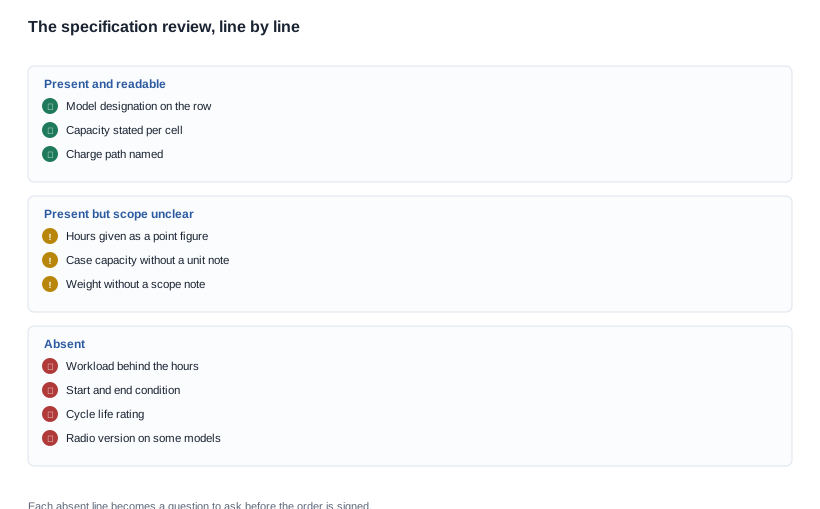
Step one, normalise. Convert every capacity to a per-cell figure and record the architecture next to it. Convert every hours figure into one of two classes: point or range. Note the condition column beside every one of them, and where a row is absent for a different reason — a case capacity, a radio version, a weight — write "absent" rather than leaving the cell empty, because an empty cell disappears in a spreadsheet and an empty cell is a decision.
Step two, classify the workload. Attach to each model the workload the published figure most plausibly describes, and mark it as an assumption where it is one. The children's platforms sit in the duty-cycle class; the camera platforms sit in the capture class, with the six that publish a range supporting it and the five point figures resting on the assumption alone; the audio platforms sit in the playback class.
Step three, list the open rows. For every model, list what the sheet does not say: the workload, the start and end condition, the cycle count, the case capacity where it is missing, the radio version where it is missing, the weight in every case but one. This list is the actual output of the reading work.
Step four, decide which open rows are disqualifying. A missing radio version on a camera model matters if your programme depends on a specific radio generation; it does not matter if the product is a fixed-platform accessory. A missing case capacity matters if your brief depends on a week of charge. A missing weight matters if the channel is size-sensitive. Sorting the open rows by consequence is what turns the reading work into a shortlist.
Step five, write the request list from the open rows. Each open row becomes a question, each question has an owner and a deadline, and the answers go into the purchase order as acceptance criteria. This is also the moment when a supplier's responsiveness becomes visible: a supplier who answers all seven condition questions is telling you something about the measurement discipline behind the sheet, and one who answers only the convenient question is telling you something too.
A worked example, briefly. Assume a channel buyer who needs a camera platform for a two-shift operation with a case in the box and a radio generation fixed by the device list their customers run. Reading the range: the hours criterion keeps all eleven camera models, because every one of them publishes a figure — six as a range and five as a point — and normalises them accordingly, which means the criterion that actually removes models is the condition criterion, not the hours one; the case criterion keeps the L1 Pro and the MT6, and the L2 Utral and the CY03, and the CY05 and the KY06 and requires a written capacity for the KY06; the radio criterion removes all of them, because no camera model publishes a Bluetooth version, so the version becomes a request rather than a filter; and the weight criterion removes nothing, because the sheet publishes a weight for exactly one model in the range. The shortlist that emerges is not a ranking. It is a list of models with a named set of open items attached to each one.
What we publish, what we withhold, and the four columns we would add
The specification sheet should be read as a set of assertions, and we would rather show a buyer which assertions we hold than fill the gaps with values we have not measured.
We publish the cell capacity for every model, the charging interface for the twenty-four models that carry one, the rated runtime for every model in the range, the case capacity where the catalogue states it, the Bluetooth version for the fourteen models that carry one, and one weight figure in the entire range — the MT6 glasses body at 158 g, including the 265 mAh cell and the camera, excluding the foldable 1200 mAh charging case whose own weight is not published. We do not publish a test condition behind any runtime, a usable capacity, a cycle life rating, a charge curve or a thermal figure for any model, and we will not estimate them from typical industry values. We do not publish a bare frame weight for any model, and we would rather say that than quote a figure you cannot verify.
If we could add four columns to any specification sheet in this category, they would be these. Workload, so the hours figure has a subject. Start and end condition, so the measurement is bounded. Observation method, so the end of the session is defined. Unit scope, so a per-cell figure is never compared with a total. None of the four requires new engineering; all four require that somebody decided to record them, which is a management decision rather than a technical one.
What we will do is help you fill them. Give us a model and the workload your product runs, and we will tell you which published rows apply, which are absent, and what a first measurement should contain so that the four columns exist for your programme and not only for ours. The smart glasses battery life and power pillar covers the measurement methods behind each of these figures in more detail, and the charge-interface question is treated separately under bluetooth connectivity because the radio and the charging path share physical constraints on several platforms.
Related reading
- Why runtime figures differ by workload — smart glasses battery life test conditions
- Choosing between platforms before sampling — smart glasses model comparison
- Radio and charging share physical constraints — bluetooth connectivity
- The electrical detail behind the audio platforms — bluetooth audio glasses
Send us your workload definition — capture duty cycle, playback volume, target temperature — and we will tell you which rows we can and cannot confirm against it.


