
A published runtime in smart glasses is the output of a chain, not a property of a cell. The chain runs from a cell in the temple, through a protection circuit, a charge path and a conversion stage, into a load that changes minute by minute, and it finishes on an ageing curve that starts the day the unit ships. Most catalogues print the first term of that chain and present it as a specification.
For a procurement decision this matters in one practical way. Two models can be compared on their published rows and the comparison will still be wrong, because the rows describe different points in the chain. The row that separates a usable supplier from an unusable one is not the capacity figure. It is the answer to a question about the load and the condition behind the number.
The work is straightforward, and it is a due diligence step rather than an engineering project. Take the runtime figure and the capacity together and treat both as a screen rather than a target. Ask the supplier for the condition behind the number, in writing, per model. Measure the shortlist on one protocol of your own, with a stated sample and a stated pass condition. Then write the result into the acceptance criteria of the purchase order, where a later cell substitution cannot quietly invalidate it.
Smart glasses battery life: where the runtime figure is produced

The reader who needs this page is usually a brand-side product manager or a channel buyer who already has two or three supplier quotations in front of them. They are not choosing a technology. They are trying to establish whether the numbers on those quotations describe the same thing, because the two models that look closest on paper are frequently the two that behave most differently in the field.
What they are protecting against is specific. The first is a product that meets its published figure and fails on the afternoon it was designed for, which reaches the customer as a return and reaches the support team as an argument nobody can settle. The second is a specification written on a rating, where a later cell change makes the written specification wrong without anybody noticing, because nobody recorded which cell the rating came from. The third is a comparison built on the wrong row, where the right model is eliminated in week one and a weaker one is ordered instead.
The chain explains all three, because each failure is a specific stage of the chain being treated as if it were the whole of it. A capacity figure presented as a runtime skips everything downstream of the cell. A runtime figure presented as a working day skips the condition. A case capacity presented as extra time skips the losses in the case and the routine around it.
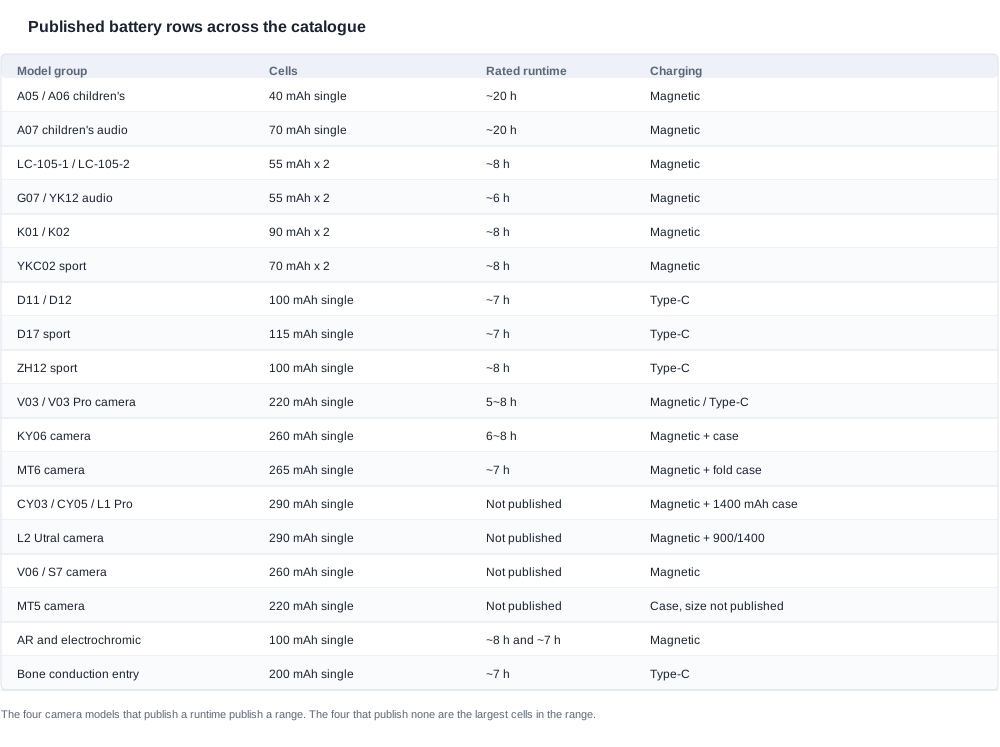
Our own catalogue makes the pattern visible. The camera tier carries cells from 220 mAh to 290 mAh, the audio tier carries dual cells of 55 mAh, 70 mAh and 90 mAh per side alongside single 100 mAh and 115 mAh cells, the children's tier carries 40 mAh and 70 mAh cells, and the bone-conduction entry carries a 200 mAh cell. Published runtimes run from roughly five to eight hours across the camera tier, roughly six to eight hours across much of the audio tier, and roughly twenty hours on the children's models. Every one of those figures arrives without a load.
The four stages a supplier answer usually covers and the two it does not
A supplier who answers well will usually give you the cell, the charge interface and the rated runtime, because those are the three rows in the catalogue. A supplier who answers very well will add the charge time and, on a handful of models, the case capacity. What almost nobody volunteers is the stage between the cell and the load, and the stage between the load and the day.
The stage between the cell and the load is the conversion chain. A cell delivers a voltage that falls as it discharges. The electronics in a pair of glasses need a stable rail, and a conversion stage provides it, and that stage loses a percentage of the energy on the way. The losses are small in absolute terms and decisive in relative terms, because they sit on top of a cell that is already sized to a thin temple.
The stage between the load and the day is the load itself. A camera that is switched on draws a different amount from a camera that is idle. A radio that is maintaining a link in a weak signal draws more than one that has a clean connection. A feature that is enabled but not in use may still hold a circuit open. The published figure is a number on the far side of that variability, and the variability is the part nobody documents.
The consequence for a buyer is that the productive question is not "how long does it last" but "what was the device doing when you measured". A supplier who cannot separate a camera-active runtime from a camera-idle runtime has not measured the two cases separately, and a single number from that supplier is the least reliable figure in the whole document.
The two architectures the catalogue actually contains
The range divides into single-cell and dual-cell models, and the division is more than a packaging detail, because it changes what a buyer can do with a spare part, what a cell document has to cover, and what happens when one of the two cells ages.
The dual-cell models publish as a pair: 55 mAh on each of the LC-105-1 and the LC-105-2, and the YK12 and the G07, 70 mAh on each of the YKC02, and 90 mAh on each of the K01 and the K02. The single-cell models publish one figure: 40 mAh on the A05 and the A06, 70 mAh on the A07, 100 mAh on the D11, the D12, the ZH12, the AR entry and the electrochromic model, 115 mAh on the D17, 200 mAh on the bone-conduction entry, and 220 mAh to 290 mAh across the camera models.
What the catalogue does not say, and what a buyer needs, is how the two cells in a dual-cell model are arranged. Whether they sit in series or in parallel changes the pack voltage, changes what a single cell substitution would do, and changes whether one weak cell pulls the pair down. It is a fair, narrow question to put to a supplier, and the answer belongs in the technical file that comes with the order.

Nominal capacity, the protection circuit and the energy you can actually use
Nominal capacity is a rating on a cell, measured under a stated method, and it is a statement about the cell rather than about the product. Three things sit between the rating and the energy that reaches the load, and a buyer who knows the three can ask a supplier three questions that are worth more than a long specification.
The first is the protection circuit. Every cell in a product like this sits behind a protection arrangement that limits charge current, limits discharge current and cuts the cell off at a defined voltage. The protection circuit consumes energy of its own in its normal state, and a part of it is spent in the conversion stage that follows. The published capacity figure does not include either. The usable energy in the shipped unit is therefore lower than the number on the cell, and the gap belongs to the design rather than to the cell maker, so the cell maker cannot answer a question about it.
The second is the conversion stage described above. It is a percentage loss on whatever passes through it, and a percentage loss on a small cell is a larger number of minutes than the same loss on a large one. This is part of why a 40 mAh cell and a 70 mAh cell can publish the same twenty-hour figure: the smaller cell is doing less, and the fixed losses are proportionally larger.
The third is self-discharge, which is the rate at which a cell loses stored energy while it is not being used. It is small per month and it is not zero, and it is the reason a unit that has been in a warehouse at partial charge for a quarter is not the same unit that came off the line. For a distributor holding inventory, and for a brand with a long product cycle, that is a working condition rather than an edge case.
Reading the catalogue rows without being misled by them
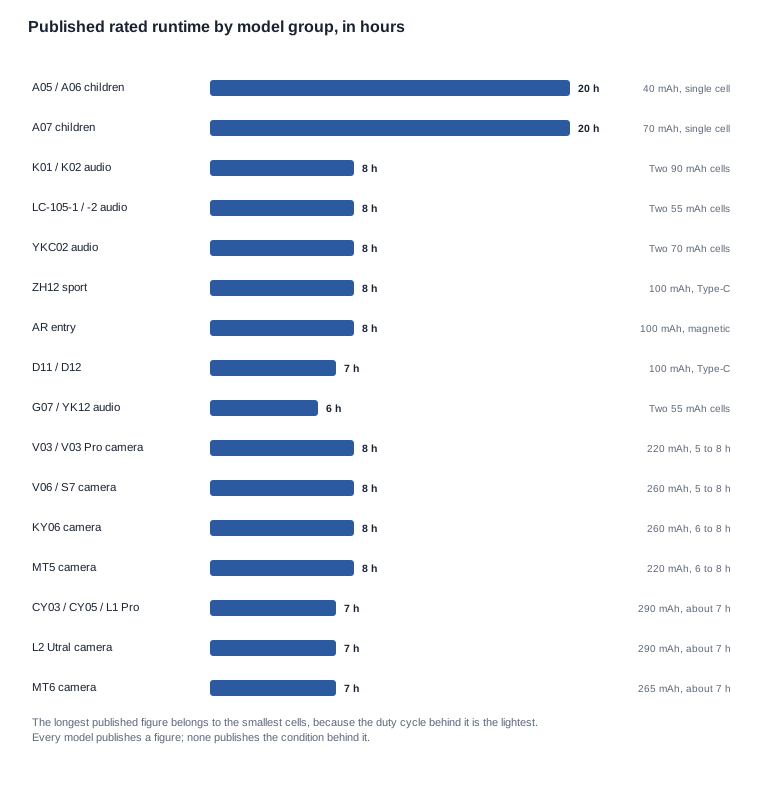
The published rows in the range are consistent and they are legible, which is more than can be said for most of the category. The camera models run from a 220 mAh cell on the MT5 and the V03, and the V03 Pro, through 260 mAh on the V06 and the KY06, and the S7, to 265 mAh on the MT6 and 290 mAh on the CY03 and the L1 Pro, and the CY05 and the L2 Utral. Rated runtime is published on all of them: the V03 and the V03 Pro publish a range of five to eight hours, the V06 and the S7 publish five to eight, the KY06 and the MT5 publish six to eight, and the 290 mAh group and the MT6 publish roughly seven.
That last point is the one worth pausing on during a procurement meeting. The four models with the largest cells in the entire range publish roughly seven hours, while the models with the smallest cells publish the longest figure. A published runtime and a cell size are two different kinds of fact, and neither one tells you what the device was doing while the hours were counted. The hours figure is published for every model in the range; the condition behind it is published for none, and that is the difference between a row you can screen on and a row you can quote.
Two models with the same 100 mAh cell publish different figures, the D11 and the D12 at roughly seven hours and the ZH12 at roughly eight, and the only difference visible in the catalogue is the charging interface. That is a reminder that the interface sits on the chain, and that a claim which omits it is incomplete rather than merely terse.
The three questions that close the gap between the cell and the load
- What is the cell part number, and what is its rated capacity and its rated discharge rate? Ask for the part number rather than the family, because a family contains several ratings and the rating decides the discharge behaviour.
- What does the protection arrangement do, and what does it cost the product at rest? A supplier who answers with a circuit rather than a number has done the work; a supplier who answers with a number alone has quoted the cell.
- What is the measured capacity of the cell in the shipped unit, at the product's own discharge rate? This is a different figure from the cell rating, and it is the only one of the three that describes the goods you receive.
All three belong in the same email, and all three are answerable without a sample order. A supplier who answers all three has a documentation habit that will show up in the quality file later; a supplier who answers one of them has given you the cell datasheet, which is a starting point rather than an answer.
The charging architecture behind a magnetic dock and a Type-C port
The charging interface is a published row in our catalogue, and it is the row most often treated as a cosmetic choice by buyers who have never watched a product fail because of it. Magnetic charging appears across most of the range, including the A05, the A06, the A07, the AR entry and the electrochromic model, the audio models and the sport models. Type-C appears on the L2 Utral and the D12, the V03 Pro and the ZH12, and the D17 and the D11 and the bone-conduction entry.
The two architectures behave differently in ways that reach the product, the packaging and the contract.
A magnetic dock depends on a defined contact geometry, and a contact geometry is a tolerance stack. It depends on a cable being supplied with the product, and on the customer choosing to use it, and on the customer plugging it into a source that delivers what the charge circuit expects. The last of these is the one that generates complaints: a port that charges slowly at one supply and quickly at another, with nothing on the product page to explain the difference.
A Type-C port is a port. It depends on a cable, which may or may not be in the box, which may or may not be the cable the customer already owns, and on a source with a declared output. It is more forgiving about alignment and stricter about the source, and in a market where the cable is not included, the difference between a product that charges and a product that a customer cannot charge becomes a support question rather than a technical one.
Why the charge time is the most misunderstood published row
Our catalogue publishes a charge time for every model in the range: two hours or less across most of it, and roughly one hour for the D17 and the ZH12. Those two are the models with a Type-C port and a smaller cell, and the figure is useful for a buyer in exactly one way: it tells you whether a charge can happen inside a break or has to happen overnight.
It tells you very little else, because a charge time without a start point is not a measurement. A charge from empty to full and a charge from a quarter to a full unit are different quantities, and the second is the one that describes an afternoon of use. A supplier who quotes one number for a charge time is quoting either a start point they did not state or a claim they did not test.
The same applies to the source. The charge circuit has an input it expects, and a source below that input produces a longer charge with the same product and the same cell. A buyer who intends to specify a charger in the box needs the input range, and a buyer who does not intend to specify one needs to know that the customer has to supply a source with a particular output. Both of those are legitimate commercial decisions, and neither can be made from a single published hour figure.
The question to ask is narrow: from what state of charge, to what state of charge, at what source output, at what ambient temperature, and does the figure include the case. The last part matters on the models that ship with one, because a case has its own charge path and its own time and neither is published for most of the range.

The charging case as a second energy store with its own losses
The case is where this category is most often oversold, and the overselling is usually a language problem rather than a technical one. A case is a second cell in the box. It is a second energy store, and like any energy store it has an input rate, a conversion stage, a usable fraction and an ageing curve, and it adds rather than removes all of them.
The published case data in the range is specific. The L1 Pro and the CY03, and the CY05 carry a 1400 mAh case. The L2 Utral carries a 900 mAh or a 1400 mAh case as a configuration choice. The MT6 carries a foldable 1200 mAh case. The KY06 and the MT5 are catalogued with a case whose capacity is not published. The V03 and the V03 Pro publish no case at all.
Four observations follow from those rows, and all four are procurement judgments rather than technical ones.
First, a case is a second lithium cell in every unit that carries one, which means a second set of transport documentation, a second packing instruction and a second mark on the carton. A programme that adds a case to a configuration adds compliance work, not just a component.
Second, the case is a second price point, and it is the cheapest one in the category. Building two price tiers from one platform, by making the case a configuration choice rather than a different product, is the lowest-cost commercial move available to a brand. That is why the 900 mAh and 1400 mAh options on the L2 Utral matter commercially as much as technically.
Third, the case only extends the day if it is charged on the same rhythm as the glasses. A customer who charges the glasses nightly and the case monthly will return the case as a defective accessory, and on the published evidence the complaint will be reasonable. This is a product-page and support-script problem before it is a hardware problem.
Fourth, and most usefully for a buyer, the number of additional sessions a case buys is not published for any model. It has to be measured, on a defined protocol, against a defined starting state for the glasses. The question to ask a supplier is therefore not what the case holds but how many additional sessions the case has been measured to add.
The models where the case is the deciding factor
The V03 and the V03 Pro publish no case, and the V03 Pro also has no case in any configuration. The L2 Utral publishes two case sizes for the same model, which means the same product name covers two different operating days. The KY06 and the MT5 ship with a case whose capacity is not published, which means their case cannot be compared against any other model's case on the published rows.
For a shortlist, this is decisive in a way that runtime never is. A buyer whose channel expects a full day without a midday charge should treat the case row as a gate, not a preference, and should ask for the measured recharge count on every model where the case is part of the offer. A buyer who is content with a morning of use should treat the case as an accessory decision and price it as one.

The whole-unit power budget and what ageing does to it
Every published runtime describes a unit on the first day of its service life, and the first day is the least representative day the unit will ever have. Two effects run in opposite directions and the net result is not published anywhere in this category, which is itself worth knowing before you write a warranty clause.
The first effect is degradation. A lithium cell loses capacity as it cycles, and it gains internal resistance as it does. Both effects show up in the same place in a product: the tail of the runtime. A cell that has lost a portion of its capacity delivers the same current for a shorter time, and a cell that has gained resistance delivers less current at the same terminal voltage, which means the electronics may see a lower rail and the shutdown threshold arrives earlier than the timing on the box suggests.
The second effect is the load. A unit sold in year one is doing what the product page describes. A unit sold in year two may be doing more, because the same hardware accumulates more functions, more notifications and more connected use, or less, because the customer found a configuration that suits them. Neither direction is knowable in advance, which is why an acceptance criterion written in terms of a calendar year is weaker than one written in terms of a cycle count.
The budget the product actually spends
A useful way to think about the budget is to split it into three parts and then ask how each one behaves. The first part is the baseline: the radio holding a link, the audio path, the sensor electronics, the indicators and the control circuit. The second part is the event load: a camera activation, a call, a voice command, a recording. The third part is the conversion and protection overhead, which is continuous and proportional to the first two.
The published figure sits on the far side of all three. In a camera model, the second part dominates, and it is the reason six of the eleven camera platforms publish a range rather than a point. In an audio model, the first part dominates and the load is close enough to constant that a point figure is defensible. In the children's models, the duty cycle is the lightest of the three and the same 40 mAh cell and the 70 mAh cell both publish roughly twenty hours.
That last comparison is the most useful single data point in the range, because it isolates the variable. Two quite different cell sizes produce the same published figure, which is only coherent if the figure describes a light duty cycle with long idle periods. Read the same figure as continuous activity and the A05 specification is simply wrong. The same logic applies to every runtime figure in the category, including the ones that look more plausible.
The two things a buyer should ask about ageing
- What cycle count is the cell rated for, and what capacity do you expect at the end of it? A figure, or a test plan with a stated method, is acceptable. A statement that the cell is a quality cell is not.
- What is the behaviour at the end of the runtime? Whether the product warns, which function stops first, and whether the shutdown is clean. This is a specification line, it costs nothing to request, and it is the difference between a support script and a support queue.
What the catalogue publishes, and the eight questions that close the chain
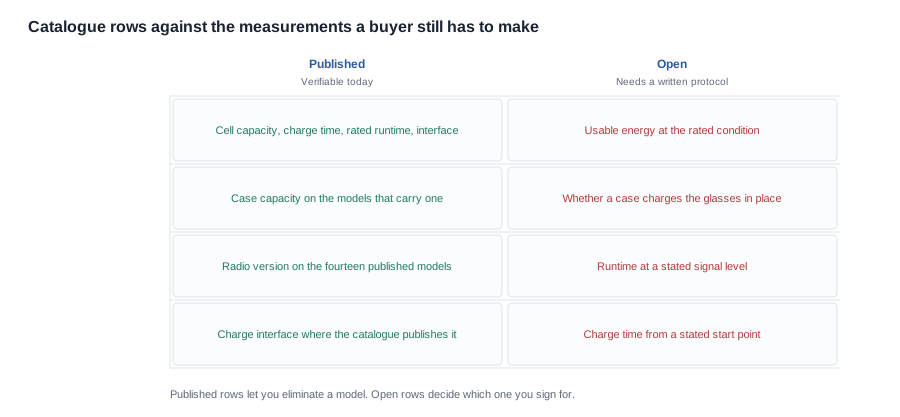
The electrical rows in this catalogue are published as the manufacturer states them, and the things which are not stated are marked as not stated rather than estimated. We publish the rated runtime, the charge time, the cell configuration, the charging interface and, on the models that carry one, the case capacity. We publish no test condition behind any runtime, no usable capacity, no cycle life and no charge curve for any model, and we will not fill those rows with values taken from other products.
That is a deliberate choice, and it has a practical consequence for a buyer: the published rows are a screen, and the open rows are the specification. A screen eliminates models. A specification decides between the two that remain, and it has to be written in the buyer's own terms because the seller's terms are the ones the buyer is trying to test.
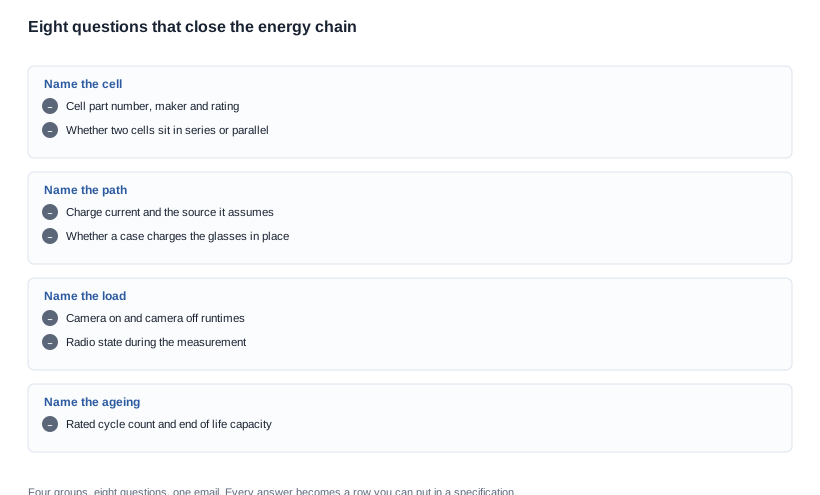
The eight-question checklist is grouped by the part of the chain it closes. Four concern the cell: the part number and its rating, and how the two cells in a dual-cell model are arranged. Two concern the path: the charge current and the source it assumes, and whether a case charges the glasses in place. Two concern the load: a camera-on and a camera-off runtime, and the radio state during the measurement. One concerns ageing: the rated cycle count and the expected end-of-life capacity.
The questions to ask are the same for every model, in the same words, which is deliberate. A supplier who answers the same question consistently across models has a measurement process, and a supplier whose answers vary in detail between models is quoting from a document. Which model you choose on the published rows is a separate decision, and it should be made after the answers arrive rather than before.
Eight questions, one email, and every answer becomes a line in a specification that a supplier cannot reinterpret later. The cost of sending them is close to zero. The cost of not sending them is a returns rate nobody can explain and a warranty term written against a number that was never a measurement.
Three red flags tell a buyer that the chain behind a quotation has not been walked. The first is a runtime figure with no condition, which means the supplier is quoting a catalogue value rather than a measurement. The second is a capacity figure presented as a duration, which means the model was compared on the wrong row. The third is a case capacity offered without a recharge count, which means the accessory was costed but not tested. None of the three is disqualifying on its own, and all three are cheap to close before you order.
When to escalate from a screen to a full evaluation is a straightforward judgment. A screen is enough when two models differ by a factor in the published capacity and the workload is light, because the larger cell wins under almost any load. It is not enough when the models sit in the same tier, as the camera models mostly do, or when the workload is heavy enough that the load dominates the capacity. In those cases the trade-offs are between the load, the case and the interface, and none of them is visible in the capacity row.
The total cost of getting this wrong is easy to understate, because it sits in three places at once. It sits in the returns column, where a product that meets its rating and fails the afternoon it was sold for becomes a replacement rather than a sale. It sits in the warranty file, where a term written against an unconditioned number has to be renegotiated after the first difficult quarter. And it sits in the commercial term, because a supplier who will not document the condition is telling you something about how the next negotiation will go.
What we will do with the same request is straightforward. Send us the models you are comparing, the workload the product will actually create, the destination market and the volume band, and we will tell you which rows of our catalogue apply to that workload, which of the eight questions our documentation can answer today, and which ones need a measurement on a sample. A buyer who is deciding whether to evaluate two models at all can start there: the answer to that question is usually the difference between a screen and a full evaluation, and it is cheaper to establish than a specification. The published rows are at smart glasses battery life and power, the interface and charge-time side is at charging solutions, and the method for producing your own number is at how to measure battery life. The wider view of what a specification sheet leaves out is at what the runtime spec sheet omits, and the transport file that has to travel with the order is at battery transport and certification.
Related reading
- How to measure battery life
- What the runtime spec sheet omits
- Charging solutions and interfaces
- Battery transport and certification
Tell us the load profile your users create and we will say which questions are already answered for you.


