

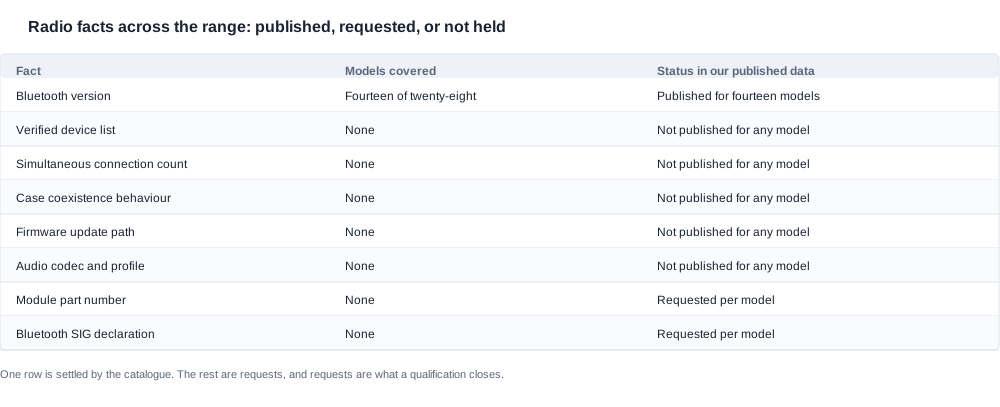
Smart glasses bluetooth version smart glasses advanced considerations matter at fleet scale and barely matter at sample scale, because the version number is a product of a chip and a stack, and the things that actually break at volume are the things that live above it. Our published position is narrow: Bluetooth 5.3 on the K01 and the K02, and Bluetooth 5.4 on the D11, the D12, the LC-105-1, the LC-105-2, the G07, the YK12, the YKC02, the D17, the ZH12, the A07, the AR glasses entry and the AI electrochromic entry.
Everything else in this area is a question rather than a fact. The verified device list is not published for any model. The coexistence behaviour of the product and its charging case is not published. The number of simultaneous devices is not published. Whether the audio profile is a given codec is not published. And the Bluetooth SIG qualification, which is a trademark matter and not a regulatory approval, is a separate thing from the radio approval that every product in this category needs. The SIG certification discussion is the right place to understand that separation.
Smart glasses bluetooth version: four questions after the first shipment
Everything in this article belongs to the second half of a programme, after the first units are in the field and before the fleet grows. At sample scale, four questions can be deferred. At fleet scale, deferring them becomes the main source of radio-related cost.
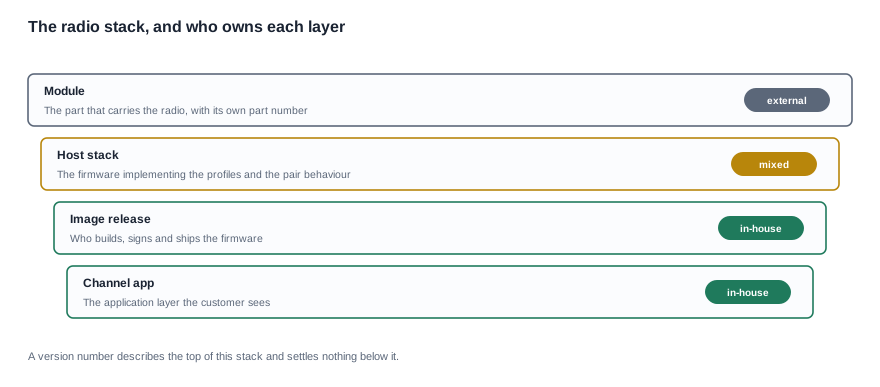
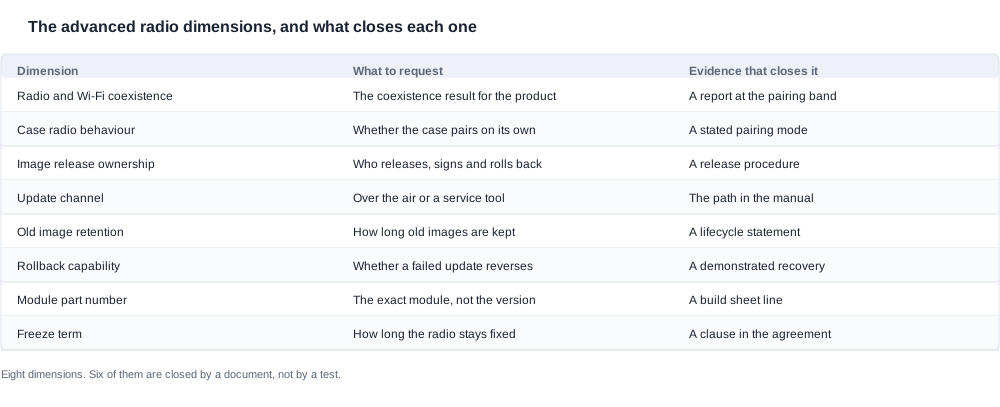
The first is coexistence. Does the product hold a stable connection in an environment where a Wi-Fi network is running in the same band? A bench test in a quiet room settles nothing about a retail floor on a Saturday or a warehouse with a dozen access points. Coexistence is a property of the module, the antenna and the host stack together, and it is not visible in the version number.
The second is the second radio. A product that ships with a charging case can put two devices from the same model into the same environment, and at volume the question becomes whether the case competes with the device for the same spectrum, whether it pairs on its own, and whether the case is a separate identity in the customer's device list. Our published case capacities are 900, 1200 and 1400 mAh, and the case's own radio behaviour and connection count are not published for any model.
The third is who owns the update. When a firmware image is released at fleet scale, the question stops being technical and becomes an organisational one: who decides, who signs, who tells the customer, and what happens when an image goes wrong. A product with no stated release policy is a product whose behaviour can change without notice.
The fourth is the freeze. The version you quoted, sampled, approved and listed is the version that has to remain available for the life of the channel. Every component change above the radio — a different module, a different stack, a different release cadence — is a potential break in that freeze, and each one needs a decision rule rather than a reaction.
Underneath all four questions sits a piece of work that is easy to postpone and expensive to postpone: the device list. The exact phone and tablet models your customers run, with the operating system versions in the field, is the input to every radio qualification a supplier will run for you, and it is also the input to the one you run yourself. Build it before the first sample arrives rather than after the first complaint, because the list that exists at the time of a problem is a list built from the problem. A shortlist of four or five device models with their operating system versions is enough to start, and it is the artefact that turns a compatibility statement into a test result.

The charging case is a second radio, and coexistence has to be designed for
The case is usually treated as an accessory and it is actually a second product with a second radio, and the two are designed together whether or not anybody says so.
The practical consequences follow one after another. The case has an identity in the customer's device list, which means it has a name, and a name at fleet scale becomes an operational identifier rather than a label — how a warehouse finds a unit, how a support agent identifies a product, how a customer tells two devices apart. The Bluetooth naming engineering discussion covers what has to be settled before a name is chosen, and it is worth reading before the naming is locked rather than after.
Second, the case and the device may or may not pair independently. If the case presents itself as a separate Bluetooth identity, the customer sees two entries and the support script has to explain both. If it does not, the case is invisible and the customer experience is simpler. The published data does not say which happens for any model, and the answer determines how much support material you have to write.
Third, and most easily missed, the case is physically close to the device. A radio in a pocket next to a radio on a head is a two-node coexistence problem, and it is a different problem from a device coexisting with a phone in a hand. The number of published case configurations in our range reflects that the case is a real part of the product, not packaging.
What to request, specifically: whether the case has its own Bluetooth identity, whether it pairs independently of the device, how many connections each of them holds, and whether the case's radio is active while the device is on the head. These are four short questions with four short answers, and they are the difference between a support script that works and a support script that improvises.
The same four answers decide how the product is presented in the listing, which is a commercial consequence rather than a technical one. A two-identity product needs a two-identity instruction set, a two-identity support script and a two-identity troubleshooting flow, and each of those is written once and maintained for the life of the product. Buyers who underestimate this discover the cost at the moment the first customer cannot tell which of the two entries in the device list is theirs. Asking the four questions before the copy is written costs a week; asking them after costs a revision of the packaging, the manual and the support material.
Who owns the firmware update, and what that costs at fleet scale
Firmware distribution becomes a fleet operation the moment a customer has more than one unit, and the operation is owned by somebody whether or not that somebody has agreed to it. The question is whether you find out before or after the first bad release.

Who builds the image. In a private-label programme this is usually the factory, and the buyer needs to know how a release is requested, how it is scoped, and what the lead time is between the request and the release. A release cadence that is not written down is a release cadence that is decided by whoever is busiest.
Who signs it. The image that carries the radio is part of the conformity position, and the Bluetooth SIG qualification covers the design. An image that changes the radio behaviour without being recorded against that declaration creates a documentation gap that surfaces at the next audit rather than at the next release.
Who tells the customer. At volume, a release that lands on a customer who was not told is a support incident. The notification route has to exist before the release, and it has to name the owner.
What happens when the release is bad. This is the question that most often has no answer. A failed update that leaves a unit unpairable is a field-return event, and the recovery mechanism has to be proven rather than assumed: whether the previous image is still reachable, whether the unit can be recovered over the same radio, whether a service tool is required, and how many units a single recovery takes. A fleet programme that has never tested a failed update has not tested its update path.
What the mixed fleet looks like. A fleet running several image levels is not a failure, it is a state to be managed, and the state has to be describable. Which images are in the field, which are supported, and how long each will be supported are three questions that have to be answerable from a list rather than from memory. The SIG checklist covers the qualification side that a product must clear before the mark can be used at all.
The checklist for this section is short, and it is worth writing it into the agreement rather than into a project plan. One: the current image on every unit in the field is known and recorded. Two: there is a named owner for each future release. Three: the previous image stays retrievable for a stated period. Four: a release that changes radio behaviour is recorded against the qualification. Five: a failed release has a recovery procedure and an owner. Six: the fleet state can be reported on request. Six rows, and every one of them is answerable by a supplier who takes the update path seriously, which makes them a reasonable due diligence question rather than an unreasonable demand.

Version freeze: the risk of a radio claim that expires
A radio version quoted in a specification is a commitment, whether or not anybody wrote it that way. The commitment is that the version stays available for the life of the programme, and it is the commitment most likely to be broken by accident.
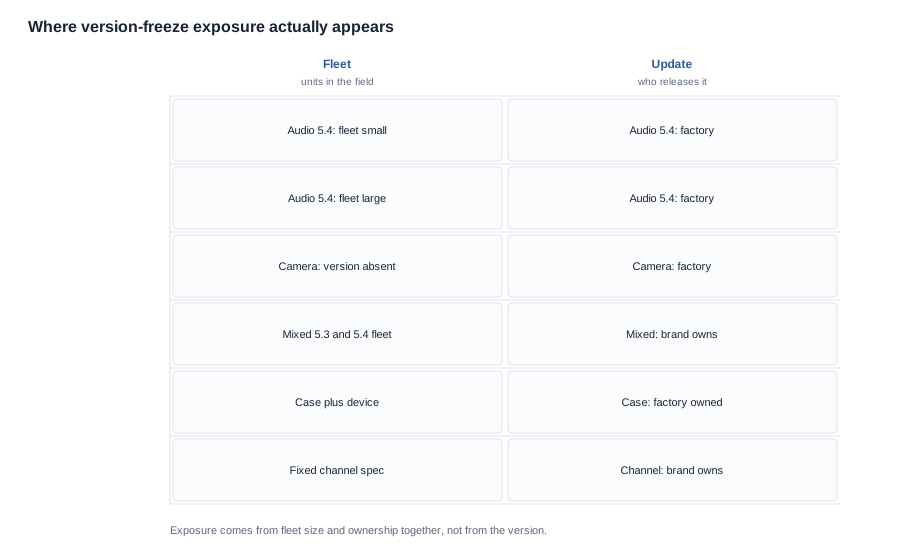
The exposure has two axes. One is fleet size: a programme with forty units in the field can absorb a radio change; a programme with four thousand cannot, because the change either happens to every unit or to none. The other is ownership: when the factory owns the image, a radio change is a scheduling decision the buyer sees coming; when the brand owns the image and the factory owns the module, a radio change can arrive as a component substitution with no announcement at all. The matrix above sets the two axes against each other, and the reading is straightforward: the risk lives in the large-fleet rows and in the mixed-fleet row, and it is smallest where the fleet is small and the factory owns the release.
The specific mechanisms that break a freeze. A module substitution, where the part number changes and the version string stays the same, which is why a build sheet line beats a version number. A stack upgrade, where the host firmware changes and the radio behaviour changes with it. A component end-of-life notice, which arrives as a procurement problem and becomes a qualification problem. And a regulatory-driven change, where the assessment behind the radio changes and the evidence has to be reissued.
The commercial exposure. A freeze break is expensive in a specific way: it is not the re-qualification that costs, it is the channel. A listing that promised a radio generation and delivered another one is a listing that has to be withdrawn, and the inventory behind it is inventory that no longer has a market position. Which is why the freeze belongs in the agreement, with a notice obligation and a defined period, rather than in the supplier's good intentions.
Choosing the length of the freeze term is a trade-off with a clear structure. A short term gives the supplier freedom and gives the buyer a shorter exposure window; a long term gives the buyer a stable channel and gives the supplier a constraint they will price. The question to ask before you order is not what the supplier can offer but what the channel actually needs: for a product with a two-year replacement cycle, the freeze has to cover the cycle, and anything shorter means the product is designed to be withdrawn mid-life. Signs that a term is too short are easy to spot — a term shorter than the channel's own replacement cycle, or a freeze that covers the radio but not the firmware that drives it.

Building a downgrade path before the fleet needs one
The downgrade question is the one nobody asks in advance, and the reason to ask it in advance is that the answer determines how much it costs to build.
A downgrade path means the ability to return a unit to a known-good state when a release has gone wrong, and there are three levels of it. The image level, where the previous firmware remains retrievable and installable, which requires the factory to retain old images and to keep the tooling to build them. The module level, where the radio hardware can be replaced rather than the software, which requires the board to be serviceable and the part to be available. The product level, where the unit is replaced with one from a later batch, which is the fallback of last resort and the most expensive one because it is the only one that works when the hardware itself is the problem.
The cost of each level is different in kind. Keeping old images costs storage and a release procedure that covers them. A serviceable board costs a design decision that is much cheaper at the start of a programme than at the end of it. A replacement buffer costs inventory and a logistics plan.
The question to put to a supplier is therefore not "can you roll back" but "at what level, and with what retained". A supplier who answers with a level and a retention period has a plan. A supplier who answers "yes" has a hope. And a programme that has decided its downgrade level before it needs it has also decided how much of its own release risk it is carrying, which is the first step towards carrying less of it.
The way to settle it is a single deliberate test, and it is worth doing once on a sample set before it is done accidentally on a customer. Take a unit on the current image, attempt an update, and deliberately interrupt it. Then attempt the recovery and record what it takes: how long, which tools, and whether the unit comes back to the same radio behaviour it had before. The three outcomes are all useful. A clean recovery tells you the image level is sufficient. A recovery that needs a service tool tells you the module level is not available and the product level is your fallback. A unit that does not recover tells you that a release failure is a replacement event, and that number belongs in the total cost of every future release.
What the published version rows do and do not settle
The working rule we apply: we publish the Bluetooth version per model, which is a durable fact about the radio, and we do not publish a verified device list, a simultaneous connection count, a case coexistence behaviour or an audio profile, because we do not hold them for any model.
The published rows cover fourteen of the twenty-eight models in the catalogue. The K01 and the K02 publish 5.3, and the D11, the D12, the LC-105-1, the LC-105-2, the G07, the YK12, the YKC02, the D17, the ZH12, the A07, the AR glasses entry and the AI electrochromic entry publish 5.4. The other fourteen publish no version at all, and the largest group among them is the eleven camera models — the MT6 and the V03 Pro, the V03 and the CY05, the CY03 and the MT5, the L1 Pro and the V06, the KY06 and the L2 Utral, and the S7 — together with the A05, the A06 and the bone conduction entry.
That split is the most consequential fact in this article, and it is easy to read past. A row with no published version is not a row with a low version. It is a row that has to be requested, and a programme that treats an unpublished row as a blank to be filled in by assumption is building its freeze on a number nobody wrote down.
Two further observations on what the rows do settle. The first is that in our range the version corresponds to no other published product difference — not to the cell capacity, not to the charging interface, not to the hours figure. The 5.3 pair and the 5.4 group differ in their radio generation and in nothing else the catalogue records, which means the version is a fact to be filed rather than a criterion to be ranked on. The second is that the version says nothing about the features buyers associate with it. The practical benefits of a newer generation generally arrive as separate capabilities, and each of those has to be evidenced separately rather than inferred from the version string.
We will also be direct that a version number is not a quality claim. What we will do is run a fleet test on a sample set against your device list and your environment, and publish the result in the form you need to defend it later.
One request list is worth having ready before the first conversation, because it determines the quality of the answer. Ask for the module part number, the host stack version, the profile list, the codec list, the simultaneous connection count, the case pairing behaviour, the release procedure, the image retention period, the rollback capability, the Bluetooth SIG declaration identifier for the model, and the model designations named on the conformity documents. Eleven items, and the last one is the one that catches a substitution. When a supplier answers all eleven, you have enough to write a specification. When a supplier answers two, you have learned what kind of relationship the programme is going to be.
Related reading
- The separation between the trademark and the radio approval — SIG certification difference
- What has to be settled before a name is locked — Bluetooth naming engineering
- The qualification side a product clears — SIG certification checklist
- Where radio behaviour shows up first — office use case
Send the device list, the environment, the fleet size and the case configuration, and we will tell you what a sample set can settle and what has to be qualified in the field.


