

The Bluetooth version is the specification row in this category that gets quoted most confidently and understood least, and the misunderstanding is expensive in a specific way: it costs money when a product is specified on the version, and it costs a market when a market is specified on the version. Those are two different failures with two different remedies, and a buyer who cannot tell them apart will apply the wrong correction to both.
Our published data shows how little the version actually tracks. Bluetooth 5.3 appears on the K01 and the K02 in the audio tier, and Bluetooth 5.4 appears on the YK12 and the D11, the ZH12 and the LC-105-2, the D17 and the YKC02, the A07 and the LC-105-1, and the G07 and the D12, the AR entry and the light-responsive entry. Eleven camera platforms, the A05, the A06 and the bone conduction entry publish none at all. Within the tier that does publish a version, the row separates no product from any other.
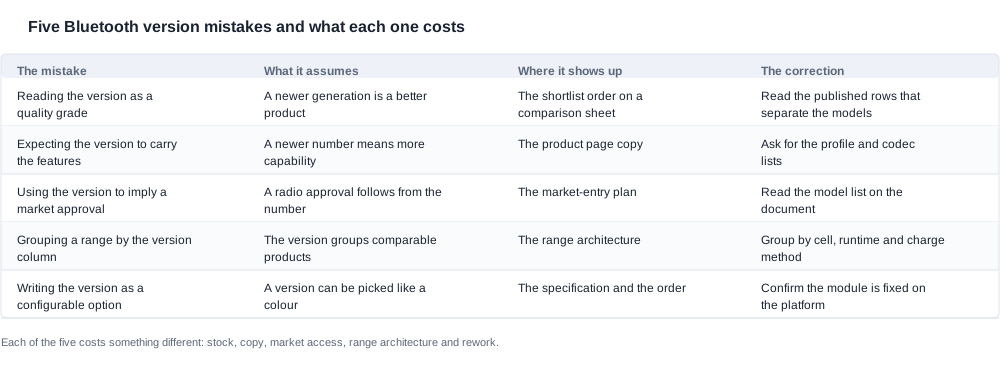
So smart glasses bluetooth version smart glasses common mistakes is best read as a costing exercise rather than a list of warnings. Each of the five mistakes below is given the price it actually charges, because a mistake with a price attached gets corrected and a mistake described as a risk does not.
Smart glasses Bluetooth version: mistake one, reading a generation as a grade
A buyer sees 5.4 on one model and 5.3 on another and infers that one is newer and therefore better. The inference is not supported by anything, because the version tracks the radio module the manufacturer chose to build on, which is usually a procurement decision made years ago rather than an engineering preference made for your product.
Concretely, in our own catalogue: the K01 and the K02 sit on 5.3, while the LC-105-1 and the LC-105-2, and the G07 and the YK12 — the same tier, the same dual-cell configurations at 55 mAh × 2 against 90 mAh × 2, the same magnetic charging — sit on 5.4. There is no product difference that explains the split, and the only explanation available is the platform the factory had already standardised on.
What it costs: stock. A shortlist ordered by version is a shortlist ordered by the manufacturer's procurement history, so the buyer has silently imported somebody else's decision into their own range architecture. The cost lands later, when the range turns out to have an unwanted duplicate in it, or when the two models that were meant to cover different price points turn out to cover the same one. Nothing announces this at the quotation stage.
How to prevent it: apply a filter that the version cannot pass. Ask what would have to be different about a product for a buyer to choose it over another, and check that the answer corresponds to a row you can see. For an audio platform those rows are the cell configuration, the rated runtime, the case capacity and the charging interface. If a decision cannot be defended on one of those, the version is not what is being decided.
The red flag to watch for: a supplier comparison sheet in which the highest-ranked product is also the one with the highest version number, and no other column explains the ordering. That sheet has ranked a procurement decision and presented it as a technical evaluation.
Mistake two: expecting the version to deliver a feature list
It is commonly assumed that a newer generation brings longer range, faster connection, better power efficiency, multi-device support and, more recently, the newer audio sharing and broadcast profiles. None of that follows from the version number alone, because the version describes what the radio controller is capable of in principle, while the features are implemented in the firmware, the host device and the application.
The version sets a ceiling. It does not fill the room. A product on a newer generation with no codec support is a product with no codec support, and a product whose firmware has not been written to negotiate a second connection is a single-connection product no matter what its radio could do.
What it costs: copy, and then returns. A product page built on the version makes an implied claim — that the product has the capabilities associated with the generation — and a customer who tests the product will find that the claim was made by the page rather than by the product. The result is a listing that has to be withdrawn, a stock of packaging that has to be reprinted, and a support script that has to answer a question the buyer's own marketing created.
How to prevent it: replace every version-derived claim with a feature that can be demonstrated. If the page is going to say something about the radio, the sentence has to be about the profile the product negotiates, the codec it carries, or the number of devices it holds. If none of those is published, the sentence should be one line of fact with no claim attached, and the line belongs in the specification annex rather than in the marketing copy.
The red flag to watch for: a competitor's listing making a claim from the version, and a plan to match it. Matching a claim requires evidence the buyer does not have, and the resulting product page will fail the first time a customer or a marketplace reviewer tests it.
Mistake three: using a version to imply a market approval
This is the expensive one, because it is the mistake that does not show up until the product is in a customs queue.
A buyer specifies a product for a market on the basis of the radio version, and the position is not what they thought. The radio version and the conformity route are related but not equivalent. In the European Union the Radio Equipment Directive (EU) 2014/53/EU applies to radio equipment, with the EN 18031 harmonised standards cited into it covering the cybersecurity requirements, in three categories: internet-connected radio equipment, radio equipment processing personal data, and radio equipment enabling the transfer of money or virtual currency. A wearable with a microphone and an application falls into the personal-data category. In the United States, FCC equipment authorisation covers the radio as a separate framework. In the United Kingdom, UKCA applies with a framework that has diverged from the European one. None of these positions is determined by the version number.
What it costs: a market, and possibly a shipment. The failure surfaces at the border, at a customs inspection, or in a post-market compliance check, and at every one of those points the remedy is a document that did not exist when the product was loaded. A unit held in a customs queue is a unit that has already been paid for, shipped, and written off as a sale.
How to prevent it: make the model list the only route to a market decision. The question is never "what version is this" but "which model designations are named on the approval document for this destination". The version stays in the technical file as a fact about the radio; the market decision is made from a document.
The red flag to watch for: a market plan in which the radio is the only thing named against each destination. If the plan says "5.4 for Europe, 5.4 for the US", it has no compliance content at all, and a version number is the only entry in the column because no document was ever requested.
The category follows the function, and the function can move with the software
There is a further trap inside this mistake, and it is the one that catches programmes that believe their radio documentation is already complete. The EN 18031 classification is determined by what the product does, not by the radio it carries and not by the version. A wearable with a microphone and an application falls into the personal-data category, and the evidence for that classification is normally a technical file describing the software's data handling, not a certificate describing the radio.
The consequence for a buyer is that the classification can move during the life of a programme without the radio changing at all. A firmware release that introduces a cloud account, a voice assistant that forwards audio, or a companion application that registers with a service can change what the product does with personal data, and therefore what the technical file has to demonstrate. A version number is completely blind to that, because the radio is exactly the part that did not change.
The practical instruction is to fix the classification against a stated software baseline, and to make any change to that baseline a trigger for a review of the file. The baseline is the firmware build and the application version that the evidence was gathered against, which is a second reason to record the build identifier on every sample and on every incoming inspection. A document that says the product is compliant, without saying which software it was compliant as, does not survive a product update.

Mistake four: grouping a range by the version column
This mistake appears in ranges rather than in single products, and it produces a range that is internally inconsistent.
If the K01 and the K02 are both 5.3 and the LC-105-1 and the LC-105-2 are both 5.4, a buyer building a range who assumes the version groups the models will make two errors at once. They will group products that are not otherwise similar — the K01 and the K02 carry 90 mAh × 2 cells while the LC-105 pair carries 55 mAh × 2, and their rated runtimes are on different terms — and they will miss that the version correlates with nothing in the published rows.
The published rows that do distinguish the models are the cell configurations, the runtimes, the charging interface, the case and the camera tier. The Bluetooth version is not one of them. A range built on the version column is therefore a range built on one of the two published numbers, and the buyer has chosen the one column that does not carry the product difference.
What it costs: the range architecture, and then the tooling. A range whose logic cannot be stated in one sentence is a range where the buyer has to justify each pair separately to a channel partner, and where the number of distinct configurations grows faster than the number of products. Every extra configuration carries its own minimum order quantity, its own packaging, its own artwork and its own firmware build.
How to prevent it: rebuild the range logic on the electrical rows and on the use case, and treat the version as a footnote in the range table rather than as the column that heads it. If the range has four models, the four should differ in something a customer can be told about.
The red flag to watch for: a range plan in which the product line-up cannot be described without mentioning the radio generation. That is a sign that the generation is doing work that a customer-facing attribute should be doing.

Mistake five: writing a version into the specification as if it were configurable
A buyer who wants to specify a version for a market should establish whether that is even possible on the platform, and the honest answer is usually that the radio module is fixed. A version change is a new product rather than a configuration, and it carries a new certification route, a new trademark qualification, a new firmware baseline and a new bill of materials.
The consequence is that a version requirement in a specification is a product requirement, and a product requirement that the platform cannot meet becomes a negotiation with the factory about whether to build something new. The buyer usually discovers this at the quotation stage, when the price and the lead time move, and by then the requirement has already been circulated internally and may have reached a channel partner.
What it costs: rework, and a lead time that was never planned. A version change deep in a programme rewrites the schedule rather than the specification, because the radio approval and the qualification have their own elapsed times that no amount of factory capacity shortens.
How to prevent it: confirm the fixedness of the module in writing before the specification is issued, and if the requirement is a preference rather than a law, write it as a preference. "Bluetooth 5.4 or later" is a requirement the platform can usually meet. "Bluetooth 5.3" as a line in a spec for a platform that ships 5.4 is a contradiction the buyer will have to withdraw.
The red flag to watch for: a specification that lists a version as one item among a list of configurable attributes — colour, capacity, packaging — without anyone having established that it is configurable at all.
The five corrections, and what each one is worth
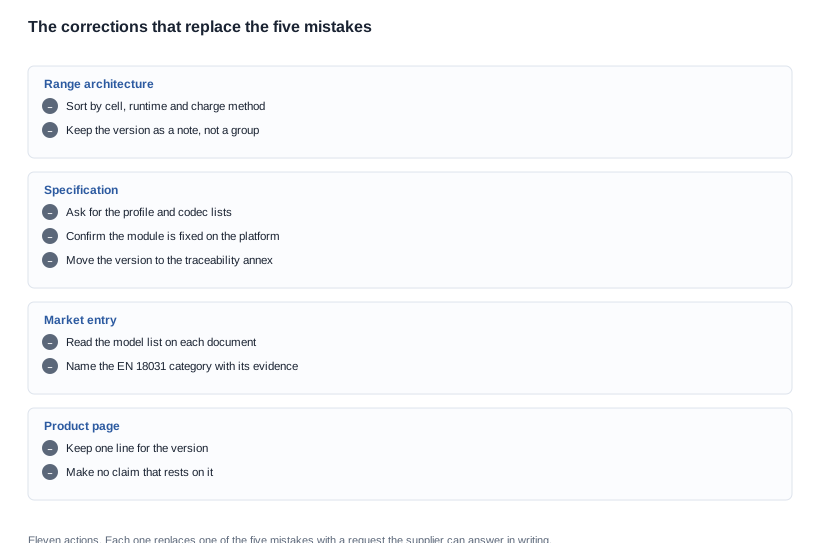
The five corrections below are ordered by the size of the cost each one prevents, not by the order in which the mistakes appear above. Together they are about half a day of work, and they are the difference between a specification that can be defended and one that cannot.
Correct the range architecture first, because it is the cheapest to fix and the most expensive to leave. Re-sort the range on the cell configuration, the rated runtime, the charging interface and the case capacity, and confirm that every pair of adjacent models differs in something a customer can be told about. This is the correction that stops the mistake from propagating into tooling, packaging and firmware.
Correct the market plan second, because it has the longest tail. Build the one-page model list matrix — one row per model designation, one column per destination market, each cell holding a document reference or a stated gap — and treat every gap as an open action with a name against it. This is the correction that prevents a shipment being held.
Correct the product page copy third, because it is cheap and it is visible. Keep one line for the version, attach no claim to it, and check the page against the features that can actually be demonstrated. Where a claim was built on the generation, replace it with a profile, a codec or a device count, or remove it.
Correct the specification fourth. Move the version out of the requirements and into the traceability annex, confirm in writing that the radio module is fixed on the platform, and add a change-control clause that sets out what happens if the module is ever substituted: who authorises it, what written notice the buyer receives, and who pays for the re-test.
Correct the evaluation matrix last, because it is the least visible and the most persistent. Delete the version column, replace it with the four rows it was standing in for — the profile list, the codec list, the transmit power and the antenna configuration — and put a rule in the template that a row which cannot change a decision does not get a column. The reason this one goes last is that it is the one most likely to be rebuilt from habit at the next quotation, which is why it needs a rule rather than a correction.

Running the five corrections in the right order
The order above is deliberate, and the reason is that the five mistakes do not cost the same amount to leave in place for the same amount of time. The range architecture is the cheapest to correct and the most expensive to leave, because it propagates into tooling, packaging, firmware builds and the minimum order quantity of every configuration. The market plan has the longest tail, because a gap in it is discovered at a border rather than at a desk, and the remedy then involves a document that has to be produced from scratch. The product page copy is visible and cheap but it is also the correction most likely to be reversed by the next person who drafts a listing. The specification is the correction that binds, because it turns a preference into an obligation. The evaluation matrix is the least visible and the most persistent, since it is rebuilt from habit at every quotation round.
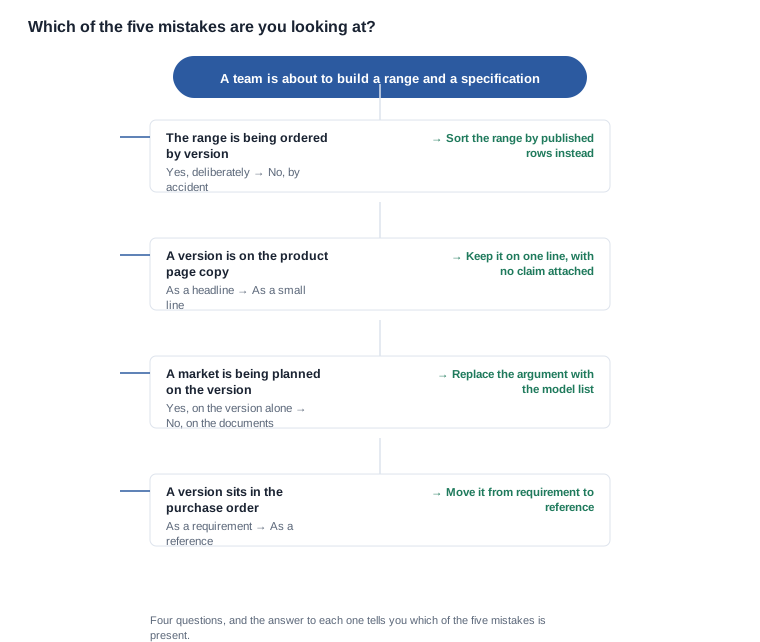
A practical sequence for a team that has found one or more of these in an existing programme is therefore: re-sort the range and freeze it, build the model list matrix and put names against the gaps, then correct the copy and the specification together so that the two do not disagree, and finally add a rule to the evaluation template so the matrix is not rebuilt the same way again. The one thing not to do is correct the copy first, because copy is the easiest to change and the easiest to change back, and a programme that fixes the visible part and leaves the range logic untouched will have the same five mistakes a year later with a newer set of model numbers.
What we publish, and what we will not put in a comparison
It is worth being precise: we publish the Bluetooth version accurately for each model — 5.3 on the K01 and the K02, 5.4 on the A07, the D11, the D12, the LC-105-1, the LC-105-2, the G07, the YK12, the YKC02, the D17, the ZH12, the AR entry and the light-responsive entry, and nothing at all for the eleven camera platforms, the A05, the A06 or the bone conduction entry — and we will not present the version as a quality indicator, because it does not track any product difference in our published data.
We will also not tell you a product is compliant in a market on the basis of its radio version, because the conformity position is determined by the route, by the model list printed on the document and by the product's function. And we will not publish a transmit power, an antenna configuration, a profile list or a codec list for any model in this range, because none is published to us and a typical figure is not a figure you can put into an acceptance criterion.
What we will do is give you the published configuration accurately, tell you which published rows differ between the models you are comparing, and tell you which of the radio questions have to be answered by a test on your own units. If you send the models, the destinations and the quantities, we will say which of the five mistakes above your programme is closest to making, and which of the two failure modes — the one that costs money and the one that costs a market — is the likelier one.
Related reading
- Bluetooth connectivity and versions
- Bluetooth SIG compliance
- How to test before ordering
- Bluetooth audio glasses range
Send the models and the markets and we will say which published rows differ between them.


