

Smart glasses Bluetooth version: what to test instead
A Bluetooth version is the one row in a smart glasses specification that cannot be tested, and a buyer who builds an evaluation plan around it will spend a week discovering that the plan has nothing to measure. The version tells you which generation of the protocol the radio implements. It does not tell you which profile the device negotiates, which codec it selects, how far it reaches with a body between the transmitter and the receiver, whether it holds two connections, or what a customer sees when the pairing fails. Those are the behaviours a customer experiences, and they are the ones that decide whether a product works in the market you are selling into.
The decision, in three sentences. Do not design a pre-order test around the Bluetooth version; design it around the oldest host device your customers own, because that handset sets the compatibility floor that everything else is measured against. Then test five behaviours — the pairing flow including its failure path, the profile negotiation, the codec negotiation, the range with the device worn rather than on a table, and the multi-device behaviour. If you cannot get a supplier to name the default profile and codec in writing, treat the version as an unverified claim and plan a sample round before you commit, because in our published data the version tracks no product difference at all.
Who is running this evaluation, and what it has to protect. The reader is a brand-side or channel buyer who is about to commit to a configuration whose radio has been described by a generation number, and who is often doing so because a competing listing mentioned a version. What the buyer is protecting is a return rate in a market whose handset mix is older than the one the development team happens to own, and a support cost when a customer cannot pair. The evaluation has to produce a written pass condition per behaviour, and those conditions have to be able to end up in the purchase order, because a compatibility problem found in the field is a refund, a listing edit and a batch of unusable stock.
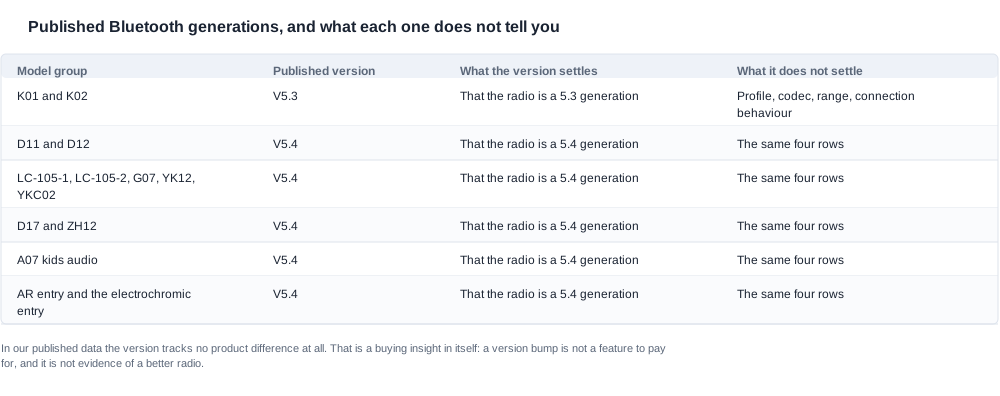
What our catalogue publishes, and where the version row is open. Bluetooth 5.3 is published on the K01 and the K02 in the audio tier. Bluetooth 5.4 is published on the D11, the D12, the LC-105-1, the LC-105-2, the G07, the YK12, the YKC02, the D17, the ZH12, the A07, the AR entry and the electrochromic entry. For the camera family, the bone conduction entry, the A05 and the A06, the radio version is not one of the published rows — which makes it a question to ask the factory rather than a fact to plan with, and that is a useful thing to know before the sample order rather than after it.
The rest of the published range is a set of electrical rows: cell configurations from 40 mAh up to 290 mAh, charge times of two hours or less with about one hour on the D17 and the ZH12, and rated runtimes of roughly five to eight hours in the camera tier, roughly six to eight in the audio tier and roughly twenty in the children's models. None of those rows tells you whether a customer's phone will find the device on the first attempt.
Where the negotiation room is in a connectivity decision. The radio itself is rarely the expensive part of the product, and a generation bump is almost never worth paying for on its own. The costs that matter are the ones around it: the number of host devices in the supported list, the localisation of the companion app, the certification route in each market, and the support cost of a customer who cannot recover a pairing. A buyer who negotiates the supported list, the app localisation and the pairing recovery experience is negotiating the lines that actually generate returns, and the unit price is the smallest of them.
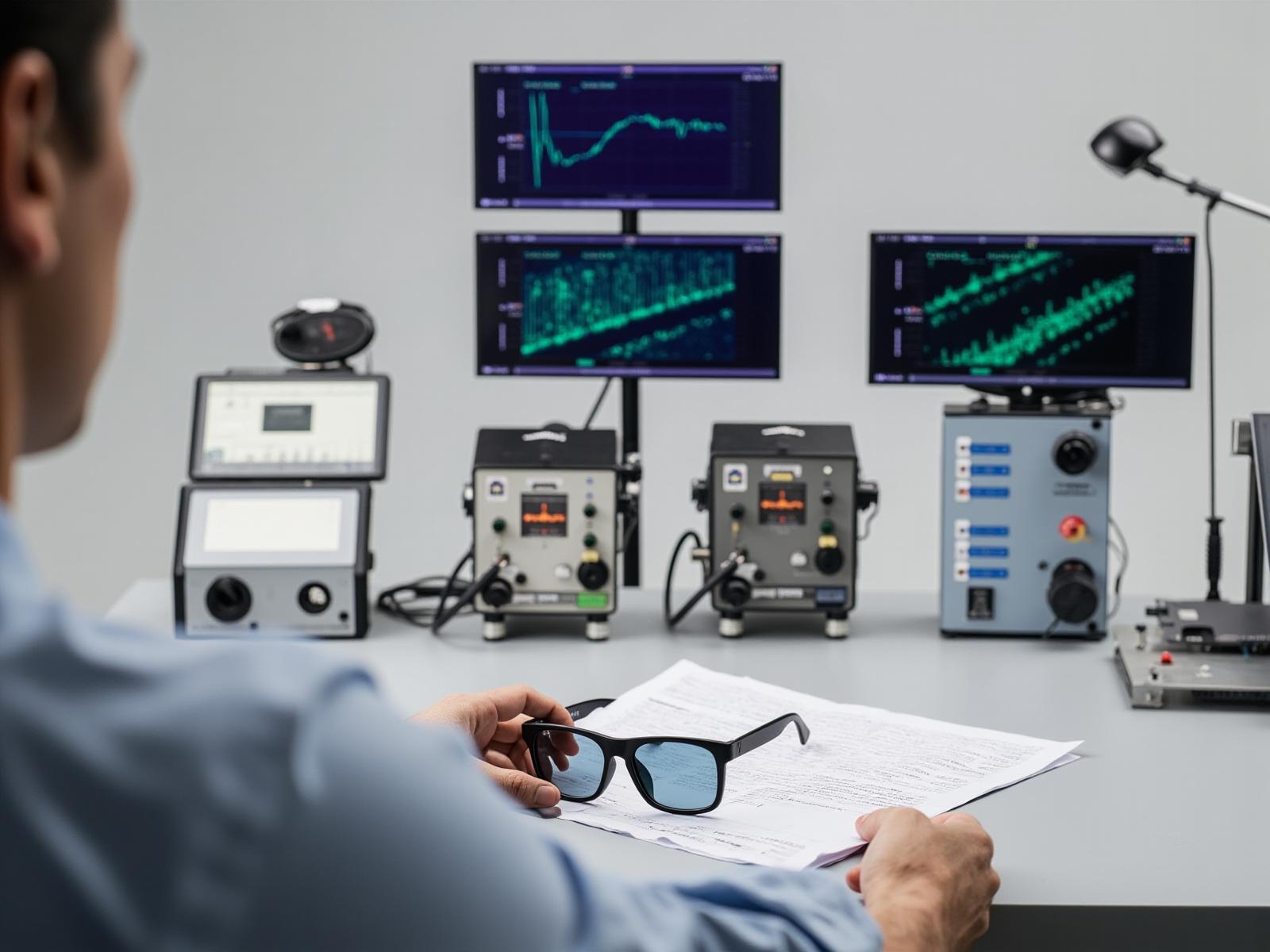
The five things to fix before the sample arrives
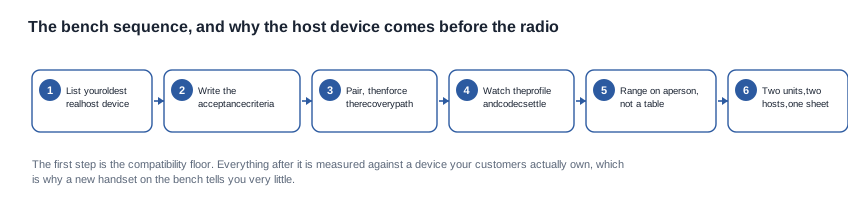
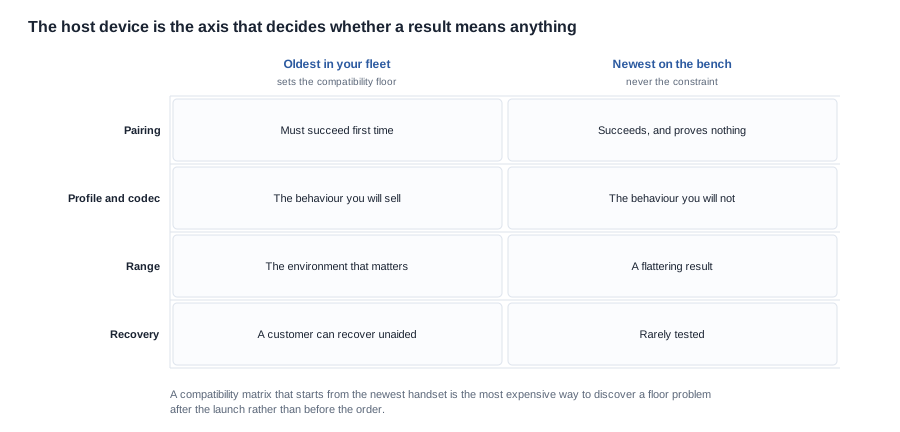
1. The host devices. List the actual phone models your customers use, not the newest one in the office. The compatibility floor is set by the oldest device in the fleet, and the radio version is what sets the floor, which is why the version matters — not as a feature but as a constraint. Ask the supplier to confirm against a specific list rather than against a marketing description of the protocol.
2. The acceptance criteria, written. Which profile you expect to be negotiated, which codecs you need, what range you need in which environment, and what a customer should see when the device cannot be found. A criterion written afterwards is a description of what happened, and it cannot be used to refuse a lot.
3. The environments. The office, the vehicle, the street, the warehouse, a dense urban market. Range and pairing behave differently in each, and a radio environment in a market with heavy cellular density is not the radio environment in a house. A criterion that does not name the environment is a criterion that will be argued about rather than applied.
4. The sample size, and the batches. One unit tells you whether it works. Two from different production runs tell you whether it works consistently, and a unit from a pre-production build tells you less than either.
5. Whether the sample is the production configuration. A firmware version, a cell configuration or a radio module difference changes the behaviour, and the difference is invisible from the outside. Ask for the configuration in writing and check it against the unit.
The four questions to ask the supplier, and the answers that matter
- Which profiles and codecs are supported, and which is negotiated by default? A product that supports a stereo profile and settles on hands-free behaves very differently in a call, and this is the most commonly missed finding in this category.
- What are the transmit power and the antenna configuration? These determine the range, and the version does not.
- What is the minimum host version, and what is the behaviour at that minimum? The behaviour at the floor is the thing a customer at the floor will experience.
- Is the radio module fixed across production runs, and does a change constitute a new product? This is the question that turns a change-control clause from a formality into a protection.
The answers that separate a supplier who controls the radio from one who is relaying a module sheet. A supplier who answers all four with specifics — a named profile list, a default, a transmit power class, a module part identity that is stable across runs — owns the design and can be held to it. A supplier who answers with a protocol generation has given you a row that was on the sheet before the order and that you could have read from a catalogue.
The two rows we do not publish for any model, and why they are the important ones. We do not publish the chipset, the profile list, the codec list, multipoint behaviour, range or the update method for any model in the range, and we will not estimate them. That is not a gap in the data so much as a statement of where the responsibility sits: the radio's behaviour is a property of a module and a firmware image, and the only way a buyer learns anything about it is to ask and then to measure.
The five tests to run, and what each one is for
Test one, the pairing flow, with the real phones, including the failure path. What happens when the phone cannot find the device, and whether a customer can recover from it without a manual. The failure path is the half of the test that almost nobody runs, and it is the half that generates support contacts.
Test two, the profile negotiation. Observe which profile the device settles on, in a call and in a media context, because the two are not always the same. A product that supports a stereo profile and negotiates the hands-free profile behaves very differently in a call, and a buyer who never looked will believe the product supports a calling experience the radio never actually offers.
Test three, the codec negotiation. What the platform actually selects, and what the audio path sounds like on a lossy connection. Record it, because a codec artefact heard once in a quiet room can be much worse on a busy network, and a codec that is selected on the phone rather than on the device is a variable the device does not control.
Test four, the range, on a person, in a real environment. Walk away from the phone with the device worn rather than placed on a table, because a body between the transmitter and the receiver changes the propagation, and a table-top range figure describes a use nobody has. Test through the relevant obstruction — a jacket, a seat, a door — and record the distance at which the audio breaks, in the environment the product will be used in.
Test five, the multi-device behaviour. Whether two connections are held, and how the switch happens. A fleet buyer will care about this and a retail customer will not, so the question of which buyer you are is worth settling before you spend a day on it.
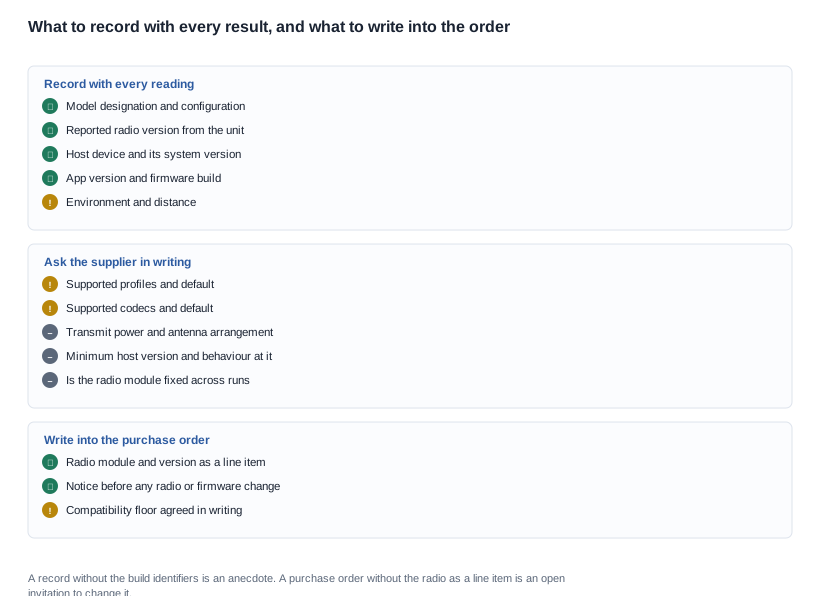
What to record with every result. The unit's model designation and configuration, the reported radio version as the unit itself reports it, the host device and its system version, the app version and the firmware build, the environment, the distance and the obstruction, the profile and codec as observed, and the tester. Without these a result is not repeatable and not comparable between suppliers, because two suppliers' "works fine" means two different things.
What these five tests cannot establish. They do not establish behaviour across a fleet, because a test on two devices is not a test on a fleet. They do not establish behaviour over the product's life, because firmware changes and app releases alter the experience and the release policy is not published in our range. They do not establish the compliance position, because the radio equipment route in each market applies whatever the version and the position comes from the documents. And they do not establish whether the published version matches the sample — that is a check rather than a test, and it is worth doing, because a mismatch is a substitution finding rather than a quality finding.

Where a connectivity programme goes wrong, and the early warning for each
The device works with the development team's handset and fails with the customer's. The symptom is a return cluster concentrated in one operating-system version or one handset model. The root cause is that the evaluation used a new device, so the compatibility floor was never probed. The prevention is to run the bench on the oldest device in the fleet, first.
The product supports a better profile than it negotiates, and nobody noticed for a year. The symptom is a persistent complaint that the call quality is poor, and a belief on the buyer's side that the hardware is at fault. The root cause is that the negotiated profile was never observed. The prevention is to record the profile in every result, and to make the default a line in the request for quotation.
The customer cannot recover a failed pairing and the ticket arrives as "it does not work". The symptom is a support load that is not really a support load, because the issue is a missing recovery path. The root cause is that the failure path was never tested. The prevention is to test the failure path deliberately, and to write the recovery behaviour into the listing and the quick-start card.
The radio changes after the order and the behaviour changes with it. The symptom is a shipped lot that behaves differently from the approved sample, with no fault to find. The root cause is that the radio module and the firmware image were never written into the order as identified components. The prevention is to make the radio module a line item, and to add a notice clause covering any change to it.
The version was used as a differentiator in the listing and it settled nothing. The symptom is a copy line that a customer tested and found meaningless, and a competitor's listing making the same claim. The root cause is that a protocol generation was treated as a performance attribute. The prevention is to delete the line, because in our published data the version tracks no product difference at all.
The compatibility floor was discovered in the field rather than on the bench. The symptom is a market-wide complaint pattern in the older handset segment. The root cause is that the supported list was never written down before the order. The prevention is to put the list in the purchase order, because a list in a purchase order is a commitment and a list in a slide is a hope.

What happens to your order when the radio changes
The radio module and the firmware image are the two lines worth putting on the request for quotation. Everything else in this article is measurement; these two are documentation, and documentation is what survives a supplier's internal change. A supplier who can name a stable module part identity and a firmware build for a configuration is telling you the configuration is repeatable, and that is the property a brand programme actually depends on.
A notice clause covering the radio and the firmware is cheap to write and expensive to obtain later. The clause should require notice before any change to the radio module, the firmware build that affects connectivity, or the companion app's pairing behaviour, with a re-test obligation attached. This is the same clause shape used in the AI and microphone categories, and it exists for the same reason: a change in the software or the module alters the observable behaviour without altering the model designation on the box.
The supported list is negotiable and is often more valuable than the version. A supplier who has tested against a longer list will say so; one who has not will say nothing. Asking for the list, and for the behaviour at the minimum host version, converts a vague compatibility claim into something the buyer's own listing can state.
The companion app is part of the connectivity product and is usually the weakest part of it. Localisation, the pairing recovery flow, the firmware update path and the permissions the app requests are all part of what the customer experiences, and each is a line in the request for quotation. A brand shipping into two markets should ask for the app's localisation status per market before the order rather than after the first complaint.
The radio certification calendar and the tooling line behave differently in a connectivity programme, and a buyer should be told which is which. The certification work follows the radio equipment route in each market, so its cost is per model and per market and its elapsed time is set by the testing body and the review queue; pressing on either produces a longer schedule rather than a shorter one. Tooling is a one-off cost usually amortised across the first order, and in a platform programme the useful question is over what volume it is amortised and what happens to the tooling if a second model on the same platform is never launched.
The documents to request before the deposit. The radio module and the firmware build identifiers for the configuration ordered. The profile and codec list with the defaults named. The minimum host version and the behaviour at it. The certificate numbers for the radio equipment route in each market, with the issuing body and the validity dates. The model designation written on the quotation. And the supported list, if one exists.
A worked compatibility plan for a brand shipping into two markets
A note on what follows: the case is constructed, it is not a client project, and it is written to show the sequence of choices rather than an outcome.
Assume a brand with a two-market plan, a fleet of companion-app installations across a mix of handsets, and a listing that currently mentions Bluetooth 5.4 as a feature. The brand's own hardware team believes the radio is the reason the product is competitive, and the commercial team has priced that belief into the target.
The first decision removes the premise. The brand reads its own published range and finds that the version tracks no product difference at all, so the listing line is deleted before anything else happens. That single edit takes the strongest-sounding feature in the pitch and converts the buying conversation into a question about behaviour, which is a question the brand can actually answer.
The second decision builds the host list. The brand pulls the operating-system and handset versions from its own app analytics, and finds that a meaningful share of its installed base is two handset generations behind the development team's devices. That list becomes the specification: the floor is the oldest device in the list, and the acceptance criteria are written against it.
The third decision is the request for quotation, with four questions. The supplier answers with a profile list and a named default, a codec list with the selection behaviour, a minimum host version with the behaviour at it, and a module part identity described as stable across production runs. Two of the three candidate suppliers cannot produce more than the protocol generation, and the brand removes them from the shortlist at that point rather than after a sample round.
The fourth step is the bench, on the floor device. The brand runs the pairing flow including its failure path, observes the negotiated profile in a call and in media playback, walks away with the device worn through a jacket, and holds two connections while a phone call comes in. The recovery path turns out to be the weakest point: the customer has to know a specific gesture to retry, and that gesture is not documented anywhere. The brand writes it into the quick-start card and asks for it in the app.
The fifth decision is the order. The brand puts the radio module and the firmware build into the purchase order as line items, attaches the acceptance criteria from the five tests, adds the notice clause, and holds a retention against the documentation package rather than against the price. It also asks for the supported list, and adds the requirement that the companion app be localised for the second market before the second delivery.
The sixth step is the launch copy. Instead of a version number, the listing states the platforms it is tested against, in a sentence a customer can check. The customer who reads it and finds their handset is not on the list does not become a return — they do not buy.
The result is a product with a smaller claim and a much lower support cost, and a supplier relationship that now has a written connectivity standard, which matters more if the brand adds a second model on the same platform later.
Where our radio records stop and the bench takes over
Stated plainly: we publish the Bluetooth version accurately for each model, and we will not present it as a quality indicator, because in our published data it tracks no product difference at all. We publish Bluetooth 5.3 on the K01 and the K02, and Bluetooth 5.4 on the D11, the D12, the LC-105-1, the LC-105-2, the G07, the YK12, the YKC02, the D17, the ZH12, the A07, the AR entry and the electrochromic entry; for the camera family, the bone conduction entry, the A05 and the A06, that row is open. We do not publish the chipset, the profile list, the codec list, multipoint behaviour, range or the update method for any model, and we will not estimate them.
We will also be direct that a test designed around the version will find nothing, because the version is a fact about the radio rather than a behaviour. The five tests above are the ones that answer the questions a buyer actually has, and we will help a buyer write the criteria for them.
Three things to settle before a radio is locked into the order
Send the host device list with the request for quotation, and ask for the behaviour at the minimum version. That single list is what turns a protocol generation into a compatibility floor, and it is the fastest way to find out whether a supplier has done the work.
Ask for the profile and codec defaults in writing, alongside the module part identity. Three answers, one email, and a supplier who cannot give all three is telling you the version on the sheet is the only thing they have.
Tell us the host devices and the environments, and we will say which of the five tests matters for your channel. The published rows are under Bluetooth connectivity and versions, the supplier questions are in Bluetooth version supplier verification, the criteria are in Bluetooth version buying checklist, and the range is at Bluetooth audio glasses.
Related reading
- Bluetooth connectivity and versions
- Bluetooth version supplier verification
- Bluetooth version buying checklist
- Bluetooth audio glasses range
Tell us the host devices and the environments and we will say which test matters.


