

Bluetooth version is the row every buyer asks about and the row that answers the fewest questions, which is a strange outcome for a specification that everyone thinks they understand. The reason is that the version describes the radio controller's capabilities, while almost every decision a buyer makes with it concerns something else.
The published data makes the oddity visible, and it is easier to see when you read the range by tier rather than as one long list. The audio tier splits down the middle: the K01 and the K02 carry 5.3, while the D12 and the LC-105-2, the YK12 and the LC-105-1, and the D11 and the G07 carry 5.4. The three sport models — the YKC02, the D17 and the ZH12 — carry 5.4 as well, and so do the A07, the AR entry and the light-responsive entry, which sit outside the audio tier altogether. That leaves a group of fourteen with no version on the row at all: the eleven camera platforms, the A05, the A06 and the bone conduction entry. So the number that every buyer reaches for first is absent from half the range, splits the other half in a place the published specifications never explain, and carries no visible relationship to the cell, the runtime or the charging method.
This guide is written for a buyer who has to write a radio specification for the first time and does not yet know which parts of the datasheet to read. The orientation it offers is not about judging the version. It is about knowing what the number is, what it decides, what it does not, and how to write a clause about it that will still be true in a year.
Smart glasses Bluetooth version: what the number is, in specification terms
A Bluetooth version number identifies a release of the Bluetooth specification. It describes the radio protocol: the physical layer, the link control, the logical transport, and the procedures and profiles that are available on top of them. A radio module in a product implements one version, and the version determines what that radio is capable of in principle.
That is the whole of it, and the sentence matters because everything a buyer wants to know falls outside it. The range, the connection stability, the latency, the codec support, the multi-device behaviour — each of these is either an implementation choice the manufacturer made, or a property of the host device and the application. The version sets a ceiling; it does not fill the room.
Three vocabulary items are worth having before reading anything else, because they are the ones that get confused with each other.
The generation. The number itself. 5.3 and 5.4 are the generations in our published range. A generation identifies a class of product, not a product.
The module. The physical part fitted inside the device. Two products both marked 5.4 can use entirely different silicon, and the module is the row that tells you what is actually inside. The module part number is the single most useful line on a radio datasheet, and it is the one most often absent.
The implementation. The combination of module, firmware, antenna and configuration that a qualification covers. It is a layer above both the generation and the module, and it is what the Bluetooth trademark qualification is tied to.
Once those three are separated, a lot of confusion resolves itself. A generation is a class, a module is a part, and an implementation is a build. A buyer who asks for a generation is asking for the weakest of the three answers.
Reading a supplier datasheet: four radio rows, and the order they appear in

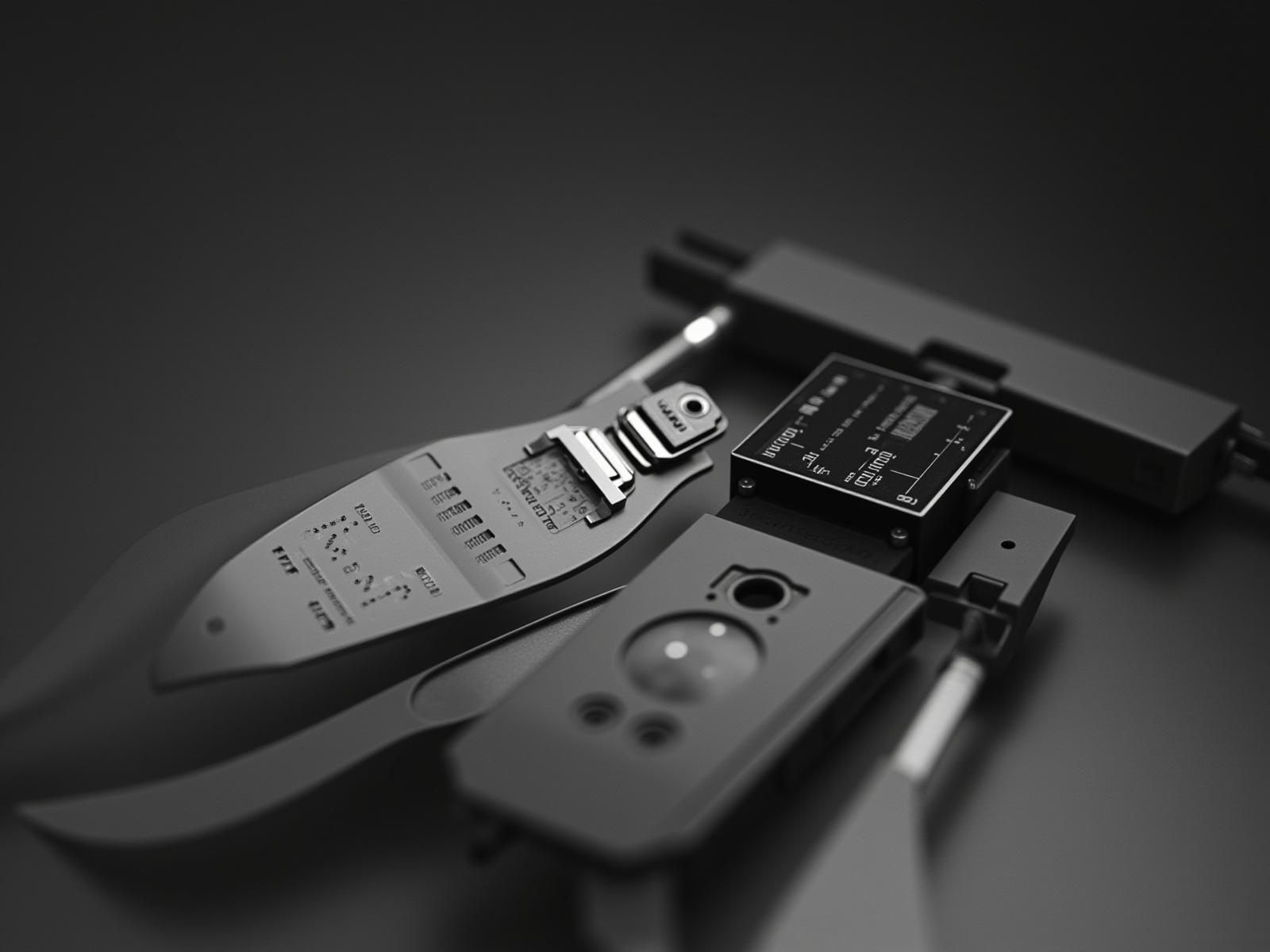
The radio rows on a supplier datasheet almost always appear in the same order, and the order is set by what the supplier wants to show first rather than by what a buyer needs to know first. Reading them in the reverse order is the whole trick.
Row one, the generation. It is at the top because it is the only row a buyer can check without opening a file. Write it down as a fact, put it in the technical file, and move on. Do not let it earn a requirement.
Row two, the profile list. Which roles the product takes on the link. This is often in a second table and is sometimes absent entirely. If it is present, it is more informative than the generation by a wide margin, because it tells you what the product actually does with a phone.
Row three, the codec list. Often absent, and worth chasing, because it decides both how the audio sounds and how much power the radio uses. Ask for playback and for a call separately, since the two paths are separate.
Row four, the module part number. The most valuable line and the one least likely to be printed. It answers the generation question and three others at once.
The most common shape of a datasheet in this category has row one and nothing else. That is not a sign of a poor product; it is a sign that the supplier has not been asked the questions that produce rows two to four. The conclusion a first-time buyer should draw is not that the product is weak but that the request for quotation needs to be more specific than the datasheet.
A second habit is worth building at the same time. Read the electrical rows on the same page and compare them with the radio rows. In our published data the electrical rows are complete across the range — cell capacity and rated runtime are published for all twenty-eight models, the charging method for twenty-four of them, and the charging case capacity is published for the five models that state one — while the radio row is published for fourteen. The completeness of one set and the absence of the other is the clearest possible signal about which rows the catalogue regards as settled and which are left open.
The four things the number does not decide, and what replaces each one
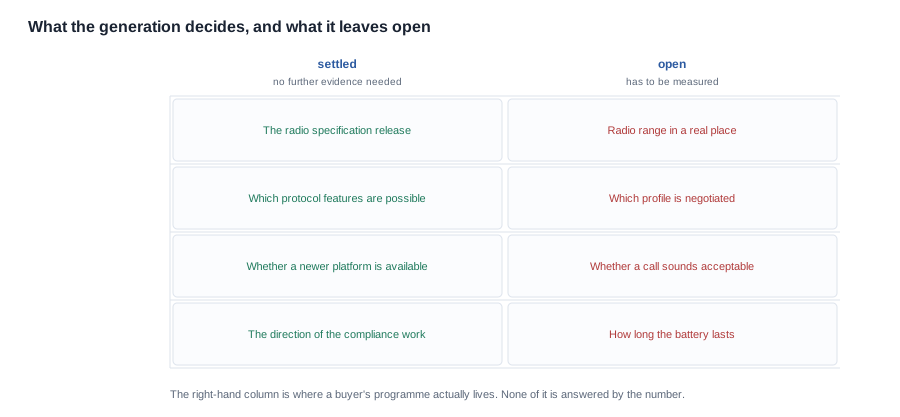
Range. This is the one buyers most often assume, and the assumption is wrong. Radio range depends on the antenna design, the transmit power, the frequency, the body of the person carrying the device and the environment around it. Two products on the same version can have very different range, and a product on a newer version with a worse antenna is worse. The row that replaces the version is the transmit power together with the antenna configuration, and neither is published for any model in our range.
Codec support. Bluetooth versions define the transport; the codecs that carry the audio — and in this category the microphone path in a call — are negotiated separately, and the list is a firmware and product decision. A device on the newest version with no codec support is a device with no codec support. The row that replaces the version is the codec list, plus the statement of which codec is negotiated by default.
Multi-device and dual-device behaviour. Whether the product connects to two devices at once, and how it switches between them, is a firmware and application decision rather than a property of the generation. The row that replaces the version is a count, together with a description of what happens when a second device arrives.
Latency. The delay between an input and an output, which in this category matters for the camera shutter and for the audio path, is a property of the firmware stack and the application. The row that replaces the version is a measured figure with a named test method.
There is a fifth gap that is less obvious and more expensive, and it is worth flagging for a buyer who is new to this category. The update path. Whether a unit bought today can still be updated in three years is a firmware and platform question, and it is the question that decides the end-of-life cost of the product. It is not published for any model in our range, and it is the row that a buyer who is writing a first specification should ask for even if they do not yet understand why it matters.

The four things the number does relate to
The regulatory route. The radio equipment route in each market applies to the product as a radio device, and the documentation position is a function of the radio module, the product's function and the model list on the document — not of the version string in a catalogue. In the European Union the Radio Equipment Directive (EU) 2014/53/EU applies, with the EN 18031 harmonised standards cited into it for the cybersecurity requirements, and the General Product Safety Regulation (EU) 2023/988 applies from 13 December 2024. In the United Kingdom UKCA applies with a framework that has diverged from the European one. In the United States FCC equipment authorisation covers the radio.
The qualification process. A product with a Bluetooth logo implies qualification with the Bluetooth SIG for the implementation, and the qualification is tied to the specific implementation. A change to the radio module is a change to the qualification, and the version tells you whether the module changed.
The compatibility question. A version does tell you which devices can connect in principle, and that is genuinely useful when you are buying for a fleet of phones with a known mix of models. It is a starting point for a test rather than a substitute for one.
The platform fixedness. In practice the radio module is fixed on a platform, and a version change is a new product rather than a configuration. Establishing this early prevents a buyer from specifying a version that cannot be changed, which is the specification mistake that costs the most to unwind.
The four questions to ask instead of reading the version, in the order that produces the most value per email, are these.
- Which profiles are supported, and which is negotiated by default? The list, and the default.
- What is the transmit power and the antenna configuration? These determine the range, and they are the two numbers a supplier will usually give if the question is asked properly.
- Is the radio module fixed, and does a version change constitute a new product? The answer to the second half is usually yes.
- Which EN 18031 category does the product fall into, and what is the evidence? Because a product with a microphone and an application processes personal data, the category follows the function rather than the version.
The cost of getting this wrong on a first programme
A first-time buyer makes these errors in good faith, and the reason to name the cost is that the cost is not where anybody expects it. It is not in the purchase order, because the order looks reasonable, and it is not in the sample, because the sample works.
The cost appears in the channel. A product page built on a generation makes an implied claim about capability, and the first customer who tests it produces a return and a review that no amount of later copy will reverse. A range ordered by generation produces a range with a duplicate and a gap in it, and the correction to that is new packaging, new artwork, new firmware builds and a new minimum order quantity, which is to say the cost of the original decision multiplied by the number of configurations.
The second cost is schedule, and it is the one that hurts a small brand hardest. A specification that names a version as a requirement, where the platform cannot meet it, becomes a conversation with the factory about a radio module change. That conversation ends in a new approval, a new trademark qualification, a new technical file and a re-test, and the elapsed time on those steps belongs to a test laboratory and a review queue rather than to the factory's capacity. The buyer who wrote the clause did not know they were buying a re-test.
Neither of these costs is visible at the point of the decision, which is why the first specification is worth getting right rather than getting corrected. The version row is cheap to record and expensive to argue about, and the discipline is to decide which of the two it is going to be before it is written.
Writing your first radio specification clause
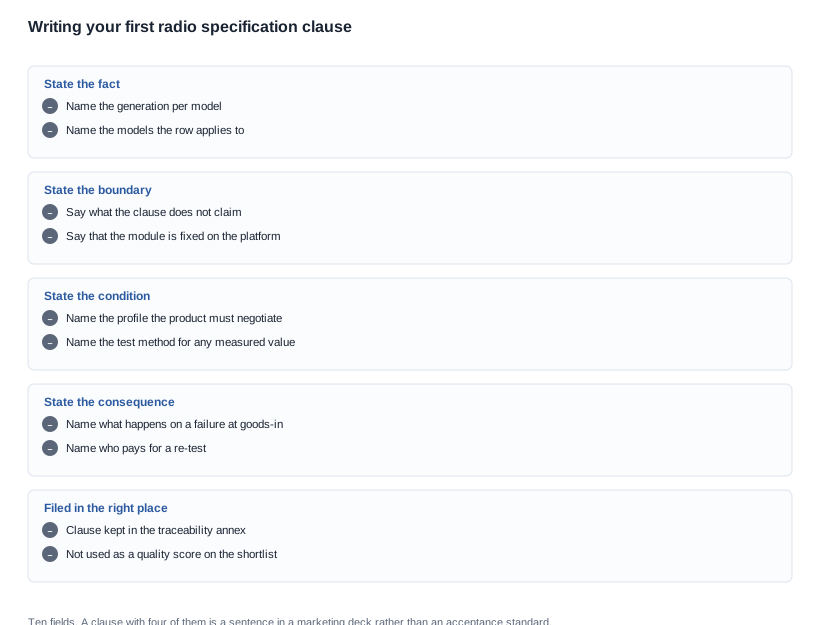
A first specification clause is usually a single line, and it is usually wrong in one of two ways: too loose to be checked, or too tight to be met. The ten fields below are what turns it into something that works.
State the fact. Name the generation, and name the models it applies to. This is the part of the clause that is easy to get right and is worth getting right, because it is the part that goes into the technical file and the traceability annex. It carries no requirement and it commits the buyer to nothing.
State the boundary. Say what the clause does not claim, and say that the radio module is fixed on the platform. A clause that only says what the product is makes it easy for a reader to assume more than was written, and a clause that says "5.4" without a boundary is read as a requirement.
State the condition. Name the profile the product must negotiate, and name the test method for any measured value that appears in the clause. A measured value without a method is not comparable to the same value from another supplier, and a profile without a default is half a requirement.
State the consequence. Name what happens on a failure at goods-in, and name who pays for a re-test. Without a consequence the clause is a note rather than an acceptance standard, and a note does not give a buyer the right to refuse a lot.
File it in the right place. Keep the clause in the traceability annex rather than in the requirements, and keep it off the evaluation sheet where it would displace a row that actually changes the decision.
The whole clause, written out, looks something like this. For the models listed, the radio is specified as Bluetooth 5.4; this is recorded for traceability and for the certification file and is not a performance claim. The radio module is fixed on the platform, and no change to the module is permitted without prior written notice and a re-test at the supplier's cost. The product shall negotiate the call profile by default; the acceptance test is a connection to the reference device set, and a failure is a grounds for holding the lot.
That is a paragraph a first-time buyer can write in ten minutes using only information that is either published or obtainable in one email, and it is worth more than the version row on any number of comparison sheets.
Two clauses that do not work, and what is wrong with each
The first clause that does not work is "Bluetooth 5.4 or better." It fails on the model list, because the eleven camera platforms in our range publish no version at all, and a supplier meeting this clause in good faith would have to fail a compliant product. The fix is to write the requirement against a stated position rather than a stated value: a stated version per model, or a written supplier position where the row is not published. A requirement that can be met by a documented gap is a requirement that survives contact with a real range.
The second clause that does not work is "Bluetooth 5.4, with multipoint and HD voice." It fails because both of the named features are unevidenced for any model in our range, so the clause asks for something that cannot be shown to exist. It also fails in a way that is harder to notice, because the clause reads as more precise than the one above, and precision is exactly what a specification is supposed to have. The two clauses look like a strict one and a loose one, and the strict one is the more dangerous of the pair.
The test that separates a workable clause from an unworkable one is short: could a supplier meet this clause for a compliant product, and could an inspector check it on a delivered unit? If the answer to the first is no, the clause excludes good products. If the answer to the second is no, the clause creates a dispute at goods-in that neither side can resolve, because there is no document and no reading of the unit that settles it.
The two errors a first-time buyer makes
The first error is assuming a newer version means a better product. In our own catalogue the version correlates with nothing: the K01 and the K02 sit on 5.3 while the G07 and the YK12, and the LC-105-2 and the LC-105-1 — the same tier, the same dual-cell configurations, the same magnetic charging — sit on 5.4. The version tracks the platform the manufacturer chose, not the quality of the product. The common mistakes article sets out the full set, and this is the first of them.
The second error is treating the version as a feature for the marketing page. "Bluetooth 5.4" on a product page is a specification without a benefit attached, and it competes against every other specification on the page for the customer's attention. It is worth a line, and it is worth exactly a line. A buyer who has just learned that the version decides very little has already solved most of this problem, and the remaining step is simply to decide where the line goes.
What we publish, and what we will not claim on your behalf
Concretely, we publish the Bluetooth version accurately for each model and we will not present it as a quality indicator, because in our own published data it does not track any product difference.
We will also not tell you a product is compliant in a market on the basis of its radio version, since the conformity position comes from the route, the model list on the document and the product's function. And we will not publish a module part number, a transmit power, an antenna configuration, a profile list or a codec list for any model in this range, because none of them is published to us and a typical figure is worse than a blank.
What we can do is give you the electrical rows that are published — the cell configuration, the rated runtime, the charging method and the case capacity — and tell you where the radio rows end. The background is under bluetooth connectivity, the trademark side is under Bluetooth SIG compliance, and the models where we can describe the electrical rows in full are on the Bluetooth audio glasses range.
If you tell us the models and the host devices your customers use, we will tell you what the published data says, which radio rows are open, and where the version stops being useful — which is usually earlier than a first-time buyer expects.
Related reading
- Bluetooth connectivity and versions
- Bluetooth SIG compliance
- Bluetooth version common mistakes
- Bluetooth audio glasses range
Send the models and the host devices your customers use and we will tell you where the version stops being useful.


