

Smart glasses Bluetooth version: one of six layers
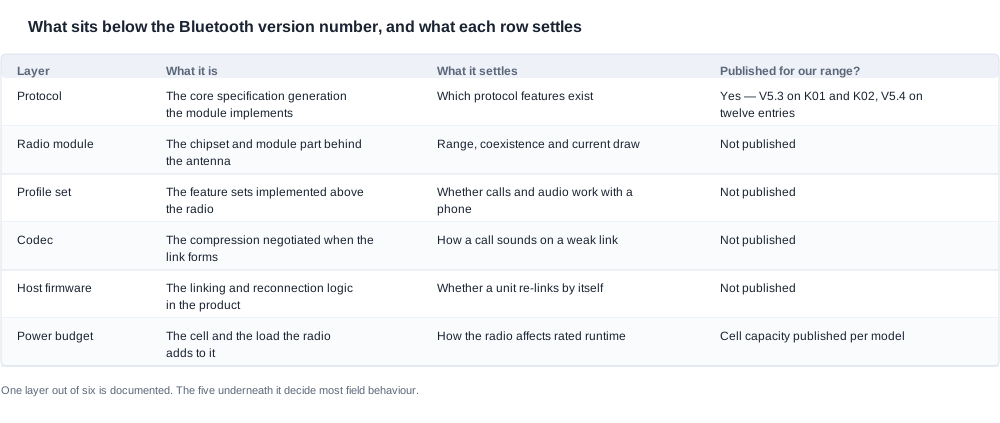
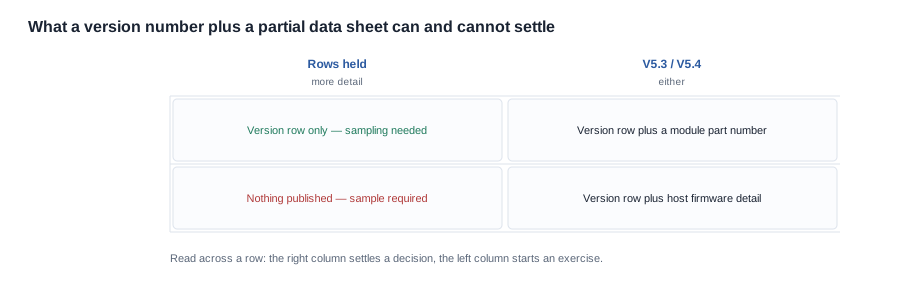
If you are comparing Bluetooth versions across a smart glasses shortlist, the version is the row that decides the least. It names the generation of the Bluetooth core specification the radio module was built to — Bluetooth V5.3 on the K01 and the K02 in our range, and V5.4 on twelve further entries. It does not name the module, the profile set the product implements, the codec a call negotiates, the number of units a device holds at once, or the distance the link survives in a given room. Across our 28 catalogue entries the version row is published for 14 and left open for 14, and the 11 camera models that buyers most often shortlist publish none at all. The right use of this row is a sanity check on the age of the radio, not a selection criterion. What should carry the shortlist is four rows the catalogue does not publish, and the way to close them is a written request followed by a sample test, not another version comparison.
What the version actually names
A Bluetooth version number identifies a released core specification. Each release defines radio characteristics, power management behaviour, and the feature set available to a device that implements it. Qualification with the Bluetooth SIG is a separate process from regulatory approval under the radio equipment rules, and the two are constantly merged by suppliers who write "Bluetooth 5.4 certified" without saying which of the two they mean.
Our published position splits in two. The K01 and the K02 carry V5.3. The A07 and the D11, the D17 and the D12, the ZH12 and the LC-105-1, the YKC02 and the YK12, and the G07 and the LC-105-2 carry V5.4, as do the electrochromic and the AR entries. The AI camera glasses family — the L2 Utral and the KY06, the V06 and the L1 Pro, the MT6 and the S7, the V03 Pro and the V03, the CY03 and the MT5, and the CY05 — publishes no version, and neither do the bone conduction entry, the A05 or the A06.
There is one commercially useful direction to read from the number. Bluetooth 5.4 added support for AES-CCM encryption, which matters because the cybersecurity requirements of the Radio Equipment Directive, described by the EN 18031 series of harmonised standards, cover secure communication, encryption, secure storage, user consent and a process for handling identified vulnerabilities. A radio design that already supports modern encryption starts closer to that requirement than one that does not. That makes the version a weak but real signal about the compliance workload sitting ahead of you — and nothing more than that.
The buyer who has to act on this row
The person reading this row is usually a brand-side product manager, a channel buyer or a sourcing engineer assembling a comparison table for an approval meeting. He is rarely choosing a Bluetooth radio. He is trying to close a shortlist, and he has been handed a column of version numbers that appear comparable and are not.
Three situations bring him here. The first is a brand opening a new line and building a comparison table from supplier sheets, where every sheet carries a version and no sheet carries the module. The second is a brand switching platforms and needing to know whether the existing accessory and app investment survives the move. The third is a distributor auditing a supplier, finding that half the catalogue states a version and half states nothing, and needing to know whether that gap is a documentation habit or a signal about the models.
What he fears is not the wrong radio. It is the combination: a model that passes a paper comparison and fails a customer test, a product that cannot be sold into the destination market because the paperwork behind the version was never assembled, and a re-order two years later where the module has been substituted without anyone noticing. All three are cheap to prevent at the request stage and expensive to prevent after the first shipment.
Why the radio row carries so little of the price
The version is not where the money sits in a smart glasses programme, and a buyer who negotiates on it is negotiating on a line that moves by very little. What moves the unit price is the bill of materials: the camera module and its sensor on the camera platforms, the cell and the charging case, the frame material and the temples, the speakers and the microphone chain, and the silicon behind the controller. The radio sits inside the controller package. Two products on different radio generations can differ by a fraction of a percent in component cost while differing by twice as much in landed cost once certification, packaging and freight are counted.
That gap between the visible price and the real one is where procurement leverage actually sits. A quotation that is five percent apart on unit price can be sixty percent apart on total programme cost once tooling amortisation, per-configuration minimums, the number of artwork rounds, the number of destination markets and the documentation work are added back in. The buyer who compares two quotations on the radio row is comparing the one line that both suppliers priced from the same reference.

The second reason the radio row is commercially quiet is that the risk it carries is not a unit-price risk. It is a programme risk and a warranty risk. A wrong antenna does not make the unit cheaper; it makes it come back. An unlinked firmware baseline does not move the invoice; it moves the return rate and the review score. Buyers who weight the radio row heavily in a specification comparison tend to under-weight the rows that determine whether the product works in the customer's environment, and that misallocation is what this article is trying to correct.
A third factor is worth naming because it explains why the row appears on so many supplier sheets at all. It is a proxy for the radio's age, and radio age is genuinely informative in one narrow direction — the maturity of the surrounding firmware and app ecosystem. A newer generation generally has better documentation, more available application processors and a wider supplier base for the module itself, and that shows up in the support you get when something goes wrong. It is a second-order signal about the ecosystem, and a buyer should price it as one rather than as a feature.
Four thresholds that separate a usable radio from an unusable one
The version row is settled. What a buyer actually needs is a set of thresholds on the four rows beneath it, each with a measurement method, a pass line, and a description of what an inflated claim amounts to. None of these four is published in our catalogue, and saying so is part of the threshold: the buyer's task is to request them in writing before the sample arrives, not to wait for a supplier to volunteer them.
The four thresholds, in the order a buyer should work through them:
- The module and its part number — the one request that turns the version into something checkable.
- The profile set — compared against the phone models that dominate the customer's market.
- The codec list and its default — because the listing describes the capability and the customer experiences the default.
- The radio's share of the power budget — because the version appears on platforms carrying very different cells.
Threshold one — the module and its part number
How it is measured. Ask the supplier for the part number of the radio module, then find the datasheet for that part. The datasheet gives the transmit power, the receiver sensitivity, the supported profiles and the certified configurations.
The pass line. The module part number has to be the same one that appears in the radio approvals and in the technical file, and it has to be a part the supplier has a current supply allocation for. A module that is confirmed for a different product and is being used opportunistically here is a programme risk, because its supply is not yours.
What an inflated claim amounts to. "Bluetooth 5.4" with no part number behind it. This is the most common form and it is the easiest to fix: a supplier who will not name the part is telling you the version was copied from a reference sheet rather than taken from the design.
Threshold two — the profile set
How it is measured. Request the list of supported profiles — telephony, audio distribution, and anything proprietary the product relies on — and compare it against the phones in the customer's installed base. The comparison is done by the phone models that dominate the market, not by the phone models in the engineering team's hands.
The pass line. Every profile the product's own feature description depends on must appear in the list, and the phone list must include the models that account for the large majority of the volume. A product that supports audio distribution but not telephony is a product whose calls will not work on some hosts, and that is a listing problem as much as a technical one.
What an inflated claim amounts to. "Full Bluetooth support", which is a statement about the standard rather than about the product. Every product built on a modern radio has access to the full profile set; what varies is the subset the firmware actually enables.
Threshold three — the codec, and which one is the default
How it is measured. Ask for the list of available codecs and for the one negotiated by default. Then make a call on a sample against each host model in the phone list and record which codec the link actually settled on.
The pass line. If the product's listing makes any claim about call quality, the default codec has to be a wideband codec on the dominant host models. A product with a wideband codec available but a narrowband codec selected by default is a disappointment that arrives in the field, because the listing describes the capability and the customer experiences the default.
What an inflated claim amounts to. A codec list with no default stated. Suppliers list every codec their stack can negotiate, which is not the same claim as which one a customer will get.
Threshold four — the radio's share of the power budget
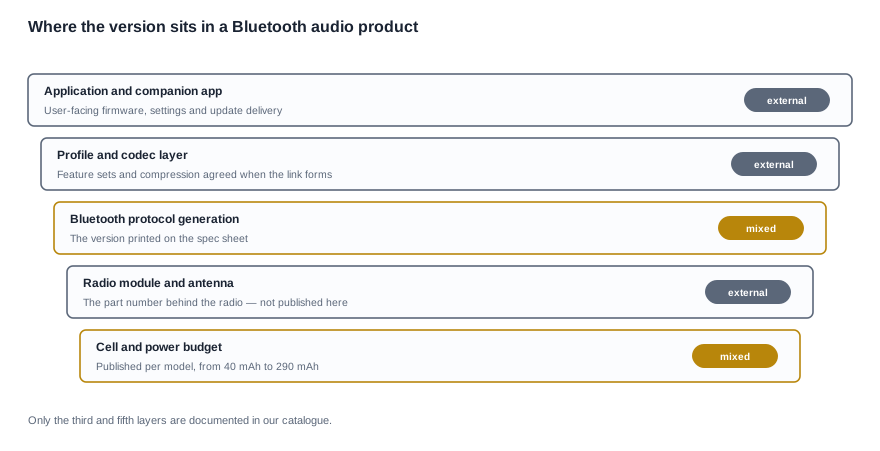
How it is measured. Request the standby and the connected-state current draw, and compare the sum against the cell capacity the catalogue publishes. Our range runs from 40 mAh in the A05 and the A06, through 55 mAh paired cells in the LC-105 pair, the G07 and the YK12, 70 mAh in the A07 and the YKC02, 90 mAh paired cells in the K01 and the K02, 100 mAh in the AR, the D11, the D12, the ZH12 and the electrochromic entry, 115 mAh in the D17, 220 mAh in the V03 Pro and the V03, and the MT5, 260 mAh in the KY06 and the S7, and the V06, 265 mAh in the MT6, and 290 mAh in the CY05 and the CY03, and the L1 Pro and the L2 Utral.
The pass line. The radio's share has to leave room for the workload the product is sold to do. For an audio platform, a 55 mAh paired cell with a power-hungry radio will not survive a full shift on one charge, and the catalogue's published runtime figures assume favourable conditions. For a camera platform, the radio is a secondary load next to the camera and the controller, and the same version number appears on both.
What an inflated claim amounts to. A runtime figure quoted without the load it was measured under. Our published runtimes range from roughly six hours on some audio platforms to roughly twenty on the children's entries, and none of those figures is a comparison across suppliers.
The warning that applies to all four thresholds
These numbers are not directly comparable across suppliers, and the reason is usually the measurement rather than the product. A range measured in an open corridor with the device in a pocket is not comparable with a range measured in an open field with the device on a desk. A codec named in a datasheet is not comparable with a codec observed on a call in a real city. A deep-sleep current measured on the bench with the device disconnected from everything is not comparable with one measured in the pocket of a customer. Until the method is stated, two numbers in the same row are two different measurements, and the comparison is not between products but between test methods.

How to establish the four rows we do not publish
The verification path for this category is short and mostly documentary. The order below is deliberate: each step assumes the previous one passed, and a failure at any step tells you what the next step would have told you.
Step one: ask for the module part number in writing, before the sample ships. One sentence in an email. This is the highest-yield request in the category because it converts the version from an unverifiable number into a part that has a datasheet, an allocation and a supply history. A supplier who answers this has a documentation habit. A supplier who does not has answered a different question, and you now know that.
Step two: find the part number's datasheet and read what it supports. The datasheet gives the transmit power, the receiver sensitivity and the supported profiles. Write down the profile list and compare it against the dominant phone models in the customer's market. This is where a project that appeared complete on paper discovers that the feature the listing leads with is not in the profile set.
Step three: request the certification records by number, not by attachment. A number is the only part of a compliance document that a broker, a marketplace or your own compliance team can check later. A PDF attachment is a claim; a number is a record. Ask for the qualification reference, the type approval reference and the issuing body with the validity dates, in the body of the email.
Step four: verify the records against the issuing body's register. Check three things: that the model designation on the record matches the model code you are ordering, that the record covers the radio band and the functions you are shipping, and that the validity date has not passed. Compare the model string character by character. In a family where several models share the same electrical rows, this is the check that catches a substitution, and a mismatch here is a stop condition rather than a query.
Step five: run the four sample tests on a fixed protocol and write it down before you start. The protocol is short: a link and re-link test on each host model in the list; a multipoint test connecting two devices and taking a call on each; a range test at a stated distance with and without an obstruction, in a room you describe; and a standby drain test with the unit connected overnight. Write the protocol down before the first reading, because a protocol designed afterwards is a description rather than a measurement.
Step six: put the criteria and the method into the purchase order. In a category with no published standard, the contract is the standard. If the criteria live in an email they are not binding; if they live in the purchase order they are the acceptance standard, and a lot that fails them is a lot you can refuse. The version row belongs in that order too, written as the version the units ship with, so that a later substitution is a deviation rather than an improvement.

Where radio programmes break, and what that costs the buyer
The version is sold as a compatibility guarantee. The symptom is a listing that leads with the version and a customer who assumed the phrase meant their phone would work. The root cause is that the version was treated as a compatibility result rather than as a protocol generation. The prevention is to write the host list into the listing copy, and to make the qualified host list a deliverable of the first order rather than a question to the supplier.
The paper passes and the customer test fails. The symptom is a batch that clears incoming inspection on the bench and returns a month later. The root cause is that the incoming inspection criteria tested the unit, not the link — it checked that the radio enumerated and stopped there. The prevention is to add a link and re-link step to the inspection criteria, on one named host model, at a stated number of attempts, with the pass line written into the order.
A part is substituted and the model code does not change. The symptom is that units ordered in one quarter behave differently from units ordered in the next, with no paperwork anywhere recording a change. The root cause is that the change control rule does not list the radio module as a controlled item, so a stock-driven substitution passes through untouched. The prevention is to name the module and the firmware baseline as controlled items with a notice obligation attached, and to ask how a change is recorded.
The documentation arrives with the wrong model on it. The symptom that reaches you is a warranty claim, a marketplace rejection, or a customs query nobody will sign. The root cause is that a family-level record was treated as coverage for a branded configuration. The prevention is to make the exact model designation a condition of the order and to check the string on the units at receipt.
The clauses a buyer can still negotiate
In a Bluetooth smart glasses programme, the items with room and the items without are not the ones most buyers assume. The version row itself has no room — it is fixed by the module the supplier has chosen, and the only lever is whether you accept that module. The certificate and qualification costs, and the laboratory time behind them, are also fixed in character: pressing on a testing queue produces a later date rather than an earlier one.
The room is elsewhere. The number of configurations in the first order moves the per-configuration minimum, and a buyer who commits to a configuration count rather than a unit count gets a better unit price than one who negotiates units in isolation. The number of artwork rounds moves the schedule by a week each, and the rounding date of the Bluetooth name on the box is a design input rather than a late decision — the name a customer sees when linking a device has to match the name on the packaging, on the manual and on the technical file, and a mismatch is a documentation defect that surfaces at customs or during a market surveillance check. Whether the supplier will run the qualification list against your customer's phone mix rather than against its own test set is a reasonable request and is often refused, and it is worth asking in the first email because the answer changes the sample plan. Whether the supplier funds a second sample round for coexistence and range work is negotiable and is usually cheaper than the alternative.
The documents to request before a deposit are therefore specific: the module part number, the profile list, the codec list with the default named, the standby and connected current draw, the qualified host list, the certification numbers with the issuing body and the validity dates, and the inspection criteria with their pass lines written out. The clauses to write into the order are the host list, the module part number as a controlled item, the notice obligation on any radio or firmware substitution, the inspection criteria, and the re-issue obligation on the documentation pack.
A worked case, our limits, and the next request
This is a constructed scenario, not a client project, and it is written to show the order of the decisions rather than to report an outcome.
Assume a European brand with an existing audio product line, currently supplying a field-service channel that works in warehouses and on factory floors. The channel has grown, and the brand is opening a second product line in the same segment: an audio platform at a lower price point. The brand's product manager has three supplier sheets in front of her, and the sheets differ in exactly one visible technical row — the Bluetooth version — plus the battery figures. Two of them state V5.4 and one states V5.3. The internal expectation was that the decision would follow from that row.
Step one: what the version tells the brand. The brand's engineering lead establishes that the version row separates the three sheets into two radio generations, which is a difference in protocol era and in the encryption direction. It tells the brand nothing about which module sits behind any of them, which is the row that governs range, coexistence and current draw.
Step two: the request. The brand sends one email asking for the module part number, the profile list, the codec list with the default named, and the standby current draw, per model. Two suppliers answer within a week. One replies with a version number again, and the brand now knows, before the sample order, that this supplier's documentation does not extend past the spec sheet.
Step three: the sample work. The brand buys one unit from each of the two responsive suppliers and runs its own protocol: link and re-link on the four phone models that dominate its channel, a multipoint test with a call on each device, a range test at a stated distance in a warehouse aisle, and an overnight standby measurement. The two suppliers' results differ in a way the version row did not predict, and the difference shows up in the standby figure rather than in the radio generation. The brand now has a measured number for the supplier it had been about to place the larger order with.
Step four: the commercial decision. The brand places the larger order with the supplier whose measured standby drain leaves the rated runtime usable across a full shift, and it writes the host list, the module part number and the measured criteria into the purchase order. It also asks the third supplier for a second submission on the same four questions, because a supplier that cannot produce the answers is a supplier whose re-order behaviour the brand cannot predict either.
The result is that the version row, which was going to decide the order, turned out to decide nothing, and four questions that took one email and one sample round decided the outcome. The brand also inherits a written host list, which is a deliverable it can reuse for the next line and for the listing copy.
What we can and cannot tell you about our own radios
The boundary we hold: we publish the protocol generation where the catalogue states it, and we mark the row as not published where it does not. That gives Bluetooth V5.3 on the K01 and the K02, and V5.4 on the D11, the D12, the LC-105-1, the LC-105-2, the G07, the YK12, the YKC02, the D17, the ZH12, the A07, the electrochromic entry and the AR entry. For the AI camera glasses family, the bone conduction entry, the A05 and the A06, the row is open.
What we do not publish, and will not estimate, is the module part number, the profile list, the codec list, the multipoint behaviour, the measured range, the standby and connected current draw, the update method and the qualification reference — for any model. We publish no antenna specification. We also publish no frame weight for most models in the range, and the only weight published anywhere in the catalogue is 158 g for the MT6 glasses unit, excluding its foldable charging case. We would rather show you empty rows than values we cannot stand behind.
We make no vision, health or eye-protection efficacy claim for any product in any market, and nothing in this article should be read as one. If your channel is built on a eyesight concern, this is the wrong category, and we would rather say that before the sample order than after the copy is written.
Three things to do before the next supplier call
Send the module question first, in writing. One sentence. It converts the version from a number you cannot check into a part you can, and it is the question with the highest yield per minute spent.
Send the four questions as a list, not as a conversation. The module part number, the profile list, the codec list with the default named, and the standby current draw. A supplier who answers all four has a documentation habit; one who answers two is telling you something you need to know before the deposit.
Send us the models, the phone mix and the destination market. We will tell you which rows our documentation answers today, which rows are open, and what the version row is actually worth in that comparison. The background is under bluetooth connectivity in smart glasses, the platform constraints are at open-ear audio specifications, and the naming question is covered under engineering customization and the device name.
Send us a connectivity row from a supplier sheet and we will tell you which of the four questions it leaves unanswered.


