

Smart glasses Bluetooth version: six claims, three kinds
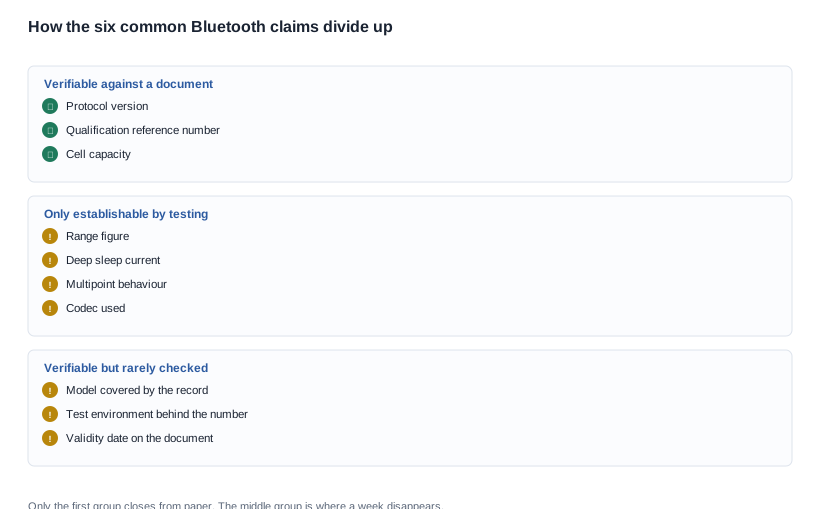
A supplier's Bluetooth claims divide into three groups, and only one of them can be closed from paper. Six claims turn up on almost every specification sheet and every listing page in this category: the version number, a range figure, a multipoint claim, a battery-life claim, a certification claim, and a compatibility promise. Two of them can be checked against a public record in minutes. Four have to be tested, because the numbers attached to them are not standardised and the same words mean different things at different suppliers. A buyer who does not separate the three groups before reading the sheet will spend a week chasing rows that were never closable and will leave the two that could have been closed unresolved. This article gives the taxonomy, the threshold to apply to each of the six claims, and a marking-up procedure that takes a single sitting and produces a document the purchasing team can use.
The position of a supplier, stated before anything else
It is worth stating our own position first, because it is the position of a supplier rather than a buyer and a buyer should know where the incentives point. We publish the radio version for every model where our catalogue states one: Bluetooth V5.3 on the K01 and the K02, and V5.4 across the D11, the LC-105-2, the D12, the G07, the YK12, the LC-105-1, the YKC02, the D17, the ZH12, the A07, the electrochromic entry and the AR entry. The AI camera glasses family, the bone conduction entry, the A05 and the A06 publish no version. We publish no range figure, no power figure and no Bluetooth SIG Design Number, and we will not quote a supplier's range claim as though it were our own.
That is the whole position, and it is deliberately thin. A supplier sheet in this category is a sales document, and a supplier has an incentive to publish the rows that are easy to state and stay silent on the rows that are not. Nothing about that is dishonest; it is how a spec sheet is written. But it means the sheet is evidence of what the supplier is willing to commit to, and only weak evidence of what the product does.
Who is doing the reading, and what they are trying to protect
The reader is normally a product manager, a sourcing engineer or a channel buyer who has been handed two or three sheets and asked to recommend one. Their concern is not accuracy in the abstract. It is that they will be asked, six months later, why they chose a supplier whose range claim turned out to describe open air rather than a warehouse.
Three failures repeat. The first is a claim that was copied into the product page without a method attached, which converts a supplier assertion into the buyer's own liability. The second is a certification claim quoted as "certified" with no number, which turns into a market surveillance question. The third is a compatibility promise written on the packaging that was never tested against the phone models in the customer's market, which turns into a return rate.
What the reader needs is a procedure rather than a warning, and the procedure in this article produces three outputs: which claims can be closed from a document, which require a test, and which have to be turned into a written condition in the purchase order.
Why a supplier sheet reads well and settles little
A spec sheet is a compressed document. Every row on it has been reduced to a value that fits in a column, and the compression removes exactly the material a buyer needs: the test method, the condition, the sample size, the model the figure covers. What survives is the assertion, and the assertion is engineered to survive.
The commercial consequence of that compression is worth spelling out, because it explains why claims drift upward across the category. A range figure that was measured once, in one corridor, with one device, becomes a general claim on a sheet, and then a feature on a listing, and then a line in a comparison table that another supplier matches with a number of their own. None of the three later statements was tested, and each of them is harder to walk back than the last. The same escalation applies to the battery claim, which usually starts as a rated figure and ends as a marketing phrase that no measurement can support.
The second reason a sheet settles little is that most of the rows are of one type — statements about a device — and the rows that decide the purchase are of a different type — statements about a permission or a behaviour. A version number and a cell capacity are device statements. A qualification record is a permission statement. A multipoint claim is a behaviour statement. The three are verified in three different places, and a sheet presents them in one column.
A third point is about where the risk actually sits in a programme. A wrong cell capacity costs a returned batch. A wrong certification claim costs a launch delay and, depending on the market, a compliance event. The claim with the highest consequence is usually the shortest on the sheet — a single word — which is why a marking-up procedure that sorts claims by their evidence type rather than by their length is worth the hour it takes.
The six claims and the threshold to apply to each
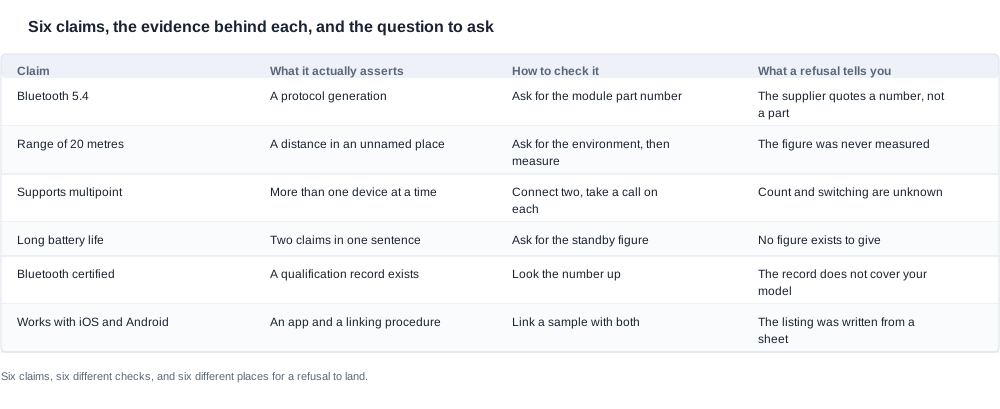
Claim one: "Bluetooth 5.4." This is the only one of the six that is a statement about a standard rather than about a device, and the only one that can be checked against a document. Threshold: it must be traceable to a module part number. Two products quoting the same version can be using modules with very different antenna implementations, so the version is a property of the module rather than of the product. Nothing here needs testing; it needs a part number, and a supplier who will not provide one has copied the row.
Claim two: "Range of 20 metres." The most misleading figure in the category, because the number is meaningless without the environment. Twenty metres through open air, twenty metres down a corridor, and twenty metres with the device on a body and the phone in a pocket are three different claims, and manufacturers rarely distinguish them. Threshold: the claim is only usable if the supplier names the environment it was measured in, and the buyer then repeats the measurement in the customer's environment. The test is straightforward — pair, walk away, find the actual drop point in a corridor and in an open space, and write the environment into the note.
Claim three: "Supports multipoint." Usually true and usually incomplete. Multipoint means more than one device can be held at once, but the practical questions are how many, whether it switches automatically when one device starts making noise, and whether it remembers more than two. Threshold: a stated count, a stated switching behaviour, and a stated limit on remembered devices. The test takes five minutes — connect a phone and a laptop, take a call on each in turn, and see whether the audio moves without manual intervention.
Claim four: "Low power consumption, long battery life." Two claims fused into one, and the second is where the work is. The figure that matters is the standby drain between uses, because that is what a customer experiences overnight. Threshold: a standby current figure, and a cell capacity beside it. Our catalogue publishes cell capacity for every entry and no standby current for any of them, which makes that figure the single most useful unpublished number in this category. The test is trivial and the result is specific: leave the device connected overnight, check the level in the morning, and ask the supplier for their own figure to compare against.
Claim five: "Bluetooth certified." This one is verifiable, and it is the one most often left vague. Using the Bluetooth trademark and the protocol requires a Bluetooth SIG qualification, now formally issued as a Declaration ID and since the QPRD v5 revision called a Design Number. Threshold: the number itself, verified in the register, and then the harder question — does that Design Number cover the model you are buying, and can your brand inherit it, or does it sit with a legal entity you have no relationship with.
Claim six: "Works with iOS and Android." A statement about an app and a linking procedure rather than about the radio. Threshold: the app name, the supported versions, and the qualified host list. The test is to link a sample with both and see whether the first-run experience matches the instructions.
The claims a buyer should turn into a condition before paying
The four claims that cannot be closed before the sample arrives, and the condition each one becomes:
- The range figure — becomes a disclosed measurement with its environment, or it does not go in the listing.
- The multipoint claim — becomes a stated count and switching behaviour in the purchase order.
- The battery-life claim — becomes a standby figure and a cell capacity, both written into the order.
- The compatibility promise — becomes a qualified host list that the supplier stands behind.
The claims a buyer can close from paper today
The two claims that can be closed before a sample is ordered, and the record each one resolves to:
- The version — resolves to a module part number with a datasheet behind it.
- The certification claim — resolves to a Design Number that can be found in a public register, with the model scope checked against your order.
The shortlist criteria, and the questions to ask
Once the six claims have been sorted by type, a buyer has something that can be scored. The shortlist criteria below are the ones that survive contact with a sample, and they are written as questions to ask rather than as adjectives:
- Which module part number sits behind the published version? This is how to verify the version row rather than accept it.
- What is the range in a stated environment, and who measured it? A total cost question in disguise: a claim you cannot repeat becomes a return rate.
- How many devices are held at once, and what happens on a switch? The number of simultaneous connections is a configuration choice, not a version property.
- What is the standby current beside the cell capacity? This is what decides the overnight complaint rate.
- Which Design Number applies, does it cover the model, and can it be inherited?
- Which host models and operating system versions are on the qualified list?
- Which of the six claims will be written into the purchase order?
These are the red flags to watch for in a due diligence pass: a version with no module behind it, a range with no environment, a multipoint claim with no count, a battery claim with no standby figure, a certification claim with no number, and a compatibility claim with no host list. Each one of those six gaps is a gap a buyer can close, and each one is also a gap a competitor can close faster. There is a real trade-off here between asking for everything up front and delaying the order, and the way to manage it is to ask all seven questions in one message, accept the answers you need for the first configuration, and treat the rest as conditions on the first shipment.
How to decide which claims to chase before you order
Two rules of sequencing make this tractable. First, chase the claims with a commercial consequence before the claims with a technical one, because the commercial ones are what appear on the product page. Second, chase the claims that block the launch before the claims that improve the product, because a launch block is worth more than an improvement.
That ordering produces a practical sequence: the module part number, the Design Number and the model scope, then the qualified host list, then the standby figure, then the range and the multipoint behaviour, and finally the codec list. If the budget for the sample round only stretches to one or two items, the last two are the wrong ones to spend it on.

How to mark up a supplier sheet in one sitting
The procedure below is designed for one sitting per sheet and produces a document rather than an impression.

Step one: pull every Bluetooth claim onto a single page. One row per claim, with the claim's wording copied exactly. Copying the wording matters, because the wording is the evidence — "supports multipoint" and "two devices connected simultaneously" are different claims and they attract different thresholds.
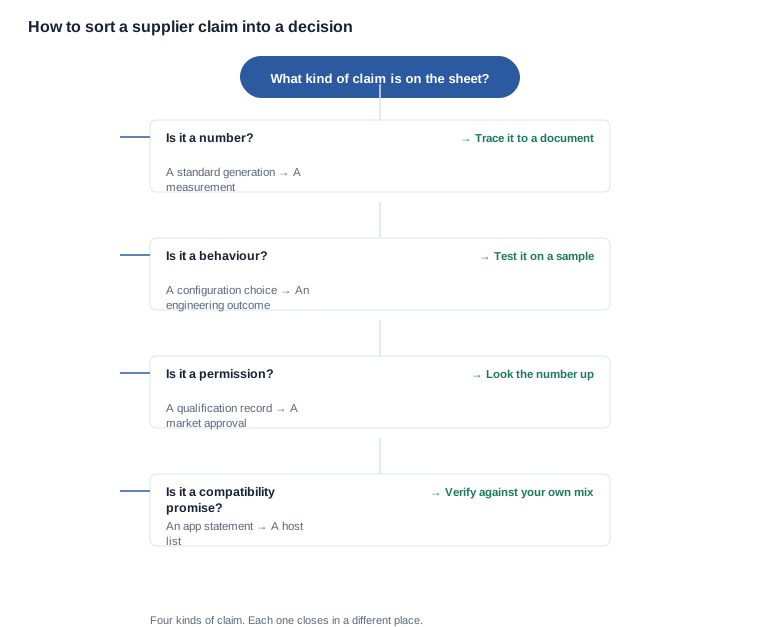
Step two: sort each claim into one of four types. A standard generation, a measurement, a permission, or a behaviour. Every claim in this category belongs to one of the four, and the type determines where the claim can be closed.
Step three: send the document-type claims to a records check and the behaviour-type claims to the sample plan. Do not mix them. A records check and a sample plan have different owners, different costs and different timelines, and combining them is how one of them gets dropped.
Step four: write the measurement claims down with a condition attached. For each measurement claim, write the condition you would accept and the method you would use. If you cannot write the condition, the claim is not usable yet and should be marked as such rather than carried forward.
Step five: write what is left into the purchase order. The point of the marking-up work is not the analysis; it is the conversion of an open claim into a contractual condition with an owner and a date.
A practical detail worth adding: mark up every sheet with the same wording, so that the answers are comparable. A buyer who asks one supplier "what is the range" and another "how far does it reach in a corridor" will get two incomparable answers and will have to do the comparison work again.
Where a claim becomes a commercial problem
A range claim reaches the product page. The symptom is returns concentrated in one environment. The root cause is that an unmeasured supplier figure became a customer expectation under the buyer's own brand. The prevention is to publish only a figure you measured yourself, with its conditions, or to publish none.
A certification claim turns out not to cover the model. The symptom is a launch delay and, in some markets, a compliance event. The root cause is that a family-level record was treated as coverage for a specific configuration. The prevention is to verify the number in the register and compare the model string, and to make the exact designation a condition of the order.
The multipoint claim is true and incomplete. The symptom is a customer expectation that the product holds several devices when it holds two. The root cause is that the word was accepted without a count. The prevention is to put the count in the order.
The battery claim and the runtime row contradict each other. The symptom is a listing that promises a full shift on a product whose published runtime is half that. The root cause is that a marketing phrase was written next to a catalogue figure without checking them against each other. The prevention is to check every claim against the catalogue rows before the artwork is released.
A claim was never in the supplier's material at all. The symptom is a feature on the listing that the supplier cannot explain. The root cause is that a competitive comparison was used as a source. The prevention is to require the supplier to confirm the claim in writing, in the specification, and to treat anything that appears only in your own file as unverified.
What is fixed, what moves, and what the contract should say
The radio version on a given model is fixed, because it is a property of the platform. Certification cost and the laboratory time behind it are fixed per family and per market and behave like queues rather than prices. Tooling is a one-off cost that is usually amortised across the first order, and the questions worth asking are over what volume it is amortised and what happens to it if the programme is discontinued.
What moves is the number of configurations, the number of markets, the artwork round count, whether the supplier will run the qualified host list against your customers' phone mix rather than against its own test set, and whether the supplier funds a second sample round for the behaviour work. The last of those has the most leverage here, because behaviour testing is a real cost and the alternative is a claim you cannot verify at all.
The contract clauses that follow are short and specific: the module part number as a named field, the qualified host list as an attached document, the inspection criteria with their pass lines, a notice obligation on any radio or firmware substitution, a re-issue obligation on the documentation pack, and a warranty period set against a written failure criterion rather than against a general promise.
A marked-up sheet, and what our own catalogue claims
The worked example here is a constructed scenario rather than a client project; it sets out the decision order rather than describing an outcome.
Assume a channel buyer with three supplier sheets for an audio platform, all of them claiming Bluetooth 5.4, all of them claiming multipoint, and two of them quoting 20 metres.
Step one: the one-page extract. The buyer copies every Bluetooth claim onto a single page. The three sheets produce 14 claims: three version claims, three multipoint claims, two range claims, two battery claims, two certification claims and two compatibility claims.
Step two: the sort. The three version claims are standard-generation claims, and each resolves to a module part number. The two range claims and the two battery claims are measurements with no conditions attached, so they are marked as not yet usable. The three multipoint claims are behaviours. The two certification claims are permissions, and one of them carries a Design Number while the other carries the word "certified" on its own. The two compatibility claims name an app but no host list.
Step three: the record check. The Design Number is found in the public register and its scope is checked against the model on the quotation. It covers a model the buyer has not quoted, and the supplier confirms that a new qualification would be required for the buyer's own brand — a queue with a lead time that nobody had mentioned. The claim that carried the number turns out to be the more expensive one, which is the opposite of what the sheet implied.
Step four: the behaviour plan. The three multipoint claims and the two compatibility claims go into the sample plan. The two range claims go into the sample plan with a written condition attached: the stated distance, the stated environment and the method. The two battery claims are answered by asking each supplier for a standby current figure and the cell capacity beside it.
Step five: the conditions. What remains open is written into the purchase order: the module part number, the qualified host list, the standby figure, the inspection criteria with their pass lines, and the notice obligation on substitutions. The range claim does not appear in the listing at all, because it was never measured in the customer's environment.
The decisive step was step two. Sorting the claims by type separated the two that could be closed from paper, and the one that closed most cheaply turned out to be the one that carried the most commercial consequence.
What our own catalogue claims, and what it does not
Concretely, we will publish the version and the models it applies to, and we publish no range figure, no power figure and no Design Number, because our source document contains none of them. We would rather show an empty row than publish a number we cannot stand behind.
Our own version rows follow the same discipline. Bluetooth V5.3 appears on two models, the K01 and the K02. Bluetooth V5.4 appears on the D11, the LC-105-2, the D12, the YK12, the G07, the LC-105-1, the YKC02, the D17, the ZH12, the A07, the electrochromic entry and the AR entry. The remaining entries — the whole AI camera glasses family, the bone conduction entry, the A05 and the A06 — publish nothing at all, and where the sheet says nothing a buyer should read an absent row as an absent row rather than as agreement with a neighbour.
The export-certification page in our source material shows ten patent certificates, eight of them appearance-design patents and two utility-model patents, and it names no CE, FCC or RoHS marking with no certificate number, no issuing body and no validity period attached to any of them, so we do not attach a certificate to a model because a sheet mentioned one. We publish no chipset, no module part number, no profile list, no codec list, no multipoint figure, no measured range, no update method and no qualification reference for any model, and we will not estimate any of them from the version.
The same test applies to every row, including the ones nobody argues about. Of the 28 catalogue entries, one carries a published weight — the MT6 glasses unit at 158 g, excluding its foldable charging case, which holds 1200 mAh — and the other 27 publish none. The pattern is deliberate rather than accidental: a row we can substantiate is published, and a row we cannot is left open rather than filled with a typical value. We carry no vision or health efficacy claim on any product we list.
What we will do with a sheet you send us
Send us a specification sheet and we will mark up every Bluetooth claim on it as verifiable from a document, establishable only by a test, or neither — and tell you which of the claims we can substantiate from our own documentation. The technical background is under bluetooth connectivity, the compliance instruments are collected under bluetooth SIG certification, and the field behaviour that follows from these claims is in bluetooth version problems and fixes.
Send us a specification sheet and we will mark up every Bluetooth claim on it.


