

Smart glasses Bluetooth version: six complaints, in order
Six Bluetooth complaints account for most of the tickets in this category, and each one is settled by a single cheap check — but only if the checks are run in the right order. The device will not appear in the list, or will not connect again. The connection drops repeatedly in one room. Audio cuts out when the phone rings. The assistant does not respond. It works when the phone is close and fails at arm's length. Each of those has a first check that eliminates a whole layer of possibility, and each of those checks costs minutes. Run them in order and the first-contact resolution rate is high; run them in the wrong order and a customer who only needed to remove a stale record has had a unit shipped back. The commercially important point for a buyer is that four of the six are environmental or software behaviours rather than hardware faults, and a support script that treats them as faults consumes the warranty budget on units that were never defective. The published Bluetooth version — V5.3 on the K01 and the K02, V5.4 across twelve further entries — settles none of the six.
The six checks, in the order the support script should run them:
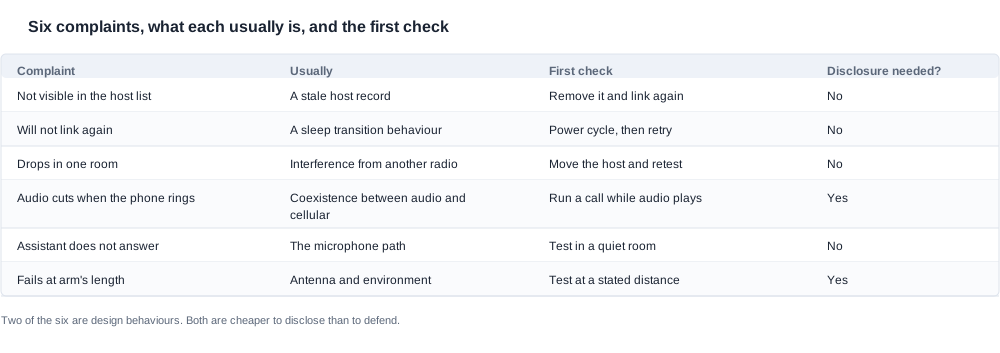
- Not visible in the host list — remove the stale host record and power cycle.
- Will not link again — power cycle and attempt a reconnection without re-linking.
- Drops in one room — move the host away from other radios and retest.
- Audio cuts when the phone rings — run a call on the host while audio plays.
- The assistant does not respond — test in a quiet room before anything else.
- Fails at arm's length — measure at a stated distance with and without an obstruction.
The reader, and the decision behind the article
The reader is a brand product manager, an after-sales lead or a channel buyer who is about to ship a Bluetooth product and has to build both the support process and the listing copy. The specific problem is that the version number is being treated as a guarantee of compatibility, and it is not. A version number is a feature-set claim; a customer who cannot hear audio when their phone rings is experiencing a coexistence configuration behaviour that the version does not describe and could not have described.
The buyer's task therefore has two halves. The first is to write the diagnostic order into the support script, so that the cheapest check comes first and the script terminates early for the majority of cases. The second is to decide which behaviours must be disclosed in the listing, because they will otherwise be reported as defects. Those two halves are not the same task, and the mistake this category makes most often is doing the first and forgetting the second. A behaviour that is fixed by a support instruction costs a ticket. A behaviour that is fixed only by a disclosure costs a review.

Where a connectivity complaint actually comes from
The six complaints that dominate the ticket queue come from four distinct layers, and each complaint belongs to exactly one of them. Sorting them this way is what makes the diagnostic order efficient, because each layer has one cheap check that eliminates it entirely.
The connection-state layer. A previous device's record is still in the phone, or the product is in a state that expects a partner it cannot find. Every complaint of the form "it will not connect" belongs here, and every one of them is cleared by removing the record and starting again. Nothing else in the category is cleared by that step, so it goes first.
The power and sleep-transition layer. The product links once and then goes to sleep, and what happens on wake depends on the firmware's behaviour with the identifier store. A complaint of the form "it works until I leave it alone" belongs here, and the check is a power cycle followed by an attempt to reconnect without re-linking.
The coexistence and interference layer. The 2.4 GHz band is shared, and both Wi-Fi traffic and the phone's own cellular activity compete with the audio path. This layer produces two distinct complaints — a connection that drops in one particular room, and audio that cuts when the phone rings — and both are cleared by moving something or reproducing a specific case.
The microphone and acoustic layer. The assistant not responding is almost never a connectivity problem. It belongs to the audio capture path, and the measurement procedure is a different one entirely, covered under noise control. Filing this as a connectivity complaint is the most common misdiagnosis in the category, and it is expensive because it produces a return, and the returned unit tests perfectly in the workshop, which produces a second wave of confusion.
The fifth layer, which straddles two of the above, is the environment: range and antenna behaviour in a particular space. It produces the sixth complaint — works close, fails at arm's length — and it is the one that most often turns into a review rather than a ticket, because the customer has described it in the review.
The four behavioural symptoms, and what a version number cannot do about them
None of the six is settled by the protocol generation, and it is worth being specific about why for the two that are most often blamed on the radio.
Audio cutting out when the phone rings is a coexistence configuration behaviour. The radio and the phone's cellular radio are both transmitting, and how the product's firmware arbitrates between them is a design decision made in the host stack. A newer protocol generation does not change that arbitration, because the arbitration happens above the protocol.
A connection that drops in one room is an interference outcome, and it depends on the antenna, the transmit power and the density of other traffic in that room. A newer protocol generation offers improved connection stability in laboratory conditions, which is not the same claim as stability in a room with a router and six other devices.
Both of these are design behaviours rather than faults, and both are cheaper to disclose than to defend. A review that describes a behaviour you had disclosed is a much smaller commercial event than a review that describes a behaviour you had not.
The six complaints, the first check, and the threshold to hold
For each complaint there is a first check, a pass line, and an action. A complaint without a pass line is a complaint without a resolution, and a resolution without a pass line is a negotiation with the customer.
The device does not appear in the phone's list. Usually: a stale connection state left over from a previous device. First check: remove the entry from the phone's paired list, power the device off and on, and re-link from scratch. Pass line: the device appears in the list on the first attempt after a full removal. Action if it fails: it is now a firmware question, and it belongs on the sample protocol rather than in the script.
It will not connect again after having connected. Usually: a power-state or sleep-transition behaviour. First check: power cycle the device and attempt a reconnection without re-linking. Pass line: the unit reconnects to the previously linked host without any user action. Action if it fails: if the unit re-links rather than reconnects, that is a product issue, and it is one of the two behaviours that decides a purchase, because a support load of that shape scales with the customer base.
The connection drops repeatedly in one room. Usually: interference or coexistence with another radio in the same space. First check: move the phone away from the interfering device and retest. Pass line: the connection holds in the room where it failed. Action if it fails: it is the room, not the unit, and the answer belongs in the listing rather than in the script.
Audio cuts out when the phone rings. Usually: coexistence between the audio path and the phone's cellular activity. First check: reproduce it with a call on the phone while audio is playing. Pass line: the behaviour is acceptable, or it is disclosed. Action if it fails: disclose it. This is one of the two that has to be disclosed in the listing, because a customer who experiences it in a building where it happens will report it as a defect otherwise.
The assistant does not respond. Usually: the microphone path, not the radio. First check: confirm the customer is speaking audibly in the environment, then test in a quiet room. Pass line: the assistant responds in a quiet room. Action if it fails: it is the microphone, and the measurement is a different procedure — see how to measure the Bluetooth version for the surrounding test set.
It works close and fails at arm's length. Usually: range and antenna behaviour in that environment. First check: test at a stated distance with and without an obstruction. Pass line: a stated distance and a stated environment at which the link holds. Action if it fails: it is the environment and the antenna, and this is the test that has to be written into the incoming inspection criteria. This is the second of the two that must be disclosed in the listing, because a customer expecting arm's-length reliability in a warehouse with steel racking will report the same thing.
The disclosure decision, stated as a rule
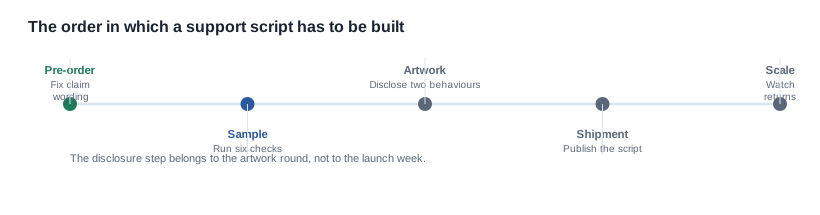
The rule is simple and it is worth writing into the product process: if a behaviour reproduces on a sample in the environment the product is sold into, and the behaviour is a property of the design rather than a fault, then it goes in the listing. There are only two of them in the standard set — coexistence during a phone call, and the achievable distance — but the number is not the point. The point is that the decision is made at the sample stage, when it costs a sentence, rather than at the launch stage, when it costs a review.

How to build the diagnostic procedure before the first ticket
Step one: write the six checks in cost order and stop at the first one that changes the state. The procedure must terminate early. A script that runs all six checks in every case is a script that has been written for the engineer rather than for the customer, and it is why first-contact resolution rates in this category are lower than the underlying fault rate would suggest.
Step two: reproduce each of the six on a sample, in the environment the product is sold into, and record the result with its conditions. Not in a laboratory, unless the product is sold into a laboratory. A coexistence result from a bench is not evidence about a warehouse.
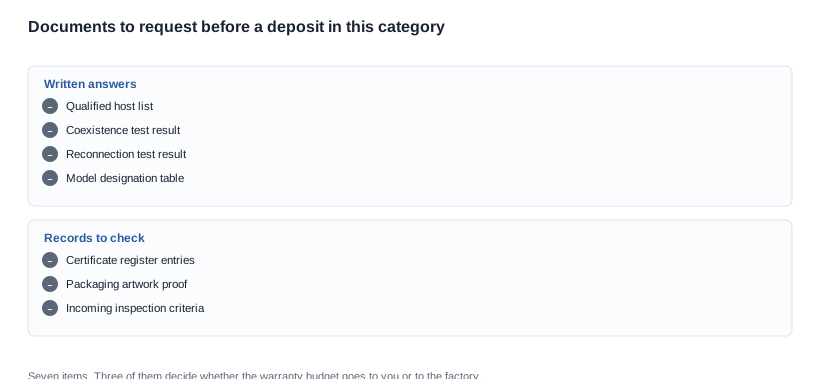
Step three: obtain the qualified host list in writing. Ask which phone models and operating system versions the linking flow has been qualified against, and insist on a written answer rather than an assurance. Without it, the answer to "does it work with my phone" is always an opinion, and the opinion is usually wrong in one direction or the other.
Step four: test the coexistence case specifically and record whether the behaviour is acceptable. This is the one test whose outcome determines what the listing says.
Step five: test reconnection after a power cycle and after the unit has been idle. This is the behaviour that generates the tickets, and it is invisible unless it is tested deliberately.
Step six: confirm the model designation on the unit against the paperwork, and verify every certificate number in the issuing body's public register at the certification checklist.
Step seven: confirm that the sample unit is the production configuration, using the procedure at sample evaluation, and check the battery transport documentation at battery transport.
The documents to request before a deposit, then, are specific and few: the qualified phone and operating system list, the coexistence test result, the reconnection test result, the model designation table, the certificate register, the packaging artwork proof, and the agreed incoming inspection criteria carrying the pass lines. Both references are public: the clause text is at contract terms; the first-order commercial structure at pricing.
Where the support budget actually goes
A microphone complaint is filed as a connectivity complaint. The symptom is a return, and the returned unit tests perfectly in the workshop. The root cause is a script that has no microphone branch. The prevention is to write the quiet-room check into the script as the first action on an "assistant does not respond" ticket, before any connection instruction.
A support script written for earbuds. The resets, the re-linking instructions and the factory-reset advice that work on a two-button earbud do not map onto a device whose radio has a sleep state, a charging case and a companion app. The symptom is that the script's final step is a return, and the return rate becomes the supplier's problem. The root cause is a script written for a different product class. The prevention is to write it against the six behaviours above and to test the script on staff before it ships.
A coexistence behaviour is discovered by the customer. This is the expensive version of the same failure. A disclosure in the listing costs a sentence; a disclosure discovered by a customer costs a review, and reviews are what the channel buys on. The root cause is that the disclosure decision was never scheduled.
A unit is returned for a fault it does not have. The symptom is a return rate that rises after launch with no change in the product. The root cause is that the diagnostic order runs the expensive checks first. The prevention is to sequence the script by cost and to publish the first-contact resolution rate as a weekly number, because it is the leading indicator for the return rate.
There is no qualification list to point at. The symptom is a support team giving a different answer to the same question on two different days. The root cause is that no written list exists. The prevention is to attach the list to the script.
The commercial terms, and where the room actually is
In a Bluetooth smart glasses programme, some things are fixed and some things move, and the two are often confused. The controller, and therefore the radio behaviour of a given platform, is fixed. The Bluetooth qualification for the shipped configuration is fixed once the platform is chosen. Certification cost and lead time are fixed per product family and carry a laboratory queue. Tooling is a one-off cost usually amortised across the first order and quoted as a separate line, and the useful questions are over what volume it is amortised and what happens to it if the programme is discontinued.
What moves is a longer list than buyers expect: whether the supplier will run the qualification list against your customers' phone mix rather than against its own test set, which is a reasonable request and is often refused; minimum order quantity tiers, and whether two models share a purchase order; colour, temple configuration, logo, lens tint and packaging; whether the supplier funds a second sample round for the coexistence and range testing; splitting a first run into two deliveries against a staged payment; and the share of units taken at the pilot tier rather than the run tier. The second sample round is the one with the most leverage in this category, because the coexistence and range work is real cost and it is the work that decides what the listing says.
A support script written in advance, and our own limits
Consider a constructed case rather than a client project, and read the steps below as the decision sequence rather than as a result.
Assume a brand-side after-sales lead who has inherited a Bluetooth audio product that launched eight weeks ago with a return rate of six per cent. The published version is V5.4 on most of the range and V5.3 on the K01 and the K02, and the listing leads with the version as a compatibility statement. The team suspects the radio because that is what the tickets say.
Step one: sorting the tickets. The lead sorts the tickets into the six complaint types. The largest group is "will not connect again after it has connected", the second largest is "audio cuts when the phone rings", and a surprising third group is "the assistant does not respond" — which the current script treats as a connectivity fault and issues a reset instruction for.
Step two: the diagnostic order. The lead rewrites the script in cost order: remove the stale host record and power cycle first; reproduce the phone-call case second; test the microphone in a quiet room third; measure at a stated distance last. The reset instruction moves out of the first step and into a later branch.
Step three: the sample round. On the next sample the team reproduces all six in a building with steel racking and a router in the office. Two reproduce: the coexistence case and the arm's-length case. The reconnection case does not reproduce on a unit that has been idle overnight, but does reproduce after a week in a drawer, which the team had not anticipated.
Step four: the disclosure decision. The coexistence case and the distance case are disclosed in the listing and in the product page. The return rate for the second month falls, because the two behaviours that were generating reviews are now expected rather than surprising. The reset instruction disappears from the first-contact path.
Step five: the commercial consequence. The team uses the reproduction results to write the incoming inspection criteria, so that a lot which fails the stated-distance test is a lot that can be refused at receiving. It also asks the supplier to fund a second sample round, on the grounds that the coexistence work is what produced the disclosure.
The decisive step was step one. Nothing about the version changed; what changed was that the tickets were sorted by cause rather than by symptom, and two behaviours moved from the defect column into the disclosure column.
What our own catalogue can and cannot tell a support team
The working rule we apply: we publish the Bluetooth version per model exactly as the catalogue states it, and we publish the absence of a measured range, a qualified host list and a coexistence result with the same prominence. We will not present a version number as a compatibility result, and we will not estimate a range from typical values.
We publish Bluetooth V5.3 on the K01 and the K02, and V5.4 on the D11, the D12, the LC-105-1, the LC-105-2, the G07, the YK12, the YKC02, the D17, the ZH12, the A07, the electrochromic entry and the AR entry. The AI camera glasses family, the bone conduction entry, the A05 and the A06 publish no version. We publish no measured range, no multipoint figure, no codec list, no profile list, no module part number, no update method and no qualification reference for any model, and we will not estimate any of them.
One further row is worth reading the same way in a support context. Our catalogue publishes a weight for a single entry — the MT6 glasses unit at 158 g, excluding its foldable charging case, which holds 1200 mAh — and publishes none for the rest of the range, so a support team working from the catalogue alone has no basis for an expectation about the units in front of them. This is not an efficacy claim for vision, health or eye protection, and we do not make one.
Models, phone mix and the decision
Send us the models you are evaluating, the phone mix your customers use, and the environments the product is sold into. We will tell you which of the six problems the published rows can already rule out, which ones have to be tested, and which have to be disclosed in the listing before you commit to a volume. The background on the version and what it does and does not tell a buyer is at manufacturer claims, the technology is at Bluetooth connectivity, and the range is at Bluetooth audio glasses.
Tell us the models, the phone mix and the environments, and we will say which of the six problems you have to test and which you have to disclose.


