
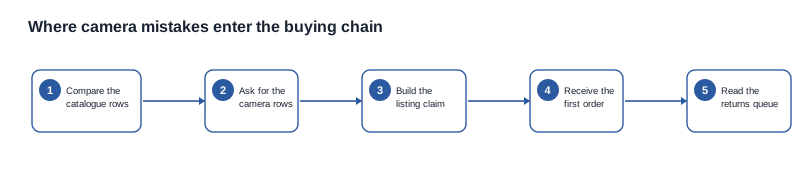
The camera is the most over-claimed component in this category, and the reason is that the number on the sheet is so easy to compare and so easy to be wrong about. In our own catalogue the camera models are published at 8 MP and 13 MP, and that resolution figure is the only imaging row we state for any of them. Everything else — the sensor, the field of view, whether the product records moving images at all, whether the material can be retrieved — is open. A buyer working from that sheet alone will make at least one of the eight mistakes below, and most of them are made before a sample is ordered rather than after one arrives.
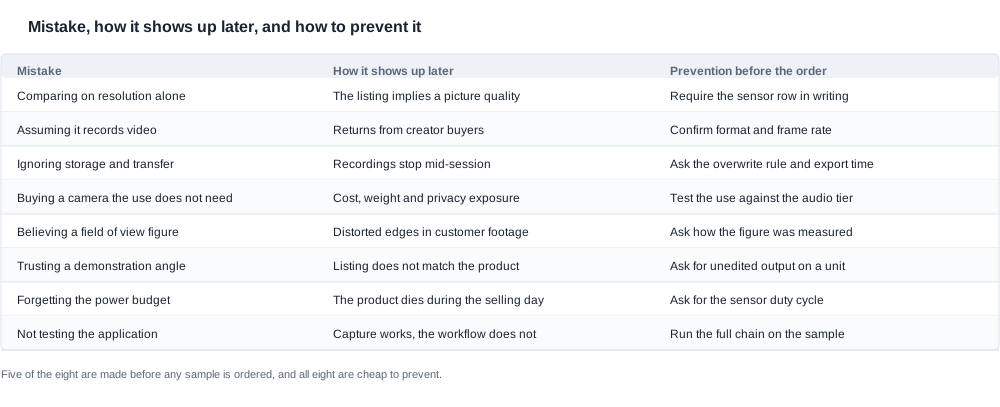
Smart glasses camera technology: eight mistakes, in order
The first mistake is comparing on resolution. Resolution is a count of pixels and it does not tell you how large the pixels are, which is what governs how an image behaves indoors or at dusk. It does not tell you the field of view, so two products with the same count can frame completely differently. And it says nothing at all about whether the product records video. A 13 MP sensor and an 8 MP sensor are two points on a sheet, not a ranking of products, and if the only difference you can see between two candidates is the number, you do not yet have enough information to choose — you are choosing on the row that decides the least.
The second mistake is assuming the model records video. Our catalogue publishes no video resolution and no frame rate for any of the eleven camera models, which means a buyer who assumes a video product is making an assumption. The consequence is a product that captures stills being sold as a first-person video camera, which is the fastest way to generate a returns wave from a creator audience. This is a one-question fix: ask for the video resolution, the frame rate and whether audio is captured with the video. If the answer is that it is stills only, the product is a different product and the listing has to say so.
The third mistake is ignoring storage and transfer. Capacity, file format and overwrite behaviour are not published for any camera model in the range, and they decide how long a session can be. A product that fills its storage mid-shoot produces a recording that stops without warning, and the customer experiences that as a fault. For a creator this is the most important row on the sheet after the video specification, and for a buyer it is the row that decides whether a customer can use the product for the thing they bought it for.
The fourth mistake is buying a camera for a job that does not need one. This is the mistake that costs the most and the one that is hardest to see, because it arrives as a product idea rather than as a sourcing error. The camera is the most expensive component in the tier, the heaviest, the largest single power consumer, and the one that brings a privacy and store-policy conversation with it. If the product is a calls product, a translation product or an enterprise meeting product, a camera is cost and mass with no return.
The fifth mistake is believing the field of view claim. A field of view figure without a statement about the edges tells you only the middle. A wide lens produces a small subject at the centre with distorted edges, which photographs dramatically and records badly. Ask what the field of view is, and ask whether the distortion at the edges is corrected in the processing.
The sixth mistake is trusting the demonstration angle. A camera mounted on a head and filmed from the front is a different image from the camera's own output, and the suppliers who publish the best images are usually filming with a wide lens close to the subject. A listing that shows a demonstration unit's output is not showing the customer's output. Ask for unedited stills and video from a unit carried as a customer would carry it, at arm's length, in ordinary light.
The seventh mistake is forgetting the power budget. The camera is the dominant consumer in a smart glasses product, and the published runtimes reflect that: the camera models sit between about five and about eight hours across four different cell capacities. A buyer who chooses a camera model on the image specification and then plans a selling-day use case will find the limit at the worst possible moment.
The eighth mistake is not testing the application. A camera that captures well and a product a customer can actually use are different things, because the capture has to reach the phone, land in the right place and be findable. The companion application is part of the product, and it is the part a buyer most often skips, because the sample photographs well and that feels like progress.
Taken together, the eight are a checklist rather than a list of warnings, and the order matters: the four at the specification stage are the ones to check before you order, and the four at the field stage are the ones to write into the acceptance criteria before the first production run. A buyer who wants a single working document should copy the eight questions out of the camera buying checklist and use them as the request, because the two articles describe the same rows from opposite ends of the same process.
The mistakes that cost money before a sample is ordered
Four of the eight mistakes are made at the specification stage, and they are the four that are expensive, because the specification sheet is what the quotation is negotiated against and what the tooling, the packaging artwork and the listing copy are all derived from. A mistake made here does not stay in the specification; it propagates.
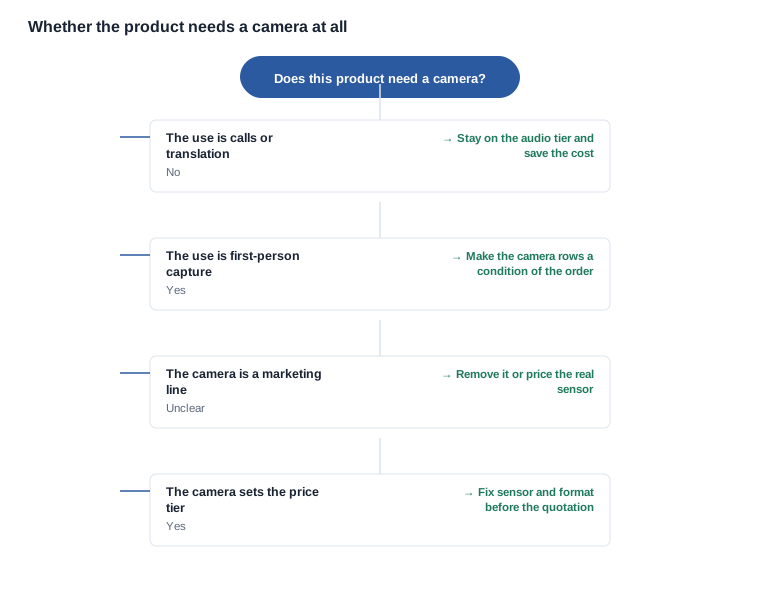
The decision chart above isolates the fourth mistake, because it is the only one of the eight that is a product decision rather than a sourcing error. The branching is deliberate: a product sold for calls or translation does not need a camera, and choosing the audio tier is normally the cheaper and simpler route. A product sold for first-person capture cannot avoid the camera, which makes the camera rows conditions of the order rather than items to check off later. A camera that is really a marketing line is a third case, and the honest handling of it is to remove it or to price the sensor that will actually be fitted — because a listing that shows a camera image from a different product is a product that returns. And a product where the camera sets the price tier has to have its sensor and its output format fixed before the quotation, not after, because everything downstream of the price depends on it.
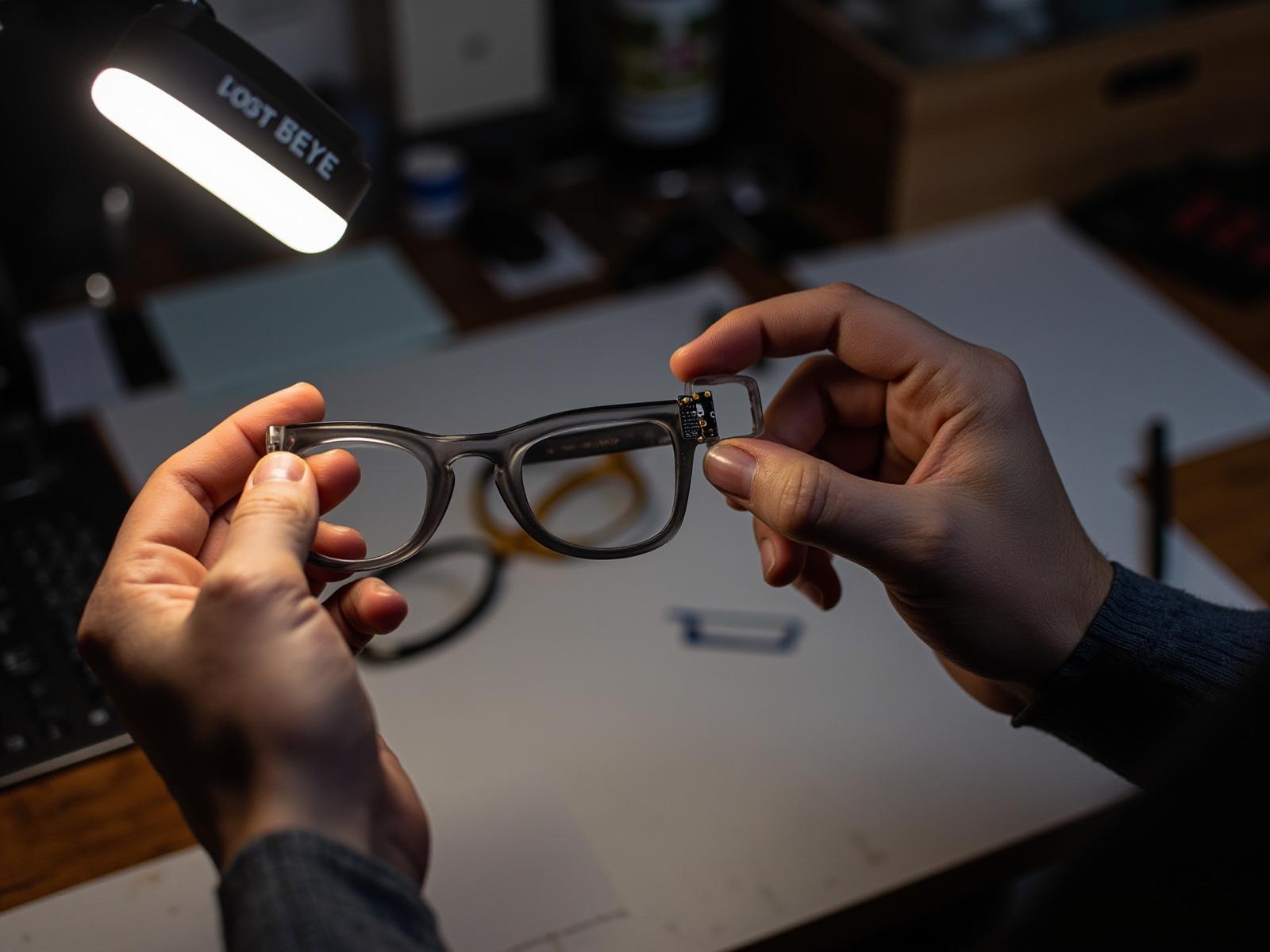
The cost arithmetic behind the first mistake is worth doing once, explicitly, because it changes the order of the questions. A 13 MP tier in this catalogue comprises three models: the L1 Pro on a 290 mAh cell with a 1400 mAh case, the L2 Utral on 290 mAh with a 900 or 1400 mAh case, and the S7 on 260 mAh with no case and an IP54 rating. A buyer who compares those three on the pixel count alone has not compared them at all, because the cell configuration, the case configuration and the environmental rating all differ. The pixel count was never going to separate them. A buyer who compares them on the cell configuration, the case configuration and the rating, and then asks for the video format and the field of view, is comparing them on something that can change the product.
How to choose between two camera candidates using only the published rows is a short exercise, and it is worth doing before any sample arrives because it changes which questions you ask. Write the two candidates down as two columns of the six published rows — resolution tier, rated runtime, cell configuration, charging method, case configuration and IP rating — and mark the rows where they differ. Where the candidates agree on all six, the camera is very probably not what separates them, and the evaluation budget belongs elsewhere. Where they differ on cell configuration and case configuration, the price difference you are about to negotiate is already explained, and the remaining questions are about the camera itself. Where one of them has no case and the other has a 1400 mAh case, the comparison is also a comparison of two accessory plans, which is a decision in its own right and is usually made earlier than the buyer realises.
The number of real differences is usually small, and that is a useful finding rather than a disappointing one. Two candidates that differ on the sensor, the video format and the field of view are genuinely different products and need the full eight-question request. Two candidates that differ only in the case configuration may be the same product with different packaging, in which case the supplier's own technical file will say so, and the camera comparison can be closed with a single question.
The second mistake is expensive for a specific reason: it is the one that determines whether the product can be listed at all. A listing that promises video and a product that captures stills is not a marketing error, it is a product that cannot be sold into the channel it was designed for, and the withdrawal of a listing mid-season costs more than the camera itself.
The mistakes that surface after the first production run
The remaining four mistakes have a longer fuse. They survive the sample stage, they survive the first inspection, and they arrive with the first production run or the first field season, which is why they are the mistakes that end up inside a warranty claim.
The third mistake — storage and transfer — becomes a returns theme rather than a specification error, because the customer fills the storage and the recording stops. The fifth — the field of view — becomes a listing problem, because the product records a scene the customer did not expect to see. The sixth — the demonstration angle — becomes a mismatch between the listing imagery and the product, which no amount of good photography fixes afterwards. And the seventh, the power budget, becomes a product that dies during a selling day, which is the worst of the four because it happens in front of the customer.
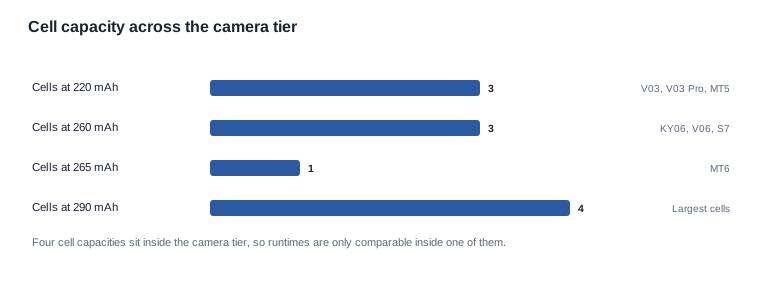
The power mistake deserves a little more detail, because the published numbers make it easy to get wrong in both directions. The camera tier spans four cell capacities: 220 mAh on the MT5 and the V03 Pro, and the V03, 260 mAh on the S7 and the V06, and the KY06, 265 mAh on the MT6, and 290 mAh on the L1 Pro and the CY05, and the CY03 and the L2 Utral. Every camera model publishes a rated runtime, and those figures run from about five to eight hours to about seven hours on the larger cells. Two mistakes live in that row. The first is comparing a runtime across cell classes, which compares three variables at once — the cell, the camera duty cycle and the workload. The second is treating any of the figures as a capture-time budget, which it is not: a runtime published for a product whose camera is idle most of the time tells you nothing about how long the product records.
The mitigation for all four is the same and it is unglamorous: write the ceiling into the acceptance criteria of the first production order. Minutes of continuous capture, clips per session, the time for a one-minute clip to reach the phone, the runtime under a stated workload. Four clauses, each of them measurable, and every one of them written before the tooling is committed. A defect reported against a written criterion is a defect that can be closed; the same defect reported against nothing is an argument about quality that the factory will win.
Reading the afters data for signs of these four mistakes is a specific skill, and the signs are usually distinguishable from each other. A storage complaint arrives with a partial recording attached and no fault reported, which is a different shape from a power complaint, which arrives with a unit that stopped working at a predictable point in the day. A field of view complaint arrives with an image that is correctly exposed and framed incorrectly, which points at the lens rather than at the sensor. And a listing mismatch produces a complaint that does not mention the camera at all, because the customer is describing the product they were sold rather than the product they received. Sorting complaints into these four shapes is what turns a returns figure from a monthly statistic into a set of addressable causes, and it is the cheapest diagnostic work available to a brand in this category.
There is also a commercial consequence to the fourth mistake that is usually discovered late. A camera model brings a data question with it — where the captured material is held, whether the processing happens on the unit or in a service, and what the customer is told — and a data question that surfaces after the listing is written is a question about the listing copy. For a brand selling into markets with privacy expectations around recorded material, that is a market-access conversation rather than a product one, and it is much cheaper to have before the copy exists.
The mistake that is really a decision about whether a camera belongs in the product
The fourth mistake deserves to be separated out, because it is the one where the sourcing question is a distraction from the product question.
The audio tier in this catalogue is substantial. Eight rows publish a Bluetooth version, with the K01 and the K02 on V5.3 at about eight hours, the D11 and the D12 on V5.4 at about seven hours, the LC-105-1 and the LC-105-2 at about eight hours, and the G07 and the YK12 at about six hours. The sport models publish a Bluetooth version as well, with the YKC02 at about eight hours, the D17 at about seven hours and the ZH12 at about eight hours, and the A07 adds about twenty hours on a 70 mAh cell. Cells across those rows run from 55 mAh × 2 to 115 mAh. There is a product in that list for a calls brief, a translation brief and a meeting brief, and none of them requires a camera to be credible.
Adding a camera to satisfy a price tier is a different act from adding a camera because the use case needs one, and the difference shows up in the afters rather than in the specification. A camera brings a component cost, mass at the end of the temple, a large addition to the power budget, a storage rule to document and a data story to tell. Each of those is manageable on its own. Together, they convert a simple audio product into a product with four new failure modes and a listing that has to be checked against a different set of claims.
The decision criteria are four, and they are answerable before anybody quotes a price:
- Does the use case require captured material, or does it merely benefit from having a camera? A translation or meeting brief usually does not, and a creator brief always does.
- Does the listing need an image to convert, and if so, whose image? The customer's unit or the demonstration unit is not a small distinction, and it is the one the sixth mistake comes back to haunt.
- Is the privacy and data story one the brand can answer in a single sentence? If it cannot, the camera is not a specification question yet, it is a product question.
- Can the camera rows be closed in writing before the first order? If they cannot, the listing is being written on an assumption, and the assumption will be tested by the first customer rather than by a sample.
A brand that answers those four questions honestly usually finds that it needs one camera model, in one configuration, for one purpose — and that the rest of the range belongs in the audio tier. That is not a narrower answer. It is a cheaper one, and it is the answer that survives contact with the first production run. Does the use case require captured material, or does it merely benefit from having a camera? Does the listing need to show an image to convert, and if so, whose image — the customer's unit, or the demonstration unit? Is the privacy and data story one the brand can answer in a sentence? And can the camera rows be closed in writing before the first order, or will the brand be listing on an assumption?
What we will not estimate for a camera model
We publish the imaging rows we have and mark the rest as open, and we would rather a buyer removes a comparison than makes it on a number that does not support it. We publish 8 MP and 13 MP tiers, and we publish no sensor model, no field of view, no video specification, no aperture, no stabilisation figure, no storage behaviour and no low-light data for any camera model. We will not tell you that 13 MP is a better picture than 8 MP, because on the evidence we hold that is not a statement we can make.
What we will do is take two candidate models and mark the eight questions above against each of them, so that you can see which are real differences and which are blank cells on both sides. Two candidates with the same blank cells are not competing on the camera, and knowing that early is worth more than a day of testing. We will also tell you which of the blanks a sample can settle, which it cannot, and which of them have to be closed in writing before the first order. A sample settles behaviour; it does not settle a batch, and a defect rate is production data rather than evaluation data.
The imaging background sits under camera and imaging, the do you need a camera discussion covers the fourth mistake in more depth, and the sample protocol sets out how the eight checks are run on a unit.
Send us the two models you are comparing and we will mark the eight questions against each of them.


