
A camera buying checklist in this category is mostly a list of rows that have to be obtained rather than compared, and accepting that is the first thing that makes the process work. Our catalogue publishes one imaging number per camera model: 8 MP on the CY05 and the KY06, the CY03 and the MT5, and the V03 and the V06, and the MT6 and the V03 Pro, and 13 MP on the S7 and the L2 Utral, and the L1 Pro. Everything else that decides whether the camera does the job — the sensor, the field of view, the video format, the stabilisation, the storage rule, the sensor duty cycle, the processing location — is open on every one of the eleven camera models.
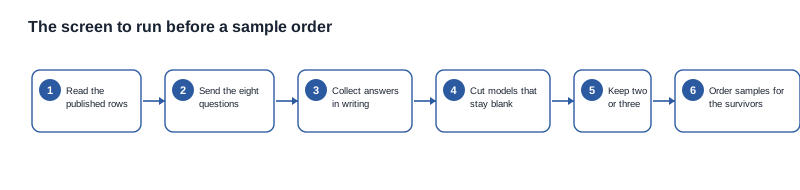
So the checklist is not a comparison sheet. It is a screening procedure, and its output is a candidate pool of two or three suppliers with a document set, rather than a ranking of eleven models on one number. This article covers the stage before the order: what to screen, what to ask, and what has to exist in the file before a quotation is worth comparing.
Smart glasses camera technology: rows before the shortlist
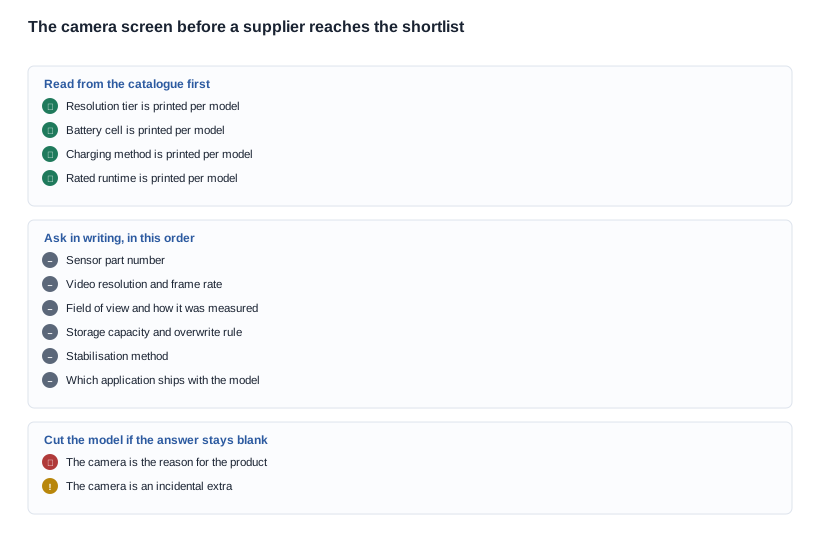
Five rows can be read from the catalogue before anyone is contacted, and a buyer who reads all five before the first enquiry removes candidates that a price comparison would later have removed more expensively. The resolution tier places the model in a product and price family. The cell configuration — 220 mAh on the V03 Pro and the MT5, and the V03, 260 mAh on the V06 and the KY06, and the S7, 265 mAh on the MT6, and 290 mAh on the L1 Pro and the L2 Utral, and the CY03 and the CY05 — sets the battery strategy and the price tier. The rated runtime, which every camera model publishes, tells you how the model is scheduled. The charging method tells you the accessory and the cable commitment, and it splits the range in two, because the V03 Pro is a Type-C model while the rest of the camera tier charges magnetically. The case configuration tells you the packaging and the bundle, and it splits the range again: the V03 and the S7, and the V06 and the V03 Pro have no case, the KY06 and the MT5 have a case whose capacity is not published, the L1 Pro and the CY03, and the CY05 carry a 1400 mAh case, the L2 Utral carries a 900 mAh or 1400 mAh case, and the MT6 carries a 1200 mAh folding case.
The sixth published row is the IP rating, and it is the one most often missed because it is present on two models only. IP54 appears on the V06 and the S7 and on no other row in the catalogue. If the brief is a wet-environment or an all-weather brief, that is a hard screen rather than a preference, and it reduces the camera tier to two candidates before a single question is asked. If the brief is not, the absence of the rating on the other nine models is not a defect; it is a statement that no water-resistance claim may be made for them, which is a listing-copy constraint rather than a product constraint.
The screen has a second job that is less obvious than the first. It establishes the commercial shape of each candidate before any question is asked, which means the price comparison that follows is a comparison of like with like. A model with a 1400 mAh case in the bundle and a model with no case at all are not two prices for the same product; they are two products with two different landed costs, two different packaging commitments and two different accessory plans. Screening on the published rows first means that difference is visible in week one rather than in the negotiation, when it is much harder to move.
After those six rows, the screen has done what it can and the remaining seven rows have to come from the supplier. The point of screening first is that the candidate pool entering the request stage should be small. Three or four candidates is a workable number; eleven is a request you cannot read carefully, and a request you cannot read carefully produces a response you cannot compare.

Eight questions that decide whether a camera model reaches the sample stage
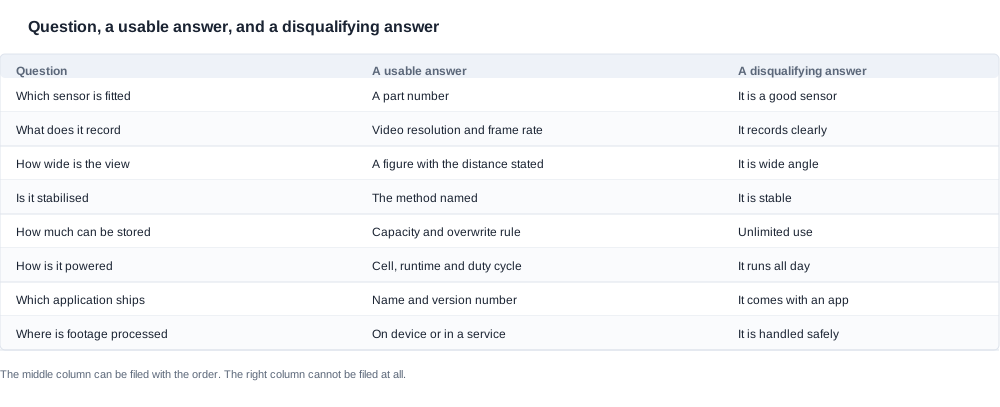
The eight questions below are ordered by how much they eliminate, not by how interesting they are. The first one alone removes a large share of the field, because a manufacturer knows its sensor part number and a trader frequently does not.
- Which sensor is fitted? A part number is enough, because it gives the pixel size, the design era and whether low-light behaviour is plausible at all. A usable answer is a part number with a datasheet; a disqualifying answer is a description of how good the camera is.
- What does the model record? Video resolution, frame rate, and whether audio is captured with the video. A usable answer names all three; a disqualifying answer says it records clearly.
- How wide is the view, and how was it measured? A usable answer is a figure with the measurement distance stated; a disqualifying answer is a claim that it is wide angle.
- Is it stabilised, and by what method? A usable answer names the technique or states plainly that there is none; a disqualifying answer says the footage is stable.
- How much can be stored, and what happens when it fills? A usable answer gives the capacity, the format and the overwrite rule; a disqualifying answer promises unlimited use.
- How is it powered during capture? A usable answer gives the cell, the rated runtime and the sensor duty cycle the figure assumes; a disqualifying answer is a claim that it runs all day.
- Which application ships with the model, and at which version? A usable answer names the application and the build; a disqualifying answer says one is included.
- Where is the captured material processed? A usable answer states whether the processing is on the unit or in a service, and where the material is held; a disqualifying answer reassures rather than states.
How the request is written matters as much as what is in it. Send all eight questions as one request, with the model named against each one, and with a response deadline that sits alongside the commercial deadline rather than after it. A request issued as a single document produces a single answer that can be filed; eight separate emails produce eight answers that have to be reconciled later, and the reconciliation is where a discrepancy between two replies hides. Where a model is offered in several configurations, ask the questions per configuration, because the answer for one configuration is not transferable to another — a case configuration in particular changes the bundle, and a supplier who answers for the configuration they prefer to sell is answering the wrong question.
Two of these carry most of the weight. The first is the one that separates a manufacturer from a trader, and it does so in a single question because a manufacturer chose the sensor and can name it. The sixth is the one that converts a runtime claim into a production plan, because a runtime figure quoted without a duty cycle describes a unit whose camera was idle for most of the published period, and a buyer planning a selling day around that figure is planning around the wrong product.
A partial answer is normal and should be handled rather than treated as a refusal. A supplier who answers the sensor, the video format and the storage rule and leaves the field of view open has given you the three rows that decide whether the product is the right product at all. The right handling is to record the open row as open, with a deadline attached, and to let the sample stage settle it. The wrong handling is to treat the unanswered row as answered in the supplier's favour, because the silence of a quotation is read as agreement by everyone downstream of it.
Two candidates can both answer all eight questions and still be different decisions, and the difference is usually commercial rather than technical. One may carry a case configuration that suits the bundle the brand already sells, and the other may require a new accessory line, a new packaging artwork and a new barcode, which is a real cost that does not appear on the quotation at all. One may sit at a minimum order that the first year of volume cannot reach, which turns a good product into a product the brand cannot actually buy. Another may have a lead time that is longer than the launch window allows, regardless of how good the camera is. The question to ask before the order is therefore not only which camera rows are closed, but whether the commercial shape of the candidate survives contact with the first year of the plan.
There is a fourth question that is easy to leave to the end and expensive to leave: does the supplier actually build this model, or does it buy it and rebrand it? The camera rows are the fastest way to find out, because a manufacturer can answer all eight without hesitation and a trader has to go and ask somebody. The answer is not disqualifying on its own — plenty of successful programmes are sourced through a partner who does not build the product — but the supplier who cannot say where the camera came from cannot also answer questions about the firmware that follows the sensor.
The document set that has to exist before a quotation is compared
Five documents make up the file that a camera quotation should be read against, and the order in which they are assembled matters because it stops the comparison happening too early. The imaging sheet holds the seven answers above. The electrical sheet holds the published rows — cell configuration, rated runtime, charging method, case configuration, IP rating — which are the rows the supplier cannot change without changing the product, and which are therefore the ones a negotiation should be conducted against. The conformity document set holds the declarations and the test reports, so that the model designations can be read against the models actually being bought; the camera technology manufacturer claims article covers how the marketing versions of these rows are usually phrased, and the camera technology red flags article covers the entries to reject before a sample is ordered. The application and processing description holds the two answers that decide whether the product works without a connection and what happens to the captured material. The commercial sheet holds the minimum order, the price tier, the lead time, the packaging commitment, the warranty position and the terms for a private-label programme.
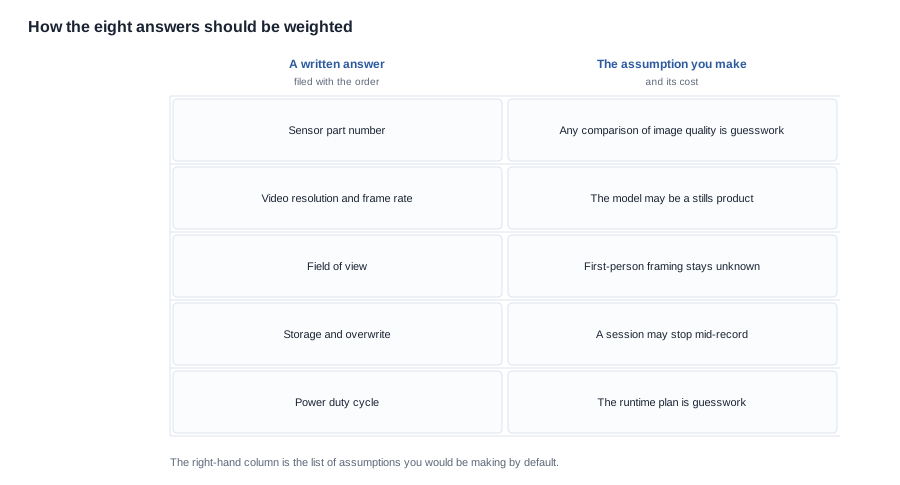
The weighting in the matrix above is the point of the whole procedure. A written answer that can be filed is worth more than an assumption that happens to be right, and the cost of a wrong assumption is not symmetric across the seven rows. An assumption about the field of view is recoverable, because it shows up in the first sample review. An assumption about the storage rule is recoverable, because it shows up in the first week of field use. An assumption about the video format is not recoverable, because it determines whether the product can be listed at all, and a listing written on the assumption has to be withdrawn after the sample arrives.
The commercial sheet deserves particular attention because it is the part most often left informal, and it contains the terms that decide whether a camera programme is profitable. The minimum order, the price tier and the lead time determine whether the programme can be planned at all. The packaging commitment determines whether the accessory and the bundle can be changed after the artwork is approved. The warranty position determines whether the afters exposure sits with the brand or with the factory, which on a camera product is a much larger number than on an audio product because the camera is the part customers complain about. And the terms for a private-label programme determine who owns the mould, which is the question that decides what can change in year two.
A short due-diligence step on the supplier side is worth adding to the same file: ask which configurations the conformity documents in your possession actually cover, and check that list against the models in the candidate pool. A camera programme that covers two configurations in its documents and buys three is a programme that will discover the third one during a shipment.
The reason the file has to exist before a quotation is compared is straightforward. A quotation compared against an unknown is a comparison of the wrong thing: the supplier who has closed the rows is quoting a product, and the supplier who has not is quoting a possibility, and the two prices are not comparable because they cover different amounts of specification work. The total cost of a camera programme includes the engineering time the open rows consume, and that time is real whether or not it appears on the quotation.

Weighting the published resolution tier without over-reading it
The resolution tier is the one published camera number, and it deserves a careful treatment because it is the row buyers reach for first and over-read most often.
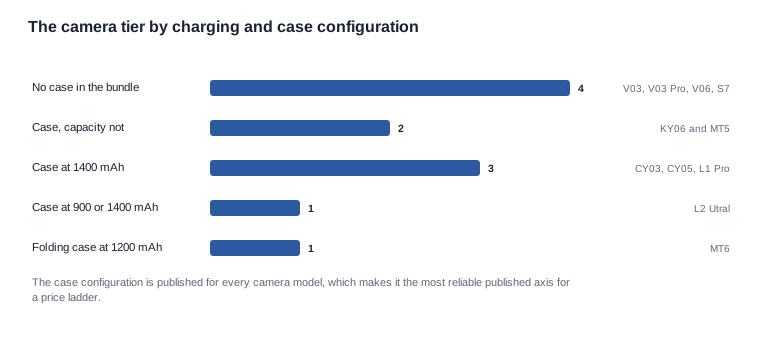
What the tier is good for is grouping and structuring. Eight MP covers eight models spanning four cell configurations, two charging methods, three case configurations and both IP ratings, which means the tier is a product family rather than a performance class, and it is an excellent basis for a price ladder. Thirteen MP covers three models: the L1 Pro at 290 mAh with a 1400 mAh case, the L2 Utral at 290 mAh with a 900 or 1400 mAh case, and the S7 at 260 mAh with no case and an IP54 rating. That is a genuinely useful answer to a brief that says thirteen megapixels — three candidate models, with three different commercial shapes.
What the tier is not good for is predicting quality, and the reason is that resolution is a count rather than a measurement. It does not state how large the pixels are, which is what governs how an image behaves indoors or at dusk. It does not state the field of view, so two products with the same count can frame completely differently. It says nothing about whether the product records moving images. And because the sensor part number is unpublished for every model, a buyer who wants to know whether the 13 MP tier is genuinely better than the 8 MP tier cannot find out from the catalogue, from us, or from any other published source — only from a sample comparison and a part number.
There is also a commercial caution about reading the tier as a quality ladder in the listing. A brand that positions its camera product on the 13 MP tier without being able to show what the extra pixels change is making a claim that the sample will not support, and the gap between the claim and the product is the gap that produces returns and one-star reviews. The published tier is enough to justify a resolution claim and not enough to justify an image-quality claim, and the discipline is to write the listing in the first register rather than the second.
The disciplined use of the published tier therefore looks like this. It works to build the candidate pool, to structure the price ladder and to write the listing copy at the correct level of precision. Use the cell configuration, the case configuration and the IP rating — all published — to separate the candidates within a tier. Then spend the evaluation budget on the seven rows that are actually open, ranked by which of them would be decisive for the use case. A buyer who does that will end up with a shortlist of two or three models, a document set for each, and a defensible reason for the one that wins.
The same published rows also determine where the commercial risk sits in a camera programme, and a buyer who reads only the tier will miss it. The models with a case in the bundle carry a second component that has to be sourced, stocked, shipped and eventually disposed of, and that component has its own lead time and its own failure mode; a case that does not charge or a case whose firmware does not match the glasses is a support contact that is attributed to the camera. The models without a case have a lower landed cost and a simpler afters story, and for a first product in a category that is frequently the better risk position even when the case configuration looks like the more complete answer. The models with a folding case sit in between, and the one published weight in the catalogue belongs to the folding case model, at 158 g for the glasses body including the battery and the camera, excluding the foldable case whose own weight is not published — which means the shipped weight of that configuration is not a number anyone can quote from this catalogue.
It is worth being precise: we publish resolution because the manufacturer publishes it, and we will not estimate a sensor, a field of view, a video format, a stabilisation status, a storage figure or a low-light result for any model in the range. Where we hold an answer we will give it, and where we do not we will say so rather than supply a number that will later be held against the product.
Send us the models you are narrowing down, the volume, the destination market and the use case, and we will tell you which of the eight questions we can answer from the catalogue, which have to go to the supplier, and which of the two should decide the comparison. The imaging background sits under camera and imaging.


