
Adding a camera to a pair of smart glasses is not a feature decision. It is a product decision, and it changes the hardware, the power budget, the compliance file, the retail conversation and the privacy conversation at the same time. Plenty of programmes arrive at a camera-equipped product by default, because the reference product in the category has one and the assumption is that a competitor without one will read as the cheaper option. This article is about testing that assumption, because in a lot of cases the audio-only product is the better commercial answer even though it is the less exciting one.
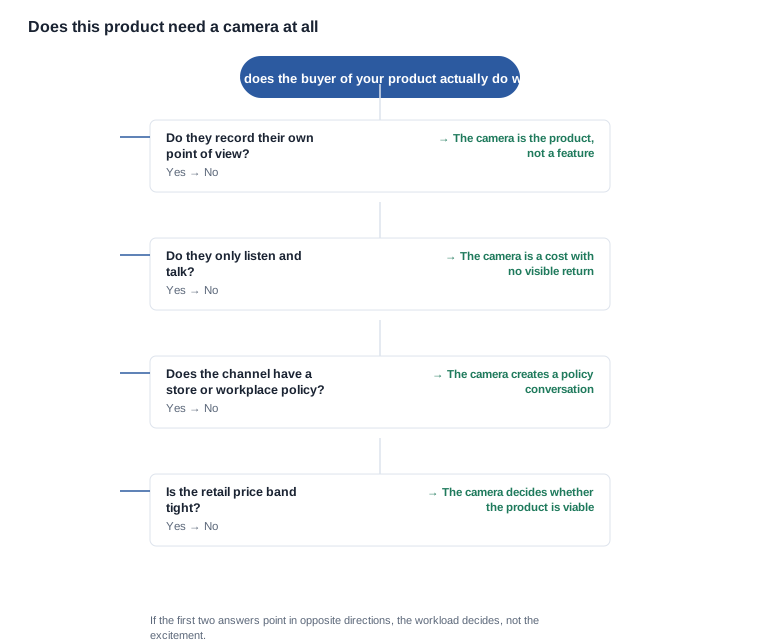
The test is narrow and it is decidable: what does the buyer of your product actually do with it? If the answer involves recording their own point of view, the camera is not an accessory, it is the product, and the question becomes how good it is and how well it is evidenced. If the answer involves listening, talking and being hands-free, the camera is a cost with no visible return, and the arguments for it are commercial rather than functional.
Smart glasses camera technology: a product decision, not a feature decision
The four questions that settle it
The first question is what the customer does with the product. If they record their own point of view, the camera is the product and the question becomes quality: the resolution tiers we publish, 8 MP on the CY03 and the MT5, the KY06 and the MT6, and the V03 Pro and the V03, and the V06 and the CY05, and 13 MP on the S7 and the L1 Pro, and the L2 Utral, and then the much harder question of what else to ask for, because resolution is the least informative of the rows.
If they listen and talk, the camera is a cost. It adds a sensor, a lens, an image pipeline, storage and a transfer path. It adds weight, it adds a meaningful amount to the power budget, it adds a line to the technical file, and it adds a privacy and store-policy conversation that an audio product does not have to have.
The second question is whether the channel has a policy problem. A retailer who stocks a product that records continuously has questions about the store floor, a corporate buyer has questions about the workplace, and a marketplace has rules about it. An audio product avoids all of that, and for a product sold on calls and hands-free use, that avoidance is worth real money.
The third question is the retail price band. A camera moves the bill of materials and the tooling, and at the bottom of a price band the difference between a camera product and an audio product is frequently the difference between a viable product and one that does not clear the landed cost.
The fourth question is the one that is asked last and should be asked first: does the reference product in your channel have a camera? A competitor's specification is not evidence for a feature in your product, and the competitive comparison that drives the decision is usually a shelf comparison rather than a workload comparison.
When the answer is yes, the camera has to earn the position
If the workload genuinely involves first-person capture, the camera has to be specified like the primary function rather than treated as an accessory, which means the six imaging rows have to be requested in writing and the acceptance criteria have to be written before the sample order. Adding a camera and then not evidencing it is the worst of both outcomes: the cost is in the bill of materials and the compliance file, and the benefit is absent because the evidence was never gathered.
What the camera actually adds to the bill of materials and the file
The four layers the camera touches
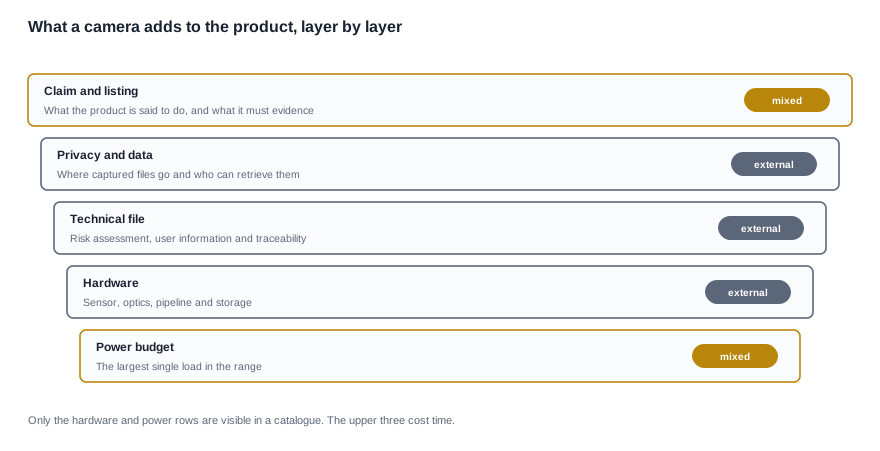
The hardware layer adds the sensor, the optics, the image pipeline, the storage and the alignment step in assembly. It also changes the frame, because the module has to fit inside a temple, and the frame change is the part of the cost that does not appear on an electronics line.
The power budget layer is where the camera's cost appears first and most visibly. The camera is the largest single consumer in the range, which is why the camera models' published runtimes cluster in the five-to-eight-hour band while several of the lighter audio models publish eight hours, and why a camera product with a case is a different commercial proposition from one without.
The technical file layer adds a privacy and security assessment, a user information document that states plainly that the product records, and a data-flow description. The general product safety regime has applied since 13 December 2024, and a product with an imaging sensor and storage brings questions the audio version does not.
The claim layer adds the promise. A product page that says the device records images creates an expectation about bystanders, about retention and about where the files go, and each of those expectations has to be answered somewhere the customer can read it.
Why the audio version avoids all of it
An audio product's output is sound, and sound has no format problem, no transfer problem, no storage exhaustion problem and no bystander problem. Its file covers the radio, the substances and the cell, and the cell is a smaller cell: the audio family in our catalogue runs from 55 mAh per cell on the LC-105-2 and the G07, and the YK12 and the LC-105-1, through 90 mAh on the K01 and the K02, to a single 100 mAh on the D11 and the D12. The children's models sit below that band at 40 mAh on the A05 and the A06 and 70 mAh on the A07, and the sport models sit above it, with 100 mAh on the ZH12 and 115 mAh on the D17. Several of those models carry two cells rather than one, which is how a 55 mAh cell reaches an eight-hour rating.
The children's range publishes a runtime of about twenty hours at 40 mAh and 70 mAh, which is a different power architecture rather than a better version of the same one. The comparison matters for one further reason. An audio product is the easier product to re-order, to re-tool and to keep in the catalogue, because the configuration space is small. A camera product's configuration space includes the camera tier, the case state, the colour and the charging interface, and each combination carries a per-configuration minimum.
The power budget is where the camera's cost first appears
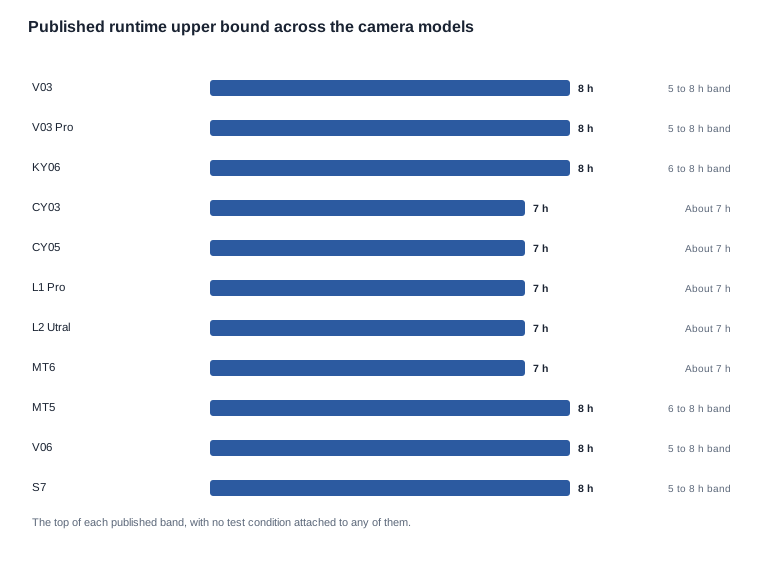
Reading the runtime band across the camera models
The published runtimes cluster tightly: about seven hours on the 290 mAh configurations — the CY03 and the CY05, and the L1 Pro and the L2 Utral — and on the MT6 at 265 mAh; five to eight hours on the V06 and the V03 Pro, and the S7 and the V03; and six to eight hours on the KY06 and the MT5. The chart shows the upper end of each band, and no test condition is attached to any of them.
That last point is the commercially important one. A runtime figure with no load, no temperature and no recording mode is an upper bound, and a buyer who puts an upper bound on a product page as if it were a typical figure will generate returns from the customers who work in the worst case rather than the average one.
The case configuration as the practical answer to the power problem
Seven of the eleven camera models ship with a charging case, and the case is the published answer to the runtime problem: 1400 mAh on the L1 Pro and the CY05, and the CY03, 900 or 1400 mAh on the L2 Utral, and a foldable 1200 mAh on the MT6. The KY06 and the MT5 ship with a case whose capacity the catalogue does not publish. Four camera models — the V03 Pro and the V03, and the S7 and the V06 — publish no charging-case row at all.
For a buyer choosing between camera and audio, this is the practical comparison to make: a camera product with a case and a runtime of about seven hours has a working rhythm that an audio product with eight hours and no case row published does not, but it also carries a second component in the packaging, a second cell in the transport paperwork, and a second configuration in the per-configuration minimum.
The published rows, camera family against audio family
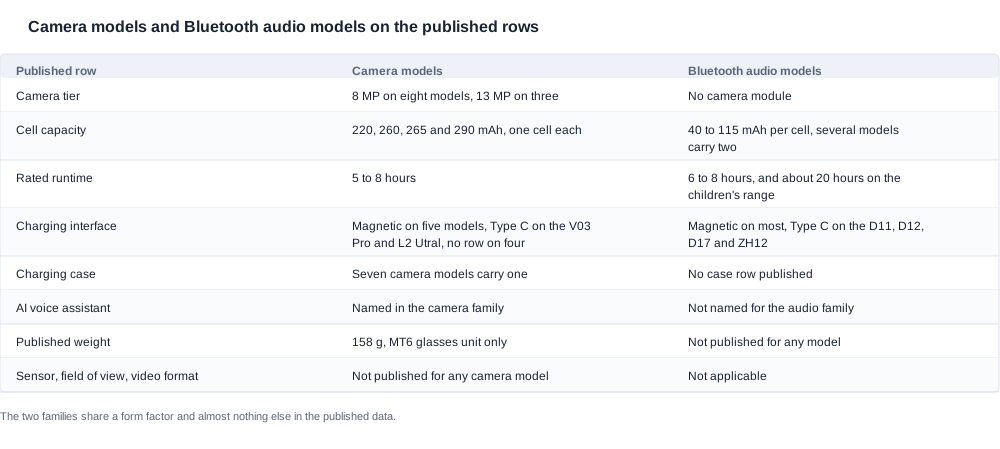
Reading the two families side by side
The two families share a form factor and almost nothing else in the published data. The camera family carries the resolution tier and no imaging specification; the audio family has no camera module and therefore no camera specification at all. The camera family runs on cells between 220 mAh and 290 mAh, one cell each; the audio family runs on cells between 55 mAh and 100 mAh per cell, with several dual-cell configurations. Seven of the eleven camera models carry a charging case, and the audio family has no case row published for any model.
The charging interface is a working proxy for how different the two are operationally. On the camera side it is magnetic on five of the eleven models, a Type-C port on the V03 Pro, a Type-C interface badge on the L2 Utral catalogue page, and no interface row at all on the L1 Pro and the CY05, and the CY03 and the MT6. On the audio side it is Type-C on the D11 and the D12 and magnetic on the other six audio models. The sport models publish the same kind of row, with the YKC02 on magnetic charging and the D17 and the ZH12 on Type-C at around one hour.
The rows that neither family publishes
Sensor model, field of view, video resolution and frame rate, stabilisation, low-light behaviour, storage capacity, format and overwrite behaviour, latency, export method, application support statement and update policy: none of these is published for any camera model. For the audio family, most of them do not apply, which is the structural reason the audio family is the easier product to specify and the camera family is the harder one.
One published row applies to the whole catalogue and is worth stating because it is often misquoted: the only published weight in the range is 158 g, and it is the MT6 glasses unit including its battery and camera, excluding its foldable charging case. No bare frame weight is published for any model, and the weight of that case is not published either.
Four commercial cases where the audio product is the better buy
A calls product sold into enterprise
A team that wants a device for meetings does not want a camera, does not want the storage-policy conversation, and will not pay for a sensor it is not permitted to use. In this case the camera also complicates the security review, because a device that captures audio and video falls into a different assessment category than a device that captures audio alone.
A translation product
Translation depends on audio and processing, not on imaging. A camera adds weight and a charging penalty to a product whose runtime is already constrained by the processing load, and our published runtimes for the camera models are lower than the audio family band because of that load.
A sport product where the camera is a liability
In a category where the form factor is used in rain and on a bicycle, a sealed camera assembly is a harder engineering problem than a sealed audio one. Our catalogue publishes IP54 on two camera models, the V06 and the S7, and on no audio model, which means the sealed and unsealed configurations are both a cost line and a schedule line.
A product with a tight retail price band
At the bottom of a price band the camera's effect on the frame, the tooling and the line decides whether the product clears its landed cost at all. This is the case where the camera decision is made by the quotation rather than by the workload, and it is worth naming explicitly, because it is a legitimate commercial reason to choose an audio product rather than a failure of ambition.
A six-question checklist to settle the camera decision
The questions, in the order that produces an answer fastest
A camera decision goes wrong in a predictable way: it is argued from a competitor's specification, settled by a preference, and only formalised when the first quotation arrives. The six questions below settle it in a single working session, and they are ordered so that each answer removes the need for the next one.
- What does the customer do with the product in the first ten minutes? Write the answer as a verb and an object, not as a scenario. "Records a clip of the panel and attaches it to a job record" is an answer. "Content creation" is not, and it is the reason so many camera decisions are taken on the wrong basis.
- Which of the four physical uses is that? Capture, calls, translation, or a general-purpose device. Each has a different camera verdict, and the answer above usually settles it on its own.
- Does the channel have a recording policy problem? A store, an office or a school is a different conversation from a private purchase. If there is a policy, an audio product removes it.
- What is the total cost of the camera version at the landed price? Not the unit price: the unit price plus the amortised tooling, plus the case and packaging, plus the freight consequence of the heavier unit, plus the freight and duty, plus the defect and warranty allowance. The camera usually costs more in the frame and the line than in the electronics.
- Which model would you shortlist if the answer is yes? The workload narrows the candidates faster than the specification does, and the shortlist should be built on the published rows first: the cell capacity, the resolution tier, the charging interface, the case configuration and the runtime band.
- What evidence will the listing claim? Only the rows you hold. Our catalogue publishes the tier, the cell, the charge time, the runtime, the interface and the case capacity, and it publishes no sensor model, no field of view and no video specification for any camera model, so a listing built from our data alone can claim the tier and the endurance and nothing about the image.
How to read the answers
The most valuable output of this checklist is not the yes or the no. It is the identification of the one workload that would justify the camera, because that is the workload the acceptance criteria should be written against. If the answers do not produce a single workload, the camera is not supported by the requirement, and the requirement is what should be renegotiated.
The trade-off to hold in view is between the camera's cost and the channel's shelf comparison, not between the camera's cost and an image quality claim that nobody can measure. A buyer who can produce a measurable image advantage without a sensor model and a sample is describing a preference, not a result.
The red flags that the decision was taken too early
- A comparison document where the camera column is empty for the competitor and populated for you, with no workload attached to either.
- A product brief that names a feature rather than a use, such as "with AI imaging" or "8 MP camera".
- A quotation that itemises the electronics and not the tooling, which means the camera's real cost is invisible.
- A listing draft that claims a field of view, a video format or a low-light performance that no supplier has evidenced.
Each of these can be corrected cheaply before the sample order and expensively after it, which is why the checklist is worth an hour of a product manager's time.
The case for including the camera, and the case against
The three arguments that hold up
The workload argument. First-person capture cannot be substituted later. A product without a camera cannot gain one through a firmware update, so if the channel's demand is for recording, the decision has to be made at the platform stage or not at all.
The feature argument, with a condition. Our catalogue names an AI voice assistant among the key technologies for the camera glasses family, and the camera family is the family that carries it; the audio family has no camera module and no AI voice assistant. Removing the camera from a product removes the feature the assistant was attached to. That is a genuine product argument, but it only holds if the assistant is what the channel is buying, and it has to be checked against the published position that the AI feature details, the models supported, the processing location and the data handling are all Not published in our range.
The competitive argument, with a condition. If the comparison product in your channel has a camera and the comparison is made on a shelf, an audio product reads as the cheaper option. That argument holds only for the shelf comparison, and it is worth asking whether the shelf comparison is the one that determines your sell-through.
The three arguments that do not
An argument that the camera makes the product look more technical, that buyers will pay more for a higher resolution, or that the feature list looks better against a competitor, is an argument about the listing rather than about the product. Each of them can be true and each of them can still be wrong for the buyer.
What we will and will not tell you
The boundary we hold: a camera should be present because the product needs it, and the decision to add one deserves the same scrutiny as any other cost decision. We publish the case capacities, the charge times, the resolution tiers, the charging interfaces, the rated runtimes and the battery capacities exactly as the catalogue states them, and we publish no sensor model, no field of view, no video specification, no frame weight outside the MT6 and no ingress rating for the camera models beyond the V06 and the S7. We will not fill those rows with typical values, and we will not tell you a 13 MP sensor produces a better picture than an 8 MP one, because we cannot support that and neither can a resolution comparison.
What we will do is take your channel, your price band and your retail markets, and tell you whether the camera is load-bearing for your proposition or whether the audio product serves it better. The imaging rows are under camera and imaging, the models that carry a camera are on the AI camera glasses range, the models that do not are on the Bluetooth audio glasses range, and the power budget the camera competes in is covered under battery life.
Tell us the channel, the price band and the markets, and we will say whether the camera earns its place in the product or whether the audio version is the better buy.


