

Regulations reach a camera in smart glasses through the product rather than through the camera, and the mechanism is not obvious: the camera is the component that makes the finished device a data-processing device, and that single fact moves the whole product into a different set of obligations. A camera captures images of people who have not agreed to be recorded. A camera writes files to a device that leaves the user's control. A camera is a component whose substitution changes what the product does, and therefore what the technical file has to describe.
Our published position in the camera tier is the whole of what those obligations operate on. The published camera data is two resolution tiers, eight and thirteen megapixels, and the electrical rows around them: the cell capacity, the rated runtime and the charge time for each of the eleven camera models, the charging interface for seven of them, the case capacity for five, and the unit weight for one model only. The sensor model, the field of view, the video resolution and frame rate, the stabilisation, the low-light behaviour and the storage format are all Not published. That thinness is not a compliance problem. It is a documentation problem, and it is exactly where a camera product's technical file gets built.
So smart glasses camera technology smart glasses how regulations affect this is a question about what a camera adds to the product's regulatory position, and the answer is more than most buyers expect, because it adds a data obligation, a component-control obligation and a wording obligation on top of the radio and safety obligations every Bluetooth product already carries.
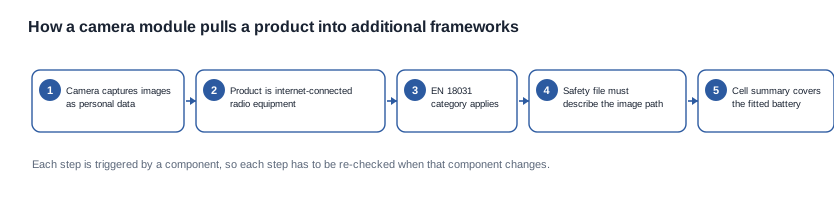
Smart glasses camera technology: what a module adds to the conformity position
The camera does not change which market-access regimes apply. It changes what the evidence inside them has to say.
It moves the product into the personal-data category
A wearable with a microphone and an application is already internet-connected radio equipment that processes personal data, and in the European Union that places it in the personal-data category of the EN 18031 series cited into the radio equipment framework, Directive 2014/53/EU. Those cybersecurity and privacy requirements became a mandatory component of the CE mark from 1 August 2025. A camera adds a second data stream to that position: not only what is said in range, but what is seen in range. Every question that had to be answered for audio now has to be answered again for images, and the answers are not the same, because an image captures bystanders who never knew a device was present.
It adds a component whose change is a change to the product
The camera module is a specific part from a specific supplier, and replacing it is a change to the finished device rather than an interchange of like with like. A substitution alters the field of view, the exposure behaviour and the image characteristics, all of which may be referenced in the technical file and in the instructions for use. A camera swap therefore triggers a review against the conformity position rather than an assumption that the existing position carries over, and the review is a dated activity with a queue behind it.
It adds a storage path that has to be described
The general product safety framework, Regulation (EU) 2023/988, applies from 13 December 2024 and it sits on top of the sector rules rather than replacing them. For a camera product the safety file has to answer the foreseeable-use questions: what happens when the storage fills, whether recording continues when a person is not expecting it, what the user is told before recording starts, and whether the customer can delete what has been captured. A product without a camera answers none of these, and a camera product answers them badly if they are treated as obvious.
It changes the transport documentation
A camera product is still a product with a cell, and the transport rules cover a specific cell. The published cell configurations in this tier run from 220 mAh to 290 mAh, and the camera models with a charging case add a second cell: 1400 mAh on the CY05 and the L1 Pro, and the CY03, 900 or 1400 mAh on the L2 Utral, and a 1200 mAh foldable case on the MT6, while the KY06 and the MT5 carry a case whose capacity is not published. Every one of those is a separate declaration, and a substitution invalidates the summary regardless of whether the finished product looks unchanged.
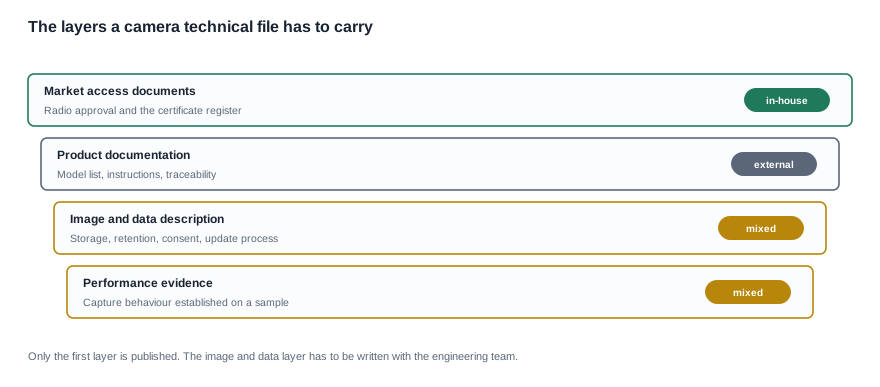

The data questions a camera raises that a microphone does not
This is where a buyer's legal function and the engineering team have to be in the same room, because the answers are technical and the consequences are legal.
Retention, storage and deletion
Where the captured frames are stored, for how long they are kept, and whether the customer can delete them are questions about the product, not about policy. If frames sit on the device until an application syncs them, the device is a personal-data store and the deletion path has to work when the application is not running. If frames move to a phone and then to a cloud service, the cloud is in scope and the data position changes with the business model rather than with the hardware. Our catalogue publishes no storage capacity, no storage format and no overwrite behaviour for any camera model, so none of this is answerable from the published rows.
The consent and disclosure position for a device worn on the face
A camera in glasses records people who are not the operator and who did not consent, and this is a different question from the operator's own data. A retailer's compliance team will read the disclosure position in the instructions before they read anything else about the product, because a wearable that records others is a different commercial object from one that records its operator. The presence of a recording indicator, the behaviour on power-up and the wording of the notification are all decisions that have to be made before the tooling, not after.
Whether any processing happens on the device
Our published position is that the camera tier names an AI voice assistant as a key technology, and that which models are supported, whether processing runs on the device or in a service, whether a subscription is attached and where any data is held are all Not published. A camera plus an on-device model is a materially different data position from a camera feeding a cloud service, and the difference is invisible in any published row. It also changes with a firmware update, which means the file needs a mechanism for describing it rather than a single line.
The update path when a vulnerability is found
The cybersecurity obligations reach the firmware and the application, and the practical question is whether a security update can be delivered to units already in the field. A camera product with a long-lived model list and no update route is a harder position than the same product with one, and the answer is a question for the engineering team and for the supplier.
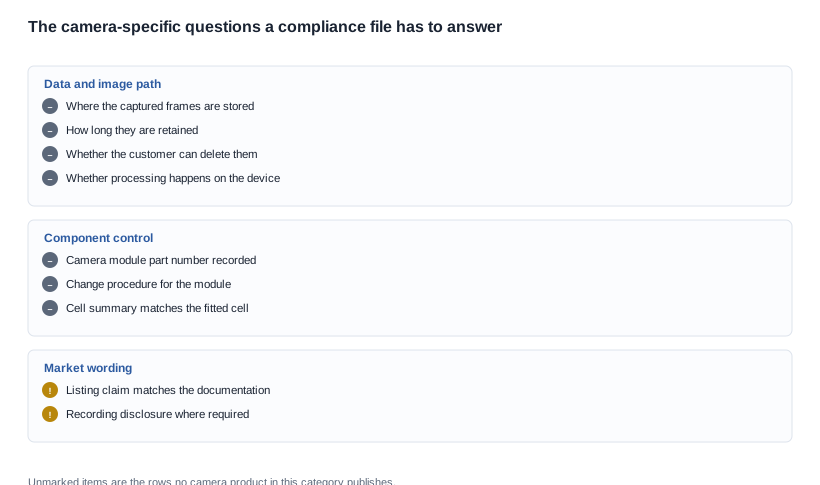
Component change and cell change, and what each one reopens
A buyer running a camera programme will change something at some point, and the useful question is what each kind of change costs in compliance terms.
A camera module substitution
This reopens the technical file. The new module has a different field of view, a different exposure behaviour, a different power draw and a different thermal load, and the image path in the file describes the old one. If the substitution also changes the sensor generation, the low-light behaviour described in any internal documentation becomes wrong. The date on the conformity position no longer covers the shipped configuration, which is the specific failure that turns a compliant product into a non-compliant one.
A cell substitution
This reopens the transport documentation and the electrical rows. The cell capacities in the camera tier run at 220, 260, 265 and 290 mAh, and the transport test summary covers a specific cell. Changing the cell changes the summary, the declared energy and the runtime figure, and the runtime figure is one of the published rows on the catalogue page, so a substitution also creates a mismatch between the page and the product.
A charging case substitution
This is the one most often overlooked, because the case is treated as an accessory rather than as a product. The case cells published for this tier are 1400 mAh on the CY03, the CY05 and the L1 Pro, 900 or 1400 mAh on the L2 Utral, and a 1200 mAh foldable case on the MT6, and the KY06 and the MT5 ship with a case whose capacity is not published at all. A different case is a different cell in a different package with different labelling and a different declaration, and it changes the shipping profile of every unit in the order.
A firmware change that alters behaviour
A firmware update that changes what the camera records, where it stores it, or whether it transmits is a change to what the product does. The file has to describe the shipped behaviour, and a programme with a stable documented configuration is worth more than one with a flexible configuration that nobody has pinned down.
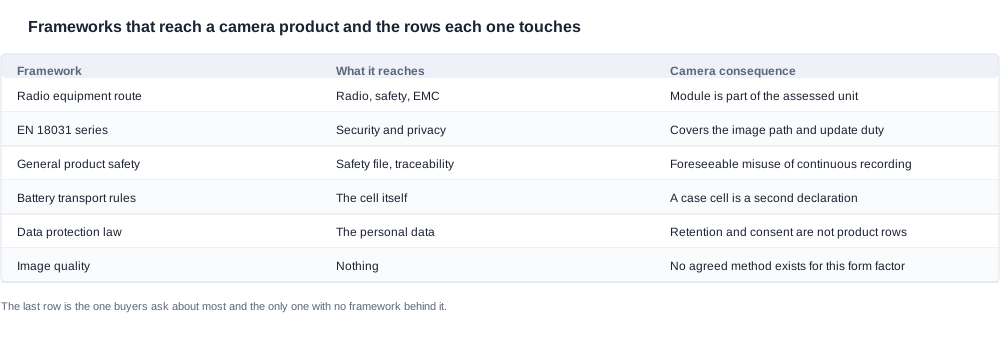
A hypothetical market-entry sequence for a camera product
This is a hypothetical case rather than a client project, and it is included because the order of the work matters more than the content of each step.
A brand is preparing a camera-glasses line for sale in the European Union and the United Kingdom. The first step is not the certificate but the configuration. The team fixes the camera module, the cell, the case and the firmware version, because each of those four choices determines what the file has to describe. Fixing them early is what keeps the subsequent steps from reopening each other.
The second step is the model list. The radio approval is taken against a named model list, and a camera configuration that is not on that list does not inherit it. The team asks which model designations the existing documents cover, and answers that question in writing before anything else is scheduled.
The third step is the image path description. The storage behaviour, the retention position, the deletion path and the disclosure wording are written with the engineering team, because no published row in the camera tier covers any of them and a compliance file cannot be assembled from catalogue rows.
The fourth step is the battery transport documentation, taken against the cells that will actually ship, including the case cells, with the numbers checked against the electrical rows the catalogue publishes. The fifth step is the certificate register: every number, every issuing body and every date on every document, checked against the issuing body's public register rather than accepted from a forwarded PDF.
The sixth step is the wording. The listing copy is checked against the documentation line by line, because a pixel count published as a quality statement and a resolution claim made without the video rows are both claims the documentation does not support.
The total cost of getting the sequence wrong
A buyer who runs these steps out of order pays for the rework twice. A camera configuration changed after the conformity work has started reopens the file and re-enters the queue; a case changed after the transport documentation is taken reopens that; a firmware behaviour changed after the manual is written reopens both. The total cost of the sequence is not the fee for each step, it is the number of times the steps have to be run again, and the cheapest control on that number is to fix the configuration before the first document is commissioned.
The commercial version of the same point is a negotiation one. Certification cost and lead time follow the testing process and the testing body, so they are not the kind of line that moves in a negotiation; the configuration of the order, the case that ships with it, the model list that is named on the document and the schedule on which the sample reaches the buyer's laboratory are all things that can be settled in the agreement, and settling them early is worth more than a discount on the unit price. The certification checklist sets out the document set as a procurement list rather than a compliance list, and the contract terms page sets out the clause language that keeps a camera configuration from drifting during a run.

The regulatory questions to put to the supplier in writing
The order of these questions matters, and so does the form of the answer required. A buyer collecting assurances collects nothing usable; a buyer collecting sentences that can be pasted into a technical file collects the thing the file needs. Ask for a paragraph, not a yes.
- What data does the camera collect, where is it stored, how long is it retained and how is it deleted? The answer should be a paragraph that can be pasted into a technical file, not a general assurance. If the supplier answers with a statement about privacy rather than a description of the mechanism, the row is still open.
- Is any processing performed on the device, and what does it do? Our catalogue publishes nothing about this for the camera models, so it has to come from the engineering team and be written down.
- What is the conformity position for the exact camera configuration ordered, and does the model list on the document cover it. This is the question that decides whether an existing certificate is usable at all.
- What is the cell in each shipped configuration, including every case, and does the transport summary cover each of them.
- Is there a firmware update path for units already in the field, and what does it change.
- What does the recording disclosure consist of, and where does it appear in the product and in the instructions.
- Which certificate numbers apply to this model, with the issuing body and the expiry, so that each one can be looked up independently.
- What is the change-control procedure for the camera module, and who has to sign off a substitution.
The order matters. Asking about the certificates first is how a programme ends up with a valid certificate for a product it no longer sells.
The criteria for judging the answers
A supplier answer in this category falls into one of three shapes, and the shapes are easy to tell apart once you have seen them.
A mechanism. The supplier describes what the product does and where the data sits, and the description is specific enough that a compliance reviewer can read it and decide whether it satisfies the obligation. This is the answer worth paying for, because it is the answer that survives an audit.
An intention. The supplier describes what the product intends to do, in the conditional, with no statement about the mechanism behind it. An intention cannot be written into a technical file and cannot be verified on an incoming unit, so it has to be pushed on until it becomes a mechanism or is recorded as open.
An assertion. The supplier confirms compliance in a single line and offers nothing further. This is the shape that most often turns out to be a certificate for a different configuration.
The checklist to apply before you order is short: for each of the eight questions above, name who answered, what document the answer came from, and whether the answer can be re-checked by someone who did not ask the question. An answer that only the supplier can confirm is not a closed row.
The red flags that mean a configuration is not ready
A model list that names the family but not the camera configuration. The radio approval is taken against named model designations, and a configuration that is not named does not inherit it.
A certificate forwarded without an issuing body, an expiry or a number. Every one of those three has to be present, because each one is what makes the document checkable by a third party.
A data answer expressed as a policy. A retention policy that describes what the company intends to do is not the same as a statement of where the frames are stored, and the technical file needs the second.
A case described as an accessory. A case cell is a cell. It has its own declaration, its own labelling and its own shipping profile, and a buyer who treats the case as packaging will discover the gap during freight booking.
An instruction manual written for a product without a camera. The disclosure wording, the recording indicator and the deletion instructions are specific to a camera configuration, and a manual carried over from a non-camera variant is a red flag on the product's readiness rather than on its paperwork.
What we can evidence in a camera technical file, and what we cannot
Stated plainly: the camera rows we publish are also the only rows a conformity file can be built on, and we will not stretch them to cover what is missing. The resolution tiers and the electrical rows are accurate as published, and an eight or thirteen megapixel figure will not be converted into a statement about image quality, because resolution is not a quality metric and the sensor data that would underpin one is not published to us.
The practical consequence is that a compliance file has to be assembled around what is actually documented — the radio, the battery, the model designation, the traceability and the instructions — while the imaging behaviour is established separately with the engineering team and written into the file in its own right, because no line on a datasheet will carry it. The same applies to the data path: the storage, retention and consent behaviour of a camera product has to be written by the people who built it, and our catalogue publishes none of it.
We will also be direct that the regulatory questions a camera raises are data questions, and that the AI feature details which would determine the answer are Not published in our range, so they have to be established with the engineering team and the legal function rather than read off a sheet. The EN 18031 cybersecurity compliance page covers the cyber side of the radio route, the GPSR compliance page covers the safety side, the AI camera glasses page lists the range the file has to cover, and the AI camera glasses imaging page sets out the published camera position.
If you tell us the destination markets, the camera configuration and the intended use, we will say which of these questions are decisive for you and which are already settled by the published rows.
Related reading


