

There is no standard for the picture quality of a wearable camera, and that is the most useful thing to know before a buyer in this category asks what the camera has to comply with. The standards reach the product, the hardware, the software and the data. They do not reach the image. A camera that produces an excellent picture and a camera that produces a poor one are equally compliant with every regime that applies, and the only thing that separates them is a measurement and a comparison. Any sourcing decision in this category that assumes a certificate will settle the imaging question is built on a premise that no standard in the world supports.
That absence is not an oversight, and understanding why it is not an oversight is what tells a procurement manager where to spend the money. A standard for image quality would have to specify a scene, a lighting condition, a subject, a test method and a metric, and no agreed set of those exists for a camera worn on the head. So the only comparable numbers in this category are the ones a manufacturer chooses to publish, and the only real comparison is one the buyer runs.
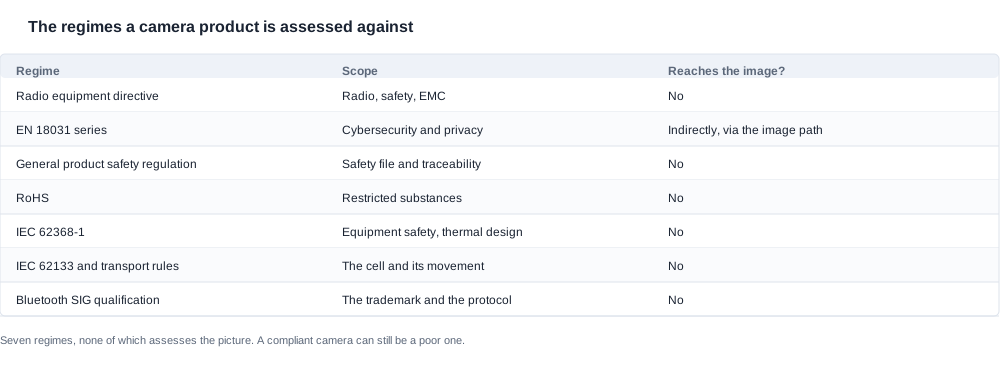
Smart glasses camera technology: which regimes reach the product, and which stop
Seven regimes apply to a camera product in this category, and a buyer who knows which is which can allocate the compliance budget correctly. Six of them cost money and take time and are non-negotiable. The seventh is the absence of a regime, and it is the one that determines how the camera gets selected.
The radio equipment route
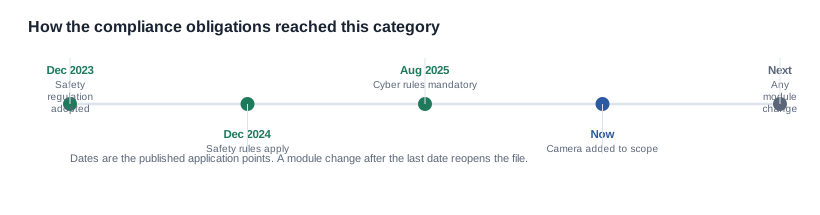
Directive 2014/53/EU is the frame for a radio product placed on the European market, covering the radio, the safety requirements and the electromagnetic compatibility of the device as placed on the market. The assessment is made on the finished unit, and the camera module is part of it: a module that changes the housing geometry or the antenna environment moves the radio behaviour of a product whose electronics are otherwise identical. The United Kingdom runs the UKCA equivalent on a framework that has diverged from the European one, and the United States covers the radio through FCC equipment authorisation.
The cybersecurity and privacy standards cited into it
The EN 18031 series has been a mandatory component of the CE mark since 1 August 2025. It covers secure communication, encryption, secure storage, user consent, and a process for handling vulnerabilities that are identified. For a camera this reaches the image path specifically: where the frames go, whether the transfer to the application is authenticated, who can reach the stored files, and whether the software can be updated when something is found. The categories in the series are internet-connected radio equipment, radio equipment processing personal data, and radio equipment enabling the transfer of money or virtual currency, and a wearable with a camera and an application sits squarely in the second.
The general product safety framework
Regulation (EU) 2023/988 has applied since 13 December 2024 and it layers general safety obligations on top of the sector rules. For a camera product it puts the safety file in play: a device that records continuously raises foreseeable-use questions the file has to answer, and a product aimed at a workplace or a school raises them more sharply than a consumer product does, because the people being recorded are not the people who bought it.
The material declaration
RoHS reaches the substances in the housing and around the module. A resin change or a finish change moves the declaration, which means a cosmetic adjustment to a camera product is not a cosmetic adjustment to its paperwork.
The equipment safety standard
IEC 62368-1 covers the power input, the enclosure and the thermal design of the finished product, and it is the standard a retailer's technical team will usually name first. The camera module is a heat source inside a small enclosure pressed against the head, and the thermal design of the product is therefore partly a camera decision.
The cell standard and the transport rules
IEC 62133 covers the cell, and the transport rules cover moving it. The published cell configurations in the camera tier run from 220 mAh to 290 mAh, and a charging case adds a second cell: 1400 mAh on the CY05, the CY03 and the L1 Pro, 900 or 1400 mAh on the L2 Utral, a 1200 mAh foldable case on the MT6, and a case of undeclared capacity on the KY06 and the MT5. Each is a separate declaration, and the transport rules reach the case exactly as they reach the product.
The trademark qualification
The Bluetooth SIG qualification is the right to use the trademark and the protocol, and it is a product-level permission covering the radio, the firmware and the brand. It is a separate instrument from the radio approval, answered by a different body, carrying a separate cost.
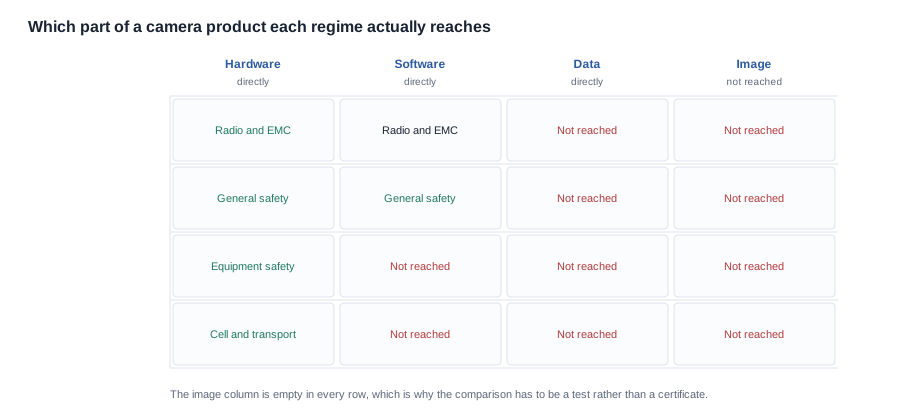

Why no image-quality standard exists for this form factor
This is the part of the framework that a buyer has to understand properly, because it is easy to misread as a gap in the standards and it is in fact a settled position.
What a standard would have to specify
A usable image-quality standard needs five things at once. It needs a scene, so that two laboratories are photographing the same thing. It needs a lighting condition, because a sensor's ranking changes with the light. It needs a subject, because a face and a wall and a landscape expose different parts of an imaging chain. It needs a test method, so that the number is reproducible rather than procedural. And it needs a metric, so that the number means something.
For a camera in a phone, the industry largely settled on informal agreement: a scene, a bright room, a chart. For a camera worn on the head, none of the five has an agreed answer. The subject is whatever the operator happened to be looking at. The lighting changes every second. The method would have to specify how a moving operator is followed, what is held still, and how the frame is evaluated.
Why the result is a published tier rather than a published quality
When no metric exists, the number that survives is the one that does not need a method. A pixel count is that number: it is a property of the part, it can be printed on a box, and it means the same thing in every laboratory. So the published camera position in this category is a resolution tier, and every other imaging row is either absent or qualified with a method attached.
Our own catalogue follows the same rule, which is why it publishes eight and thirteen megapixels across the eleven camera models and publishes no sensor part number, no field of view, no video resolution or frame rate, no aperture, no stabilisation figure, no storage capacity or overwrite behaviour, no low-light data and no transfer time for any camera model. That is not a marketing choice. It is what remains when a row cannot be published against an agreed method.
What this means for a buyer who has been told the tiers are the same
Two suppliers quoting the same tier are quoting the same quantity of pixels and are not thereby quoting the same camera. The practical consequence is that the tier is a grouping for pricing and a description of the generation, and the selection has to be made on a measurement. A buyer who asks which tier to choose is asking the wrong question; a buyer who asks what method produced a figure is asking the one that can be answered.
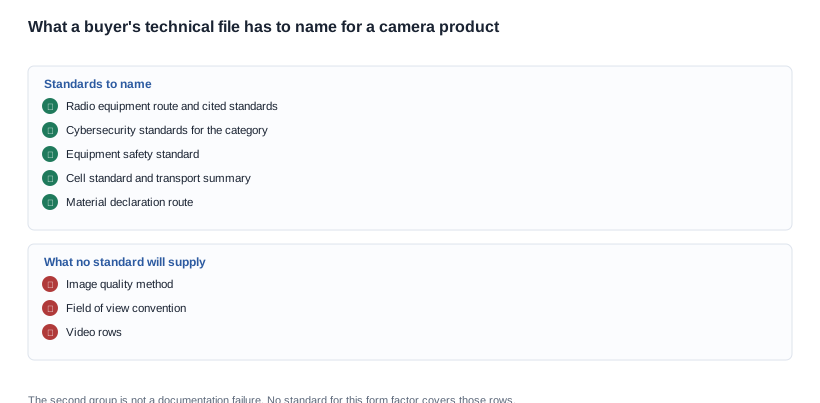
The standards a buyer's technical file has to name
The document set for a camera product is not long, and a procurement manager who knows the seven regimes can assemble it without waiting for a supplier to volunteer it.
- The radio equipment route and the standards cited into it, including the EN 18031 category the product falls into and the evidence for that classification.
- The equipment safety standard and the report that covers the finished product rather than the module.
- The material declaration and the specific list of substances it covers.
- The cell standard and the transport test summary for every cell that ships, including every case.
- The Bluetooth qualification where the trademark and the protocol are used.
- The safety file, with the traceability, the instructions for use and the foreseeable-misuse assessment for a device that records other people.
- The declaration of conformity, tied to the model list that the shipped configuration actually appears on.
The model list is the row that ties the file together
Every one of the documents above is issued against a named model list, and a camera configuration that is not named on the list does not inherit the coverage. This is the single most common structural failure in a camera programme, and it is invisible from the outside because the certificates exist, the numbers verify and the product still looks right. The check is short: take the model designation printed on the unit and confirm it appears on each document. The certification checklist sets out the same check as a procurement list.
The rows that have to be written rather than collected
Three things in the file are not documents that can be requested, because they do not exist yet as documents. The image and data path description has to be written with the engineering team, because no published row covers where frames are stored or how long they are kept. The recording disclosure and the deletion instructions have to be written for the shipped configuration, because a manual written for a non-camera variant does not carry them. And the change-control procedure for the camera module has to exist as an internal document, because a substitution with no approval route reopens the file by default.

A hypothetical standard review of a camera launch
This is a hypothetical case rather than a client project, and it shows what a review looks like when it is run before the tooling is committed rather than after.
A brand is preparing a camera-glasses line and has asked a compliance adviser to review the framework before the first order. The adviser's first question is not about certificates. It is which configuration is being ordered, because the camera module, the cell and the case together determine what the file has to describe, and a review of a configuration that may change is a review that has to be repeated.
The second question is where the product is sold. The European Union, the United Kingdom and the United States run three separate routes, and the file is assembled per destination rather than once for all of them. The third question is what the product records, because the EN 18031 classification follows the function. A camera that stores frames locally and a camera that feeds a service are in the same category but produce different evidence.
The fourth question is the cell list, item by item, including every case configuration that might ship, because the transport documentation is taken against cells and a case cell added later invalidates it.
The fifth is a walk through the seven regimes against the model list, and the finding is the one this category produces most often: one model designation on the units does not appear on one of the documents, and the gap is a week of testing rather than a redesign. The review's value is that it was found in week one rather than in week twelve.
The sixth is the empty column. The adviser confirms what each regime reaches and then states that none of them reaches the image, which is why the imaging comparison in the campaign plan is a sample test and not a compliance argument. The brand accepts that framing because it is cheaper than the alternative, which is a launch whose only defence is a certificate that says nothing about the product the customer bought.

Where compliance and product performance are confused
Reading a compliance mark as a quality mark
This is the confusion that costs the most, because it is easy to make and hard to unpick in public. An ingress marking on a camera product is a statement about the enclosure and about the conditions the product was tested in. It is not a statement about condensation, which is what a lens actually suffers from when a unit is carried from a warm room into a cold street, and it is not a statement about immersion. In our range the IP54 marking appears on the V06 and the S7 only, and it appears without a published report number, so a buyer who wants to lean on it needs the report behind it.
Treating a supplier's compliance assertion as a substitute for its specification
A supplier that states the product conforms to a directive has told the buyer that a document exists. It has not told the buyer what the camera does, and it has not told the buyer which model the document names. Those are separate questions with separate answers, and a shortlist built on the first will not survive a due diligence review.
Believing a certification covers the software after an update
The cybersecurity obligations reach the firmware, and a firmware update that changes what the camera records or where it stores it is a change to what the product does. A product that was compliant when it shipped can stop being compliant through an update the buyer never approved, unless the update path and the change process are written down as part of the programme.
Assuming the absence of a standard is a temporary gap
A buyer who plans to rely on a standard that might arrive is planning against a date that is not controlled by the supplier and not controlled by the buyer. The categories of imaging data that a standard would eventually cover are exactly the categories that a buyer can obtain today as a supplier document or as a sample measurement, and obtaining them today is what stops the launch depending on a standard nobody can schedule.
Treating the radio approval as a product-level blessing
The radio approval covers the radio and the safety and electromagnetic compatibility of the finished unit. It says nothing about the camera's behaviour, the storage rule or the disclosure wording, and a buyer's due diligence that stops at the radio approval has checked one column of the file and assumed the rest.
Spending the compliance budget on the wrong column
A camera programme can absorb an enormous amount of money and time in the six regimes that work, and still arrive at a launch where the imaging question is unanswered. The trade-off is worth making explicitly. Certification cost and the testing body's schedule are not the kind of line that moves in a negotiation, so over-investing there is expensive and irreversible. The imaging comparison, by contrast, can be closed with one sample round and one afternoon of shooting, and it is the part that decides whether the channel works. A buyer who sequences the budget in that order gets a better product for less money, and gets it sooner.
What to do with a supplier who answers the image question with a certificate
Ask what the certificate is a certificate of. In this category the honest answer is usually that it covers the radio, the safety and the material, and that the image was never inside its scope. Once that is established, the two options are simple: close the imaging rows with a sample test, or accept the product on a basis that does not involve the image at all, which is a legitimate decision for a product where the camera is a secondary feature rather than the reason for the purchase. What is not legitimate is holding both positions at once, which is how a channel ends up defending an image it never measured.
What the absence of a standard means for a sourcing decision
Stated plainly: the absence of an image-quality standard does not make the image unimportant. It makes the comparison a buyer's job, and a buyer who does that job will find a bigger difference between two camera products than any compliance document will reveal.
We publish the 8 MP and 13 MP resolution tiers and the electrical rows across the eleven camera models in our range, together with the battery capacity, the charge time, the rated runtime and the case capacity for each model, the charging interface for the seven of the eleven that carry one, and the unit weight for the MT6 alone. We publish no sensor model, no field of view, no video resolution or frame rate, no aperture, no stabilisation figure, no storage capacity or overwrite behaviour, no low light data and no transfer time for any camera model. We publish no model-level certificate numbers and no test report numbers, and the minimum order quantities, the production capacity and the lead times remain open internally.
That boundary is the reason we will not tell a buyer that thirteen megapixels produces a better picture than eight megapixels. On the evidence we hold, that is not a statement we can make, and a buyer who is told it cannot check it either. What we will do is take two candidate camera models and a use case and run a fixed measurement session with you, so that the comparison lands on the picture rather than on the paperwork. The imaging rows themselves are at camera and imaging, the measurement method is at measuring the camera, the production-side controls are at camera quality control, and the document set as a whole is at certification checklist.
Send the two models and the use case, and we will build the measurement session with you.
Related reading
- The imaging rows and what they mean — camera and imaging
- The measurements that settle it — measuring the camera
- The production side — camera quality control
- The document set as a whole — certification checklist


