
In this category the supplier's camera claim is the easiest thing to overstate and the hardest to check, because the published rows are so thin. Across the whole camera range the published camera figures are a resolution on every platform and a platform feature line on all of them. No sensor model, no field of view, no video resolution, no frame rate, no aperture and no low-light figure is published for any model in our range.
Which means verification has to be done with the supplier and with a sample, and the actions below are ordered so that the cheapest disqualifying question comes first. Two of the six actions cost a paragraph and a week respectively, and both of them remove more suppliers than the expensive ones do.

Smart glasses camera technology: six verification actions, cheapest disqualifier first
The ordering is deliberate, and it is the part most suppliers of advice on this topic leave out. A buyer who spends two weeks testing a sample before asking the one question that would have eliminated the supplier has paid for the privilege of discovering the answer late.
- Audit the written camera claim against the catalogue rows. Ten minutes, no sample, and it removes the suppliers whose documentation does not match their own product sheet.
- Request the four missing camera rows in writing. A paragraph to the supplier, with a deadline. The answer — or the absence of one — is the single most informative piece of information available before a sample is ordered.
- Check the build identifiers on the sample units. Fifteen minutes with the units that have already arrived, and it establishes whether the sample is the thing that will be shipped.
- Run the printed chart sharpness and exposure test. Half a day, and it produces a figure that can be repeated on incoming units.
- Record one continuous session against the published runtime row. One working session, and it converts the published runtime from a catalogue figure into an observed behaviour.
- Write the findings into the incoming inspection criteria. Half a day, and it is the only one of the six that has value after the order is signed.
Actions one and two together disqualify more suppliers than the other four combined, because they test whether the supplier's documentation discipline matches the claims being made. A supplier whose product sheet contradicts its own catalogue rows has a configuration problem, and a configuration problem will not be fixed by a better sample.
Action one: the written claim audit
The audit is a line-by-line comparison between what the supplier has written and what we actually hold, and it takes less time than it sounds because our side of the comparison is a single page.
The camera facts we hold are these. Eleven platforms carry a camera. Eight publish 8 MP — the V03 and the MT6, the CY05 and the CY03, and the V03 Pro and the V06, and the MT5 and the KY06 — and three publish 13 MP: the L1 Pro and the L2 Utral, and the S7. Every one of them publishes a cell capacity between 220 mAh and 290 mAh, a runtime between roughly five and eight hours, and a charge time of two hours or less; seven publish a charging interface, magnetic on the V06 and the V03, and the KY06 and the S7, and the MT5 and Type-C on the V03 Pro and the L2 Utral, while the CY03 and the L1 Pro, and the CY05 and the MT6 publish no interface row at all and are therefore a verification question rather than a reading. Five publish a case capacity: 1400 mAh on the L1 Pro and the CY03, and the CY05, 900 or 1400 mAh on the L2 Utral, and a foldable 1200 mAh on the MT6. Two publish an IP54 ingress marking, the V06 and the S7. One publishes a unit weight, the MT6 at 158 g for the glasses themselves.
Everything else in the camera row is absent from our documentation, and that is the point of the audit. A supplier's claim that matches our published rows exactly is not suspicious; it is the expected result of reading the same source document. A supplier's claim that differs is interesting, and the difference has to be explained before the sample is ordered.
Actions two and three: the sample protocol and the build identifier
The four missing camera rows are the sensor model, the field of view, the video resolution and frame rate, and the storage format and capacity. Ask for all four in one message, in writing, with a date. Asking for four rows in a single request rather than one at a time is what makes the answer useful: a supplier who answers all four in one reply is a supplier with a configuration document, and a supplier who answers two of them and drops the other two is telling you which two are settled in their documentation.
The build identifier check is the cheapest of all six actions and the one most often skipped. The units that arrive as samples carry a firmware build identifier, a hardware version or an equivalent mark. Record it, and confirm it against the units that will arrive later. A supplier whose samples are not the production configuration is not necessarily dishonest — samples are frequently built earlier than production and on a different line — but the buyer has to know, because the sample result transfers to the order only if the build transfers with it.
The questions that disqualify a supplier fastest
The disqualifying questions are the ones where a particular answer ends the evaluation, as opposed to the ones that merely require a follow-up. The difference matters commercially: a question that requires three exchanges of email costs three weeks of elapsed time and no supplier anything, while a question that disqualifies costs the supplier the opportunity.
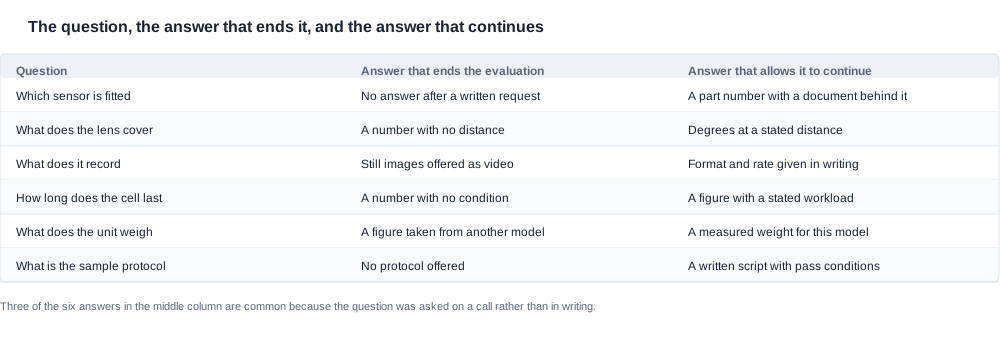
Three of the six disqualifying answers in that table are common, and they are common for one reason: the question was asked on a call rather than in writing. A supplier asked verbally for the sensor part number will produce a plausible-sounding part number. A supplier asked in writing, with a request that a document be attached, will produce a part number and a document or nothing at all.
The second common cause is a question that carries no deadline. "Please confirm the field of view" invites a response at some point in the future. "Please confirm the field of view, with the measurement distance, by the 14th" invites a response by the 14th. The absence of a deadline is the most common reason a verification programme quietly stalls, and it is a failure of the buyer's process rather than of the supplier.
A disqualifying answer is not the same as a bad product
It is worth being precise about this, because the instinct after a disqualifying answer is to assume the product is poor, and that assumption is usually wrong.
A supplier who cannot name the sensor may have a perfectly good product and a poor documentation habit. That supplier may still be the right manufacturer for a different reason — capacity, price, a working relationship, a better case design — and the camera documentation gap may simply be a function of where the brand sits in the supply chain. The verification process exists to produce a decision, and the decision it produces is sometimes "this supplier cannot support a camera claim, so we do not publish one and we scope the row out of the copy."
That decision is a good one. A product whose page makes no camera claim beyond the resolution tier is a defensible product. The failure mode is a product whose page makes a camera claim the manufacturer cannot evidence, and the cost of that failure lands on the brand rather than on the factory.
How to structure the request so that it actually gets answered
The difference between a request that is answered and a request that is quietly deferred is almost always structural rather than a matter of the supplier's attitude. Four features of the request make the difference.
One message with one deadline. A request split across three messages produces three partial answers, each of which has to be chased, and the supplier can answer the easy one first. A single message with a single date produces one answer that can be judged as a whole.
Each item asks for a document, not for a statement. The wording that works is "send the document in which this appears" rather than "confirm this". A supplier asked to confirm a figure will confirm it from memory or from a datasheet; a supplier asked for a document has to find one, and the search is often what reveals that the figure is not settled.
Each item names the model. Every request should carry the model designation as the buyer knows it, because a supplier who answers for "the camera glasses" rather than for a specific model has answered for their own product range rather than for the unit being ordered.
Each item names what happens next. A sentence such as "we need these to complete the evaluation before the order is raised" turns a document request into a gate rather than a courtesy, and it is entirely accurate.
The documents to request before a deposit
Documents are the cheapest evidence and the easiest to collect, and the request should be specific enough that each item can be answered with a document rather than a summary.
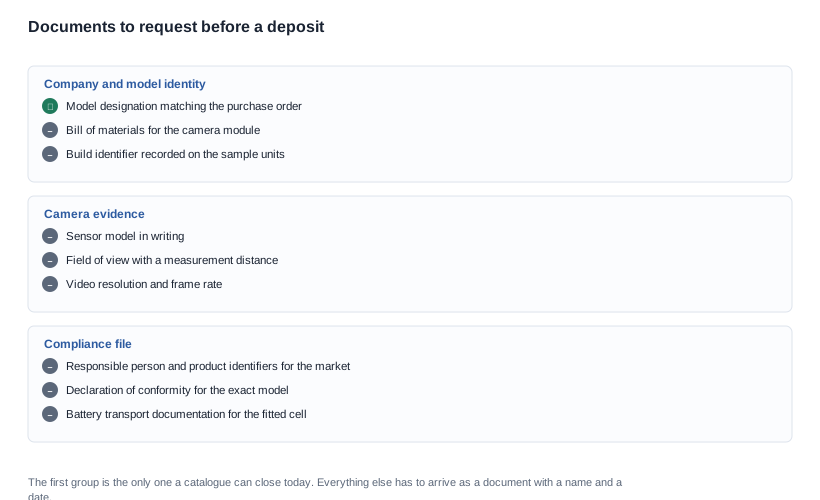
The list above is organised by what it settles. The identity group establishes that the documentation belongs to the product being bought, which sounds obvious and is the group most often skipped. The camera evidence group carries the four missing rows. The compliance group carries the market-access file, and for a European sale it includes the responsible person and the product identifiers required under the General Product Safety Regulation, together with the declaration of conformity for the exact model designation and the transport documentation for the fitted cell.
A useful discipline is to request the camera evidence group as a single deliverable rather than as four questions. A supplier who sends a one-page note titled with the model and the four rows has done something a supplier who sends four separate emails has not: they have put a document in front of the buyer that can be attached to the evaluation file and referenced in the purchase order.
What to do when a document arrives without a date
It happens more often than a buyer expects, and the response should be procedural rather than confrontational. A document with no date has no baseline, and a baseline is what makes a later comparison possible: without one, a claim can change between the evaluation and the production run with nothing to point at.
Three things resolve it, in order of preference. Ask for the document to be reissued with a date and a version reference, which is usually a same-day request and usually produces a dated document. Ask which revision the current production build corresponds to, which converts an undated document into a dated one by association. If neither is possible, record the gap in the evaluation file and treat the affected rows as unverified, which means the claim cannot be printed on the listing. That last step is the one that matters, because a gap that is recorded does not become a claim later by accident.
What a supplier's answers reveal about the factory
The answers to the verification questions carry information about the manufacturing operation, not only about the product. This is the part of the process that pays a dividend over a long programme, because it tells the buyer what to expect from a supplier whose performance nobody has measured yet.
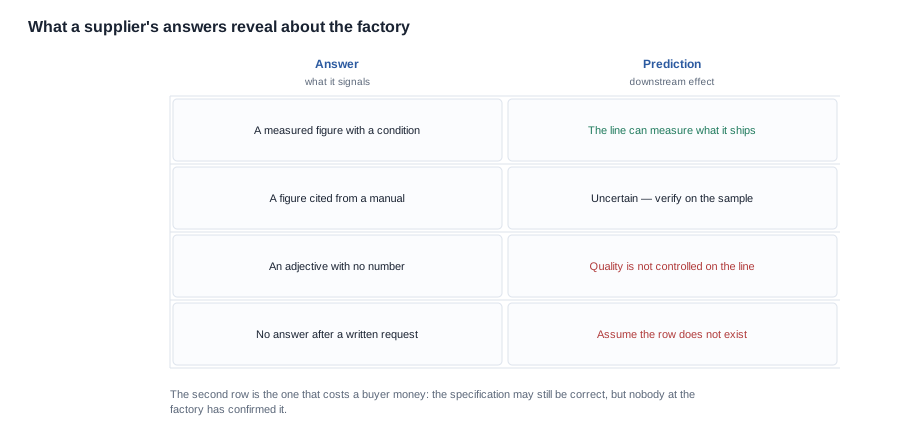
The second row of that matrix is the interesting one, because it is the answer most often given and the one that costs the most time. A figure cited from a manual may be perfectly correct for the configuration being ordered, and it still has to be verified, because a manual figure describes the product family and the buyer is buying a unit. Asking whether the figure was measured or transcribed is a one-line question, and it sorts the answer into a row that can be closed by a sample and a row that has to be closed by a sample anyway.
The answers also predict what will happen when something goes wrong, which is the part a buyer cannot test in advance. A supplier who logs failures is a supplier who can tell you why, and a supplier who cannot tell you why will offer a credit instead. A credit is a worse outcome than a cause, because a credit settles the invoice and leaves the process exactly as it was, so the same units fail again in the next shipment.
There is a further question worth asking once, because it is the best single indicator of whether a supplier will be workable over a multi-year programme: has any of this been recorded before, and can it be shown? A supplier with a camera inspection log, a failure record or a configuration history is a supplier whose process has been exercised. A supplier who answers that question with a general description of their quality system is telling you the system is documented but has not been run on this product.
The sample protocol as a contractual document
There is one item in the list above that is worth treating differently from the others, because it is the only one that keeps producing value after the first shipment: the acceptance criteria.
Most buying processes treat the criteria as a description of the finished product, which is why they are written in adjectives and why the first rejection becomes an argument. A criterion written as a method is a different instrument. It says what is measured, under what condition, against what threshold, and by whom — and once that is in place, the same document can be handed to an incoming inspection clerk, to a third-party inspector, or to a customer auditor, without being rewritten.
The commercial advantage is that the buyer who has a method can refuse a lot. Refusing a lot is an expensive and unpopular action, and the person taking it at the goods-in desk needs a document that says the refusal is correct. A supplier who has accepted a method in the order has accepted that the criterion is theirs to meet, and a supplier who has not accepted one will find every rejection negotiable.

What to put in the purchase order once the answers are in
Verification that does not land somewhere is a study rather than a control. Six things belong in the order or the quality agreement, and each one is a sentence rather than a clause.
- The camera configuration as documented at the date of the order, referenced by document and revision, so that a later change is a change against a stated baseline.
- The acceptance criteria, each with a condition, a method and a threshold, so that a rejection can be defended rather than argued.
- The build identifier or hardware version the delivered units must carry, so that a sample result can be tied to the production units.
- A notice period before any change to the camera configuration, with the period stated, so that a copy change is a scheduled event rather than a discovery.
- The obligation to disclose what was not verified. A supplier that could not evidence a row says so, and the order records it, which prevents the gap from being quietly filled by an intermediary later.
- The disposition of a failed unit and the recording of the failure, which is what turns a returns figure into a corrective action.
The fifth of those is the one that is unusual and the one that is worth having. An unverified row that is written down as unverified is a managed gap. The same row that is left silent becomes an assumption, and an assumption in a buying file has a habit of becoming a claim in a listing.
What we can evidence and what we cannot
We cannot publish a sensor model, a field of view, a video resolution, a frame rate or a low-light figure, because none of them is published for these models, and we will not estimate them. We will also not present a resolution figure as a demonstrated image advantage, and our own documentation is explicit that a parameter comparison of this kind should not be claimed externally until it has been checked against a competitor's unit in the hand.
What we can do is supply the verification set: the published rows for every camera platform, the six actions in the order that closes the most for the least, and an honest statement of which of the four missing rows our own records can answer for a given model and which have to go to the manufacturer. We will also tell a buyer when a row in a supplier's answer conflicts with ours, because the conflict is usually a configuration difference rather than a mistake, and it is much cheaper to find in a document than in a shipment.
Tell us the models, the channel and the volume, and we will come back with the published rows and the questions we can close for you. We will also say which of the six actions we can answer on our side and which have to be run against the manufacturer's own documentation, so that your evaluation file contains only the steps that are genuinely open. The camera family is on our AI camera glasses range page, the background is under camera imaging, and the related data question is covered under AI features.
Related reading
- How to compare two camera platforms — how to compare camera technology
- The market access file a camera product needs — general product safety
Tell us the models, the channel and the volume, and we will come back with the published rows.


