
An upgrade from the 8 MP tier to the 13 MP tier in our camera range is not a power decision and it is not a platform decision, because the two tiers share the same battery class and the same runtime class. It is purely an image decision, which is convenient, because it means it can be evaluated on your own pipeline. The difficulty is that we publish neither sensor model for either tier, so smart glasses camera technology smart glasses upgrade considerations has to be answered against an unusually thin specification. This page is written for the buyer deciding whether the step up is worth the step up.
Smart glasses camera technology: what actually changes between the two tiers
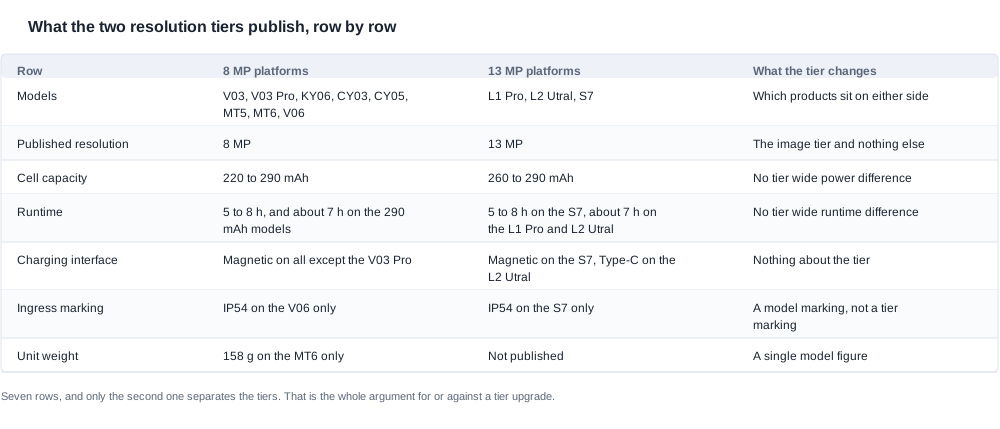
Seven rows describe the two tiers, and only one of them separates them. The 8 MP group is eight models — the V03 Pro and the V06, the KY06 and the CY03, and the V03 and the MT5, and the CY05 and the MT6 — and the 13 MP group is three: the L1 Pro and the S7, and the L2 Utral.
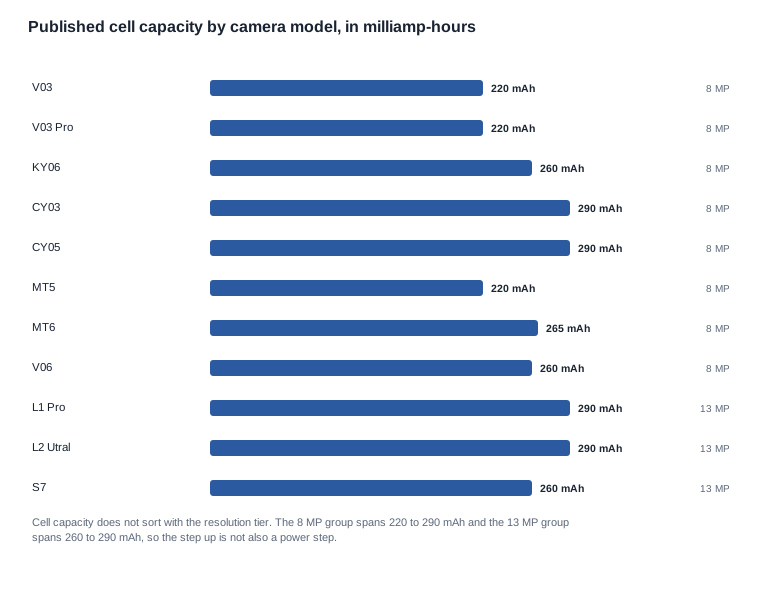
The cells do not sort with the tier. The 8 MP platforms run from 220 mAh on the MT5 and the V03 Pro, and the V03, through 260 mAh on the KY06 and the V06, with the MT6 at 265 mAh, up to 290 mAh on the CY03 and the CY05. The 13 MP platforms are 290 mAh on the L1 Pro and the L2 Utral and 260 mAh on the S7. So the step up is not a power step, and a buyer who is treating the tier as an upgrade in every sense is reading a price list rather than a specification.
The runtimes do not sort either. Roughly five to eight hours is published for the V06 and the S7, and the V03 Pro and the V03, six to eight hours for the KY06 and the MT5, and about seven hours for the L2 Utral and the MT6, and the CY05 and the CY03, and the L1 Pro. The 13 MP group therefore contains both the platform with the shortest published range and the platforms with the longest fixed figure, which is another way of saying that the tier tells a buyer nothing about endurance.
What the tier does correlate with is the commercial end of the range. The 13 MP platforms include two of the models with a published case capacity, the L1 Pro at 1400 mAh and the L2 Utral at 900 or 1400 mAh depending on configuration, alongside the S7, which is a sport platform with the IP54 ingress marking, the detachable inner frame and the shortest published runtime range in the camera group. That last point is the one that catches buyers out: the higher tier is not the premium tier, it is a different set of products, and the products in it are chosen for reasons other than their resolution.
Why the tier number settles less than it appears to
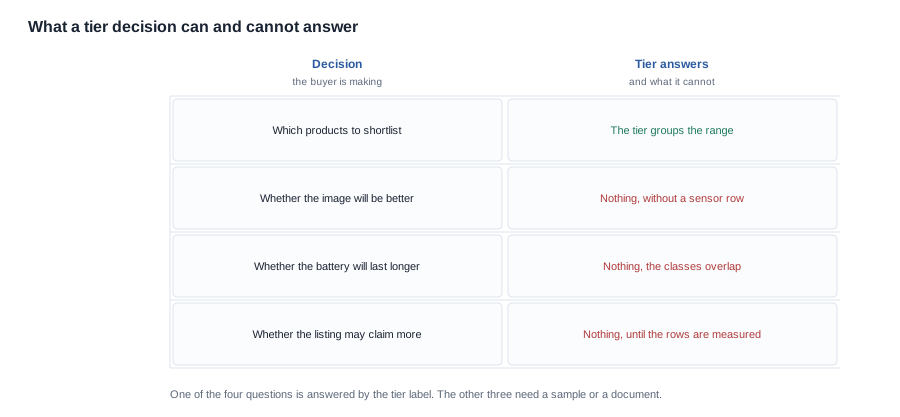
The step from 8 MP to 13 MP is a step in a count. It is not a step in the size of the pixels, in the amount of light the sensor gathers, in the width of the lens, in the format of the recording, or in the way motion is handled. Every one of those rows is empty across the whole camera range, and they are the rows that would decide whether the step up is worth anything.
There is a second, quieter consequence. A tier label on a product page is an invitation to compare, and the comparison a customer will make is between the cheapest product carrying the lower label and the most expensive product carrying the higher one. That comparison is not about the two products; it is about the distance between the two ends of the range, which in our case includes the colour options, the lens options, the case capacities and the ingress markings. If the copy names the tier as the benefit, the customer will read it as the benefit, and the product will be judged on the one row that cannot carry that weight.
There is a third issue that is specific to this range and worth naming. The camera tier publishes no radio version. Across the eleven camera platforms there is no Bluetooth version row at all, while the audio and sport models in the same catalogue do carry one. A buyer checking a camera platform's sheet for the radio version will find nothing, and the absence is easy to misread as an omission rather than as a row that has to be requested. The radio and camera rows are documented separately, and the camera rows are the thinner of the two sets.

Three conditions under which the step up earns its cost
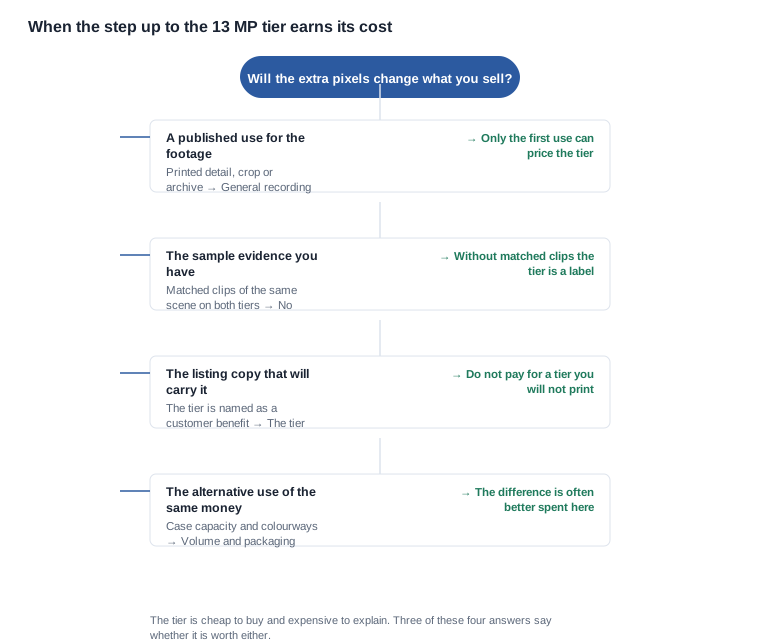
The tier is cheap relative to a programme and expensive relative to a single unit, so the question is rarely whether the step up is affordable. It is whether the extra pixels change something the buyer is selling, and the total cost of the step is usually larger than the unit price difference suggests.
The components of that total cost are worth listing, because a buyer evaluating a tier decision should have all of them on one sheet. The unit price difference across the volume. The tooling and artwork changes if the tier forces a different housing or a different lens. The additional configuration count, and each configuration carries its own minimum. The photography and listing work, which is not free when a second tier means a second set of assets and a second set of claims to defend. And the returns exposure, which is the one nobody prices and the one that dominates when the tier has been promised rather than demonstrated.
It is whether the extra pixels change something that the buyer is selling.
Condition one: the content is cropped, printed or archived. Cropping and printing are the only operations where a higher pixel count reliably produces a visible difference, and even there the difference depends on the source. If the content is captured at a distance and then reduced for a feed, the extra pixels are discarded in the reduction and the tier bought nothing. If the content is captured and then cropped tight for a still, the tier is doing exactly what it is supposed to do. This is a decision about the customer's workflow, and it can be settled by asking how the footage is used rather than by testing the camera.
Condition two: the customer compares pixel counts. This is a real commercial condition and it is uncomfortable to write down, because the right answer to it is not a better camera. If the decision is made on the specification table rather than on the output, the tier is the deciding row, and a product at 13 MP will outsell an 8 MP product of equal quality. Buyers who want to avoid that fight can decline to print the tier at all, which is a legitimate option and one that many of our own customers take.
Condition three: two platforms are already in the range and the line-up needs a step. A range that carries both an 8 MP and a 13 MP platform lets a buyer offer a choice, and a range that carries only one tier makes the comparison with a competitor harder. The cost of the tier is then a range-management cost rather than a product cost, and it is amortised across the whole line.
If none of the three conditions applies, the honest conclusion is that the tier decision is a marketing decision rather than a technical one, and it should be made with that description attached to it.
A shortlist and evaluation checklist for a tier decision
Before you order anything, the tier question is answered by six criteria, and the shortlist should be built against them rather than against the tier label.
- The customer's workflow, written as an operation. Crop, print, archive, feed or none of these. This single sentence decides whether pixel count has anything to do with the outcome, and it is the first question to ask the customer rather than the supplier.
- The output size at which the content will be published. The comparison has to happen at that size. A tier difference that survives at full resolution and disappears at feed size has not bought anything.
- The light level of the real environment. A tier decision taken in office lighting is a tier decision taken in the wrong place, and the low-light case is where the pixel count usually stops deciding the outcome.
- The total cost of the step across the volume, not the unit. The unit price difference is visible in the quotation; the difference in the returns rate, the support load and the listing work is not, and it is usually larger.
- The rows that would have to exist to defend the claim. If the copy will name the tier as a benefit, the sensor rows are what defend it, and until they exist the claim is an assertion.
- The trade-off against the rest of the line-up. The case capacity, the colour options, the ingress marking and the price ladder are the things the money is competing with, and they are the things a customer notices first.
These six criteria are deliberately written so that four of them can be answered before a sample arrives. A buyer who applies them and finds that only the second and the third are open has a two-week evaluation ahead rather than a two-month one, and the tier question gets settled by evidence instead of by the price list.
How to test a tier decision before the purchase order
A tier test is simpler than most camera tests, because the comparison is between two products rather than between a product and a specification. The protocol has three steps.
Shoot the same scene on both tiers, in the same light, on the same day. Same scene, same light and same day are the three conditions that make the comparison readable. Comparing a clip captured last month with one captured today produces a conclusion about the weather.
Keep the footage and compare it on the customer's own pipeline. Not on a monitor in the evaluation room, and not by eye against a reference. The step up has to be judged at the output size the customer publishes at, because that is the only size at which the difference either exists or does not. A 13 MP recording reduced to a phone screen can look identical to an 8 MP one, and if the customer's use is a phone screen then the tier bought nothing and the decision is already made.
Test the low-light case. This is the step that most often reverses an initial impression, because it is the condition in which the pixel count stops being the deciding variable. If the 13 MP platform produces the noisier image in the light the customer actually works in, the tier decision is settled and it is settled against the higher tier.
The sample protocol itself does not need to be complicated. Two units of each tier, one continuous session, one low-light scene, one indoor scene, and the footage kept. The underlying point is that a tier decision is a comparison, and a comparison that has been made once, in a controlled way, is worth more than any amount of specification reasoning.
Six ways a tier upgrade goes wrong commercially
The tier is bought for a use the customer does not have. Symptom: the product launches with a tier-led proposition and the reviews do not mention the image. Root cause: the tier was chosen from a comparison table rather than from a workflow. Prevention: write the customer's use as a workflow before choosing.
The two tiers are sold as different products when they behave the same. Symptom: buyers ask why the cheaper model produces the same footage. Root cause: the tier was published as a benefit that the evidence does not support. Prevention: do not print the tier as an advantage unless the sensor rows exist.
The step up moves the unit out of the price band. Symptom: the range loses its entry point. Root cause: the tier decision was made without a line-up plan. Prevention: decide the tier by model role, and check the resulting price ladder before the order.
The sensor rows arrive later and contradict the assumption. Symptom: a second supplier's 8 MP unit outperforms the 13 MP unit in the customer's environment. Root cause: the tier was treated as a quality ranking without evidence. Prevention: never write a quality comparison into copy that rests on a pixel count.
The upgrade is funded by cutting the case. Symptom: the shipped configuration does not match the sample. Root cause: the money was moved from the accessory budget rather than from the volume budget. Prevention: keep the case capacity as a published row and do not substitute it.
Nobody on the team knows which tier each model is. Symptom: an ordering error, or a listing that names the wrong tier. Root cause: the tier was recorded in the buyer's head rather than in the product master. Prevention: maintain one product table with the tier, the cell, the runtime and the interface, and let every document draw from it.
The common thread through all six is that a tier decision is a product decision dressed as a specification decision, and the pitfalls are the ones that come from treating it as a specification. The signs that a decision has drifted in that direction are simple: the tier is the reason in the quotation, nobody on the team can say what the customer does with the footage, and the sample test was run once, in one light, by one person, on one unit.
The terms a tier decision is worth negotiating
The tier itself is a fixed hardware fact, so the commercial room is not in the tier. It is in the things that surround it.
The sample protocol. A supplier willing to shoot your scene on both tiers, in your light, on units from your production build, has removed the largest single unknown in the decision, and it costs them less than it costs you. Ask for it as a condition of the quotation.
The acceptance criteria for the tier. If the customer is comparing counts, then a criterion that measures what the buyer actually cares about — output at the published size, in the target light — is worth more than a price concession, because it prevents a decision that will be regretted.
The range planning. The number of distinct configurations a supplier commits to is negotiable, and each configuration carries its own minimum. A buyer who needs both tiers for a line-up is usually better served by a committed configuration count than by a unit count.
The case and the accessory scope. Case capacities are published for five camera platforms — 1400 mAh on the CY05 and the CY03, and the L1 Pro, 900 or 1400 mAh on the L2 Utral, and a foldable 1200 mAh on the MT6 — while the KY06 and the MT5 have a case with no published capacity. Two models can be shipped with a case that the buyer has not priced, and that is a negotiation to have early.
What does not move is the certification cost and the elapsed time of a certification programme, which belong to the test laboratory and the review queue, and the tooling cost, which is a one-off usually amortised across the first order. The useful questions about tooling are over what volume it is amortised across and what happens to it if the programme is discontinued.
What the tier does not tell you, and what we will not claim
Stated plainly: the step from 8 MP to 13 MP in this range is an image decision and nothing else, which makes it easy to evaluate and hard to evidence. We will not publish a sensor model, a field of view, a video resolution, a frame rate, a pixel size or a stabilisation figure for a model where the manufacturer has not provided one, and we will not present a tier label as a quality claim.
What we publish for the camera range is the resolution tier, the cell capacity, the runtime, the charge time, the case capacity where it exists, the charging interface, the IP54 marking on the V06 and the S7, and the unit weight on the MT6 at 158 g for the glasses themselves. Everything that would let a buyer rank the two tiers by image quality is absent from our documentation, and we would rather say so than let a buyer pay for a difference the evidence does not describe.
The chart above is the reason the tier cannot be treated as a power decision: capacity does not sort with resolution.
There is one further comparison worth making before a tier decision, and it is not a camera comparison at all. Two platforms in the same tier can differ by more than two platforms in different tiers do: a photochromic lens option, a detachable inner frame, a folding case, an ingress marking or a colour list are all published rows, and all of them are visible to a customer in a way that a resolution tier is not. When the brief is to choose between tiers, the honest question is what the customer will actually be comparing. A buyer who wants the higher tier for endurance will be disappointed, and a buyer who wants endurance will find the 290 mAh platforms in both tiers.
Related reading
- The published position — camera and imaging
- The misreadings this tier invites — camera technology myths
- The range structure — smart glasses model comparison
- The radio rows, documented separately — bluetooth connectivity
- The protocol for evaluating a sample — sample evaluation
Tell us the use case, the environment and the models you are comparing, and we will tell you what the tier changes and which rows still need evidence.


