
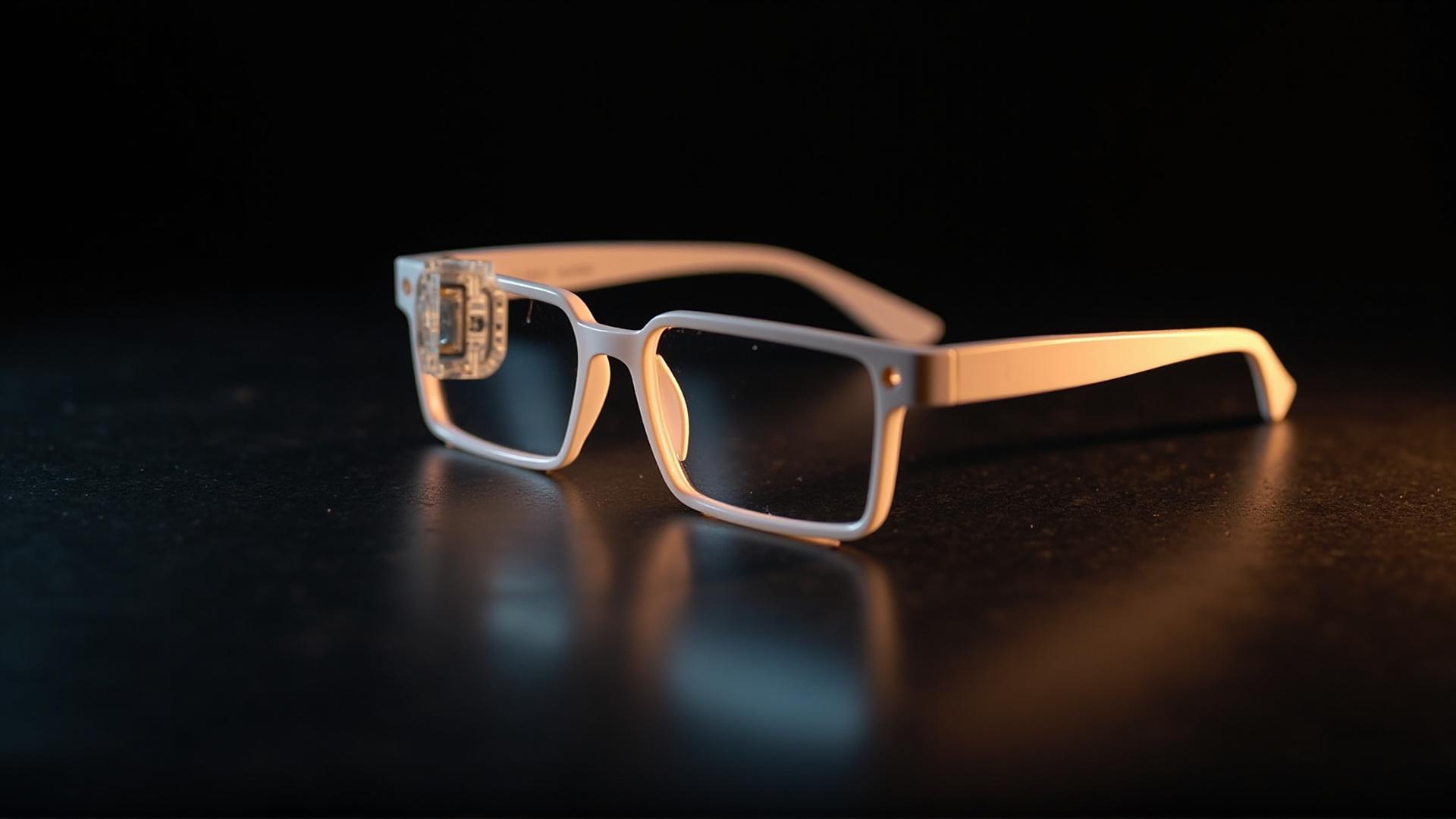
Smart glasses camera technology smart glasses myths are the beliefs that survive because a catalogue never settles them, and they are expensive because each one leads to a different purchase. This page is written for the buyer choosing a camera platform and for the channel team writing the copy, and it sets out the beliefs with the published fact underneath each one.
The published camera position in our range is this. The camera tier publishes eight megapixels on the CY05 and the CY03, the V06 and the V03, and the KY06 and the MT5, and the MT6 and the V03 Pro, and thirteen megapixels on the L1 Pro and the S7, and the L2 Utral. Cell configurations run from 220 mAh to 290 mAh, and the charge time is two hours or less on every camera model. The published runtimes are five to eight hours on the V03 Pro and the V06, and the S7 and the V03, six to eight hours on the KY06 and the MT5, and roughly seven hours on the CY03 and the L2 Utral, and the CY05 and the MT6, and the L1 Pro. The IP54 marking appears on the V06 and the S7 only, and it appears without a published report number. The V03 Pro publishes photochromic lenses, and the D17 and the ZH12 publish a remote shutter. And that is the whole of the published camera position, because the video resolution, the frame rate, the field of view, the stabilisation, the microphone specification and every third-party measurement are Not published for every model.
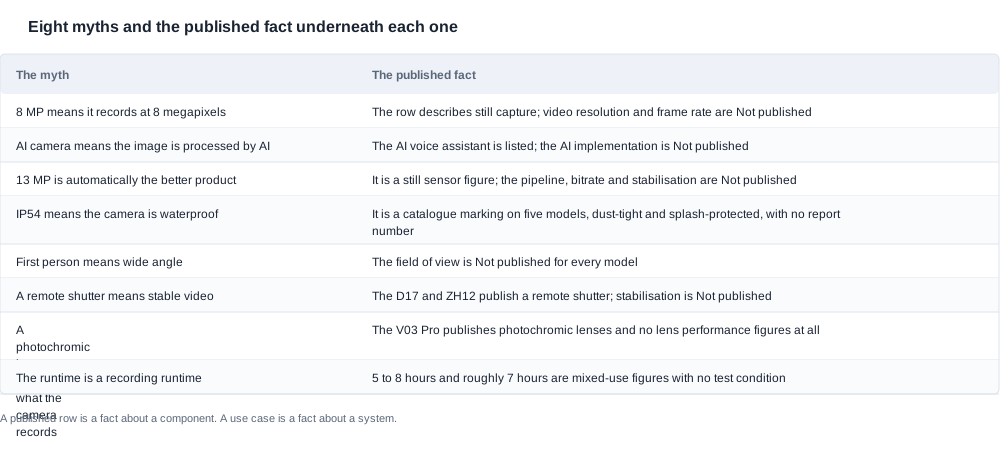
Smart glasses camera technology: the beliefs the open rows keep alive
| The belief | The published fact underneath it | The threshold or the question | The cost of leaving it |
|---|---|---|---|
| 8 MP means it records at 8 megapixels of video | The row describes still capture. A video pipeline is a separate set of numbers, and none of them is published | The video resolution and the frame rate | The most expensive misunderstanding in the category, because a content channel is built on video and the published figure is about stills. The buying guide sets out why |
| AI camera means the image is processed by AI | The AI voice assistant is a listed key technology and the implementation is Not published for every model | Whether the assistant and the image pipeline are the same thing | A claim the product cannot evidence. An assistant and an image processor are different things, and neither is evidenced in our catalogue |
| 13 MP is automatically the better product | For stills it is a larger sensor figure. For video it depends on the pipeline, the bitrate and the stabilisation, none of which is published | The sensor part number, the pixel size and the video rows | The two tiers are not ranked by the megapixel row, and a tier built on that ranking can be overturned by a customer in a shop |
| IP54 means the camera is waterproof | The marking appears on the V06 and the S7 only, with no third-party report number behind it. It says dust-tight and splash-protected. It says nothing about a lens, a sensor, condensation or immersion | The report number, the standard and the tested configuration | A camera product sold on a marking that does not cover condensation, which is what a lens actually suffers from |
| The charge time is the runtime | Two separate published rows: a charge time of two hours or less, and a rated runtime between five and eight hours | The runtime with the sensor active, and its duty cycle | A shift planned on the wrong figure, and a case ordered for the wrong session length |
| The charging case is an accessory | A case is a second cell: 1400 mAh on the L1 Pro, the CY03 and the CY05, 900 or 1400 mAh on the L2 Utral, 1200 mAh in the MT6's foldable case | The case cell in the transport declaration and the case in the box | A transport and labelling gap that surfaces at freight booking, not at the factory |
| A published weight means a light frame | One model in eleven publishes a figure: the MT6 at 158 g, and that is the glasses body including the battery and the camera and excluding the foldable case | The weight for the model being quoted, with its boundary stated | A comfort promise extended across ten models that do not publish one |
| An unpublished row is unimportant | Unpublished means untested. The camera rows that decide the purchase are exactly the ones nobody has written down | Which four rows have to be closed before the order | A launch with no specifications, and a support script that starts from a symptom |
The belief that costs the most in a content channel
One of these is worse than the others, and a buyer who has budget for only one correction should spend it here.
The published pixel count is being read as a video specification. The catalogue publishes eight and thirteen megapixels because that is the figure that is available for the still path. It does not publish a video resolution or a frame rate for any camera model, because those are not published to us. A channel team that reads a megapixel row as a description of the recording capability builds a proposition on a number that describes a different function, and the customer finds out by recording a clip and watching it stutter.
The cost has three stages, and the third is the expensive one. The first is the listing, which promises more than the product delivers. The second is the review, where a customer compares the product against a competitor's unit and finds a difference. The third is the returns queue and the channel rating, which is the part a procurement manager owns.
The correction is cheap and it is a procurement task rather than a marketing one: ask for the video resolution and the frame rate for every candidate, in one message, in the same format, before the copy is written. If the answer comes back with the still path again, that is itself a finding about the product.
The second most expensive: inheriting a marking from another model
The IP54 position is the clearest case of a family-level inference going wrong. In our range the marking appears on the V06 and the S7. It does not appear on the other nine camera models, and it carries no published report number. A range page that generalises it across the family creates a claim on nine products that their own rows do not support, and the customer who tests it with a tap finds out in a way that is expensive for the brand.
The two checks are short. Read the marking off the specific model's row rather than off the family. And where the marking exists, ask which configuration was tested and under what standard, because a marking without a tested configuration is a description.
The third: treating the case as packaging
A charging case with a cell is a second product in the box. It carries its own declaration, its own labelling, its own packing instruction and its own freight treatment, and the capacity is published per model rather than per family: 1400 mAh on the CY05, the L1 Pro and the CY03, 900 or 1400 mAh on the L2 Utral, and the MT6's foldable case at 1200 mAh. The KY06 and the MT5 are stocked with a charging case whose capacity is not published at all, which is a second question rather than a solved one. A buyer who treats the case as an accessory discovers the documentation gap during freight booking, and freight booking is a much worse place to discover it than the order form.
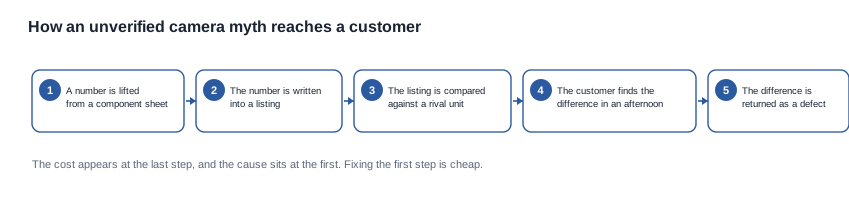
How a camera belief travels from a datasheet into a listing
The transmission path is short, and each step makes the belief slightly stronger. Understanding it is what makes the prevention obvious.
A number is lifted from a component sheet. The figure was measured on a reference board, or quoted from the sensor's datasheet, or written by a marketing team in another market. It arrives with the authority of a specification and none of the conditions.
The number is rewritten into a sentence. A figure becomes a phrase. Phrases lose their units, their conventions and their conditions faster than figures do, because a sentence has no place to put them. "13 MP" survives a rewrite as "13 megapixels". "130-degree field of view" survives as "wide-angle view" only if somebody actively edits it down, which nobody does.
The sentence is placed on a listing. By now the claim is in a format where it is read as a product promise and where it is compared against a competitor's page rather than against a datasheet.
The customer finds the difference in an afternoon. They record a clip, or they test the marking, or they read the label on the box. The difference is real and it is theirs, and no amount of it being written on a datasheet elsewhere in the world changes that.
The difference is returned as a defect. The return arrives with a complaint that describes a fault, and the first support response will treat it as one, because that is what the buyer's copy invited.
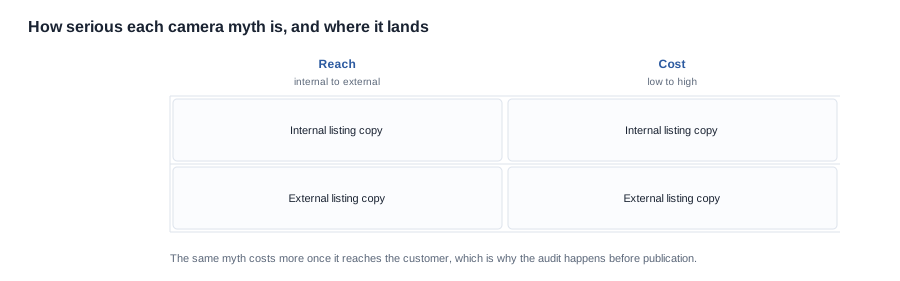
Where the transmission stops if you intervene at the right point
The cheapest intervention is the first step, before the rewrite. A claim that never becomes a sentence cannot be paraphrased, and a claim that is recorded with its condition at the configuration stage stays attached to it through the listing, the packaging artwork and the support script.
The second-cheapest intervention is at the last step, which is a matter of the buyer's copy and of what the support script is allowed to say. A product whose published rows are narrow enough to be accurate is easier to support than one whose listing promises more than its documentation holds.
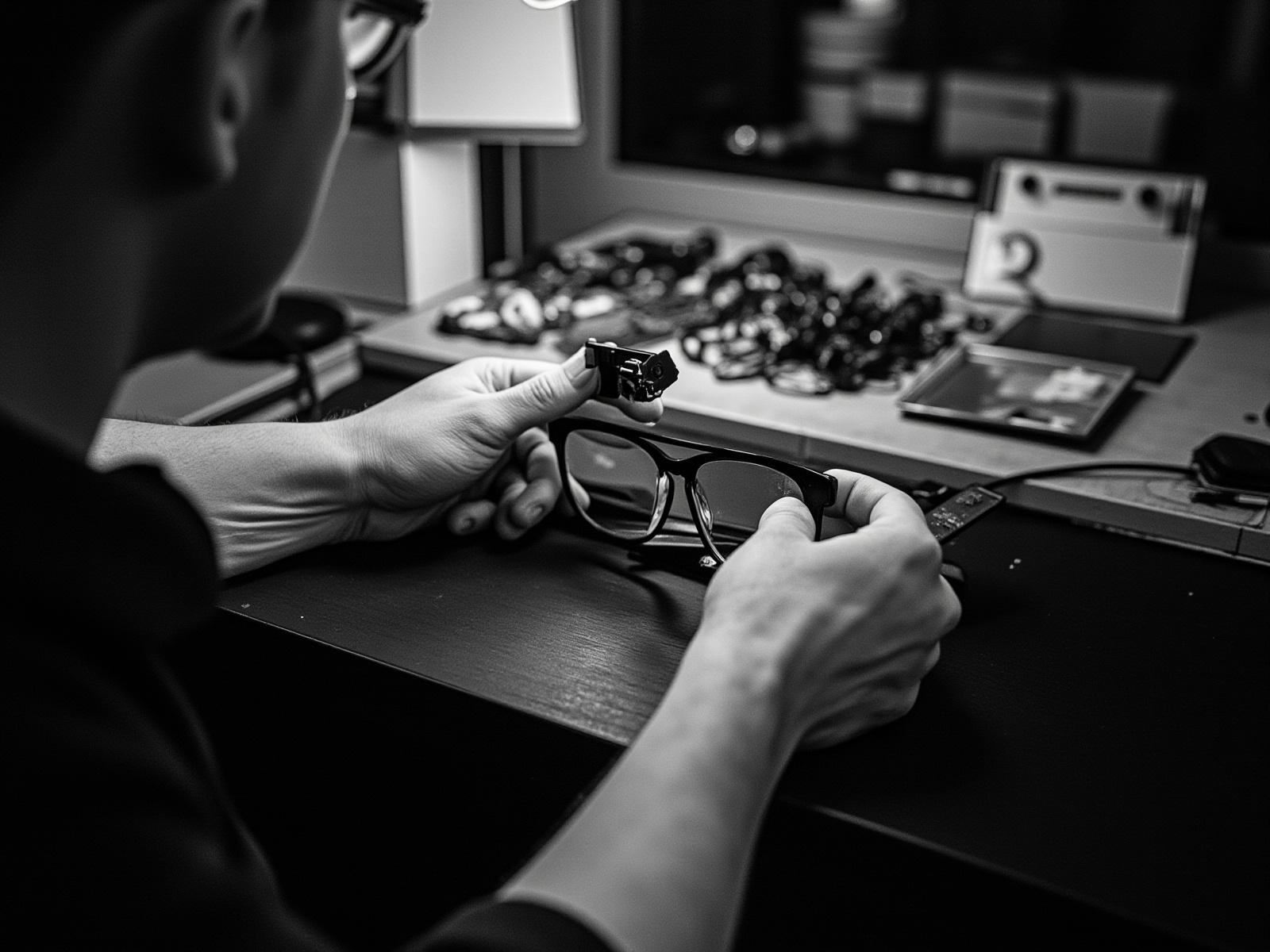
A hypothetical myth audit before a listing goes live
This is a hypothetical case rather than a client project, and it is written as a procedure, because it is the procedure rather than the insight that removes the risk.
A brand is about to publish a camera-glasses listing. Before the copy goes live, the team runs two passes over it.
The first pass traces every number. Each figure in the listing is traced back to a row or a document: the resolution tier to the published tier for that model, the cell capacity to the published electrical row, the runtime to the published figure, the weight to the published figure for that specific model, the ingress marking to the marking on that model's own row. Each figure that cannot be traced is either removed or replaced with a statement the documentation supports.
The second pass traces every inherited claim. This is the pass that catches the family-level inference. Features are checked against the model they are being claimed on rather than the family: a photochromic lens is claimed only where the catalogue publishes it, a remote shutter only where it is published, an ingress marking only where that model carries it, and a Bluetooth version never, because our catalogue does not publish one for any camera model.
The audit produces three lists. The figures that are published and can stay. The figures that are open and need to be closed before the listing goes live, which in this category means the video rows, the angle, the stabilisation and the storage behaviour. And the figures that were removed because nothing supports them.
The audit at the range-page level rather than the listing level
The same procedure has to run at range level, because a range page is where family-level inference happens. The questions there are simpler: does every model on this page carry the marking shown next to it, does the feature list on the page describe this model or the platform, and does the page present a specification in a way that a customer will read as a performance. The range structure itself is set out in the entry level options page, and the application scenarios that justify the camera at all are at content creation and social media.
How to choose between two camera platforms when the beliefs are the same
A buyer who has removed the beliefs from the copy still has to choose. The criteria that survive the audit are short, and they are the same criteria for every candidate, which is what makes the comparison fair.
Which platform can produce the video rows at all. The first question to ask before any comparison is whether the supplier will state a video resolution and a frame rate. A platform whose supplier will not is not comparable on any axis, because the axis that matters is unknown, and it has to be eliminated before the shortlist is built rather than after.
Which platform's runtime is stated on a duty cycle. Our catalogue publishes a rated runtime for every camera model, but the duty cycle behind it is not published. A supplier who will state the runtime with the sensor active is a supplier whose figures can be used to plan a session, and one who will not is asking the buyer to plan from an unconditioned figure.
Which platform has a case configuration that matches the session. The case cells published for this tier differ by model, and the L2 Utral alone offers two capacities. A platform whose case does not match the session length is a platform whose returns come from the operational limit rather than from the camera, and that is a cost the buyer can price before ordering.
Which platform's published rows will still be accurate at the second run. A supplier who will re-confirm the configuration and the rows at the second order is a supplier whose shortlist entry does not expire; one who treats the first quotation as final is a supplier whose programme will have to be re-sourced.
The trade-off to watch is between a platform that publishes a narrow set of rows precisely and one that publishes a broad set loosely. In this category the first is more useful, because a precise narrow row can be checked and a broad loose row cannot be checked at all.
The questions to ask before you order, in one place
- What is the video resolution and the frame rate, with the duty cycle behind the runtime.
- What is the field of view, in a stated convention, for the product rather than the module.
- What is the sensor part number and the pixel size, and does the supplier hold measurements behind them.
- What is the storage capacity, the format and the overwrite rule, and will the rule appear in the manual.
- What is the unit weight for this model, with its boundary stated, and what is the ingress position for this model only.
- What are the terms for the case, the case capacity and the transport declaration that covers it.
- Which claims will the supplier state publicly, and which will only appear in a technical file.
A shortlist built on these answers is comparable. A shortlist built on tier labels is not, and the myth is the reason why.
What removing a belief is worth commercially
A camera comparison that publishes its conditions is the cheapest defence of a content channel, because the customer is going to test the image in the first week anyway. Four rows and one afternoon of shooting remove an entire class of dispute from the channel, and the cost of those four rows is one message to a supplier.
What can be negotiated, and what can be settled. Unit price and volume tiers, the accessory and charging set with its minimum order quantities, packaging specification, delivery splitting, payment nodes against inspection, the warranty period with a stated response, the return terms for a content channel, and the terms of a pilot order are all negotiable and all worth the negotiation time. The return terms are the line that moves most in a channel where the image is the purchase, because they are where the cost of an unresolved belief lands. Certification cost and the testing body's lead time follow the process and are not the kind of line that moves, and tooling is often amortised across the first order while certification cost is per product family, so it is worth asking which of the two is being quoted, because the two are frequently bundled into a single line that hides which is which.
What belongs in the agreement. The published rows for the configuration ordered; the sensor part number, the field of view, the video resolution and the frame rate; the lens figures where a photochromic lens is in scope; the ingress evidence; the measured weight with its boundary stated; and the warranty period with a stated response.
What stays out. Any image quality, video quality, lens performance or protection claim that has not been established on a sample. The absence of such a claim is not a weakness in the listing. It is the reason the listing can be defended when a competitor's page is not.
The unpublished rows are part of the specification
It is worth being precise: the camera beliefs survive because the catalogue leaves the gaps open, and a buyer who closes the four camera rows and shoots a sample will choose better than one who compares tier labels. We will not publish a sensor model, a field of view, a video resolution, a frame rate, a pixel size, a stabilisation figure, a lens performance number or an ingress report for a model where the manufacturer has not provided one, and we will not present a megapixel tier as an image quality claim.
What we will do is give you the beliefs, the published fact under each one, and the two actions that close them. The camera and imaging page sets out the full published position, the buying guide covers the selection logic, and the photochromic smart glasses page covers the lens feature on the models where it is published.
The four actions.
- Request the four camera rows in one message, for every candidate, in the same format.
- Shoot the same scene on a sample of each, and keep the footage.
- Test the low-light case if the deployment needs it.
- Put the camera rows and the return terms in the agreement, and write the listing only from the rows you have.
Tell us the use case, the environment and the models you are comparing, and we will tell you which rows are documented and which have to be measured.
Related reading
- The full published position — camera and imaging
- How the shortlist is made — buying guide
- The range structure — entry level options


