

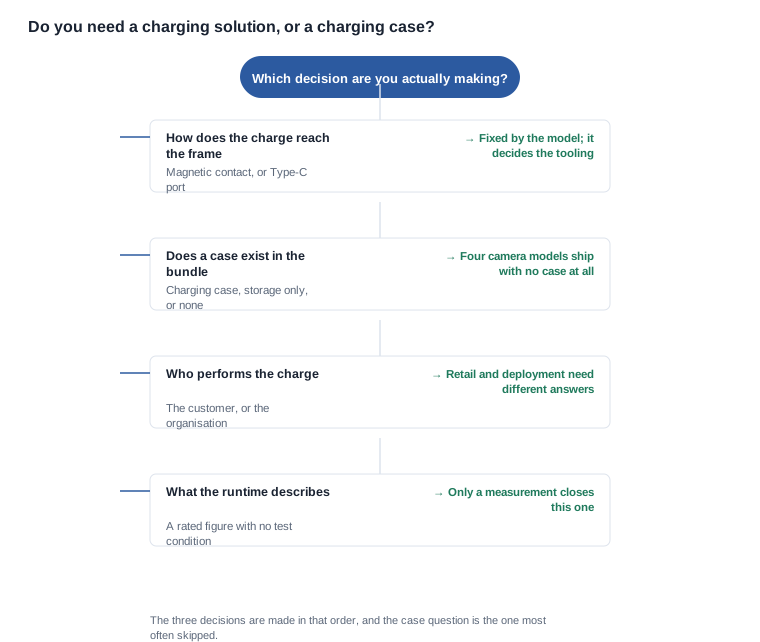
Charging looks like one line on a specification sheet. It is actually three decisions that a buyer makes separately and that a factory will happily let you make in the wrong order. The first is the interface: how the cell connects to power, and what source reaches it. The second is whether a case is part of the package at all, and if so, whether it charges the frames or only stores them. The third is what the runtime number on the sheet actually describes, because a runtime that no test condition supports is a decision made by whoever writes the listing. A product with the right answer to all three is a different product from one with the right answer to two of them, and the cost of finding out late is a new tool, a new box and a new set of packaging artwork.
The short version of the answer: in this range, eleven models carry a camera and four of them ship without any charging case at all, so "does it come with a case" is not a question about the category but a question about a specific model. Work out which of the three decisions you are actually making, in order, before anyone quotes you.
Smart glasses charging: three decisions in one word
The interface decides your tooling. A magnetic contact arrangement needs a specific cradle geometry and a specific case interior, and it cannot be retrofitted to a product designed around a cable. A Type-C port is cheaper to tool, universally understood by the buyer, and lets the customer charge from a power bank they already own. Neither is better in the abstract; they are different products aimed at different buyers, and the choice is close to irreversible once the frame tool is cut.
The case is a commercial decision wearing an engineering costume. A charging case turns a pair of glasses into a retail object. It raises the achievable basket value, it gives the customer a reason to keep the product on a desk rather than in a drawer, and it turns a consumable-battery anxiety into a daily habit. It also adds packaging, adds shipping weight, adds a second cell to your shipping documentation, and adds a hinge to your quality control.
The runtime figure is a claim about a test, not a property of a cell. Our catalogue publishes a charge time and a runtime for every model, and in most cases the runtime is a range rather than a point, which is honest. What the catalogue does not publish is the test condition behind any of them, and that condition is the entire difference between a seven-hour figure and a three-hour experience. The V03 and the V03 Pro are published at five to eight hours, the K01 and the K02 at about eight, the D11 and the D12 at about seven. A camera draws more current than an audio-only device, so identical numbers across those groups are not describing identical workloads — the camera models in this range carry eight or thirteen megapixel sensors, and the number of megapixels is a description of the imaging chain rather than of the power budget, which is exactly why the catalogue's silence on the test condition matters.
The order in which these three get decided is the thing that costs money. Interface first, because it fixes the tooling. Case second, because it fixes the box, the freight, the transport scope and the copy. Runtime third, because it is a claim you write about a product whose hardware is already settled.
Why a factory is content to let a buyer make them out of order is worth understanding, because it explains most of the quotations a buyer receives. Each of the three decisions has its own cost attached to it, and the supplier is usually carrying that cost. A different interface means a different frame tool, and the supplier has one frame tool. A case in or out of the bundle means a different carton, a different insert and a different freight calculation, and the supplier has already committed the packaging development. A runtime claim is free until someone writes it down and a customer checks it. So the cheapest sequence for the supplier is to let the buyer settle all three at once, late — and the reason the question appears as one line on a specification sheet is that one line is convenient for everybody until it is not.
The trade-off a buyer is actually making is therefore between three things: a decision taken late and cheaply, or a decision taken early and expensively. The early version costs engineering time and possibly a tool charge. The late version costs a tool charge, a reprint, a new transport scope and a support queue. There is no version of this where the decision is free, and the honest question is which clock you want it to land on.
A related point that catches buyers out: the three decisions are not equally reversible. The interface is effectively permanent once the frame tool is cut. The case decision is reversible at a price — a case can be added to a later production run, at the cost of new packaging, new artwork and a new transport scope for the shipment. The runtime claim is fully reversible, right up to the moment it is printed on a carton. A buyer who knows which of the three is being made in which direction can stop worrying about the reversible ones and spend the attention on the one that matters.

Decision one: how the charge reaches the device
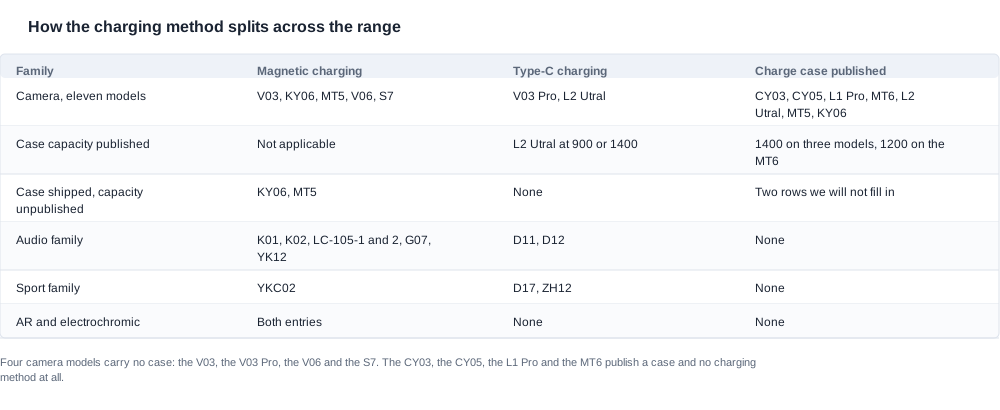
On our range the charging method is published for twenty-four of the twenty-eight models, and it splits cleanly enough that the sourcing question is answerable before any sample arrives.
Magnetic charging is the majority. In the camera family it covers the V03 and the MT5, and the V06 and the KY06, and the S7, and in the audio family it covers the LC-105-2 and the K01, the LC-105-1 and the G07, and the YK12 and the K02. Among the sport models the YKC02 is magnetic as well, while the D17 and the ZH12 are Type-C. The AR glasses entry and the AI electrochromic entry are magnetic as well. The advantage is that the customer never handles a connector, and the disadvantage is that the customer needs a dock or a case, because a magnetic frame has nothing to plug into.
Type-C is the minority and it is where the two interesting models sit. The V03 Pro and the D12, the D17 and the D11, and the ZH12 and the bone conduction entry all charge over Type-C, and the L2 Utral carries a Type-C charging port alongside a charging case. The advantage is that the customer already owns a cable and can charge from a power bank; the disadvantage is that there is a port cut into the frame, which has to be sealed, which is a moulding and inspection consideration rather than a free choice.
Four camera models sit outside both groups. The L1 Pro, the CY05 and the CY03, and the MT6 publish a charging case capacity and no charging method at all, so the charge path for those four has to be established on a sample before it can be written into a purchase order.
The consequence you should draw from this is that the interface question is largely answered for you by the model, and the real decision is about the source. A magnetic frame needs a dock or a case in the customer's possession, and that is where the accessory line and the freight cost enter. A Type-C frame needs nothing from the customer, and that is where the support cost of "it charges slowly" enters instead. Two different problems with two different solutions, and the model only tells you which one you have.
The source question is the one a buyer is most likely to skip, because the model list feels like it has already answered the charging question. It has not. A magnetic frame whose customer owns no dock and no case is a product that does not charge, and the only fixes are a bundle decision (put a case in the box) or a listing decision (tell the customer to buy a dock). A Type-C frame whose customer owns no cable has the same problem in a different form, and it is much cheaper to fix because any cable will do.
So the criteria for the source decision are these. First, what does the customer own on day one — and if the answer is nothing, the bundle has to supply it. Second, where does the charging happen — a desk, a vehicle, a site, a pocket — because that decides whether a wall adapter is sufficient or whether a power bank or a case is needed. Third, what does the channel assume the customer owns; a retail channel usually assumes more than a wholesale one, and the assumptions have to match the bundle.
The red flags here are recognisable. A quotation that lists the charging method but not the accessory in the box has answered the easy half of the question. A specification that gives an interface and a charge time but no case status for a model that visibly has a case is missing the row that matters. And any claim of the form "charges from any USB source" for a model where no input current has been published is a claim about a test that has not been shown to you — ask which input current the device accepts and what charger the figure assumes.

Decision two: whether the case charges or only stores
This is the decision most often skipped, and it is the one that produces a support contact within weeks of launch. A case that stores the frames and a case that charges them are different products: one is a dock, the other is a second battery, and the second brings a second cell into the consignment, a second transport document, and a second line in the quality control instruction.
What the catalogue publishes for the camera family, verified model by model, is this:
- The CY03 and the L1 Pro, and the CY05 each ship with a 1400 mAh charging case and publish a frame cell of 290 mAh with a runtime of about seven hours.
- The L2 Utral ships with a charging case offered at 900 mAh or 1400 mAh, carries a 290 mAh frame cell and a runtime of about seven hours, and charges through a Type-C port.
- The MT6 ships with a foldable 1200 mAh charging case, a 265 mAh frame cell and a runtime of about seven hours. It is also the only model in the range with a published weight: 158 g for the glasses body including the battery and the camera, excluding the folding charging case, whose own weight is not published.
- The KY06 and the MT5 both ship with a charging case, and neither publishes a capacity for it — the cell value is 260 mAh for the KY06 and 220 mAh for the MT5, with runtimes of about six to eight hours, and the case capacity is not stated.
- The V06 and the V03 Pro, and the S7 and the V03 ship without any charging case. The V03 is magnetic with a 220 mAh cell and a five-to-eight-hour runtime; the V03 Pro is Type-C with the same cell value and runtime, and adds photochromic lenses and a flexible temple; the V06 and the S7 are magnetic with a 260 mAh cell and a five-to-eight-hour runtime, and both carry the IP54 marking.
That last group is the one worth checking against your own assumption. Four of the eleven camera models have no case, and two of them — the V06 and the S7 — are the sport models with the ingress rating. A buyer who assumes "camera models come with a case" is wrong on four, and the way that assumption fails is a customer who has bought a case for a product that has no charging contacts.
The question behind the second decision is not "does a case exist" but "who pays for it and who benefits from it", and there are three answers. The case is standard, in the box on every unit, when the channel is retail and the case is part of the proposition the customer is buying. The case is optional, sold as a separate line or through the distributor, when the channel is price-sensitive or the freight is the deciding constraint. The case is absent, when the model does not have one and the product's use does not need one — which is the correct answer for the V06 and the V03, and the V03 Pro and the S7 unless your channel is explicitly selling a storage accessory alongside them.
Those three answers have different consequences and they are not interchangeable after the artwork is locked. A standard case adds freight on every unit and puts a second cell in every consignment. An optional case adds a catalogue entry, a spare-parts line and a support path that the channel has to be told about. An absent case leaves the customer with a cable and a product that has no dock, which is fine as long as nobody has written a listing that implies otherwise.
Two pitfalls are specific to this decision and both are common. The first is treating a model that ships with a case as though the case were an upgrade; if the case is in the box, the listing has to say so and the specification has to include it in the freight calculation, and a listing that presents a standard inclusion as a premium option is a returns generator. The second is the row we refuse to fill in — the KY06 and the MT5, where the case exists and the capacity is not published. The due diligence step there is narrow: ask for the capacity, in mAh, for the case as fitted, and treat the row as open until it is answered rather than carrying a neighbouring model's figure across.

Running the three decisions in the right order
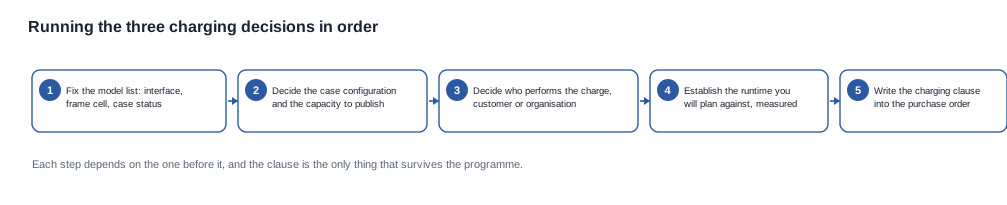
The sequence below is the working order for a sourcing team, and each step has a completion criterion. Steps one and two are answerable from a catalogue; step three needs a sample or a measurement.
- Fix the model list. The charging method, the cell capacity and the case situation are all published per model, so the first step is a table with one row per model and three columns. Done when every model on the order has an interface, a frame cell value and a case status.
- Decide whether the case is in the bundle. For the four camera models with no case, the question is whether the channel needs one supplied separately. For the two models that ship with a case but publish no capacity, the question is the missing figure. Done when the order line states the case configuration and, where it applies, the capacity.
- Decide who charges the device. In a retail channel the customer charges it, which makes the accessory line and the source compatibility part of the product. In a deployment channel the organisation charges it, which makes the charger ratio and the spare-unit plan the product. Done when the channel is written into the requirement.
- Establish the runtime you are planning against. Our published figures carry no test condition, so a deployment plan built on them is built on an unmeasured number. Done when a derated figure you have measured is written into the plan instead of the catalogue figure.
- Write the charging clause. Interface, accessory in the box, case configuration and capacity, charge time with its condition, and the point at which a change to any of it becomes a priced variation. Done when the clause can be quoted by a third party without a conversation.
The order is not arbitrary. A model list is needed before a case decision is possible; a case decision is needed before the accessory list; the channel decision determines what has to be measured. And a runtime claim written before the hardware is settled is the one that has to be retracted later.
Two more rules close the sequence. The first is that the runtime you plan against should be a derated figure you have measured on a sample, not the catalogue figure, because the catalogue figure has no test condition attached and the whole purpose of the sequence is to replace assumptions with measurements. The second is the negotiation rule: a change to any of the three decisions after the order is placed should be a priced variation rather than a conversation, because a change to the case configuration moves the transport scope, the carton, the artwork and the freight all at once, and a change absorbed silently lands on someone else's schedule without their agreement.
Before you order, the practical test of whether the sequence has actually been run is simple: ask the supplier to restate, for one model, the interface, the accessory in the box, the case configuration and the charge time with its condition, in one paragraph and without referring to a brochure. If the answer comes back in that form, the specification exists internally and you can rely on it in the quotation. If a brochure comes back, you have a catalogue, and a catalogue cannot answer a question about your order.
Settle the charging decision before tooling starts
Stated plainly: the charging decision is a requirements decision, and settling it after tooling has started means paying for the answer twice. We will publish the interface, the charge time, the battery capacity and the case capacity exactly as the catalogue states them, including the rows where the case is published but its capacity is not, and we will not invent a charge time, a case capacity or a runtime condition that the documentation does not carry.
There is one row in the catalogue where the distinction matters most, and it is worth naming because it is easy to fill in from a neighbouring model by mistake. The KY06 and the MT5 are provided with a case whose capacity is not published. The right response is to request the figure, not to carry 1400 mAh across from the CY03 — a case capacity that has been guessed becomes a transport scope that has been guessed, and it is the transport scope that stops a shipment.
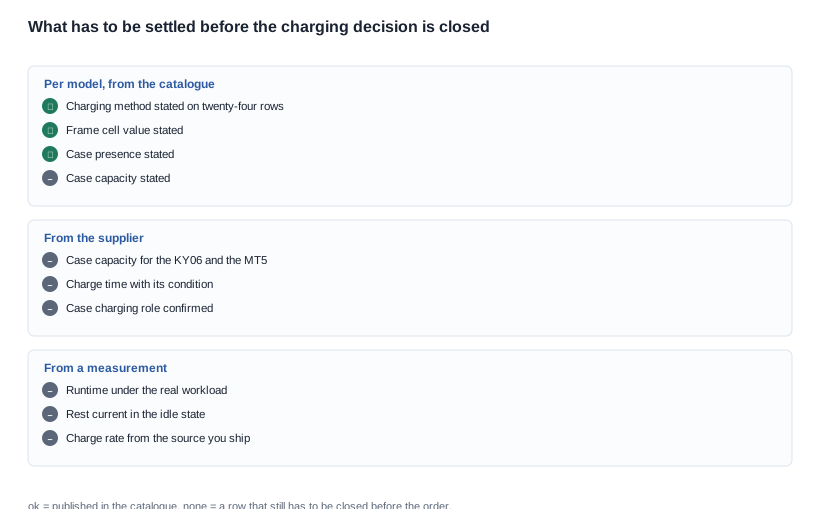
The other thing we will not do is treat a case as a charger because it is described as a charging case. Where the catalogue states a charging mode for a case-equipped model, we will use it; where it states a case capacity and a charge time and nothing about the case's charging role, we will say that the role is not published and ask. That distinction is the whole of the second decision, and it is cheap to settle now and expensive to settle after the artwork.
What we will do is take your usage pattern, your channel and your destination market and tell you which configuration answers all three questions, which models in our range already do it, and which rows would still need to be confirmed with you before a quotation. The charge time and runtime figures for every model we publish are set out under charging solutions, how a runtime figure should be read before you accept it is covered under battery life specifications, the models that ship with a case and the ones that do not are listed on the AI camera glasses range, and what a cell needs before it can move by air is set out under battery transport.
Related reading
- The charge time and runtime figures for every model we publish — charging and runtime specifications
- How a runtime figure should be read before you accept it — battery life specifications
- The models that ship with a case and the ones that do not — AI camera glasses range
- What a cell needs before it can move by air — battery transport
Tell us how the product is used, how it is sold and where it ships, and we will tell you which charging configuration fits without a second tool.


