

A standards question in this category is usually asked as "is this product certified", and the answer usually fails in a specific way: it collapses four different instruments into one word. A transport summary for a cell, a declaration of conformity for the finished product, a radio approval route for the market, and a set of packaging and waste obligations are not one thing, they do not cover the same object, and they do not have the same trigger.
For a buyer, the useful map is instrument → object it attaches to → model row it covers → change that invalidates it. Get that map wrong and the consequences are specific: a shipment held at a carrier, a product page making a claim the file does not support, or a second programme started from scratch because the first one's documents never covered the charging configuration that shipped.
Our catalogue publishes the charging rows for all 28 models. It does not publish a per-model certificate list, and the reason is stated in full later in this article rather than buried, because a buyer who assumes otherwise will build a programme on it.
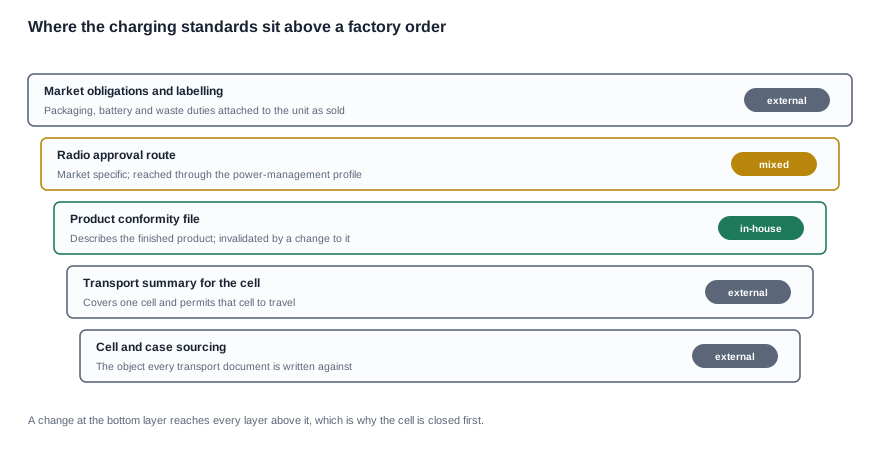
Smart glasses charging: sorting the standards by what each attaches to
The first instrument is transport. The UN 38.3 test summary covers a specific cell and permits that cell to travel. It is the document a carrier asks for, and it is the one that expires against a substitution rather than against a date. The object it attaches to is the cell, not the product, which is the whole difficulty: a buyer comparing two finished products is comparing products whose transport documents may cover entirely different objects.
The second instrument is product conformity. The declaration of conformity describes the finished product and the standards used to assess it. In the European Union it carries no expiry date, which sounds like permanence and is not: what invalidates it is a change to the product. A different cell, a different charging case, a different connector and a different power-management profile are all candidate changes, and each of them means the file has to be reviewed rather than assumed to carry over.
The third instrument is the radio approval route for the destination market, which in Europe runs through the Radio Equipment Directive, (EU) 2014/53/EU. The charging function reaches it because the radio's behaviour is a function of the power budget: what the firmware is permitted to draw, how the product behaves when the cell is depleted and what the radio does while the unit is on charge are all power-management decisions.
The fourth instrument is the set of packaging, labelling and waste obligations that attach to the commercial unit as sold, including the battery inside the product and the battery inside the charging case.
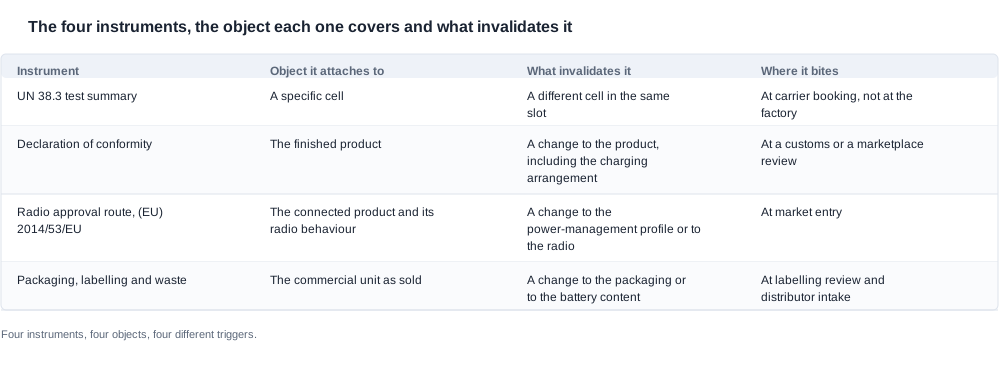
| Instrument | Object it attaches to | What invalidates it | Where it bites |
|---|---|---|---|
| UN 38.3 test summary | A specific cell | A different cell in the same slot | At carrier booking, not at the factory |
| Declaration of conformity | The finished product | A change to the product, including the charging arrangement | At a customs or marketplace review |
| Radio approval route, (EU) 2014/53/EU | The connected product and its radio behaviour | A change to the power-management profile or to the radio | At market entry, when a market list changes |
| Packaging, labelling and waste | The commercial unit as sold | A change to the packaging or to the battery content | At labelling review and at distributor intake |
The four instruments also differ in how long they take, and that difference is the reason a charging programme gets compressed at the wrong end. A transport summary follows a cell that already exists, so it can be produced inside a normal documentation cycle provided the cell is settled. A conformity review after a configuration change is scheduled engineering work, and it sits behind an engineering change rather than in front of it. A radio approval route for a new market is the longest of the three, because it is not a document you request but a route you enter. Packaging and labelling obligations sit in a fourth category again: they are quick to satisfy and expensive to satisfy late, because they change artwork that has usually already been approved. A programme that treats all four as one task will sequence them wrongly and discover the error at the shipment.
The three instruments that most often get confused in this category
The most common confusion is between the transport summary and the declaration of conformity, because both are filed under "certificates" and both are PDFs attached to an email. The practical difference is who needs them and when: the carrier needs the first one at booking and will refuse the shipment without it, while a compliance reviewer needs the second one at market entry and will question the product rather than the freight. A supplier who sends one when you asked for the other has not made an error of housekeeping; they have told you that the cell is the only part of the charging arrangement they track.
The second confusion is between a directive and a standard. These are different instruments with different numbers and different roles, and in this category the two that get swapped are the Radio Equipment Directive, (EU) 2014/53/EU, and the EMC Directive, (EU) 2014/32/EU. The EN 301 489 series sits on the EMC side as a harmonised standard; the EN 18031 series is cited into the radio directive and covers aspects of how a connected product behaves. Writing the radio directive's name with the EMC directive's number is a factual error that a reviewer's own system will catch, and a buyer who cannot tell the two apart cannot tell whether a supplier has actually read the file they are quoting.
The third confusion is between a company-level capability and a model-level document. A factory that exports to several markets holds approvals and procedures; that is a statement about the company. It is not a statement about the CY03 or the ZH12. This one is discussed in full below because it is where our own catalogue is most often misread.

The country rows that arrive after the sample is approved
A charging programme is usually specified against one market and then sold into several, and the charging function is where the country rows surface first — because the radio route is market-specific and the battery obligations are market-specific, while the cell and the interface are global.
Three things vary by market and only two of them are visible in a quotation. The radio approval route varies, and it has a lead time that is not on any factory schedule. The labelling and battery registration or recycling obligations vary, and they reach the artwork rather than the electronics, which means they arrive as a change to packaging that has usually already been approved. The third thing, which is not market-specific but is often discovered late, is that the supplier's own approved market list is narrower than the buyer's plan, and the gap is discovered when the buyer asks for an approval route the supplier has never used.
The commercial consequence is that the market list is a negotiation, not only a decision. A programme served from markets where approvals and labelling treatment already exist is worth a better price than one that requires new work in three new jurisdictions. That is an argument to make before the quotation is accepted, because after the artwork is approved the cost of adding a market is a reprint rather than a line item.
The charging arrangement interacts with this in a specific way. A country row that adds a charger to the box, or changes what the packaging must say about the battery, is a change to the charging arrangement — which means it is a change to the product file, which means it is a question for the compliance owner and not only for the artwork owner.

The order in which to question a supplier about charging compliance
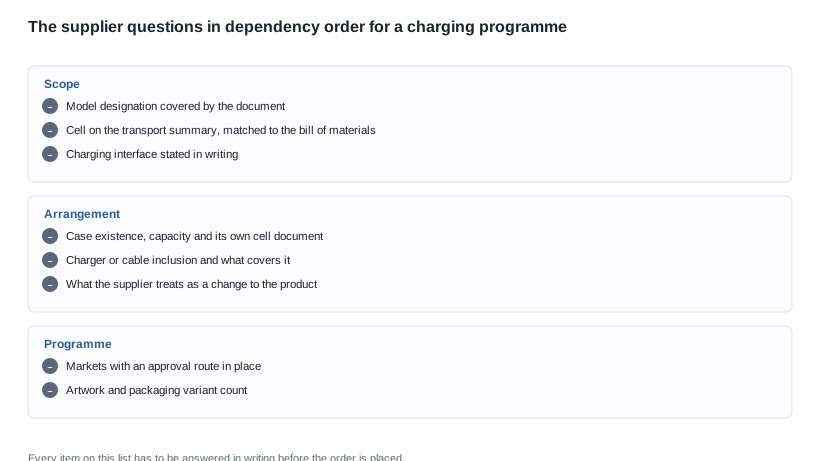
The sequence below is ordered by dependency rather than by importance, because the questions that come later are unanswerable until the earlier ones have been answered.
-
Which model designation does the document cover? Every later answer is scoped to this. A document that names a platform rather than a configuration is a family-level claim and cannot be used to support a configuration-level claim.
-
Which cell does the transport summary name, and is that the cell in the current bill of materials? Compare the two strings. This is the check that catches a substitution, and it is cheap enough to do on every model on a shortlist.
-
Which charging interface does the model use? Our catalogue publishes no interface for the MT6 and the CY05, and the CY03 and the L1 Pro, and on those rows this question has no catalogue answer at all.
-
Does a charging case exist, what is its capacity, and does its own cell have a document? Seven of our rows carry a case. On two of them — the KY06 and the MT5 — the capacity is not published, so the question cannot be answered from the catalogue.
-
Does a charger or cable ship in the box, and what covers it? A supplied accessory has to sit inside the product's file rather than beside it.
-
What will the supplier treat as a change to the product, and will it notify the buyer? The answer is a list, and it should name the cell, the case, the connector and the firmware.
-
Which markets has the supplier actually worked in for this configuration? Not the markets the supplier is willing to try, but the ones with an approval route in place.
The question to put to a supplier about market readiness is deliberately narrow: which market, which configuration, which document, and by when. The general form of the question — can you ship this into Europe — is answered by the company capability statement discussed below, and it tells you nothing about the configuration you are actually buying. The narrow form has a date attached to it, and a supplier who has to look it up is telling you something useful. The other half of the answer is the negative one: ask which of your target markets are not covered for this configuration today, and write that answer into the launch plan rather than into a risk register nobody opens.
A worked scenario: a distributor entering three markets with one charging programme
This is a hypothetical case rather than a client project, and it is written to show how the sequence above changes a decision rather than to report a result.
Assume a distributor that already sells Bluetooth audio glasses and now wants to add a camera glasses line with a charging case bundle, entering three markets. The constraint is not the unit price; it is that the programme has one artwork budget and one compliance file, and both are being asked to absorb three markets and two case configurations.
Step one: the model and the cell. They ask for the model designation covered by the document and the cell on the transport summary. The candidate is the L2 Utral, which publishes a 290 mAh cell, a Type-C charging interface, a ≤2 h charge time and a case published as 900/1400 mAh. The cell designation matches the bill of materials, and the transport summary is valid for it.
Step two: the case. The case is a second cell, so it has its own document, and the case capacity is published as two options. They take one capacity for the first market rather than both, because a two-capacity decision multiplies the artwork, the minimums and the packaging variants, and the retailer requirement is a bundled accessory rather than a customer choice.
Step three: the interface and the file. They ask for the charging interface in writing and get it. They also ask the supplier what it treats as a change to the product, and the answer names the cell, the case, the connector and the firmware. That answer is written into the agreement, and it is the clause that makes the rest of the programme auditable.
Step four: the market list. They ask which markets the supplier has actually worked in with this configuration, and the answer is shorter than the three they planned. They drop one market from the first run rather than carrying an unproven approval route, and they keep it on the roadmap for the second run. The dropped market is also where the unit price was best, which is worth noticing: the cheapest market to sell into is frequently the one with the least documentation behind it.
Step five: the commercial terms. They negotiate the configuration count, the artwork round count and the packaging variant count, and they leave the certification cost and the certification lead time alone, because those are fixed per product family and a queue at the test laboratory.
The result is a smaller first run with one case configuration, one market fewer, and a programme whose compliance position is described rather than assumed.

A company-level export capability is not a model-level certificate
Our catalogue carries an export certification statement, and it is a company-level capability rather than a per-model row. The catalogue does not contain a certificate row for the CY03, or for the L2 Utral, or for the D17, and it would be wrong for a buyer to infer from the existence of a company capability that any particular model carries a specific document in a specific market.
We would rather state that than let it be assumed, for two reasons. The first is that the assumption is expensive when it is wrong — a programme that assumes a document exists discovers otherwise at a customs review, and the cost of that discovery is a delay and a re-file rather than a discount. The second is that the inference is easy to make and hard to spot, because the company statement is genuine and sits in the same material as the product rows.
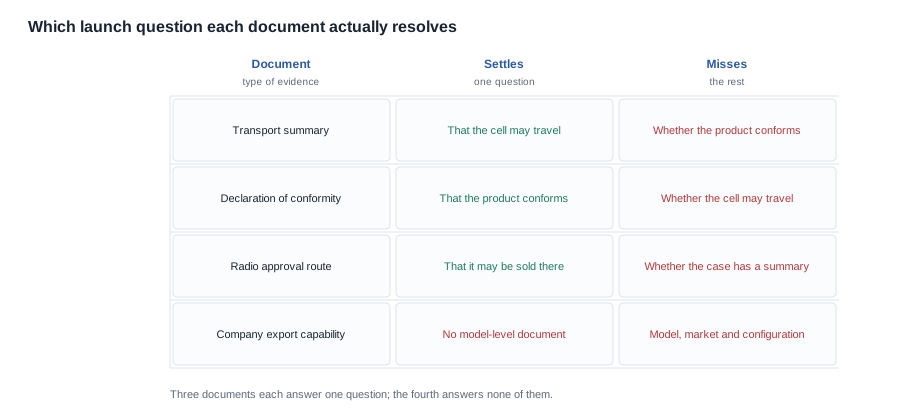
The practical rule that follows is short: a document that covers a model designation is evidence for that designation, and a document that covers a company is evidence about the company. Ask which one you have been given, and if the answer is the second, ask for the first.
It also sets a boundary on what we can tell you. We can tell you which charging arrangements exist for a requirement, which models publish which charging rows, and where our catalogue is silent. We cannot tell you that a model carries a certificate, because no model-level certificate list is published in our material and we will not manufacture one from a company-level statement. Where a buyer needs that document, it has to come from the cell supplier, the case supplier or the testing laboratory, and the questions to ask them are the same ones listed above.
What we publish about charging, and where our own documentation stops
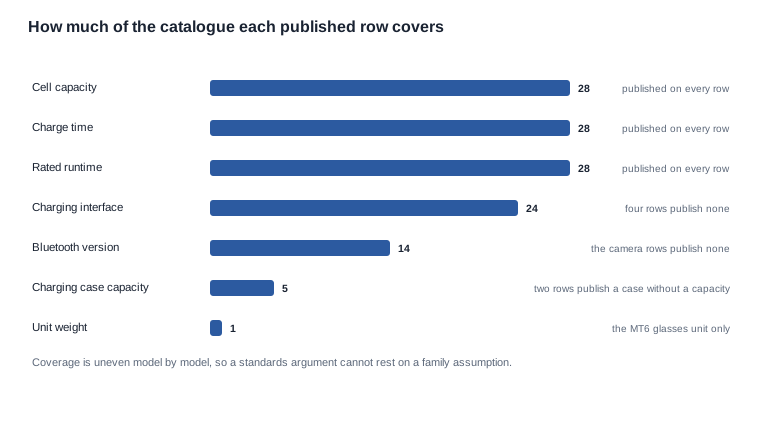
The chart above is the honest summary of what our catalogue is good at and what it is not. All 28 rows publish a cell capacity, a rated runtime and a charge time. Twenty-four publish a charging interface, and the four that do not are the L1 Pro and the CY05, and the CY03 and the MT6. Fourteen publish a Bluetooth version, and the camera rows do not. Five publish a charging case capacity, and the KY06 and the MT5 publish a case without publishing its capacity. One publishes a weight, and it is the MT6 glasses unit at 158 g, including the battery and the camera and excluding the foldable charging case, whose capacity is published separately as 1200 mAh.
The point of the chart is not to be complete. It is to show that a standards argument cannot be built on a family-level assumption in this catalogue, because the coverage is uneven model by model. A buyer who wants to know whether the charging arrangement of a specific model is documented has to ask about that model.
When a buyer genuinely needs a model-level document, the request has to be specific enough to be answerable: the model designation, the destination market, the configuration including the charging arrangement, and the date by which the document is needed. A request that says "send us your certificates" comes back with the company capability statement and starts the conversation again. A request that names four things comes back with either a document or a clear statement that it does not exist for that configuration — and the second answer is more useful than the first, because it is a fact you can plan around. The turnaround is worth asking for in writing, and so is the name of the person who signs it, because the person who can answer that question is usually not the person who answers the quotation.
The room to move and the terms to write. What can be negotiated is the number of configurations, the minimum per configuration, the artwork round count, the packaging variant count, the accessory list and the market list. What cannot be negotiated is the certification cost and the certification lead time, which are fixed per product family, and the physical behaviour of the charging interface, which is not a commercial variable at all. The terms worth writing into the supply agreement are the model designation on the document, the cell designation and the transport summary, the case capacity in milliamp-hours with its own document, the shipping state of charge, the change-notification obligation on the cell, the case, the connector and the firmware, and the re-issue obligation on the documentation package.
What we will not claim. We publish no test report data, no cycle life, no cell chemistry, no charge efficiency, no input current, no contact cycle life and no safe charging temperature range for any model, because none of those appears in our published material. We make no vision, health or eye-protection claim for any product in any market. And we publish no model-level certificate numbers, because the certification we can evidence is a company-level capability rather than a per-model row.
The next step. Send us the models, the destination markets, the quantities and whether a case is in the box, and we will tell you which charging arrangements exist for that requirement, which rows our catalogue answers, and which documents you have to obtain from the cell and case suppliers. The transport document route is covered under battery transport, the certification review route under certification checklist, the charging arrangements themselves under charging solutions, and the surrounding battery facts under battery life.


