

Charging is the part of a smart glasses product most likely to disappoint a buyer who bought it on a specification sheet, and the disappointment is almost never about the specification being wrong. It is about the specification being incomplete in ways that are invisible until the product is in a customer's hand.
Five limitations account for almost all of it, and none of them is fixed by negotiating the price. The published charge time carries no starting state and no end criterion, so it cannot be converted into an interruption allowance. A charging case is spare energy rather than extra runtime, so it cannot be sold as a battery-life improvement. A magnetic charging interface degrades through surface condition and presents as a battery fault rather than as a connection fault. A case is a second battery and a second mechanical object, and it fails for its own reasons. And nothing in the published range gives you a cycle life, a chemistry or a safe charging temperature range, which means the durability of the whole arrangement is uncharacterised.
None of these is a reason not to sell the category. They are reasons to change what you promise, what you provision and what you write into the agreement.
Smart glasses charging: the five limitations a specification never shows
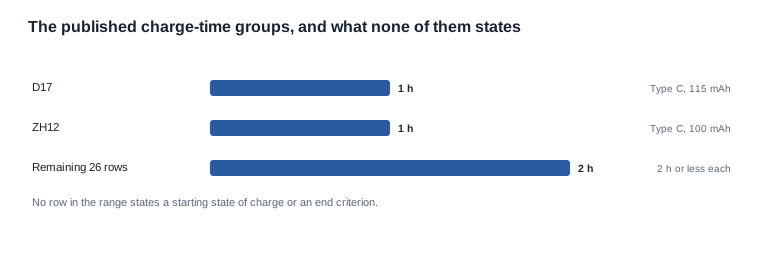
The charge time is a condition, not a number. Every one of the 28 rows in our catalogue publishes a charge time — 26 of them at ≤2 h, the D17 and the ZH12 at ~1 h — and not one publishes the state the cell started in or the point at which charging is judged complete. A buyer who takes "≤2 h" and turns it into a service-level commitment is committing to a number produced under conditions nobody has stated, on hardware that may not be the hardware in front of the customer.
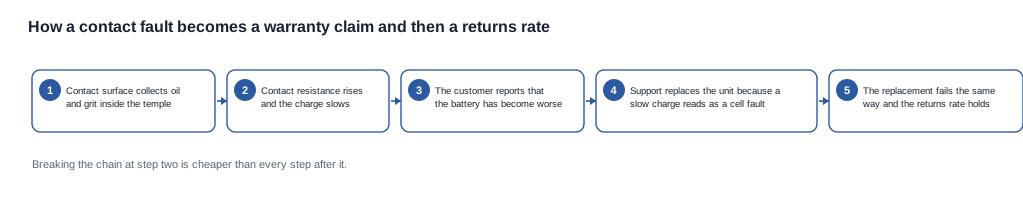
The interface determines the failure mode, and the failure mode is not what the label suggests. Magnetic charging is a seated contact pair, and the contact surfaces are exposed to grit and skin oil inside a temple opening. The degradation is gradual, which means the symptom the customer reports is that the battery has become worse. A support team that does not know this replaces good units indefinitely, and a procurement team that has not priced it is buying a returns rate it did not model.
A case is not a bigger battery. The case capacities in our range are 1400 mAh on the L1 Pro and the CY03, and the CY05, 900/1400 mAh on the L2 Utral, and 1200 mAh on the MT6's foldable case, and the KY06 and the MT5 are published as having a case with no published capacity. Every one of those is spare energy in the box, and the hours it converts into depend on the case's own conversion efficiency and on the end criterion — neither of which is published anywhere in the range.
The case is a second failure-prone object. Cases are small, are carried loosely and contain a cell. The MT6's foldable case adds a hinge, which is a mechanical joint with its own cycle life and a different spare part from a rigid case. A single warranty term across the glasses and the case misprices one of them, and the part being mispriced is the cheaper one that fails more often.
The durability of the arrangement is uncharacterised. We publish no cycle life for any cell or any case, no chemistry, no charge efficiency, no safe charging temperature range and no input current. That is a statement about our published material, and it is also a statement about the category: in the absence of a published figure, the buyer who does not measure is choosing blind, and a channel with a three-year life is making a three-year bet on a number nobody has written down.
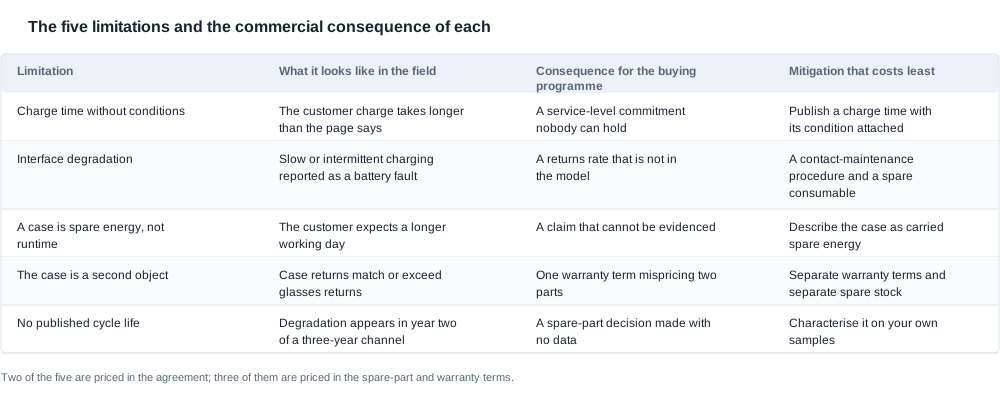
| Limitation | What it looks like in the field | The consequence for a buying programme | The mitigation that costs least |
|---|---|---|---|
| Charge time without conditions | The customer's charge takes longer than the figure on the page | A service-level commitment nobody can hold | Publish a charge time with its condition attached |
| Interface degradation | Intermittent or slow charging reported as a battery fault | A returns rate that is not in the model, and units replaced that should have been serviced | A contact-maintenance procedure and a spare consumable line |
| A case is spare energy, not runtime | The customer expects the case to extend the working day | A claim that cannot be evidenced, and a review when it fails | Describe the case as carried spare energy and nothing more |
| The case is a second object | Case returns are as frequent as or more frequent than glasses returns | One warranty term mispricing two parts | Separate warranty terms and separate spare stock |
| No published cycle life | Degradation shows up in year two of a three-year channel | A spare-part decision made with no data | Characterise it on your own samples before the first order |
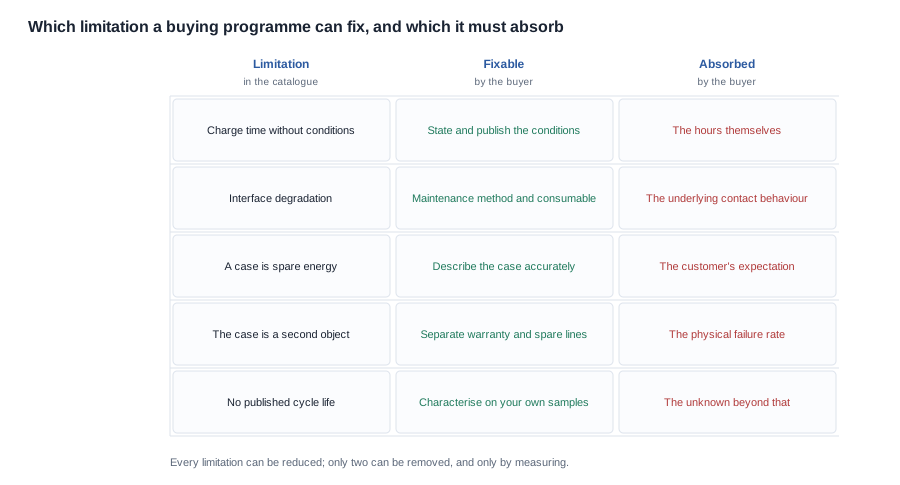
The four things a buyer cannot fix with a price negotiation
It is worth being explicit about which of these are commercial variables and which are not, because the negotiation effort is finite and it is usually spent on the wrong line.
A price negotiation can move the configuration count, the per-configuration minimum, the artwork round count, the accessory list, the packaging version count and the spare-part allocation in the first shipment. Those are the levers, and they are real.
A price negotiation cannot move the degradation behaviour of a contact pair, cannot create a published cycle life, cannot turn a case into extra runtime, and cannot make a charge time measurable when the supplier will not state its conditions. What it can do is buy the documentation, the protocol and the measurement, which is usually a smaller and more certain gain than the unit price is worth. A buyer who spends a negotiation on a two per cent unit-price gain and then discovers that the charge time cannot be defended has spent the quarter badly.
The five questions that turn the limitations into decisions
-
Which models on the shortlist use a magnetic interface and which use Type-C? The answer determines whether the slow-charge failure mode applies to the line at all, and our catalogue publishes it for 24 of 28 rows, so the question is answerable on most of the list without asking.
-
What is the contact-maintenance method for the magnetic models, and what does it consume? A method that needs no consumable is cheaper than one that does, but a method with no consumable is usually a method that does not exist. Ask for the instruction and the consumable together, because the consumable is what the channel has to stock.
-
What is the safe charging temperature range, and where is it written? Without it, a unit that refuses to charge on a hot day is indistinguishable from a defective unit, and the support line will absorb a real defect under a rule built for a false alarm.
-
What is the shipping state of charge for the programme? Goods held at full charge in a warehouse arrive degraded, and the symptom is a unit that appears dead on arrival and is returned as a manufacturing fault. This is a one-line term that removes an entire category of arrival complaint.
-
What spare-part and consumable availability can the supplier commit to, at what lead time? A channel can only service what it can replace. The case is a different SKU from the glasses, and a spare-part plan that names only the glasses is a plan that fails on the part that fails more often.

A bigger case is not more runtime
The 1400 mAh case on the L1 Pro and the CY03, and the CY05 invites a specific and wrong conclusion: that a customer carrying the case gets a longer working day. The arithmetic does not support it, and the reason is instructive.
The product cell is 290 mAh. The case is 1400 mAh, so the case carries roughly five times the product's charge. That sounds like five times the runtime, and it is not, for three reasons that are all unpublished and all measurable by the buyer.
The first is conversion efficiency. Moving charge from the case into the product is not a free transfer; there is a circuit in the way, and the loss is a function of the current and of the cells' own behaviour at that current. The second is the end criterion. A charge is finished when the product says it is finished, and how much charge is actually in the cell at that moment depends on the end criterion the product applies. A product that ends at a higher state of charge takes fewer hours per case charge. The third is that a case cycle is not a working day. The customer has to be present, with the case, and take the time to recharge — and the customer's day is not made longer by the existence of the device.
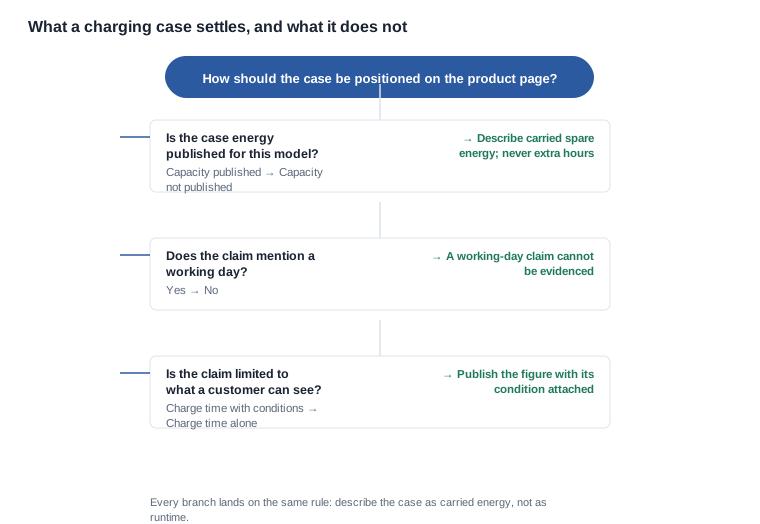
The honest commercial statement is that a case carries spare energy and extends the interval between charges for a customer who is away from a socket, not the length of the working day. The MT6's 1200 mAh foldable case is the same proposition with a different form factor, and the L2 Utral's 900/1400 mAh publication means the same model can be offered at two levels of carried energy — which is a legitimate good/better structure for a channel, and an illegitimate runtime claim if the product page tries to make it one.

The fault that arrives as a battery complaint and is not a battery fault
The single most expensive pattern in this category is a misdiagnosis, and it happens because the symptom and the cause are in different places.
A unit charges slowly. The natural conclusion is that the cell has degraded, so the unit is replaced. The actual cause, on a magnetic interface, is usually surface condition on the contacts: a film of skin oil and grit raising the contact resistance, which slows the charge, raises the case temperature and presents as a slow charge. The replacement unit has the same contacts and degrades the same way, and the returns rate does not fall. The cost per unit is not the replacement, it is the freight, the handling, the channel's margin on a second unit, and the customer's growing belief that the product is unreliable.
The procurement consequence is that the fault has to be diagnosable before it is expensive. Three things have to be true at the sourcing stage for that to be possible: the charging interface has to be stated in writing for the model, a contact-maintenance method has to exist and be documented, and a spare consumable or a replacement part has to be available at a price and a lead time the channel can carry. A supplier who will not answer the first question cannot support the second, and a channel with no spare-part line cannot support the third.
The mirror-image case is the one where a genuine defect is dismissed as expected behaviour, which happens when a category has no published thermal or charging-temperature range and the supplier's support line says "it stops charging when it gets warm" as a general statement. Thermal protection during charging is a feature, and a unit that refuses to charge at a high temperature is behaving correctly. The problem is that "correctly" and "defectively" are indistinguishable to a support agent without a written temperature range, and a buyer who has not obtained one will eventually absorb a real defect under a rule designed for a false alarm.

What the charging arrangement costs in volume, weight and support
Beyond the technical limitations, a charging arrangement has a commercial footprint that a buyer should price before the order rather than discover after it.
Volume and freight. A case adds a second object to the shipped unit. That means more cubic volume per unit, a different carton quantity, a different pallet specification and a different freight line. For a distributor, this is usually the largest single difference between a case-equipped line and a bare line, and it is rarely in the unit price.
Weight. Only one weight is published in the whole range: the MT6 glasses unit at 158 g, including the battery and the camera and excluding the foldable charging case. The case capacity is published separately as 1200 mAh and the case's own weight is not published. For the other 27 rows no weight is published at all, which means a buyer planning a case bundle for a retail channel cannot put a shipping weight on the product page from the catalogue.
Spare stock. The case is a separate SKU from the glasses. A channel that stocks spare glasses and no spare cases will discover the gap on the first case failure, and by then the customer has already had a gap in the product they bought.
Support load. The consumables differ by interface: a cable for a Type-C model, a contact-maintenance consumable for a magnetic one. The in-box contents differ by the same split, and a product shipped without a cable generates a support load that has no relationship to the product's quality.
Warranty. A single warranty term across the glasses and the case misprices both. The glasses fail because of use; the case fails because it was dropped, or because its cell aged, or because its hinge fatigued. Three different causes, three different replacement economics, one term.
A worked scenario: a brand that discovered the case was the product
This is a hypothetical case rather than a client project, and it is written to show how the limitations compound rather than to report a result.
Assume a brand launching a camera glasses line with a bundled 1400 mAh case for a retail channel with a two-year commitment and a depot service model. The product page for the case bundle was written as "up to five times the battery", because that is the arithmetic the case capacity suggests.
Step one: the review. The brand's own reviewer asks for the claim to be evidenced and cannot evidence it, because the case's conversion efficiency and the product's end criterion are both unpublished. Rather than drop the case from the bundle, they rewrite the claim as carried spare energy and describe the charging arrangement factually, including the ≤2 h charge time with its conditions unnamed. The narrower claim survives the review; the wider one would not have.
Step two: the returns assumption. The brand sets the returns model on the assumption that a case fails at the same rate as the glasses, because they were priced as one product. A half-year of channel data later, the case accounts for more failures than the glasses, and the returns model was never right. The correction is a split: separate warranty terms, a separate spare-part line, and a separate failure category on the returns sheet.
Step three: the diagnosis. The brand's support line replaces units that charge slowly, because the category guidance says a slow charge is usually the cell. It is not, on the magnetic models they chose, and the replacement rate does not fall. They fix it by obtaining the interface in writing for every model, adding a contact-maintenance instruction to the packaging insert, and stocking the consumable, and the returns rate falls within a quarter.
Step four: the freight. The case adds cubic volume that nobody modelled, and the channel's freight cost per unit rises against a price that was set before the case was added to the carton. This is discovered at the first shipment, and it is corrected in the next price rather than in the current one.
The point of the walk-through is that all four of these were knowable before the sample order. None of them required a supplier to give us something we do not publish, and none of them would have been visible in a unit price.
The limit of what we will claim about charging drawbacks
We publish the rows we hold: the interface where the catalogue states it, the charge time for every model, the cell capacity, the rated runtime, and the case capacity on the five rows where it exists. The chart above is the honest version of that list — twenty-six rows at ≤2 h, two at ~1 h, a case published on seven rows and a case capacity on five of them, and one published weight in the whole catalogue.
We publish no cycle life, no chemistry, no charge efficiency, no input current, no contact cycle life, no safe charging temperature range, no shipping state of charge and no case weight, and we will not fill those rows with typical values. A typical contact life would let a three-year channel fail quietly in year three. We also make no vision, health or eye-protection claim for any product in any market.
What is negotiable and what is not. The configuration count, the per-configuration minimum, the artwork round count, the accessory list, the packaging version count, the spare-part allocation in the first shipment and the warranty structure are all negotiable, and the warranty structure is the one most buyers forget to raise. What is not negotiable is the certification cost and the certification lead time, which are fixed per product family, and the physical behaviour of the charging interface.
The terms that price a limitation instead of absorbing it. Write the case capacity in milliamp-hours on the order line and state that the case is carried spare energy. Write separate warranty terms for the glasses and the case. Write the charging interface in writing for every model. Write the contact-maintenance method and the consumable into the supply agreement, with a price and a lead time. Write the shipping state of charge into the order. And write the measurement conditions into the purchase order if you intend to publish a charge time on the product page, because a figure with conditions is defensible and a figure without them is not.
The next step. Send us the models, the quantities, the target market and whether a case is in the box, and we will tell you which charging arrangements exist for that requirement, which published rows we hold for it, and which of the five limitations above you are most exposed to. The arrangements themselves are described under charging solutions and the surrounding battery facts under battery life.


