

A first contract in this category should be short and boring, because its job is to define a standard order. The second contract is where the interesting clauses live, because by then the buyer has money in the system: a mould, an application build, a printed carton and a volume commitment. This is a smart glasses contract smart glasses advanced guide for the point at which those things exist, and it is organised around one question — what have you put money into, and therefore which clause is carrying the risk?
Smart glasses contract: why the second agreement differs from the first
The first agreement sets out what a unit is and what happens if it is not right. It is defensible to be simple at that stage, because the buyer has little at stake beyond the units in the first shipment and the factory has little at stake beyond a production slot.
The second agreement is a different kind of document because the risk has moved. The brand has paid for a mould that only exists inside one factory, commissioned a firmware build that nobody else has the source for, and signed a volume commitment that ties a season's revenue to a single production line. None of that is visible in the price, and all of it is visible in the clauses.
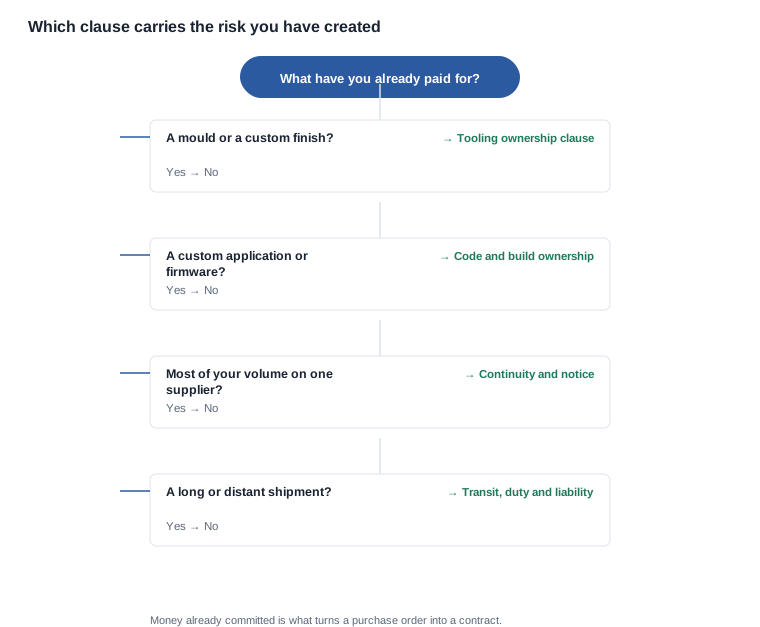
The practical consequence is that the second contract should be read against a list of what the brand has funded, not against a list of standard headings. A clause that is entirely sensible for a first order can be entirely wrong for a second one, because the thing it is protecting is now worth protecting.

Match the clause to the money you have already committed
What actually changes between the first agreement and the second
The six rows below are the whole difference, and they are worth putting side by side before any clause is drafted, because a buyer who drafts the second agreement from the first one will inherit the first one's assumptions.
| Between the first and the second agreement | What the first order looked like | What the second order looks like |
|---|---|---|
| Specification | A catalogue model, unmodified | A named configuration string with a revision |
| Tooling | None | A funded mould and artwork, listed as assets |
| Application | Factory software, as supplied | A commissioned build under the brand's name |
| Volume | One production slot | A season's commitment on a single line |
| Evidence | A file that covers the model | A file that has to survive a configuration change |
| A dispute | One shipment | The tooling, the build and the forecast |
Read across the last row and the argument for the whole section becomes clear. At the first order, a dispute costs a container. At the second, a dispute can cost the mould, the code and the forecast, and the agreement that governs it has to be a different document rather than a longer version of the same one.
The four questions that route the agreement
The routing is simple enough to do in a meeting. For each of the four kinds of money in the programme, there is a clause that carries the risk, and a question that settles it. A brand that has funded all four needs all four clauses, and the order in which they are negotiated follows the order of the money.
Tooling and artwork ownership
A custom logo treatment, a moulded temple, a bespoke retail carton. Each of these is a one-off asset that stays useful only as long as the factory that holds it is willing to keep producing. The clause that matters names the asset, states who paid for it, and states that ownership sits with the buyer once it is paid for in full.
Without it, a buyer who has spent a year building a brand on a distinctive mould negotiates from a weak position the first time the relationship sours. The related clause is the one about continuity: how long the supplier will hold the tooling, what notice applies, and whether the tooling can be used for another customer. A clause that permits the tool to be used elsewhere without notice is a clause that hands the other side a royalty on the buyer's own brand.
The order file should list the tooling as an asset with a value, because it is one. If the asset does not appear in any schedule, then the question of who owns it becomes a matter of what a supplier's standard terms happen to say, and standard terms are written by the supplier.
The code and the build
A custom application build, a modified user interface, a firmware variant with the buyer's name on it, a translation pack. Who owns the source, who maintains it, and who can ship a changed build to the buyer's fleet without asking are three separate questions, and the answers should not be the same.
The clause worth adding is the one about fleet freeze: a period during which a build change requires written approval. For a buyer who has deployed into a corporate customer, an unannounced build change is a support incident across the whole fleet, and it is an incident that arrives with no documentation and no way to reproduce the previous behaviour.
There is a second clause that is easy to omit and expensive to want: the right to receive the source, or to receive a build that the buyer's own engineers can sign. Many factories will not transfer source for a firmware build that also contains their own components, and that is a reasonable position. The point is to establish it now, in the agreement, rather than to discover it during a negotiation to change something.
Dependency and continuity
At volume, the risk changes character. A small order can be re-sourced; a large order with a fixed retail window often cannot, because the alternative supplier has to be qualified from nothing and the season does not wait.
The clause to add is a notice obligation: if the model is discontinued, if a component is substituted, or if the production line is reallocated, the buyer gets warning with enough time to act. The notice period is the substance of the clause. A notification given after the order has been placed is useless, because by then the decision has already been made.
A supplier who will not accept a change-notification clause is telling you that a component swap is a routine internal decision. That may be entirely reasonable and is still something a buyer with a committed retail window needs to know before signing.
Transit, duty and liability
The incoterm decides where risk passes, and three things usually live outside it: the liability cap, the insurance arrangement, and what happens if the goods are held at customs.
The clause worth reading closely is the one that caps the supplier's liability, because a cap that is a multiple of the order value is a different commercial proposition from one that is the order value. A cap expressed as a multiple of the amount paid is normal. A cap expressed as a multiple of an amount nobody can calculate — total programme value, lifetime value, or a figure that includes tooling — is a cap the buyer cannot price.
The customs question belongs in the same clause set. When a shipment is stopped, the immediate cost is demurrage and the immediate problem is that the person named on the booking is the person who has to defend the paperwork. The agreement should say which party responds, within what time, and at whose cost, because the buyer is often not the party that can answer.
The four kinds of money and the question each one asks
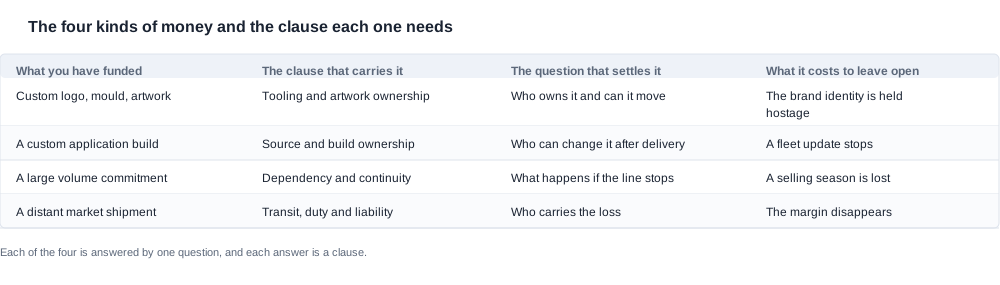
The four rows of that table are worth reading in order, because each one appears later in a typical programme. Tooling arrives first, because a private label needs a finish that a stock configuration does not have. The code arrives next, when the brand wants its own application on the device. Continuity becomes a real issue at the point where the volume makes the line worth reallocating. Transit and liability become live items at the point where the programme reaches a market the brand has not shipped to before.
There is a fifth kind of money that is easy to forget because it never appears as a line on a quotation: the evidence work. Commissioning a document for a market or a configuration that is not already covered is a cost, and if it is not scoped it gets absorbed into a general allowance or, worse, discovered after the production slot is booked.
The evidence work that never appears on a quotation
There is a fifth kind of committed money that is easy to leave out of the four, because it never reaches the quotation as a line. Commissioning a document for a market or a configuration that is not already covered is work, and it has a cost, a duration and a dependency on the factory's own schedule.
If it is not scoped, it gets absorbed into a general allowance and then discovered when the production slot is already booked. By that point the cost of closing it has stopped being a choice and become a schedule penalty, which is the worst moment to discover that the market you are shipping into needs something nobody asked for.
The clause to add is short: state which documents are included in the price, which are charged separately, and which are held for a different configuration or a different market. That single sentence converts an open-ended question into a scoped one, and it is the clause that turns a quotation into something two suppliers can be compared against.

The clauses that are usually missing from an advanced agreement
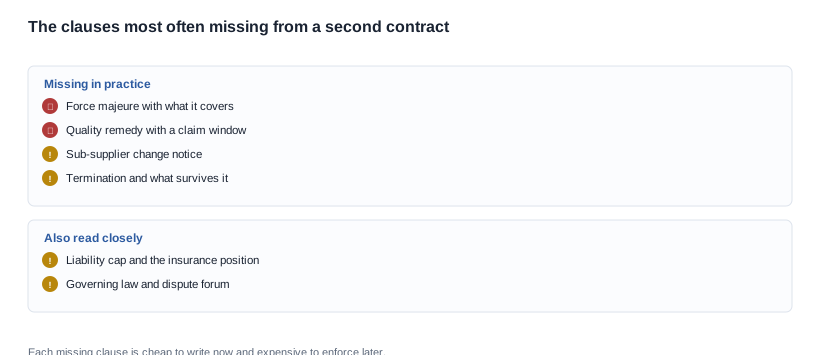
Force majeure, written with what it covers and what it does not. A clause covering "any cause beyond our reasonable control" is a clause a buyer cannot enforce, because every commercial disappointment qualifies. The version worth having names the specific events — a component shortage at a named supplier, a port closure, an epidemic restriction — and states what happens to the schedule and to the deposit when one occurs.
Quality remedy. A rejection gives a credit, a replacement, a rework or a return, and the agreement should say which applies to which defect class and what the time limit is for raising a discrepancy at the goods-in gate. The time limit is the part that matters at scale, because a claim window that is generous for one container is far too short for a season's stock sitting across several warehouses.
Sub-suppliers. If the cell, the sensor or the packaging comes from a third party, the buyer should at least be entitled to know, and to be told when it changes. This is the practical version of the change-notification clause and it is the one that protects the configuration, because a substituted cell is the most common route to a configuration that no longer matches the file.
Termination and survival. What happens to a paid deposit, to owned tooling, to units in production, and to documentation when the relationship ends. Termination clauses are read at the worst possible moment, and they are worth reading at the best possible one.
Governing law and dispute resolution. Which jurisdiction, which forum, and whether arbitration or litigation. This is not a legal opinion — it is a reminder that the answer changes how enforceable everything else in the agreement is, and it should be chosen knowing where the supplier's assets are.

Who carries what once the money is committed
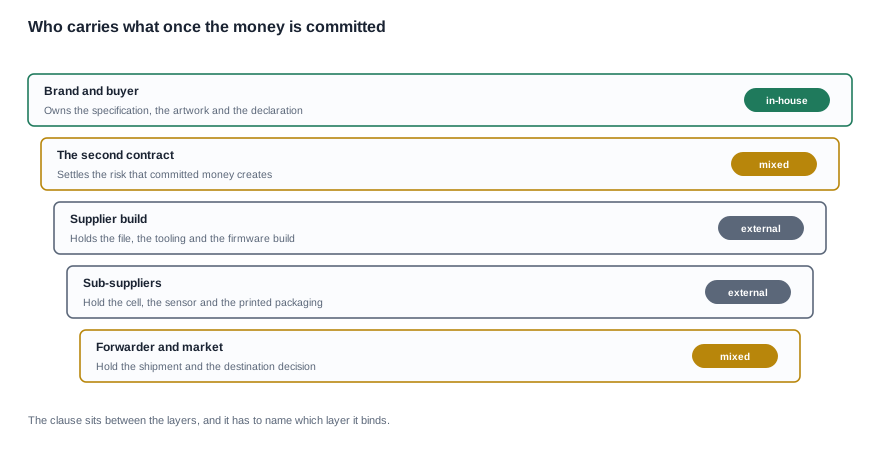
The layers diagram is worth reading as a routing map rather than an org chart. The brand owns the specification and signs the declaration. The agreement sits between the layers and has to name which layer it binds — that is what makes a clause operational rather than aspirational. The supplier holds the file, the tooling and the build. The sub-suppliers hold the cell, the sensor and the printed packaging, which is why the change-notification clause has to reach down through the supplier rather than stop at it.
The forwarder and the destination market hold the shipment and the local decision. No clause in the agreement can bind either of them, which is why the delivery clause is about dividing responsibility rather than about controlling events.
The practical consequence for drafting is that a clause should name the party it binds. A clause written in the passive voice, which does not say who must do what, tends to bind nobody, and in a dispute the court or the arbitrator has to infer a party from context — which is the worst possible place to start when the money at stake is a mould.
Where a clause becomes operational
A clause becomes operational when somebody can name the action it requires, the party who has to take it and the date by which they have to do it. Most of the clauses that fail in this category fail that test in one of three ways.
The first is the clause written in the passive voice, which says that something shall happen without saying who must arrange it. The second is the clause that names an event rather than a trigger: "where the quality of the goods is not satisfactory" is an event, and "where a unit in the agreed sample fails criterion three" is a trigger. The third is the clause that names a party that does not exist in the structure — "the manufacturer" in an agreement between a brand and a factory, where the manufacturer is a third company in the sub-supplier tier.
Rewriting a clause against those three tests usually makes it shorter, not longer, and it makes it arguable. That is the test worth applying to every clause in the agreement before signature, and it is much easier to apply at signature than to a dispute.
The three numbers that must not be blank
A contract in this category is incomplete if it does not state the configuration, the quantity and the delivery basis, because all three are set per order rather than from a standing list.
The configuration should be a string, not a model name. Resolution, cell capacity, charging interface, case configuration, colour, logo treatment, packaging and firmware build. In our catalogue that string can be assembled from published rows for most models, with the exceptions noted below. A contract that names only the model is a contract in which a 220 mAh unit and a 290 mAh unit are the same thing on paper.
The minimum order quantity is not published as a standing figure in our own documentation, because it depends on the configuration, the customisation scope and the production slot. It is agreed per order in writing, and the contract is where that number has to live. A contract that leaves it blank will be renegotiated at the worst possible moment, which is when a buyer has already committed the marketing spend.
The delivery basis should distinguish the ready-to-ship date from the delivery date, and name the forwarder and the incoterm. Blurring the two produces a date that nobody controls and a delay that nobody can attribute.
The configuration string is where most of the discipline sits, because it is the one field that a buyer can construct themselves from published rows without asking the factory anything. A camera model with a cell, a charging interface and a case configuration produces a string that either matches what the factory builds or it does not, and the value of writing it out before the quotation is that the quotation can then be checked against it rather than read as a description. Where a row is not published, the string records that fact rather than leaving the field to be filled in later by whoever is describing the product to a customer.
Our position on what we will put in writing
We publish the per-model configuration facts that belong in a contract: resolution, cell capacity, charging time, the rated runtime with its caveat, the charging interface, the case configuration, the Bluetooth version and the customisation scope we support.
We mark as Not published the frame weight of every model, with one exception that has to be stated precisely: our catalogue publishes a single weight, 158 g for the MT6 glasses body, which includes the battery and the camera and excludes the folding charging case; the case itself is 1200 mAh and its weight is not published. No bare frame weight is published for any model in the range, and no weight should be assumed from it.
The sensor part numbers, the field of view, the ingress test report numbers, the certification numbers and the AI implementation details are also marked as not published. We will not sign a clause that depends on a specification our source material does not contain, and we will put the configuration, the minimum quantity, the delivery basis, the acceptance criteria and the change-notification commitment into the agreement in writing. Where our own commercial terms are not published as a standard table — deposit ratio, credit, lead time, capacity — we set them for the specific order and say so.
If you send us the list of what the programme has already funded, we will tell you which clause each item needs, in the order the money was committed, and which of the four kinds of risk is currently unaddressed in your draft.
The contract terms section covers the standard clauses, and the worked case example shows how they attach to a real order sequence.
Related reading
- Camera and audio smart glasses range
- Negotiating the commercial terms
- What a first contract has to define


