

Most contract guides hand you a list of clauses. This one follows one order from the first enquiry to acceptance, and shows which clause did the work at each point and which one nearly cost the buyer money. The example is constructed from our published catalogue so that every figure in it can be checked against something real. It is a reasoning exercise rather than a client project: no customer name, volume, price or term from a real account appears in it, and the figures are the catalogue rows, not order data.
Smart glasses contract: the order described, and why it was chosen
The programme in one paragraph
A brand is planning a European launch of a first-person camera glasses line and wants a 13 MP platform with a charging case in the box, private branding on the retail carton, and a firmware build under their own application. The buyer's stated concern is not price — it is that a delayed shipment would kill the retail window, so the agreement is going to be judged on whether it protects a date.
Why a 13 MP platform with a case was chosen
The choice of platform was not a technical preference, and reading the choice as one would miss the point of the example. Three commercial reasons drove it, and each one produced a clause later in the agreement.
The first was the channel. A first-person camera line sold into a marketplace with an existing accessory ecosystem has to be physically compatible with the charging cases, the cables and the mounts that the channel already stocks, and that is a constraint that arrives before any specification does. The second was the packaging. A line with a case in the box has a larger carton, a different pallet arithmetic and a different transit packaging, and a buyer who decides the case after the print artwork has been approved pays for that decision twice. The third was the evidence scope: a platform that already has a published runtime rating and a published case option is a platform whose acceptance criteria can be written before the sample is built.
None of that is visible in the catalogue rows. The rows tell you what the product is; the reasons above are why a particular configuration was chosen over a slightly different one, and they are the part of the enquiry that a factory cannot answer for you.
The five published parameters that define it
Five rows from our catalogue define the order, and all five are published: a 13 MP camera, a 290 mAh cell, a Type C charging interface, a rated run of about seven hours, and a charging case available at 900 mAh or 1400 mAh. The charge time is two hours or less.
The case is the interesting one, because it is an option rather than a fixed value. A case available in two capacities is two configurations, and the agreement has to name which one is in the box. Left unnamed, it becomes the first place where the goods and the paperwork disagree, because the smaller case and the larger case change the carton, the declared transport weight and the transit packaging.
What the agreement had to cover that the catalogue does not publish
The things the agreement has to pin down are the things the catalogue does not publish: the frame weight, the sensor part number, the field of view, the ingress rating, the certification numbers and the test condition behind the seven-hour figure. Each of those is either not published at all or published without the condition that would make it a testable number.
That list is the reason the agreement is written from the configuration outwards. A clause cannot settle an unknown, so the agreement has to be built on what is known — the published rows — and the unknowns have to be handled by a mechanism rather than by a number.

The clauses in the order they mattered
Configuration freeze, before anything else
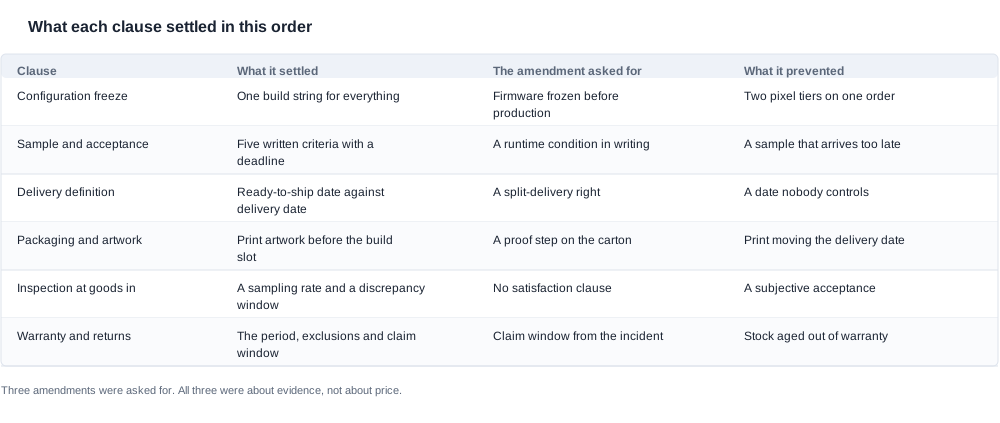
The first clause pins the configuration: 13 MP platform, 290 mAh cell, Type C charging, the 1400 mAh case rather than the 900 mAh one, the private logo, the retail artwork and the application build. Everything downstream references that single configuration string. An agreement that describes the product in prose and leaves the configuration to a later email is an agreement in which a 13 MP unit and an 8 MP unit are the same thing on paper.
Sample and acceptance, with a deadline
The second clause makes the sample part of the agreement rather than a courtesy: the sample must be built to the same configuration, the buyer has a fixed period to test it against written criteria, and silence after that period counts as acceptance. This is the clause that saves the buyer from the "the sample did not arrive in time, let us start again" conversation, and it is the clause a supplier is most likely to resist, because it puts a deadline on their own dispatch.
The test criteria are worth writing down at this point, because they are the criteria that will be applied to the bulk run later. The buyer writes: rated run time consistent with the published figure under mixed use, the case charges the device, the controls respond as described, the firmware build matches the agreed version, the retail artwork fits the device without crushing the temples.
The clause that nearly cost the buyer money
One clause in this order came close to being expensive, and it is worth naming because it is the kind of detail that looks trivial until the goods are packed.
The charging case for this platform is offered at two capacities. The buyer chose the larger one, partly because the smaller one was cheaper and partly because the retail carton they were about to print had been drawn around it. The agreement named the capacity explicitly as part of the configuration string. Had it not, the factory would have built the version it considered standard, the carton would not have fitted the case inside it, and the discovery would have happened at the packing stage with printed cartons already in the building.
The cost of that discovery is not the carton. It is the schedule. Print lead time is external and long, so a carton that has to be reprinted does not move the delivery date by a day; it moves it by however long the printer needs, and the printer is not the party that is waiting for the goods.
This is the general shape of first-order risk in this category, and it is why the configuration string has to include the options and not only the model. The unit price is the largest number in the quotation and it is almost never the thing that goes wrong.
Delivery date, with a definition
The third clause says what "delivery" means, and this is where the worked example is instructive. The buyer wanted a date in the retailer's warehouse. The supplier commits to a ready-to-ship date and states plainly that transit, clearance and receiving are outside it, with the incoterm and the named forwarder agreed. Both parties are better off than they would have been with a single ambiguous date, because the risk now sits where it can be managed.
Packaging and labelling, tied to the artwork
Print lead time is external and long, so the fourth clause requires print-ready artwork to be delivered before the production slot begins, and ties the packaging to the agreed artwork with a proof step. Without this, packaging artwork becomes the last item on the critical path and the delivery date moves for a reason nobody owns.
Inspection and acceptance on arrival
The fifth clause repeats the acceptance criteria at the goods-in gate, with a sampling rate agreed in advance, a defined time window for raising a discrepancy, and a clear statement of what happens if the goods do not match. Note what is not in it: a discretionary "reasonable satisfaction" clause, which hands the buyer a right that is difficult to enforce and a supplier an obligation that is impossible to price.
Warranty and returns
The sixth clause sets the period, the covered events, the exclusions, the return authorisation path, the freight arrangement and the turnaround. In this catalogue the warranty period and the RMA turnaround are set in the agreement rather than published as a table, because they depend on quantity, configuration and destination. The clause that matters most in the field is the claim window: measured from the incident rather than from the invoice, since a device that sits in a warehouse over a winter comes out of it with a dead battery and no date.
The three amendments the buyer asked for
A firmware build freeze. The buyer asked for the application build to be frozen before production starts, with a change window afterwards. The supplier agreed, and it is the amendment that most reduced the risk of a shipment that arrives but cannot be paired with the buyer's own application.
A cell-specific runtime criterion. The buyer wanted a written runtime condition, since a seven-hour rating is meaningless without the test condition. The supplier can state the published rating and its caveat, and can commit to a mixed-use test result in writing for the specific batch. It cannot commit to a condition its source material does not document, and saying so plainly was more useful than inventing one.
A split-delivery right. The buyer asked for the right to take part of the shipment if a retailer's store network required it. This was agreed with a stated notice period and a stated packing-list consequence, because a part shipment changes the carton arithmetic.
What each amendment cost to agree
The three amendments were not free, and the reason each one was granted is worth recording because it tells a buyer which amendments to push on and which to drop.
The firmware freeze was granted because the alternative was a support incident the supplier would also have to handle. It cost the supplier a little flexibility and it cost the buyer nothing, which makes it an easy amendment to ask for in any programme.
The runtime criterion was granted because it replaced a vague commitment with a specific one, and a supplier who can meet a specific commitment usually prefers it to a general one. It cost both sides one meeting and a paragraph.
The split-delivery right was the expensive one, because it required the factory to hold part of the order and manage a packing list it would otherwise never have produced. It was granted because the alternative was that the buyer discovered the retailer's requirement after the goods were packed, and a factory is generally more willing to absorb a packing cost than to lose a season's order.
Why these three and not the penalty clauses
The amendments were all about evidence rather than about consequence. Two of them narrow what a number means, and the third adds a mechanism. Not one of them was about a remedy for breach, and none of them was about money.
That pattern is not a coincidence. The clauses that carry penalties are the ones buyers assume matter most, and in practice they are rarely invoked, because a supplier who has missed a date on a fixed retail window has already lost the commercial outcome that the penalty was supposed to compensate for. The clauses that matter are the ones that remove a disagreement before it becomes a dispute.

How the acceptance gate was built so it could be reused

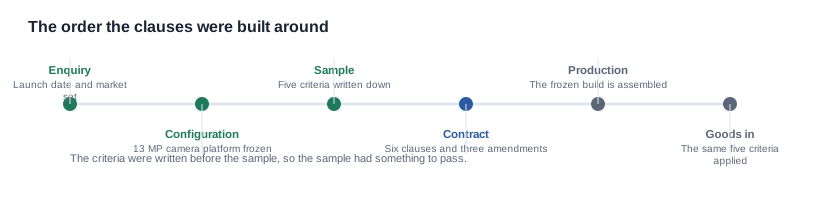
The acceptance criteria were written before the sample existed, which is counter-intuitive and was the single most useful thing that happened in this order. Writing them first meant the sample had something to pass rather than something to demonstrate, and it meant the criteria applied to the bulk run were the same criteria rather than a second set that happened to be similar.
The sequence has six steps and each one has an owner. Write the criteria, apply them to the sample, give the sample a fixed period and then a deadline, repeat the same criteria at goods in, state the sampling rate and the discrepancy window, and name the remedy for a failed batch in advance.
The last step is the one most agreements leave to the day. A failed batch with no pre-agreed remedy turns into a conversation between two teams at a moment when both of them are otherwise busy, and the conversation is about principle rather than about units.
Why the same criteria had to appear twice
The criteria are stated in two places in the agreement, once against the sample and once at the goods-in gate, and the duplication is deliberate. One set of criteria is enough for the sample because the sample is a single unit that somebody can look at; the bulk run needs a second statement because it is a population, and a population is judged by sampling rather than by inspection.
That distinction is where most acceptance disputes in this category come from. A criterion that says "the controls respond as described" is testable on one unit and untestable on a thousand, unless the agreement says how many units are tested, how they are selected and what a failure rate triggers. Writing the same five criteria twice, once for the sample and once for the run, with a sampling rule attached to the second, removes the gap between the two.
It also removes a subtler problem. When the criteria are only written for the sample, the bulk run is judged against whatever the receiving team remembers of them, and a receiving team is under pressure on the day the container arrives.
The one criterion that caused an argument
The runtime criterion was the difficult one, because the published figure is a rating under a stated use profile and the buyer's own test was a different profile. The resolution was not to argue about which number was right but to accept that they measured different things, and to write the criteria so that the batch test is the one that counts for acceptance while the published rating remains a catalogue statement.
That distinction — a published rating as a catalogue statement, a batch test as an acceptance criterion — is the cleanest way to handle any figure that a supplier publishes without a test condition.
Deciding the part shipment, and what it changed
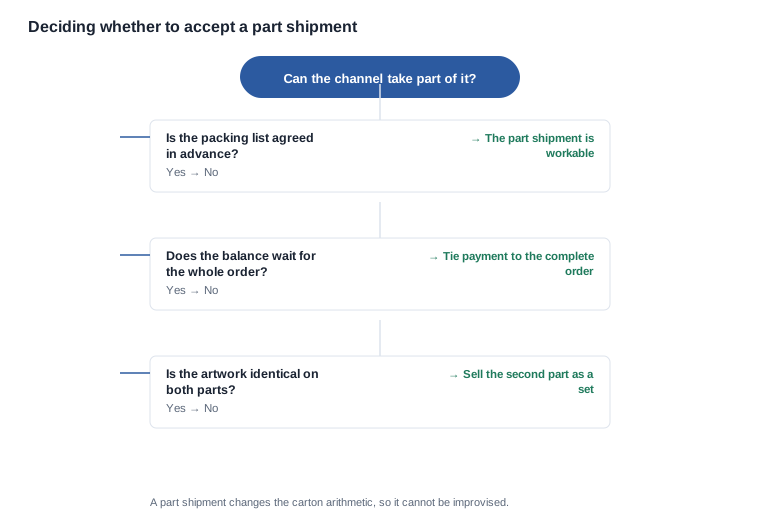
The split-delivery amendment was the most expensive clause to write and the one that would have cost the most if it had been left out, because the retailer's store network requirement was discovered after the goods were already packed.
Three questions decided how it worked in practice. The packing list had to be agreed in advance, because a part shipment without an agreed packing list means two cartons with different quantities and no record of which is which. The balance had to wait for the complete order, because a supplier that has shipped half the goods and been paid for them has little incentive to ship the other half quickly. And the artwork had to be identical on both parts, because a retailer holding two different cartons of the same product has a problem that no agreement clause can solve.
The clause worked because all three conditions were written in rather than assumed. A split-delivery right on its own, without a packing-list rule and a payment rule attached to it, would have moved the problem rather than solved it.
The outcome, our position, and what transfers
What the order actually demonstrated
The order shipped within the window the supplier committed to, and the acceptance criteria applied at the goods-in gate were the same five criteria the sample had passed. That is the transferable lesson: the clauses that saved the buyer were not the ones about penalties, which nobody invoked, but the ones that made the configuration, the sample, the date and the acceptance criteria unambiguous.
The second lesson is about the order of the drafting. The configuration came first because everything else referred to it. The sample came second because the criteria had to exist before the sample was judged. The commercial terms came last because they were the only part of the agreement that could be written without reference to anything else.
A third lesson sits underneath both of them. Almost every difficulty in this order was a disagreement about what a word meant rather than a disagreement about what should happen, and every one of them was closed by making the agreement say which build, which sample, which criteria and which date it referred to. Not one of them was closed by a remedy, and not one of them would have been closed by a larger penalty.
Our position on how a contract in this category should be built
Here, an agreement for this category should be written from the configuration outwards rather than from the commercial terms inwards. We will put a configuration string, a golden sample, a firmware baseline, a cell specification and an acceptance rate in the order, and we will tell you in writing which of the published figures each of them is anchored to. We will not sign a clause that depends on a specification our source material does not contain, because the first time that clause is invoked is the worst possible time to discover it.
Where a figure is not published, the agreement has to use a mechanism instead of a number — the sample, the batch test or the photograph of the label. Every unknown in the configuration can be handled that way, and handling it that way is what keeps a first order signable without inventing a specification.
Our contract terms section sets out the clauses in the order we would draft them, and the sample policy checklist covers the stage before this one, when a single unit is still being tested.
Related reading
- Camera and audio smart glasses range
- A worked comparison of contract clauses
- Reading a contract line by line


