

A usable smart glasses sample policy SOP has eight clauses, and every clause settles one decision. That is the whole template. A procedure with fewer clauses has gaps, and the gaps do not stay empty — they get filled by whoever is under the most pressure on the day, which is how a sample programme ends up approving a unit nobody specified. A procedure with more than eight clauses is usually a checklist wearing a document's clothes, and checklists are easier to skip than clauses are to ignore.
The eight clauses below are written as clauses rather than as advice, which means each one can be lifted into your own procedure with the bracketed fields filled in. They are written for a brand-side procurement manager or an importer running a programme of perhaps two to six sample rounds a year, which is the volume at which a formal procedure pays for itself.
Two design decisions run through all eight. The first is that each clause has an owner and a single decision, because a clause owned jointly is a clause nobody enforces. The second is that every clause produces a document, because a procedure that produces no document produces no evidence.
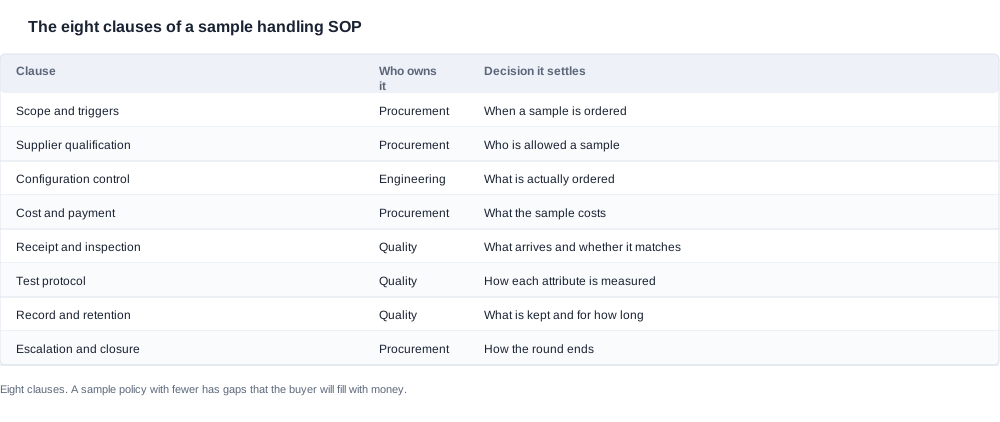
Smart glasses sample policy: the eight clauses a working SOP needs
Why clause-based beats checklist-based
The difference between a checklist and a clause is the difference between a reminder and an instruction, and it shows up in the first audit.
A checklist says "confirm the configuration". A clause says something closer to: "A sample request is invalid unless it names a configuration string in the form set out in clause three, and the requesting buyer is accountable for that field. A request that does not name it is returned rather than processed."
The second version is longer, and it is the version that survives a programme in which two buyers are working at once and a third is covering one of them while on leave. It states the owner, the trigger, and what happens when the clause is not satisfied. That third element is what most procedures omit and what makes the difference between a procedure that shapes behaviour and a document that shapes nothing.
The clause map at a glance
| Clause | Owner | Decision it settles | Output document |
|---|---|---|---|
| 1. Scope and triggers | Procurement | When a sample is ordered | Sample request form |
| 2. Supplier qualification | Procurement | Which supplier may receive one | Qualification record |
| 3. Configuration control | Engineering | What is actually ordered | Configuration string |
| 4. Cost and payment | Procurement | What the sample costs | Order confirmation |
| 5. Receipt and inspection | Quality | What arrived and whether it matches | Receipt record |
| 6. Test protocol | Quality | How each attribute is measured | Protocol sheet |
| 7. Record and retention | Quality | What is kept and for how long | Evaluation record |
| 8. Escalation and closure | Procurement | How the round ends | Closure memo |
Two owners only, and that is deliberate. A sample procedure owned by procurement, quality and engineering as three separate departments usually ends up owned by none of them, because each department approves its own clauses and the seams between them are where the evidence is lost. Where a clause has to cross a departmental line, it is written as one clause with two names against it rather than as two clauses.

Clauses one to three: when to order, who may order, what is ordered
Clause one: scope and triggers
Owner: Procurement. Output: the sample request form.
The clause should state the situations in which a sample is ordered, and the situations in which it is not. This is the part of the template most often left implicit, and leaving it implicit means the programme samples things it did not need to sample.
A workable scope for a brand-side programme covers four situations: a new supplier requiring qualification before a production order, a new configuration within an existing supplier's range, a quality investigation on a specific production window, and a pre-launch check on a channel or market-specific build. It excludes internal testing of firmware variants, marketing evaluation units, and evaluation units intended for demonstration, none of which produce evidence a production order can rest on.
The clause should also name the two situations where a sample is required regardless of the buyer's preference. One is a change to the build configuration after a design freeze, which invalidates the existing evidence. The other is a first production order from a supplier that has not yet produced for the buyer, where the question is not whether the product works but whether the process holds.
Clause two: supplier qualification
Owner: Procurement. Output: the qualification record.
This clause governs who may receive a sample at all, and it is the clause that saves the most money, because it sits in front of the spend rather than behind it.
The qualification gate should be a written questionnaire, sent to every candidate at the same time, with a defined scoring rule. Ten questions is enough. The completion test on each answer is specificity rather than length: an answer that could be pasted into a specification without asking for more is a complete answer.
The scoring rule needs to be written in advance, because criteria applied after the answers arrive are always a rationalisation of the answers. A supplier should fail the gate on any one of four things: an inability to produce a configuration string, a minimum order quantity that does not distinguish a model from a configuration, a certification answer at company level where a per-model scope is required, or an inability to say where the lot identifier comes from.
The clause should also state how long a qualification record stays valid, and what reopens it. A new model, a changed build, a change of production line, a missed delivery or a quality complaint are the natural triggers, and they should be listed.
Clause three: configuration control
Owner: Engineering. Output: the configuration string.
This is the clause that decides the most and is the most often skipped, because a model name feels like a specification until the first shipment arrives with the wrong accessory.
The clause should specify the fields the string must contain. For this category the minimum set is: the model, the charging case option where the model has one, the charging method where it is published, the artwork or colour requirement, and the firmware baseline. It should also specify who may change a string and how a change is handled, because the common failure is not an absent string but two strings — one in the order and one in the factory.
The published options make this concrete rather than theoretical. The L2 Utral is published in two case options, 900 mAh and 1400 mAh. The V03 Pro is published with no charging case. The CY03 and the CY05, and the L1 Pro are published with a 1400 mAh case, the MT6 with a 1200 mAh folding case, and the KY06 and the MT5 with cases whose capacity is not published. And the charging method is published as magnetic on seventeen models and Type C on seven, while it is not published at all for four camera models, the CY05 and the L1 Pro, and the CY03 and the MT6 — which means that for those four the string has to carry a supplier statement instead of a catalogue reference.
Clauses four to six: what it costs, what arrives, how it is measured
Clause four: cost and payment
Owner: Procurement. Output: the order confirmation.
Three commercial terms belong in one clause and one document: the sample fee, the credit condition against the first order, and the number of evaluation rounds included. They are separated in most negotiations and should not be, because the round count and the credit condition both determine what the sample is worth to the supplier, and a supplier who has priced a round count is a supplier who has priced the programme.
The clause should state what happens to the credit if the first order is cancelled, if it is split across deliveries, or if it falls below a stated value. It should state who pays freight and who bears duty on the sample, and it should state whether the sample fee is per configuration or per request, because the difference decides whether a programme that samples six models is buying six things or one.
Clause five: receipt and inspection
Owner: Quality. Output: the receipt record.
The receipt clause is short and it is the clause that protects the programme from a unit that was never what was ordered. It requires that the configuration string is checked against the unit on arrival, that the case option is confirmed as the ordered option, and that the lot identifier is captured with its source stated.
It should also state what happens to a unit that fails receipt. The three options are quarantine pending clarification, return, or accept with a recorded deviation — and the clause has to choose one, because the default in most organisations is to accept and move on, which is precisely how a mismatched unit becomes an approved one.
Clause six: the test protocol
Owner: Quality. Output: the protocol sheet.
The protocol clause should require, for every attribute tested, four things: what is measured, the condition before the measurement starts, the limit the result is compared against, and what happens to a unit that falls outside it. The fourth is the one most often omitted, and without it a failed measurement has no defined consequence.
The published catalogue makes this clause practical rather than theoretical. The runtime band is published for all eleven camera models, about seven hours on the CY03 and the L2 Utral, and the MT6 and the L1 Pro, and the CY05, six to eight hours on the KY06 and the MT5, and five to eight hours on the V03 and the S7, and the V03 Pro and the V06. The charge time is published for all twenty-eight models, at up to two hours on twenty-six and about one hour on the D17 and the ZH12. The charging method is published on twenty-four models and not published on four. The resolution tier is published for all eleven camera models, 8 MP on eight of them and 13 MP on the S7 and the L2 Utral, and the L1 Pro.
Those rows are the limits. A protocol that says "check the runtime against the published band for this model, from the stated charge state, on the stated duty cycle" is complete. A protocol that says "confirm the battery meets expectations" has no limit in it at all.

Clauses seven and eight: what is kept, and how the round ends
Clause seven: record and retention
Owner: Quality. Output: the evaluation record.
The record clause decides whether the programme is auditable six months later, and it should require four items without exception: the lot identifier and production date, the protocol used word for word, the result against each threshold, and the name of the person who ran the test.
The retention period should be stated in months, not in principle, and it should name what is retained. A retained unit from each evaluated lot is the item that turns a channel complaint into an investigation rather than an argument, and it should be specified as a physical retention, because a digital record of a unit that no longer exists proves very little.
Clause eight: escalation and closure
Owner: Procurement. Output: the closure memo.
Every round ends, including the rounds that end badly, and the clause should say how. The closure memo is short and has three parts: what was evaluated, what the result was, and what happens next — production order released, another round opened, supplier withdrawn, or supplier re-qualified.
This clause is where a template earns its keep, because without it a failed round tends to end in an email thread that nobody closes. The clause should also state the escalation threshold: a flag raised and answered within the round is carried; a flag raised and not answered becomes a condition on the production order; a flag raised twice in the same programme stops the programme and re-opens the supplier qualification.

The workflow the clauses produce
The eight clauses run as six stages with two owners. Procurement raises a sample request against an approved configuration. Quality confirms the protocol and reserves bench time. The supplier confirms the build identity and dispatches the unit. Quality receives it, checks identity, then runs the protocol. Quality records the result and updates the specification file. Procurement closes the round in writing and releases the order.
The handovers are where a sample programme loses its evidence, and there are three of them. The request handover loses the configuration string. The receipt handover loses the lot identifier. The closure handover loses the result. Each is closed by making the receiving party responsible for checking it, rather than the sending party responsible for sending it.
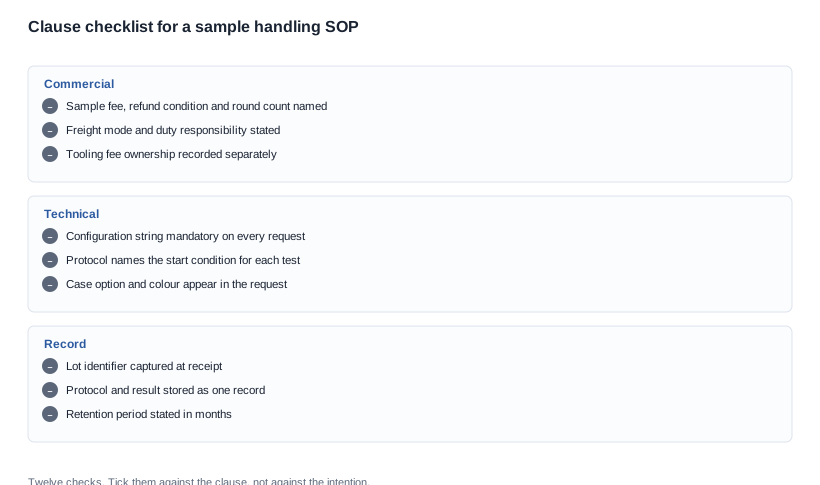

Reviewing the SOP, and what we publish
The review cadence, and what triggers an early review
A sample handling SOP without a review date becomes a set of habits within two years, and habits expire quietly. A workable cadence reviews four things on four different rhythms, which is what keeps the document current without turning it into a project.
- Quarterly, the commercial terms. Sample fees, credit conditions and round counts move more often than anything else in this category, because they are the terms closest to the supplier's own cost position.
- On each new model entering the range, the protocol is revised. This is the review that matters most, because a protocol written for a camera model and then used on an audio model without revision produces results nobody can compare.
- Annually, the retained records are audited. Not for compliance theatre, but to find out whether anyone has ever actually opened a retained record, and whether the retention period is longer than the storage arrangement supports.
- On any supplier change, the qualification record is refreshed. A supplier that has been re-qualified against a different production line is a different supplier as far as the programme is concerned, even if the name on the order is the same.
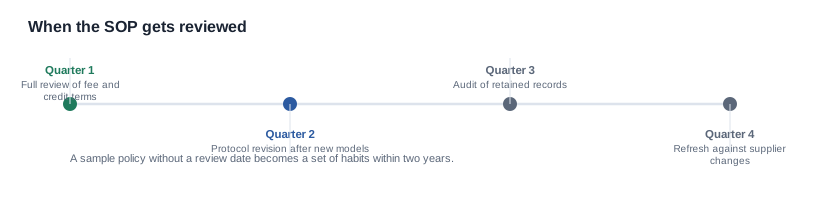
How to evaluate whether the SOP is actually working
A procedure that has been issued is not the same as a procedure that is being followed, and the two are easy to confuse from the inside. Four checks tell you which one you have, and each of them is a question a buyer can answer from the file rather than from an opinion.
Count the returned requests. Under clause one, a request that does not name a configuration string is returned rather than processed. A programme that has never returned a request either has no such clause in practice, or has a clause and no enforcement, and the two are the same thing.
Count the records with a named tester. Under clause seven, every result carries the name of the person who ran it. A file where most records are signed with a department name rather than a person is telling you that the clause was written for an organisation that no longer exists.
Count the rounds that were closed. Under clause eight, every round ends with a closure memo. If the number of sample requests and the number of closure memos are different, the difference is the number of rounds that were never finished, and those are the rounds whose results are still being treated as approval.
Look at the last clause that was changed. A sample SOP whose most recent edit is older than a year is not necessarily wrong, but it should be the first thing the next review examines, because an untouched template and an enforced one look identical from the outside and behave completely differently.
None of these four checks needs an audit programme or a software tool. They need about twenty minutes with the file, which is cheaper than the first complaint they would have prevented.
What we publish, and what stays out of the template
The template above is deliberately empty of numbers on the left side of the clause. That is not an oversight. Where our catalogue publishes a row, the clause can point at it; where it does not, the clause has to ask the supplier, and a template that filled the gap with a typical figure would be teaching the wrong habit.
The catalogue publishes, model by model: the camera resolution tier, the cell capacity, the rated use, the charge time, the charging method where one exists, the charging case option where one exists, the colour availability, and the ingress marking on the V06 and the S7. Three things it does not publish, and the template asks for rather than assumes.
We do not publish frame weight for any model, and where a weight is published, as it is for the MT6 glasses body at 158 g including the 265 mAh cell and the camera and excluding the 1200 mAh folding charging case, we state exactly what the figure covers so that it cannot be misread as a frame weight. We do not publish per-model certification, because the catalogue carries a company-level export certification page and no per-model certification row for any of the twenty-eight models, and its text contains no reference to CE, FCC or RoHS at all. And we do not publish sample fees, credit conditions or round counts, because those are commercial terms of one quotation and not catalogue data.
How to start with this template
Take the eight clauses, delete any that your programme genuinely does not need, and do not add any that you cannot staff. A seven-clause SOP that is followed beats a nine-clause SOP that is negotiated, because the value of a template is entirely in whether the receiving party has ever been asked to act on it.
If you want the clause boundaries checked against the published rows for the models you are specifying, send us the models, the quantities and the target market. We will tell you which rows the protocol can point at directly, which rows need a supplier statement instead, and where the template should ask a question it currently assumes.
Related reading
- Sample policy red flags — the clause that catches each failure
- Practical advice for smart glasses buyers — the working sequence behind the clauses
- OEM quality expectations — where the record clause meets the supplier's own process
- OEM ready products — the product line this SOP is written against
- AI camera glasses — where most of the published rows sit
Send the configuration, the quantity and the market, and we will say which clauses can point at a published row and which have to ask.


