

A first order does not need a forty-page agreement. It needs ten clauses written precisely enough that both sides can tell what "done" means. Everything else can be a purchase order annex, revised next time. The ten below are the ones where vagueness costs money rather than time, ordered by how often they cause trouble, with the trap written against each one.
Smart glasses contract: why ten clauses, not forty pages

The reason a first agreement can be short is that a first order has very little at stake in the way a second one does. There is no funded tooling, no commissioned firmware deployed into a customer fleet, no season's revenue depending on one production line. A buyer who opens a forty-page template on a first order is mostly producing a document nobody will read and a negotiation nobody enjoys.
The reason it cannot be shorter than ten clauses is that each of the ten closes a gap where vagueness turns into money. A short shipment with no agreed tolerance gets rejected by the receiving team. A payment milestone with no document attached pays against the wrong event. A defect rate with no number in it turns every warranty conversation into a negotiation about whose number is right.
The ten clauses as a quick reference
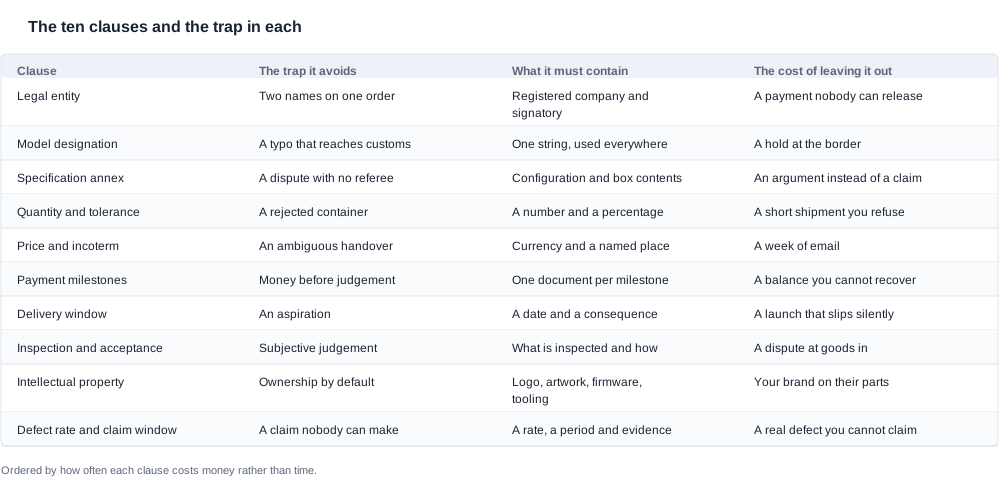
The table below carries the same ten clauses with the trap in each, and the bullets underneath are the version you can paste into an email to a supplier who has sent you their standard terms:
- Legal entity — the registered company, its address, and the signatory with authority
- Model designation — one string per SKU, identical in every document
- Specification annex — the configuration, the box contents and the artwork reference
- Quantity and tolerance — a number and a percentage
- Price, currency and incoterm — a number, a currency and a named place
- Payment milestones — a named document behind each one
- Delivery window — a date and a defined consequence for a slip
- Inspection and acceptance — what is inspected, by whom, and what failure means
- Intellectual property — the logo, the artwork, the firmware and the tooling
- Defect rate and claim window — a number, a period and the evidence required
Sending that list as a request rather than as a redline is usually more productive, because it gives the supplier ten specific answers to give instead of a general instruction to make the agreement better.
The difference between a clause that costs time and one that costs money
A clause that costs time is one that slows the exchange. It produces another email and another week. A clause that costs money is one where the parties end up in the same place but the outcome is different — a rejected container, a reprinted carton, a unit in a warehouse that nobody will accept, a balance paid against goods that were never judged.
The ten clauses below are all of the second kind, which is why they are the ten and not the forty. The clauses that cost time — the governing law paragraph, the confidentiality language, the notice periods — can wait for the second order.
How the ten were derived, and what was deliberately left out
The list was assembled from failure modes rather than from a template, which is why it is ten clauses long and why it contains no liability cap. Each clause exists because there is a specific, repeatable way that a first order in this category goes wrong, and the clause is the shortest thing that stops that particular thing.
Several of the ten are there because the agreement needed to name something specific rather than because the topic mattered. The model designation clause exists because catalogue spellings drift. The quantity tolerance clause exists because short shipments are ordinary and rejection is not. The claim window clause exists because inventory ages in a warehouse rather than on a shelf.
Four clauses were deliberately left out of a first order, and the reasons are worth recording because the omissions are as deliberate as the inclusions. Tooling continuity and the cost of a re-tool do not matter when no tooling has been funded. A fleet freeze for the firmware does not matter when there is no deployed fleet. A detailed intellectual property assignment does not matter when there is no commissioned code, beyond the one line about what happens to the artwork. And a split-shipment regime does not matter when the order is one delivery — although, if the channel tells you early that it will want part of the order, that is the one omission worth reversing before signature rather than after.
Deferring a clause is a decision with a reason attached. Leaving the field blank is not a decision, it is a default, and the default is rarely the one either side wanted.

The three clauses that stop everything after them
One. Legal entity
Name the registered company, its registered address, and who is authorised to sign. This is not pedantry on our side — we operate under a Chinese legal entity that appears in several trading forms across our own materials, and buyers who have worked with us have had to resolve which one is signing. One order, one entity, one signatory with authority. If a bank payment is going to a different name than the agreement names, somebody in your finance team will stop it, and that stoppage lands on the production slot.
The trap is a mismatch between the agreement and the invoice rather than a mismatch inside the agreement. Both names can be correct and still be different names.
Two. Model designation
One string per SKU, and it must be identical in the agreement, the proforma invoice, the compliance file and the carton label.
This clause exists because our own catalogue prints one model as "L2 Utral", which appears to be a rendering of "Ultra". Copying a supplier's catalogue spelling into an agreement propagates a mismatch into your customs file and your retail listing. Fix the string before signature, not at the port.
The trap is a string that is correct in one document and abbreviated in another. "L2 Utral" in the agreement, "L2" on the carton, and "L2 Utral" on the invoice is a single order that fails three different checks at three different moments.
Three. Specification annex
Configuration, colour, what is in the box, packaging type, carton marks and label artwork reference. Attached as an annex, it becomes the reference against which any later disagreement is judged. Without it, the dispute has no referee.
The trap is an annex that describes a product family. A drawing of a family shows one member of it, and the member it shows may not be the member with the charging case in the box, or the member with the firmware build the buyer ordered. The annex has to name the configuration rather than illustrate it.
The four clauses that decide how the order finishes
Four. Quantity and tolerance
A number and a percentage. Short shipment by a small amount is normal in this industry; short shipment with no agreed tolerance means your receiving team rejects a container, and the freight on a rejected container has already been paid.
The trap is a tolerance stated as an exact figure. "Five hundred units, tolerance plus or minus zero" is a clause that guarantees a conversation if the factory is one unit short, and the conversation happens at the port where the cheapest remedy is no longer available.
Five. Price, currency and Incoterm
The Incoterm needs a named place — a port, an airport, a warehouse address. "FOB" alone leaves the point of transfer ambiguous and turns a five-minute conversation into a week of email.
The trap is a price that is fixed to an event rather than to a date. "At current prices at the time of order" sounds reasonable and is a clause that moves with the component market, which means the number the buyer approved is not the number that appears on the invoice.
Six. Payment milestones with documents attached
Each milestone tied to a named document, as set out in payment terms. The deposit is against a proforma invoice with the model designation on it; the balance is against an inspection report that has been agreed in advance.
The trap is the ordering. A balance released against an inspection report that the supplier produces is a balance released against the supplier's own opinion, because a supplier who has not shipped the goods has no incentive to fail them. A report against a sample that the buyer and the supplier both signed is a different instrument.
Why the balance should wait for a judged sample
The ordering of the milestones is the clause that determines whether the inspection has any force at all. If the balance is released when the goods leave the factory, the inspection is a formality with a document attached to it. If the balance is released after the inspection window closes and the discrepancy window passes, the inspection is the thing that releases the money, and both sides know it.
The practical version is three milestones rather than two. The deposit against a proforma invoice that carries the model designation, a second payment against the production completion notice and the inspection report, and the balance after the discrepancy window closes. Each milestone has a document that somebody has to produce, and each document can be checked rather than trusted.
There is a variant worth considering for a first order with a supplier the buyer does not yet know: hold the whole balance until the discrepancy window closes rather than splitting it. It is a harder conversation for a new relationship, and it is considerably easier than the conversation that follows a rejected container.
Seven. Delivery window and the remedy for delay
A date with nothing attached to it is an aspiration. Either party needs a defined consequence, and both sides should be able to state it without a lawyer.
The trap is a date that conflates two clocks. The factory controls when the goods are ready; the forwarder and the destination control when they arrive. A single date covering both is a date that will be missed for reasons outside the factory's control, and a clause that treats a transit delay as a factory breach will be renegotiated at the worst possible moment.

The three clauses where the money hides
Why the trap matters more than the clause
Every clause in the list has a straightforward statement, and it is the statement that gets agreed without discussion because everybody recognises it. The trap is what makes the clause worth writing, and the trap is the part that survives contact with a real shipment.
The difference matters because the clause and the trap fail differently. A clause that is missing gets noticed immediately by whoever reads the document, and the conversation about it is short. A trap is the failure mode of a clause that is present, so it is invisible until the situation it describes occurs, and by then the clause has already failed.
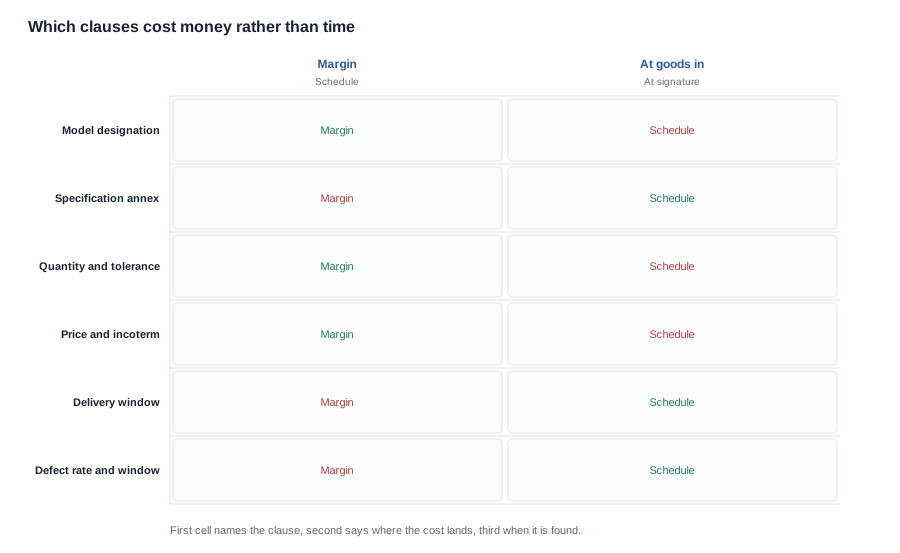
Three examples from the list make the point. "Quantity and tolerance" sounds administrative until the receiving team rejects a container over one unit. "Payment milestones with documents attached" sounds reasonable until the balance is paid against a supplier's own inspection report. "Defect rate and claim window" sounds complete until a unit that spent a winter in a warehouse comes out of it with a flat battery and a claim window that has already closed.
None of those failures is dramatic, and all of them are expensive in the same way: they cost a week and a decision that has to be made under pressure.
Eight. Inspection and acceptance criteria
What is inspected, by whom, at what stage, and what a failure means. Whether the function sample is production-representative is part of this and belongs in the same sentence — the distinction is set out under sample evaluation.
The trap is the word "equivalent". A clause allowing equivalent components without re-approval hands a production decision to whoever is under schedule pressure that week, and the buyer discovers the substitution when a unit behaves differently from the approved sample.
Nine. Intellectual property and non-recurring work
Who owns your logo, your packaging artwork, any firmware you pay to develop, and any tooling paid for. If a custom colour or a mould was funded by you, that fact belongs in writing. Absent a clause, ownership defaults in ways neither party expects.
The trap is a clause that covers the artwork but not the code. A private label and a commissioned firmware build are both things the buyer paid for, and they are often commissioned in the same conversation by different people. The artwork gets a clause because it is visible on the carton; the firmware does not, because nobody can see it.
Ten. Defect rate and claim window
A number and a number of days, plus what evidence you must provide — photographs of the carton, of the label, of the defect, within the stated period. "Warranty as per company policy" is not a clause, because you have not read the company policy, and the company policy has never been written for a buyer's evidence.
The trap is a window that starts at the wrong end. Measured from the invoice, a unit that sat in a warehouse over a winter comes out of it with a flat battery and no claim to make. Measured from the incident, the same unit is claimable and the supplier has a route to answer it.

Two clauses that get forgotten, and what they are worth
Where a first order's omissions actually surface
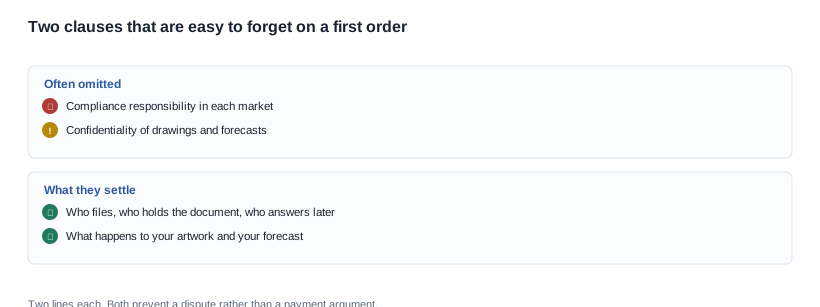
The two clauses above are forgotten rather than deliberately left out, and they surface in characteristic places. The compliance responsibility clause surfaces eighteen months later, when a regulator asks a question and nobody can say who was supposed to answer it. The confidentiality clause surfaces the week after the forecast was sent, when a supplier's sales team quotes the volumes to a different customer.
Both failures are cheap to prevent at signature and awkward to fix afterwards, and both of them are missing because the first order was assembled from a template rather than from a list. A template has the clauses that somebody thought of; a list has the clauses that somebody paid for.
Compliance responsibility. Who files in which market, who holds the resulting document, and who responds if a regulator asks a question eighteen months later. Our position on this should be stated plainly: our catalogue carries a company-level export-certification page whose content is images rather than text, and the catalogue text contains no reference to CE, FCC or RoHS. There is no per-model certification row anywhere — no certificate number, no issuing body, no validity date — and none for the child models either. The applicable scope for a given model in a given market is written material to be requested and filed before the order, not a marking a buyer can read off a catalogue page. Verification therefore sits with you until we supply documents. The check list for doing that is at certification verification.
The trap is that the compliance clause is written as if it settled the compliance question, when all it settles is who does the work. A clause that names the filing party and the document holder is worth having precisely because it tells you which of the two you are, and therefore which queue the question is sitting in.
Confidentiality of drawings and schedules. If you send a private label design or a volume forecast, say what happens to it. This is a two-line clause that prevents a genuine dispute later.
The trap is that both of these clauses cost nothing to include and are the two most frequently omitted from first-order templates, because the first is filed under compliance and the second under legal, and on a first order neither department is in the room.
What we will not sign, and what we will put in writing
Our two refusals
The working rule we apply: we will not sign an agreement that leaves the model designation ambiguous, and we will not accept a specification described verbally. Those two refusals occasionally cost us an order at the start, and they have never cost us a return claim.
We also do not publish standard contract terms, because the terms we can accept depend on the order, the market and how much risk you are carrying. What we will do is put the ten clauses above into your first agreement in a form both sides can sign.
What we can put in writing from the published rows
The configuration rows that a first agreement needs can be assembled from what the catalogue publishes for most models: resolution tier, cell capacity, charging interface, charging time, rated runtime with its caveat, case configuration and, for the audio range, the Bluetooth version. Where a row is not published, the clause has to use a mechanism rather than a number — the sample, the batch test, or the photograph of the label.
What we will not do is fill an unpublished row with a typical figure from a supplier's general data, and we will not commit to a weight that the catalogue does not publish. The catalogue publishes exactly one weight, 158 g for the MT6 glasses body including the battery and the camera and excluding the folding charging case; no bare frame weight is published for any model, and a clause that references one should be written as an acceptance against the sample instead.
The camera models this most often applies to are listed on the AI camera glasses page, and the wider topic sits under contract terms.
Putting a first order terms template in front of us
Send us your terms template or tell us the points that are genuinely open, and we will mark up the ten clauses so you can see where the real disagreement is. If the template is longer than a page and a half, send it anyway — the first pass is usually about which of the ten clauses are present, and that is a quick reading.


