

Smart glasses contract: the five variables that actually move the terms
A smart glasses contract is assembled rather than negotiated, and the assembly is decided long before anyone opens a document. Five variables determine what the agreement is able to say: how much of the specification is published at all, how far the ordered configuration sits from the catalogue configuration, which destination markets the batch will enter, whether the volume is permanent, and what your own sales team will claim on the product page. The first of those five changes the drafting method, because this category publishes the electrical rows and leaves almost everything else to the agreement.
That distinction matters because a contract that says the goods "conform to the manufacturer's published specification" is doing a great deal of work in most categories and almost no work in this one. Our catalogue publishes 28 models with their battery capacity, run time, charge time, charging method, Bluetooth version and — for the eleven camera models — sensor resolution. It publishes no frame weight for twenty-seven of them, no camera sensor part number, no field of view, no video resolution, no frame rate, no stabilisation figure, no microphone pickup distance, no ingress test report number, no certification number, no defect rate and no yield. A buyer who writes a conformity clause and stops there has written a clause that references a document which does not contain the attributes the buyer actually cares about.
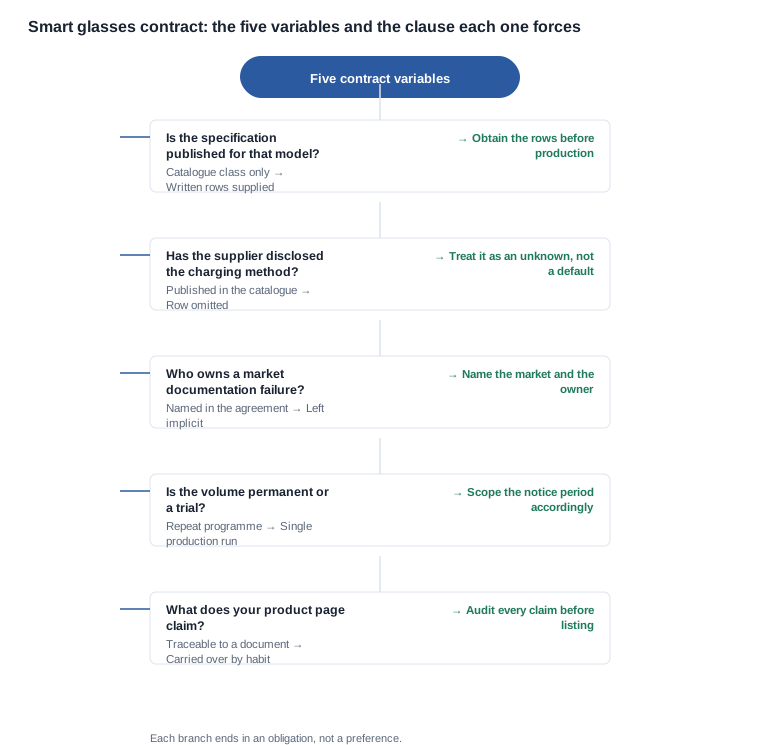
The five variables in the order below are worth keeping apart because they do not move together, and a clause that assumes they do will be either unenforceable or empty. The first variable governs the specification. The second governs what counts as the same product. The third governs whose law applies and who owns a paperwork failure. The fourth governs how long you can keep making the same thing. The fifth governs the language your marketing team will use whether or not the agreement says anything about it.
A useful way to frame the work: every clause in the agreement should be traceable to one of these five. If a clause cannot be traced, it is either decoration or a clause that belongs to a different document — most often the purchase order, the quality agreement or the artwork approval record. Mixing them is the most common structural error in this category, and it produces a contract that is long, emphatic and incapable of resolving the disputes it was written to prevent.

Why conformity wording collapses when the specification is incomplete
Conformity is the standard clause in a hardware agreement, and it is normally sufficient. The goods must match the specification annexed to the contract; if they do not, the buyer has remedies. The clause works because the specification is complete enough to be the test, and because both parties can read the same document and see the same number.
In this category the test document is thin, and the thinness is not an accident of one supplier's catalogue. It is a property of where the product sits in its own lifecycle. A camera model is published with a resolution class — eight megapixels across eight of the eleven camera models, thirteen megapixels on the L2 Utral and the L1 Pro, and the S7 — but not with the sensor part number, the pixel size, the lens focal length or the video frame rate. An audio model is published with its Bluetooth version, its cell configuration and its run time, but not with the driver size, the codec list or the microphone specification. The published rows describe the product's class. The rows that would let you test conformity are absent.
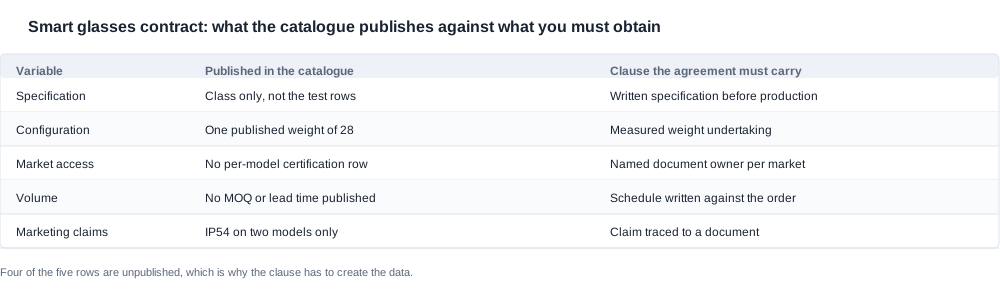
This has three practical consequences for drafting.
First, a reference to a class is not a reference to a specification. If a clause says the goods must be "of the published specification for model MT6", the buyer has no way to know whether a given unit is inside that description. The clause creates an obligation that cannot be tested and therefore cannot be breached in any way a buyer can use.
Second, the remedy shifts from comparison to inspection. When the specification is complete, conformity is decided by reading two documents side by side. When it is incomplete, conformity is decided by inspecting the delivered unit against criteria the buyer wrote. That moves the dispute from a paper exercise to a measurement exercise, and it means the measurement protocol has to exist before the first shipment, not after the first complaint.
Third, the party with the information has to be obliged to give it. This is the only clause that works: an undertaking to supply, in writing and before production, the specification rows the catalogue does not publish for the ordered model code. Not a promise that the goods will turn out to have certain characteristics, but a promise that the buyer will be told what they are, in a form that can be measured.
That single change does more than anything else in the agreement, because it converts an unevidenced attribute into a disclosed one. A camera's frame rate that the supplier has written down in a datasheet is something the buyer can accept, reject, or set a tolerance around. A camera's frame rate that the supplier has never written down is something the buyer can only guess at, and guessing is what produces the returns.
The same logic applies to certification, and the point has to be made carefully because it is easy to get wrong. Our catalogue carries a company-level page of export certification material and gives no per-model certification row. The full text of the catalogue contains no CE, FCC, RoHS, REACH or UN38.3 marking at all, which means a buyer cannot infer a model's compliance position from anything we publish, and equally a buyer cannot claim that we have asserted one. For the agreement, the correct clause is an information obligation — the model list, the test report numbers, the issuing bodies and the validity dates for the ordered configuration — not a warranty that the goods "are certified", because there is nothing published for that warranty to attach to.
Precedence: the ranking that decides which clause wins
When five variables move at once, the agreement needs a rule for which clause wins. Without one, a conflict is decided by whoever is more assertive in the dispute, and a contract that has to be read by a lawyer instead of a buyer is a contract that has already lost part of its value.
There is a defensible ranking for this category, and it is not the order the clauses usually appear in.
Safety and market-access obligations come first. If the goods cannot lawfully be sold in the destination market, the contract has failed regardless of what the unit price was. A batch destined for the United States needs the radio authorisation pathway resolved for a Bluetooth-equipped device; a batch destined for the European Union needs the Radio Equipment Directive (EU) 2014/53/EU conformity route settled, and the general product safety regulation's requirement for an established economic operator's details on the online product page has applied since 13 December 2024. None of these are commercial terms, and none of them should be subordinate to a delivery schedule.
Second comes the configuration identity. Whether the delivered unit is the configuration that was ordered is a precondition for every other clause. If the goods are a different configuration, then the specification clause, the price and the delivery date are all describing something that does not exist. This is the point where the charging method becomes contractually relevant: seventeen models in the catalogue are published as magnetic charging, seven as Type C, and four — the CY05 and the L1 Pro, and the MT6 and the CY03 — publish a charging-case capacity but no charging-method row at all. A buyer whose operational assumption is "the unit charges magnetically" has an order that is materially different on the four models where we do not publish the method.
Third comes conformity to the agreed specification, defined by the disclosed rows and by the buyer's own inspection criteria.
Fourth comes quantity, quality and delivery, which is where most of the commercial negotiation actually happens and which is also the part buyers spend the most attention on.
Fifth comes the commercial terms — price, payment schedule, margin, warranty administration. These are the last in precedence because they are the terms both sides can most easily do without for the length of a dispute, and because a price concession does not cure a product that could not be sold.
The reason to write this ranking down is not elegance. It is that each of the first three can be raised as a stop condition at goods-in without any commercial discussion at all, while the last two require a negotiation. A precedence clause tells the receiving team which door to knock on first.

Converting five unpublished rows into five obligations
The practical output of the precedence work is a set of clauses that each attach an owner to a specific gap. The gaps are the same in every enquiry, which makes them a checklist rather than a negotiation.
Weight. The catalogue publishes a weight for exactly one model: the MT6 glasses unit at 158 g, which includes its battery and camera and excludes its foldable charging case, whose capacity is 1200 mAh and whose own weight is not published. For every other model, weight is not published and should not be estimated by a buyer or by a supplier working from memory. The clause is a measurement commitment: the supplier states the weight of the ordered configuration, in writing, before production, and it is measured on the delivered units rather than on a sample. Frame weight, temple weight and total shipped weight are three different numbers and a contract that says "weight" without naming which one is a contract about a concept rather than a product.
Camera specification. For the eleven camera models, the resolution class is published and the sensor, lens and video parameters are not. The clause requires a written specification for the ordered model code covering the fields the buyer will market against, and it requires that any component substitution which would change a published figure be declared in advance. The declaration obligation is the operative part: a supplier who substitutes a sensor and says so is a manageable commercial event; a supplier who substitutes a sensor and does not say so is a product liability and a recall conversation.
Acceptance criteria. No defect rate, yield figure or rework policy is published for any model. The clause therefore does not reference one. It defines a receiving inspection — a defined sample size, a defined defect classification, a defined pass condition — and it attaches the consequence. This is the only way to make "quality" enforceable in this category, because the alternative is to agree a number with no basis.
First-article approval. A first article, a written test script and a signature against it convert a first shipment from a sample into a reference. It matters most for the configurations that are actually different: a logo and packaging change is an artwork approval, a temple-shape change is a tooling approval, and a system, interface or firmware change is a maintenance approval, because it creates an obligation across every future product revision rather than a one-off setup cost.
Configuration-change notice and spare-parts availability. Whether a published configuration remains available after the programme ends is not published, and whether spare parts are stocked is not published either. A contract without a notice period and a spare-parts commitment leaves the buyer's own warranty obligation running past the point at which the supplier can fulfil it. This is the clause that protects the buyer two years after signature, which is exactly the clause that gets dropped because nothing has gone wrong yet.
Five clauses the variable structure produces
- Conformance defined against a written specification for the exact model code and configuration, with an undertaking to supply the rows the catalogue does not publish.
- A declared-change obligation for any component or process substitution that would alter a published figure, with a notice period and a right to reject before shipment.
- A receiving acceptance criterion expressed as an inspection protocol and a pass condition, since no defect rate is published for any model.
- A configuration-change notice period and a spare-parts availability window, both measured in months from the last production run rather than left open.
- A market-specific compliance allocation that names the destination market, the applicable framework and the party who owns a documentation failure before it becomes a shipment hold.
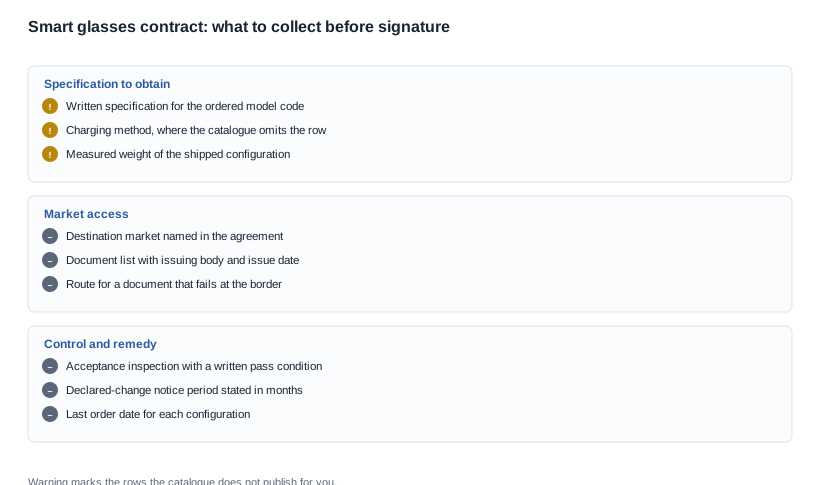
The list is short enough to be sent as a single request, and short enough that a supplier can answer it in one reply. That is deliberate: a disclosure request that takes two rounds of clarification to understand will be answered partially, and a partially answered disclosure request is indistinguishable from a refusal.

What signature settles, and what it cannot
Some terms move with the negotiation and some do not, and the useful discipline is to say which is which before the meeting rather than after it.
The parts of this agreement that genuinely move are the ones tied to your own commitment. The number of configurations you commit to is a negotiation, because a supplier prices the per-configuration setup against the number of them; the artwork round count is a negotiation, because each additional round costs a supplier a slot in a schedule; the per-market documentation scope is a negotiation, because the alternative is paying for work you do not need; the date at which the configuration must remain orderable is a negotiation, because a supplier who has kept a colourway alive for three years has carried a cost you can see; and the sample and first-article terms are a negotiation, because they are the terms that determine what you will find when the goods arrive.
The parts that do not move are the ones tied to physics and to third-party queues. The cost and elapsed time of a laboratory test is a fixed cost per configuration with a waiting period set by the laboratory rather than by your order size; pressing on it does not make the product arrive sooner. The existence of a certification obligation for a Bluetooth device in a given market is not a commercial variable at all. The interface a model uses to charge is a design decision that was made before the quotation, and the catalogue's own figures make the shape of that decision visible: the L2 Utral publishes a Type C charging interface while the L2 Utral's charging case publishes 900 mAh or 1400 mAh, and the four models with an unpublished charging method publish only their case capacity — 1400 mAh for the L1 Pro and the CY03, and the CY05, 1200 mAh for the MT6. A clause asking for a change in that arrangement is asking for a redesign, and pricing it as a request is why such requests are usually declined.
The distinction worth internalising is between what the supplier controls and what the market controls. The supplier controls the configuration, the disclosure, the acceptance criteria and the notice period. The market controls the test laboratory's queue and the regulatory timetable. Confusing the two produces a negotiation that spends goodwill on things that cannot move, and it produces a contract that over-promises on the things that can.
Two clauses deserve a second reading because they are frequently drafted backwards. The first is the warranty, which is usually written as a period of months with no definition of the failure it covers; in a category with no published defect rate, a warranty period without an acceptance definition is an open-ended liability for both sides, because nobody can say when the obligation has been triggered. The second is the claims clause, which is usually written as a prohibition on the supplier making claims, when the risk in this category is almost entirely on the other side of the table: an IP54 marking appears in our catalogue on two models only, the V06 and the S7, so a product page that applies that marking to a different model is making a claim about ingress protection that no document in the catalogue supports.
A clause review worked through a single order
The following is a hypothetical scenario rather than a client project, and it is included to show the decision sequence rather than to report an outcome.
Assume a brand-side buyer with a single market in the European Union, one camera model, one colourway, and a first production run small enough that the buyer is not certain it will repeat. The buyer has two quotations, both unit prices quoted against the same model code, and the difference between them is small enough that the buyer has not decided which to take. The buyer's internal note says the two suppliers "look the same", which is the actual problem.
The first pass is the disclosure request. The buyer sends one message asking both suppliers for the specification rows that the catalogue does not publish for that model code: the camera fields the buyer intends to market against, the measured weight of the ordered configuration in the delivered unit, the charging method, and the specific documents that will accompany the goods for the destination market. One supplier answers all of it within two working days. The other answers the camera fields, leaves the weight and the charging method as "as per the sample", and does not name any document.
The second pass is the identity check. The buyer now knows that the quotations are not comparable, because one of them is priced against a disclosed configuration and the other against an unspecified one. The buying decision is no longer a price decision, which is what the buyer should have known at the quotation stage.
The third pass is the drafting. The buyer converts each gap into an obligation with an owner: a written specification before production, a declared-change clause, a receiving inspection with a pass condition, a configuration-change notice period expressed in months, and a market allocation that names who owns a documentation failure. None of these asks either supplier to invent a number.
The fourth pass is the acceptance test. The buyer runs a first article against a written script rather than a demonstration. The script covers the camera fields, the charging path as actually built, the published figures the marketing team intends to use, and the unit weight as shipped. One clause catches an issue: the supplier's camera field for the ordered configuration does not match the sample the buyer was shown, because the sample was an earlier build. That is exactly the kind of finding the first-article script exists to produce, and it surfaces before the production run rather than after the retail launch.
The fifth pass is the claim review. The buyer's marketing team has drafted a listing. The buyer checks every statement in it against the catalogue and against the disclosed specification. The runtime statement matches. The ingress statement does not appear, because the model does not carry a published marking — a fact worth stating plainly, since the absence of a marking is not a defect and the presence of one on two models out of twenty-eight does not extend to the rest of the range. The weight statement is rewritten from a guess into a statement the buyer can defend.
The result is not a dramatic negotiation. It is an order with five named obligations, a supplier whose answer pattern the buyer can distinguish from the other's, and a marketing page whose claims all trace to something in writing. The decisive moves were all made before the deposit.
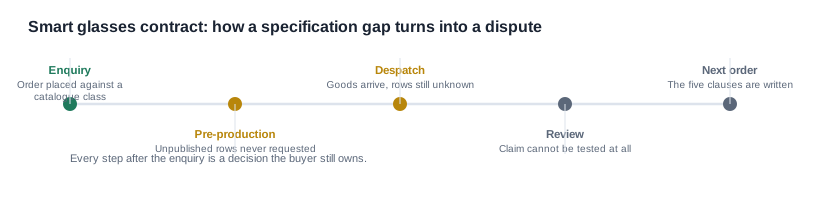
The sequence above is the one that is expensive, and it is worth noticing that the buyer's own decisions caused every step of it. The supplier did not withhold a specification that had been asked for; nobody asked. That is the argument for putting the request in the enquiry rather than in the negotiation.
What we can put in front of you, and what we will not invent
The boundary we hold: the gaps in this catalogue are a fact about the category rather than a failure of any particular supplier, and the useful response is to attach an owner to each one rather than to pretend the number exists. We will supply the published specification for the configuration you order, state which documents exist and which are not published, and commit in advance to declaring any component substitution that would change a published figure.
We will not supply figures the catalogue does not contain. We do not publish frame weight for twenty-seven of the twenty-eight models, and we would rather tell you that than quote a typical value you cannot verify; the single published weight is the MT6 glasses unit at 158 g, excluding the foldable charging case, whose own weight is not published. We do not publish a unit price, a minimum order quantity, a production lead time or a monthly capacity figure on this site, because each of those depends on configuration, quantity and date, and a clause that tries to freeze all of them at signature will be either unenforceable or empty. We do not publish per-model certification rows, and we will not let a clause imply a certification position we have not documented.
What we will do is answer the disclosure request in full before production starts, and put in writing which rows of the ordered model code are catalogue-published and which are being supplied on request.
The four requests that start the clause list
Send the disclosure request before the second quotation, not after the order. The request is short — the specification rows the catalogue does not publish, the measured configuration weight, the charging method, and the destination-market documents — and the answer pattern separates a supplier who will disclose from one who will not before either party has spent anything.
Name the destination market in the enquiry. A single-market order and a two-market order are different compliance workstreams with different timetables, and a contract that does not name the market cannot allocate responsibility for a documentation failure. This is the most common late-stage dispute in this category, and it is entirely avoidable.
Decide the configuration count before the first contract, because the minimum order quantity applies per model code and per configuration. A four-model range with two colourways each is eight commitments rather than four, and the V03 Pro's published colourways — orange, cream white and black — show how a single model code becomes three commitments at the colourway level.
Ask what the supplier will do when a published figure changes. The question is not rhetorical. A supplier with a declared-change obligation and a supplier without one will behave differently on the first component substitution, and the difference only becomes visible if you have asked the question in advance.
Send us the model, the configuration, the destination market and the volume band, and we will tell you which rows of the published specification answer your question today and which have to be requested in writing before production.
Where the clauses come from
- Contract terms overview — the commercial structure behind these clauses
- Certification checklist — the documentation file behind the compliance clauses
- How to verify a contract before you sign it — the review sequence
- Payment terms and who needs them — the cash-flow axis of the same agreement
Tell us the configuration, the destination market and the volume band, and we will tell you which clauses carry the weight on your specific order.


