

Smart glasses payment terms decide who carries risk while the goods are being made, and the schedule most buyers accept by default is not the schedule that protects them. The useful question is not which percentage seems reasonable; it is what each instalment is tied to, and who holds the position between one instalment and the next.
This page is a working sheet. It takes the questions a procurement manager, a channel buyer or an importer actually asks in this category and answers them in the order they have to be answered, with the document that settles each one named. The catalogue and camera glasses range is on the AI camera glasses page, and the wider framework is under payment terms.
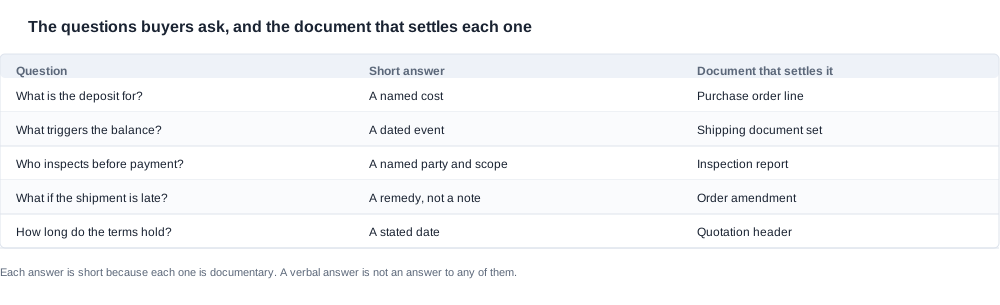
Smart glasses payment terms: the questions and the order they are answered
Who is asking, and what they are managing
The reader is a procurement manager working for the brand, a channel buyer or an importer. The situation is one of three: a quotation is on the table and has to be read, a new programme is being opened and the commercial shape has to be set before anything is quoted, or a market is being entered and the documentation route has to be understood. Underneath all three is the same anxiety, and it is not about price. It is that the first shipment will arrive different from the approved sample, or that the documentation route will stop the goods at a border, or that the returns will be worse than the business case assumed.
That anxiety is what the answers below are designed to remove. None of them requires a supplier to change its policy. Every one of them is a question whose answer either appears in a document or does not exist at all.
The first question, which is not about money
What is being ordered, in enough detail to be quoted. A configuration described in general terms produces a price that cannot be compared with anything, and in this category the forks are wide: a camera model with a 290 mAh cell and a 1400 mAh charging case, the same tier with a 900 mAh case, a model with a foldable 1200 mAh case, a model with no charging case in the box at all, and a model whose charging method is not published in the catalogue. Each is a different bill of materials, a different carton and a different freight band. The how to calculate payment terms article is the method for turning a configuration into a number once the configuration exists.
How to use this page
Work down the questions and write the answer beside each one, not in a column in a spreadsheet. The step that matters is the gap between the answer and the document. An answer that is written down but not attached to the order is a statement of intent; the same answer attached to the order is an obligation. The payment terms buyer checklist is the same list in a form that can be sent as a request, and the payment terms template is where the answers belong.
What a buildable configuration has to contain
A configuration is buildable when two people reading it independently would order the same object. In this category that means at minimum the model code, the colour, the charging case option and its capacity where the model has one, the charging interface, the firmware revision or build identifier, the box contents, the packaging artwork reference, the destination market and the quantity. Every one of those has a fork somewhere in the range, and a fork that is left open is a decision that has been taken by default, usually by whichever specification the factory keeps on file.
Two of these forks are worth naming because they are invisible in a quotation. The first is the charging method: the catalogue publishes it for most models in the range, and for four of the camera models it publishes the cell capacity, the charge time, the endurance figure and the case capacity but no charging method row at all. A buyer who asks for the method of a charging interface on a model where it is not published gets either a verbal answer or a written one, and the difference is worth recording. The second is the case. A model with a 1400 mAh case, a model with a 900 mAh case and a model with a foldable 1200 mAh case are three different retail experiences and three different freight bands, and a quotation that says only the model code has not priced any of them.
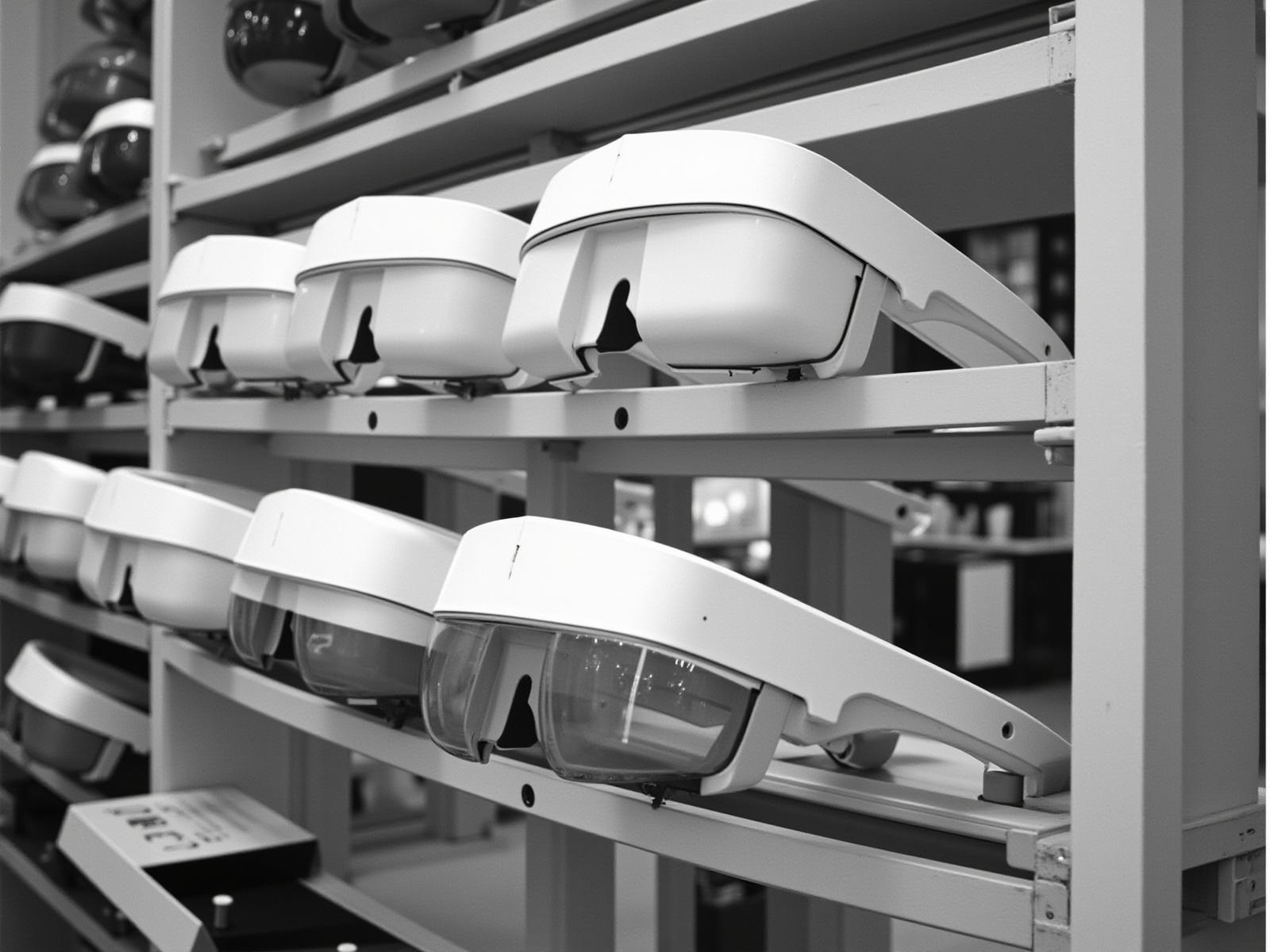
What the deposit is for, and how to make a supplier say
The question behind the deposit
What is the deposit funding? Material, labour, documentation, or all three at once. The answer decides what the buyer can trade for it, and it is the question most often left unanswered because it sounds like a formality and it is not.
The two answers that mean different things
The first answer is that the deposit covers material and booked labour. That is a cost the factory incurs and cannot recover if the order disappears, and it is the reason a deposit request at a first order is a reasonable position rather than an aggressive one. The second answer is that the deposit also covers artwork, tooling and setup. That is a different situation, because non-recurring recovery inside a recurring line is a structure that has been hidden, and a buyer who accepts it without separating it has agreed to pay for a mould at the first order without having seen the moulding charge itemised.
What to do with each answer
If the answer is the first, the buyer has a claim on the material: ask whether it has been bought yet, and on what terms, because material bought against a confirmed order is a different exposure from material bought speculatively. If the answer is the second, ask for the non-recurring recovery to be broken out and amortised over a stated volume, and ask what the amortised figure becomes on the second order. That single question converts an opaque deposit into a structure the buyer can model.
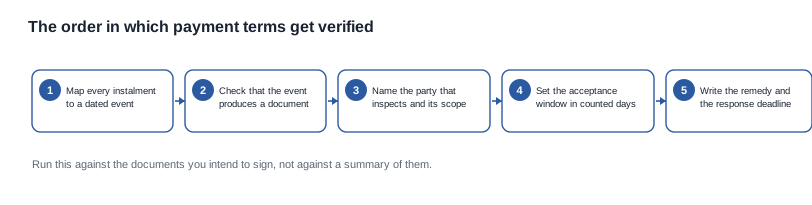
The sequence is deliberate. Each step tests something the previous step cannot, and running them in this order is what stops a percentage from being negotiated before the structure around it is understood.
What triggers the balance, and the four positions it can take
The question behind the balance trigger
What is the final payment tied to, and who carries the risk in the interval? This is the question that decides the commercial character of the whole schedule.
The four answers
Against a document set means the buyer funds the transport and holds paper evidence at the end. Against an inspection means the buyer funds the build but holds a dated finding before the money moves. Against arrival means the buyer holds the goods and the supplier holds the credit exposure. On a date after a claim window means the buyer holds a record of use, which is the only position that addresses defects that never appear at receiving.
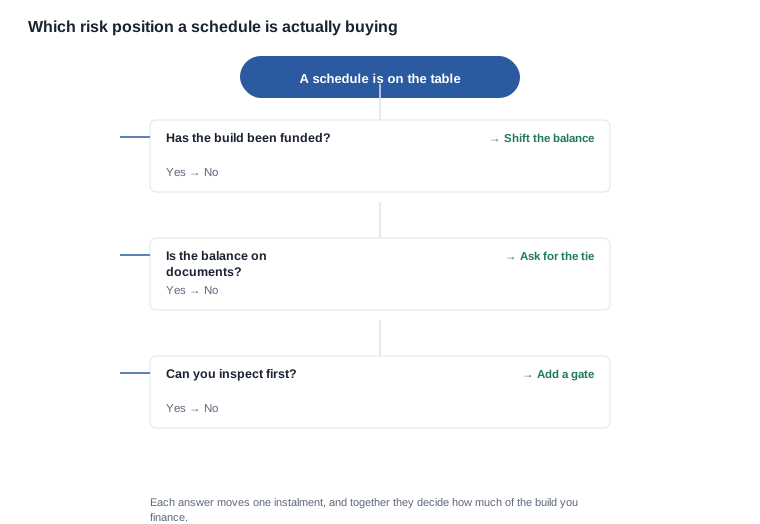
The decision chart shows how much of the build the buyer is financing under each structure, and the answer to the question is not which structure is best in the abstract. It is which one is available given the evidence the buyer currently holds.
Why a date is not an answer
A trigger written as a date tells you when money moves and nothing about what it is waiting for. It will be paid whether or not the work behind it happened, and the party who cannot influence that work is the party carrying the risk. In this category the work takes weeks and the charge time is published at two hours or less for every model in the range, so the gap between a date and the production window is wide, and a buyer who accepts a date has accepted the widest possible position.
The question that follows it
Who performs the inspection, and against what? An inspection with no scope is a formality, and a formality that a buyer has paid for is worse than no inspection at all, because it produces a report that cannot be acted on. The scope needs three things: the number of units, the criteria they are compared against, and the name of the party performing the comparison.
Net terms against events, and why the difference is a financing decision
A schedule that ends on a net basis has replaced an event with a date. That is not a small change, and it is frequently misread. The buyer who asks for net terms when what they wanted was an inspection gate has not improved their position; they have converted a risk decision into a financing decision and given up the gate in the process. The two are priced differently, which is why a supplier will often accept the second easily and resist the first, and it is worth being clear with yourself about which one you are asking for before the request is made.
Where the two combine is where the strongest schedules sit: the instalments remain tied to evidence, and the final one runs on a date from a named point, so the money movement is predictable for a finance team while the risk transfer is still documented. A buyer who wants both has to say both, because a supplier reading a request for net terms will hear a request for a date and not for a gate.
The question about the length of the funded window
How many days pass between the first instalment and the last one, and how many of those days are inside the production window rather than inside the buyer's own operation? This is the number a finance team needs and the one that is almost never on a quotation. It cannot be derived from the percentages, because the percentages do not say when the work happens. It has to be asked for in the same conversation as the schedule, in the same way the lead time itself has to be asked for, because in this category the lead time changes with the model, the configuration, the mix and the volume and is therefore not a standing figure either.

What to do when a milestone slips, and what to do when a unit fails
The question behind a slipped milestone
Is there a consequence if a milestone slips, and does the payment move with it? Most schedules in this category answer yes to the first part and no to the second, which is a contradiction the buyer pays for later.
Why the remedy matters more than the compensation
Compensation for a late shipment is a number that is set in advance, and it is usually small, because setting it large is a way of pricing the risk that neither side wants. The remedy matters more than the amount because it determines the behaviour. A schedule that says the balance moves with the production schedule, and that the buyer may require the goods to be re-inspected at the factory at its own cost, changes what happens when a line has a problem. A schedule that says a flat percentage is charged for late delivery changes nothing except the factory's view of whether it is worth telling the buyer early.
The question about a failing unit
What happens to the balance if a pre-shipment inspection finds a defect, and how long does the supplier have to respond? The answer tells the buyer whether the inspection is a control or a formality, and the honest test is what the answer would be if the buyer asked it in writing on a quotation rather than in a conversation. A supplier that names replacement, credit or rework, with a period attached, has a process. A supplier that says the buyer can raise it has a hope.
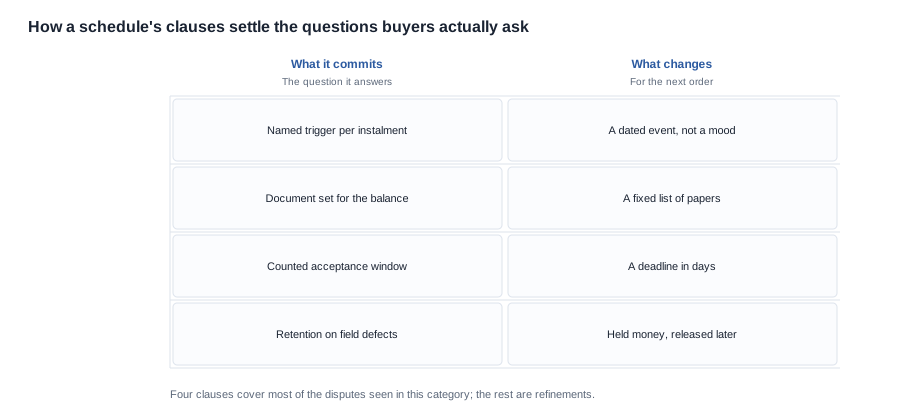
Four clauses cover most of the disputes seen in this category, and each of them answers one of the questions above. The rest are refinements, and refinements are not worth a negotiation on a first order.
The question about a defect found in the field
Who pays, and against what threshold? A percentage held against defects discovered after acceptance is what makes a field report worth making, because otherwise the buyer pays the return freight and absorbs the loss of the unit. The clause needs a period, a threshold and a release condition, otherwise the money is held indefinitely, which is a cost the factory will price and the buyer will forget.
The documents a payment schedule needs, and the ones it does not
The documents that settle the schedule
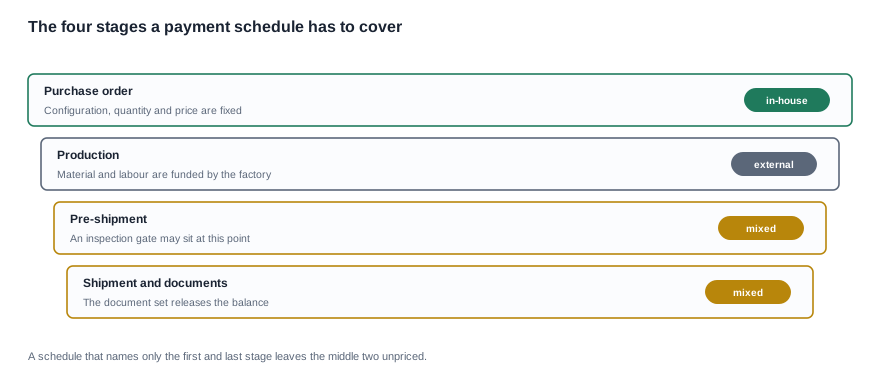
The schedule itself lives in the order, and four stages have to be covered by it: the order, where the configuration and the price are fixed; the production window, where the money is committed and nothing can be checked; the pre-shipment point, where a gate may or may not sit; and the shipment, where the document set releases the balance. A schedule that names only the first and the last leaves the middle two unpriced, and the middle two are where the money actually sits.
A short list covers the commercial documents. The quotation, with each instalment and its trigger named. The pro-forma invoice, which should match the quotation rather than replace it. The validity date and the settlement currency, both stated, both dated. The document set that releases the balance, named item by item. The acceptance window, counted in days. The remedy and the response period. The retention percentage and its release condition.
The documents to request article sets out the longer version, and the payment terms documentation requirements page separates the ones that settle the money from the ones that settle the goods.
The documents that settle the goods
These are a different set and are often confused with the first. A battery transport test summary has to be located before the shipment leaves, because it is not something that can be produced afterwards. An origin document and the commercial invoice and the packing list belong to the release set, not to the acceptance set. Market-specific documentation belongs to the configuration, and it is model-specific: a test report covering one model code does not cover its siblings.
The question about currency
What currency, and has the exposure been priced? A schedule quoted in a currency neither side has hedged is a schedule that has transferred a risk that was not discussed. In this category, where the destination market determines the document set and therefore the compliance scope, the currency question and the destination question are usually the same question.
The practical treatment is short. Agree the settlement currency at the quotation stage rather than at the invoice stage, because a currency decided later is a currency decided unilaterally by whoever issues the document. Note whether the rate is fixed for the validity period of the quotation or floats, and if it floats, decide who carries the difference. And where the buyer's own business is denominated in a third currency, price that exposure once, deliberately, and write it into the model rather than discovering it in a settlement report.
What we publish about payment terms, and what we keep inside the quotation
The boundary of our published material
The working rule we apply: the published material on this topic is the part of the specification we can stand behind, and the rest is a question for the supplier's own file. We publish what our documentation states, we mark the rows that are open, and we will not fill an open row with a typical figure taken from general data in this category. A buyer who builds a claim on an estimated number finds the error in the field rather than in the quotation, and the correction is more expensive than the question would have been.
The rows we do not publish for a payment schedule are these: our deposit ratio, our balance trigger, our credit terms, our delivery terms and our payment method. They depend on the order, the configuration, the destination, the amount and the payment history, and a published table would be wrong for most of the orders it was read against. The same applies to production lead times, unit prices and minimum order quantities, which are not published in our documentation.
Which parts of the payment schedule are settled
We will take a configuration, a quantity and a destination, and tell you which parts of the schedule are settled for this category, which are open, and which have to come from a sub-supplier rather than from us. We will put the structure in the quotation alongside the Incoterm, the non-recurring cost and the tooling lines, with each instalment tied to a named trigger, an acceptance window in days, a retention and a remedy. The payment terms industry benchmarks page covers what a schedule typically takes elsewhere in the market, and the payment terms practical advice page is the shorter version of the negotiation argument.
Models, volume, market and cash cycle
Send the models, the quantity, the destination market and the cash cycle you are working to, and we will tell you which configurations exist, which rows are open on the published data, and what the schedule for each one would have to settle.
Related reading
- The published range — camera and audio smart glasses
- Practical advice on payment terms — payment terms practical advice
- What the market expects — payment terms industry benchmarks
- The wider framework — payment terms
- The documents to request — what documents to request
Send the configuration, the quantity and the market, and we will say which parts of the schedule are settled and which are yours.


