
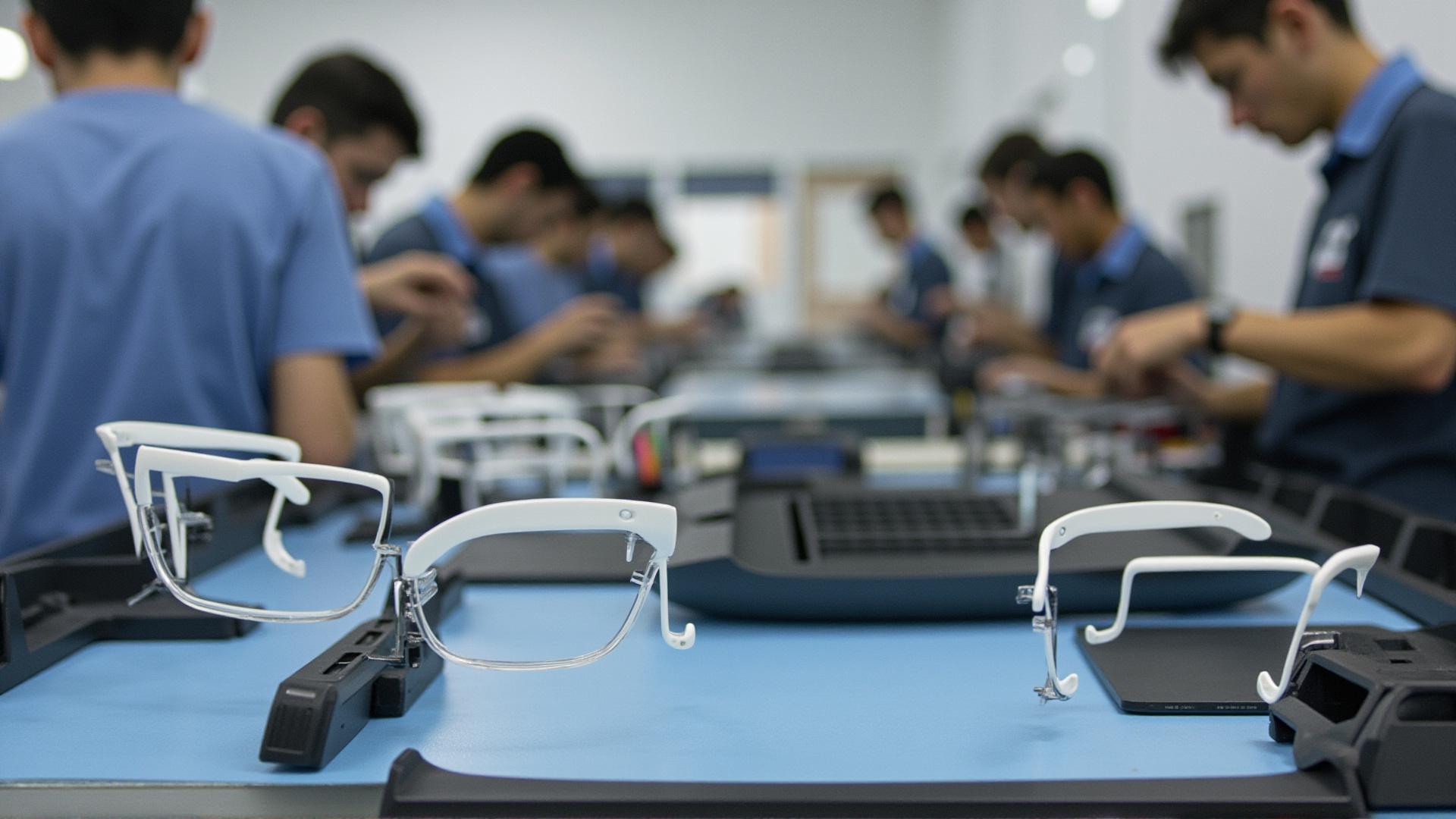
A first smart glasses factory audit establishes whether a supplier exists and can build. A second one establishes whether what they built for you will match what they build for you next time. Those are different questions with different methods, different samples and different evidence, and treating the second visit as a repetition of the first is the most common reason buyers pay for a second trip and get nothing from it.
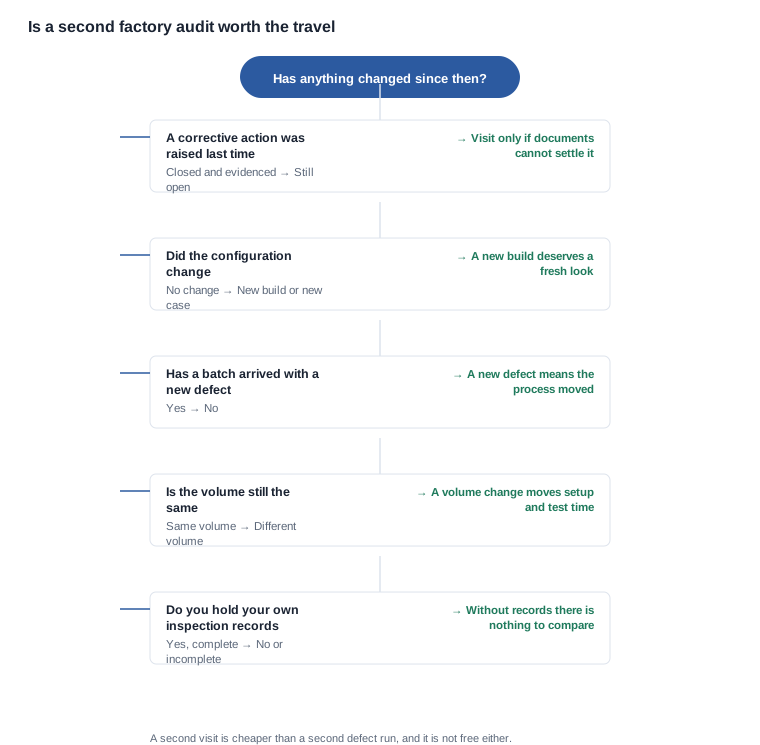
The second visit is also the visit that has to be earned. A supplier who has behaved well under a first order does not owe you a second audit, and a buyer who requests one without a reason is asking a favour. The reason is usually already in the buyer's own records: a defect that recurred, a corrective action that was never evidenced, a configuration that changed, or a volume that moved. If none of those exists, the second visit usually costs more than it returns, and the better answer is a documentary check.
Why a second smart glasses factory audit is a different exercise
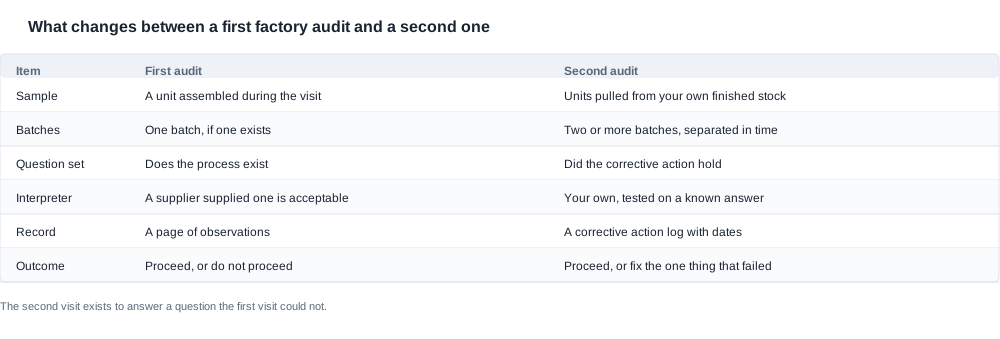
The first visit tests existence, the second tests repeatability
The first visit is an existence test. You are establishing that there is a production site, that it runs the kind of process your order needs, that incoming inspection exists, and that the people running it can explain it. Almost anything organised passes a first visit, because a factory with an active production line has documentation, benches and retained samples whether or not your programme is in them.
The second visit is a repeatability test. You are establishing that the behaviour you observed once is the behaviour you will get again. That requires three things the first visit does not: your own units, from your own batches, pulled from stock rather than built for the visit; a comparison against something that was measured earlier; and records that were kept between the two visits.
The distinction is worth stating in practical terms. A factory can be well run, well documented and honest, and still not repeat your result, because repeatability depends on controls that only bind once a batch is running. A cell from a different supplier, a firmware version that moved, a case that is no longer the case your customer approved — none of these show up on a first visit, and all of them show up on a second one if the sample is right.
The sample is the whole method
The single most consequential decision on a second visit is what you ask to see. The most informative sample in this category is finished goods built on your own order, pulled from stock rather than assembled during the visit. The reason is that a unit assembled in front of you is a unit that was just made, with a cell that was just fitted and a case that was just paired. It demonstrates that the process can produce a good unit. It does not demonstrate that the process produced good units last month, under the conditions of last month's schedule.
Ask for units from at least two different production batches if they exist. If the factory has only ever run one batch for you, that is itself the finding, and it should be written down as one: a single-batch history means every quality question about batch-to-batch consistency is unanswered, and the next order will not improve it.

What to carry, and what to leave behind
A second visit is expensive precisely because you arrive with more to check. The list below is the working set we would take. Everything on it is yours to carry; none of it can be sent by email in advance, because the point of a site visit is that the artefacts are seen rather than described.
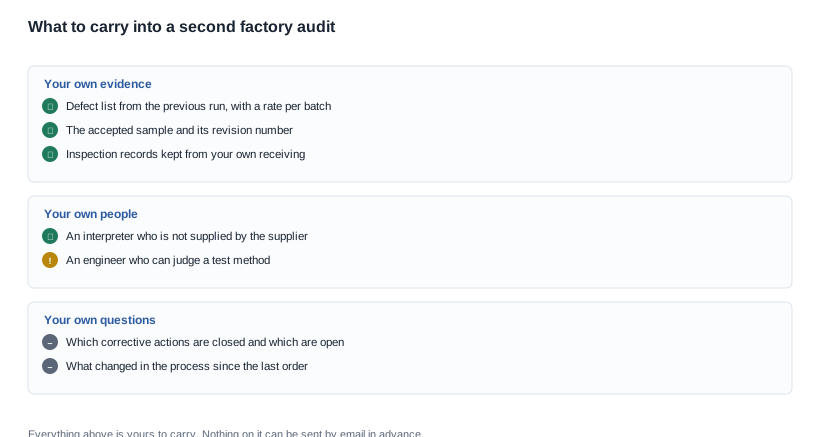
The item most often left behind is the defect list. Buyers tend to bring the complaints and not the data, and the complaints are not usable in a factory conversation because they carry no rate, no batch reference and no method. A list that says which units failed which test, in which batch, out of how many units inspected, is what turns a complaint into a question the factory can answer.
The six records that turn a complaint into evidence
For a second visit specifically, there are six records worth carrying, and it is worth being precise about why each one is on the list:
- Your own receiving inspection log, with the units inspected and the units failed counted separately. This is the only denominator you have, and without it every rate quoted at the meeting is a guess.
- The batch or lot reference for each failing unit, taken from the carton or the unit label rather than from a delivery note. This is what lets the factory locate the component deliveries behind a symptom.
- The agreed acceptance criteria, in the version that was in force for that order. Criteria that changed after the order are not criteria for that order.
- The corrective action log, if the supplier kept one, together with any acknowledgement you sent. This establishes what was agreed, not what was done.
- The artwork and specification revisions in force for that production run, so that the factory is comparing against the same build you were.
- A written note of what you asked for and what you were told, dated. Where the two versions differ later, the dated note is the only one that is contemporaneous.
Taken together these six records let a second visit run as a comparison rather than a tour. A factory facing a dated record and a specific question will answer it; a factory facing a general question will give a general answer, and the difference in what comes back is the whole value of the second trip. Bring them in one folder, indexed by batch, and the meeting starts with evidence rather than with introductions.

What a second smart glasses factory audit should sample
Your own units, from your own batches
Pull units from finished stock, not from the end of the line, and record the lot reference from each label as you pick them. The lot reference is what connects the unit to an incoming cell delivery, and without it the unit is only an anecdote.
Two batches is the minimum useful sample for a repeatability question, and there is a reason for two rather than three. Two batches tell you whether the result was stable or whether it moved. Three tells you more, but the third batch mostly tells you about the third batch, and the analytical value of a second production run is already very high. Where the two disagree, that disagreement is the finding, and it is worth spending the third batch on a different question rather than the same one.
A useful additional check, where the relationship allows it, is to compare the units in stock with the retained sample from that batch. If a factory keeps retained samples and the sample behaves differently from the stock, the retention policy has broken down somewhere and the lot reference on the box is not describing the goods inside it.
The failure modes you found last time
Bring the defect list and sample against it deliberately. The point is not to prove a failure; it is to establish what happened to the corrective action, and there are three possible answers and each one means something different.
If the same failure appears at the same rate, the corrective action did not happen or did not work. That is a capability conversation, and it is a serious one, because a supplier who records a corrective action without changing anything has a documentation habit rather than a quality habit.
If the failure appears at a lower rate, ask what changed and whether the change is documented. An undocumented improvement cannot be relied on for the next order, because the improvement exists in a person's memory rather than in a process, and it will not survive their departure.
If the failure has disappeared, ask what was done to the process rather than what was done to the units. A supplier who rewrote the inspection method rather than the product has given you something durable; a supplier who reworked the units has given you a cost.
The packaging line, examined separately
Packaging is where most visible defects live, and it is normally run at a different pace from assembly, often by a different team, often on a separate schedule. A quality review that watches assembly sees nothing about it.
Ask to see your artwork on an actual carton rather than a proof, and check three things against each other: the model designation printed on the carton, the barcode, and the unit inside. Designation drift is the specific failure this catches. It is a low-probability, high-consequence error — a label naming a different model from the one in the box is a customs problem, a channel problem and a returns problem at once, and it is invisible until somebody scans it.
The questions a second smart glasses factory audit can ask
Questions the first visit could not ask
There are four questions that only make sense once there is a history, and they should be asked in this order.
How were the corrective actions from the last batch recorded, and who signed them off. The answer should be a document with dates and names. A verbal summary of a corrective action is not a record of one, and this question separates the two quickly.
What has changed in the process since your last order. A supplier who answers "nothing" is either extremely stable or unaware, and the follow-up question separates those: ask what they changed last year that was not part of an order. Any answer at all is more informative than "nothing".
What would they refuse to make, and why. The answer should be about capability or about a constraint, not about willingness. "We would not build that because the tooling does not exist and the lead time would be a year" is an answer. "We would not build that" is not.
Show me an order you stopped taking. A factory that has never cancelled or held an order is either extremely well managed or not describing its queue accurately, and in this category the queue is the thing that determines whether your delivery date is real. The question is uncomfortable, which is part of its value.
Questions about the parts that were open last time
Second visits tend to drift into general conversation about capability, which is what the first visit already covered. The discipline is to close every item that was open last time, one at a time, with a date attached to each. If the item is closed, the record shows it and the visit moves on. If it is open, it gets a new date and a named owner.
That loop is what makes the second visit worth the travel. A buyer who arrives with a list of open items from the last order and leaves with either closure or a new date has done something no amount of correspondence could do, because the pressure of a scheduled visit is what makes an undated item acquire a date.
Bringing your own interpreter to a smart glasses factory audit
Why the supplier's interpreter is a problem
A second audit usually happens in a language the supplier speaks better than you do, and that is a problem rather than a convenience. An interpreter supplied by the factory will translate the awkward question accurately and then move on. The translation may be perfect and the interpretation still wrong, because the value of an audit question is often in the pause after it — the hesitation, the request to repeat, the counter-question that follows.
Bring your own interpreter, and use the first meeting to establish that the interpretation is literal. The way to establish it is to ask a question whose answer you already know. Ask about the volume of the last order, or the date of the last shipment, or something the factory confirmed in writing last week. A good interpreter will give you the same answer. A supplier's interpreter will give you a slightly different one, and you have learned something useful about what passes through that channel.
Questions worth testing the interpretation with
Test with questions about your own history rather than about the factory's present. Ask for the batch that had defects, the artwork revision that went wrong, the date the corrective action was signed. If the interpreter cannot produce a date and a batch number, the factory's records are not as accessible as the visit suggests, and that conclusion is itself a finding worth writing down.
There is a practical reason to insist on your own interpreter beyond accuracy. Some of the questions that make a second visit worth it are the ones that cost the supplier something to answer honestly — what they will not build, what they got wrong last time, what they have not evidenced. A question delivered through a supplier employee and interpreted by a supplier employee is a question the supplier has an opportunity to prepare for. The same question delivered in your own words, interpreted by someone with no relationship to the supplier, lands differently.
The limits of what any smart glasses factory audit can verify
A visit verifies a process on a day
This is the limit that matters and it is worth stating without hedging. An audit establishes structure, capability and traceability on the day it happens. It does not establish any of those across a year, and a factory that passes today can fail in month eight if the person running the line has left, or if a component has been substituted, or if the schedule has changed since the visit.
The mitigation is documentary and it is not optional. Keep the acceptance criteria, the inspection records and the corrective action log from your own orders, and use them as the baseline at the next visit rather than starting a fresh checklist. A buyer who arrives with their own records gets a comparison; a buyer who arrives with a blank form gets an impression.
Three things an audit cannot settle for you
Product performance. You can walk a floor full of well-run lines and still receive goods with poor endurance, because the endurance figure depends on test conditions the audit did not witness. Our own published endurance figures carry no test condition, and that is true of the category, not of this factory. Endurance on the camera models in our range is stated as roughly five to eight hours or around seven hours depending on the model, and in every case it is a rated use figure rather than a measured result under a stated load.
Whether the goods will reach your customer in good condition. That depends on packing, freight and handling, and an audit on the production floor says nothing about the journey.
Whether the documentation will be accepted at the border. Certificates are held at company level in our documentation and we do not publish certificate numbers, issuing bodies or validity dates, so a document review at a customs desk is a separate exercise with its own criteria. The audit can confirm that a file exists and that a person is responsible for it. It cannot confirm the determination a customs authority will reach.
What we will and will not show on a second smart glasses factory audit
The position we hold
We will host an audit and we will not obstruct one, including a second one. What we will not do is present undocumented capacity numbers, quality rates or certification identifiers to make a visit go quickly. Factory size, employee count, floor area, daily output, line count and defect rate are not published in our documentation, and an audit is exactly the situation where a convenient estimate would do the most damage — because an estimate given in a meeting tends to be repeated as a fact afterwards.
What we will do is answer directly about our own operation: which stages exist in it, what we can document for a specific configuration and market, which categories of evidence we would have to source from a third party before we could show them, and what our own published rows do and do not cover. The rows we can supply are the resolution tier for all eleven camera models, the cell capacity and cell count, the charging method on the twenty-four models that publish it, the charging case option where one exists, the ingress marking on the two models that carry it, and the single published weight — the MT6 glasses body at 158 g, including its 265 mAh cell and its camera and excluding its 1200 mAh folding charging case, whose weight is not published.
What we would ask of you in return
If you are planning a second visit, the useful thing to send beforehand is the open-item list from the last order and your own defect data with rates. That list is what turns the day into a closure exercise rather than a second tour, and it is the part of the preparation we cannot do for you.
For what has to be established before a second visit is worth scheduling at all, the factory audit section covers the first-stage method. For the acceptance criteria that turn a defect list into evidence, quality consistency across production runs sets out how to define them, and for the point at which a physical unit is the only thing that can settle a question, sample evaluation covers what a sample can and cannot prove.


