

A first smart glasses factory audit should not start on the production floor. It should start with documents, for two reasons that are easy to see once you have tried it the other way. In this category the document set is where most of what you want to know actually lives, and a factory that cannot produce a coherent document set for one model code will not produce coherent units for four.
There is a second reason that matters more to a first-time buyer. The floor is the visible part of a factory and the least informative part of it on a first visit. What you actually need to establish — whether incoming inspection exists and is staffed, whether traceability reaches component batches, what happens when a component becomes unavailable — takes a morning rather than a day, and much of it is confirmed by paperwork before you travel at all.
This guide follows the order that produces answers fastest: documents first, floor second, and an explicit list of the answers that cannot be used at the end.

Starting a first smart glasses factory audit with documents
Why the document set comes first
Sending a written request before travelling costs nothing and produces a result that a visit cannot reproduce, because it separates the supplier who has a file from the supplier who has a brochure. The reason a supplier with a real file answers quickly is that the file already exists and sending it is a clerical act. The reason a supplier without one answers slowly, or answers with a range-level statement, is that the file has to be created, and creating it during an enquiry produces a document that describes a company rather than a configuration.
The request also works as a filter before any money changes hands. A buyer who has asked for the specification sheet for a model code, the conformity position for that code, and the lithium battery test summary for the cell, learns more from the replies than most learn from a factory tour, because the replies are specific and the tour is general.
What you are establishing, in order
The first request should establish four things, in this order:
- The identity of the counterparty. Who signs, who is named on the business licence, and who owns the tooling. These are frequently three different entities, which is a normal arrangement in this industry and a serious one to discover after the tooling has been paid for.
- The configuration that will be built. Whether your model code runs in production, and if not, whether it is a variant of something that does.
- The documentation that will travel with the goods. Not a statement about compliance, a list of documents.
- The commercial shape. Minimum order quantity, unit price tier, lead time and payment terms, each confirmed per enquiry.
Each of those four has a documentary answer available before you travel. That is the entire argument for starting here.

The document set to request before a smart glasses factory audit
The five documents worth asking for
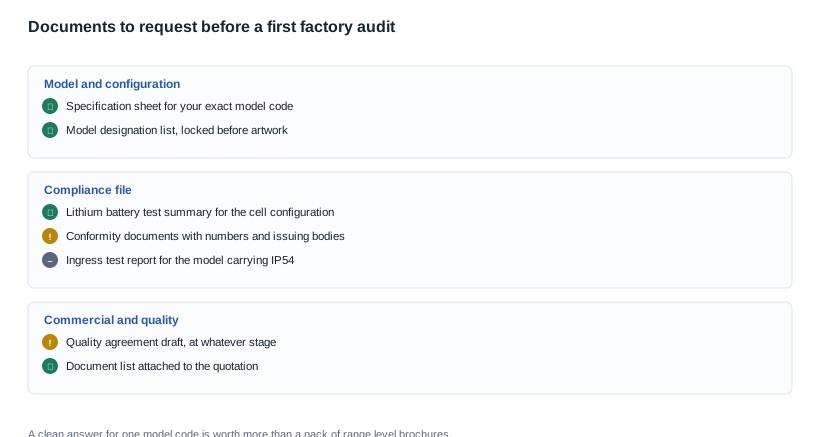
Ask for these in writing, and read them before you travel rather than on the plane:
- The specification sheet for your exact model code, not the catalogue. Ask them to reconcile it against the manufacturer's published catalogue. Where the two differ, the reason is the interesting part, because it shows how they will handle your next data conflict.
- The conformity documentation, stating which certificates exist, which model codes they cover, their numbers, issuing bodies and validity dates. In this category certificate numbers, issuing bodies and validity dates are not published generally and are issued per configuration, so "not yet issued for your configuration" is a normal and acceptable answer. "We have all our certificates" without numbers is not.
- The lithium battery test summary, recording producer, laboratory, report number and battery model. This document is more diagnostic than the others, because it is issued per battery configuration rather than per company, and a supplier with mature per-configuration documentation is a supplier who will handle your compliance file well.
- The quality agreement draft, whatever stage it is at. Asking to see a draft is more revealing than asking for a signed one, because it shows how the supplier thinks about defect definitions, and defect definitions are where most quality disputes actually live.
- A model designation list covering everything you might order, so that designations can be locked before artwork is produced.
The document that reveals the most
If you only read one document before you travel, read the lithium battery test summary. The reason is structural rather than technical: it is per cell configuration, it carries a laboratory and a report number, and it cannot be produced retrospectively for a configuration that was never tested. A supplier that holds these for the cell configurations they actually build is a supplier with a working documentation habit, and that habit is the thing you are really buying.
Six questions to put to the document set
The written request is more productive when it carries questions rather than a list of items. These six cover the document set in a single round:
- Which of these documents exist for my model code, and which are issued at company level only. The answer should be a split list, and the split is the finding.
- What is the revision or issue date on each document. A file with no date cannot be matched to a production run.
- Which document would I receive with the goods, and which would I have to request. The second category is where the surprises live.
- What is the issuing body, and does the document name my configuration. A body name is not the same as coverage.
- How long is each document valid, and what happens at expiry. A document that expires mid-programme is a supply risk rather than a compliance detail.
- Who inside your organisation holds this file, and who is allowed to change it. A file with two owners and no version control is a file that will disagree with itself.
None of these questions is aggressive, and all of them are answered quickly by a supplier with a working documentation habit. The answers are also directly reusable, because the same list becomes the document handover schedule attached to the purchase order later.
Sorting an answer into settled, open, or out of scope
Partial answers are normal in this category and they are not automatically bad. The mistake is treating a partial answer as a complete one. A supplier who says the charging method is not published for four camera models in the range has told you something precise and useful. A supplier who says nothing about charging at all has told you something less useful, and you should ask.
The workable rule is to write each answer into one of three columns. Settled, with the document named. Open, with an owner and a date attached. Out of scope, because it is not published and will not be published. Anything that cannot be placed in one of the three is a question to ask before the purchase order, and it belongs in the contract rather than in a file you keep to yourself.
What to examine on the floor during a smart glasses factory audit
Four stations, in priority order
Once the documents have been read, the visit has a different job: confirming that the documents describe something real. Four things matter most, and the order below is the order of how quickly each produces an answer.
The incoming inspection station. Is there one, is it staffed, and is there a record? Incoming component variation is the most common cause of batch-to-batch inconsistency, and it is invisible unless the station exists. The question to ask is not whether they inspect but what they inspect against, and the answer should name criteria rather than saying that goods are checked.
The test capability. Ask to see a unit being tested rather than reading a list of test procedures, and then ask whether the published specifications are verifiable in house or whether verification is outsourced and at what latency. The useful tests in this category are charge-time verification, endurance run-down, and for camera models a check that the recorded output comes from the assembled unit rather than from a component on the bench.
Traceability. Ask whether a unit on the line can be traced to a component batch. This is not theoretical: it determines whether a quality pattern is diagnosable or whether it becomes a series of unrelated complaints that cannot be attributed to anything. The test that settles it is to have somebody pick a unit and produce a lot reference while you watch.
The change control procedure. Ask what happens when a component becomes unavailable. This is the single most informative question in a first audit, because the answer determines whether a published specification will quietly change between the quotation and the shipment. A supplier who has a written substitution procedure with a named approver is telling you the specification is stable; a supplier who says they will call you is telling you the specification is negotiable in both directions.
Writing it down while you are there
A buyer who leaves a factory with a page of observations makes a better decision than one with a folder of photographs. Write down three things: the answers to the four questions above in your own words, the names and roles of the people who gave them, and the single largest thing you are unsure about. That last item is the one that turns into a clause in the contract rather than a discovery after the first shipment.
It also helps to note what the line was doing at the moment you were there, with the date. A factory's visible state changes, and the dated record is what lets you compare what you were told in the sales conversation with what you were shown on the day.

Answers a first smart glasses factory audit should reject
Five marketing-shaped answers
This is a category where marketing-shaped answers are common, and several are worth naming because they are the ones that sound most informative.
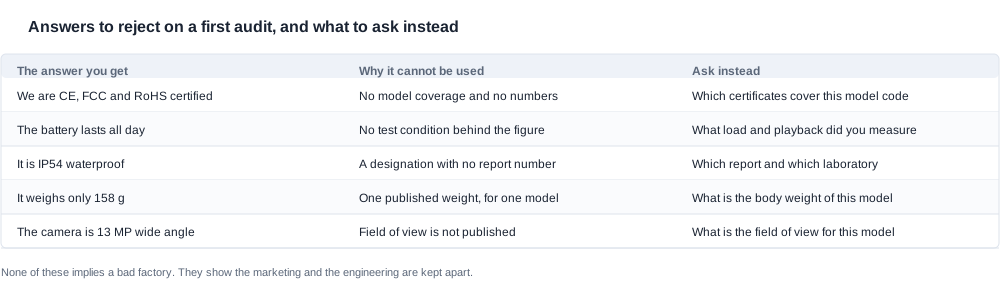
The first is a blanket certification claim. "Our products are CE, FCC and RoHS certified" with no model coverage, no numbers and no issuing body says something about the company and nothing about whether your configuration is covered. Certification stated at company level cannot be converted into per-model coverage by any amount of asking.
The second is a runtime claim without a condition. Published runtimes across this range carry no test condition — the camera models in our own catalogue are stated at roughly five to eight hours or around seven hours depending on the model, and none of those figures states a load, a volume or a temperature. "The battery lasts all day" is not what those numbers say, and a buyer who treats them as an all-day figure will end up with a returns problem that no acceptance criterion will catch.
The third is a waterproof claim. IP54 is a designation, not a test result, and it covers splashing water rather than immersion or sustained rain. In our own catalogue the marking appears on two models only, the V06 and the S7, with no published third-party report number behind it.
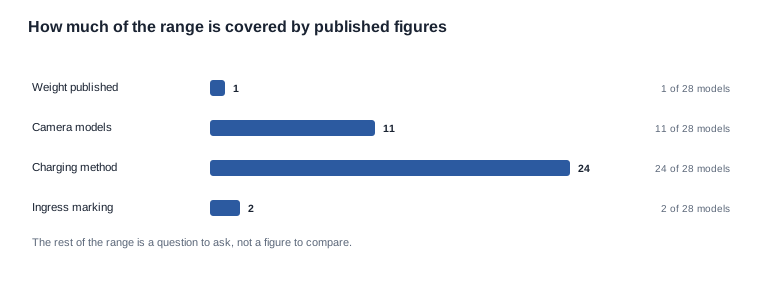
The fourth is a weight figure. Exactly one weight is published in the entire catalogue: the MT6 glasses body at 158 g, which includes its 265 mAh cell and its camera and excludes the 1200 mAh folding charging case, whose own weight is not published. Every other weight in the range is not published, so any figure offered for a different model is not from published material and should be treated as an estimate.
The fifth is a camera claim that exceeds the published row. Resolution is published — 8 MP for eight of the camera models and 13 MP for three of them. Field of view, video specification, stabilisation and low-light performance are not published for any camera model. "13 MP wide angle" is therefore half a published row and half a marketing sentence, and the two halves belong to different documents.
Why this is useful information
None of these answers implies a bad factory. What they indicate is that the marketing and the engineering are maintained separately, which is worth knowing before you place an order — because it determines which documents you will be able to rely on and which conversations you will have to have.

The published rows a first smart glasses factory audit can check
How much of the range is documented
One of the most useful things a first-time buyer can do is establish, before the visit, how much of the range can be checked from published material at all. The picture is uneven, and knowing the shape of the gap tells you what your visit has to cover.
The consequence for planning is direct. A camera model you are evaluating can be checked against a published resolution tier, a published cell capacity, a published charging time, a published endurance figure and a published case capacity — and for four models in the range, the charging method row is absent, so that one has to be confirmed at the site. Everything else you will want to know about image quality, acoustics, ingress and weight has to come from the supplier's own file or from a sample.
That is not a reason to skip the visit. It is a reason to spend the visit on the things that cannot be checked anywhere else, instead of on the figures you could have read.
Planning the day around the four questions
A first visit that is planned around the four stations above tends to take half a day, and the remaining half is usually better spent on the stations that were not in the plan. The shape that works is simple:
- First hour, documents. Compare the specification sheet against the published catalogue, with the model codes in front of you, and note every difference.
- Second hour, incoming. Walk the incoming inspection station, then follow one cell from the delivery note through to the line.
- Third hour, the line and the bench. Find your configuration running if it is running, and watch one measurement being taken on the instrument that will be used.
- Fourth hour, despatch and paperwork. Check the packing, the label artwork against the order, the lot marking, and where the technical file for your model code is actually kept.
- Last half hour, writing. Write down the answers, the names, the dates and the single largest uncertainty before you leave the car park.
The order matters more than the timings. Incoming before the line, because incoming variation is what makes batches differ from each other. The line before the bench, because the bench only means something once you know what the line is supposed to produce. Despatch before the paperwork conversation, because the paperwork conversation is easier to have when you have seen whether the goods are labelled and packed properly.
The line between a published row and a claim
A published row is a value our documentation states for a specific model code, which means it can be checked, quoted and relied on within the limits of what it names. A claim is a sentence about a product that may combine a published row with something else.
The test is simple: if you cannot point to the row, you do not have a specification. If you can point to the row but the row does not name the condition behind it, you have a starting point for a question rather than an acceptance criterion. Both of those are workable positions. The unworkable position is the third one, where a number has entered a document with no row behind it, because that number will be tested in the field and the buyer who introduced it will be the one asked.
What we will send you before a first smart glasses factory audit
The file, and the honest limits of it
Stated plainly: we will send the specification sheet for your model code, state which certification documents exist and which are not published, and supply the lithium test summary that applies to the battery configuration in question. Where a figure does not exist in published material we will say so, and that includes the unit weight for all but one model, every camera specification beyond the resolution tier, every acoustic metric, and ingress test report numbers.
We will also state plainly which rows in the catalogue are absent rather than silent about them. The charging method, for instance, is published on twenty-four of the twenty-eight models and absent on four — CY03 and CY05, and MT6 and L1 Pro. Our position is that it is not published for those four, rather than that it is magnetic, and we will confirm the method for your configuration in writing before production release.
Factory audit findings are a normal part of a first engagement and we will not treat a question about documentation as an accusation. Minimum order quantities, production lead times and unit prices are confirmed per enquiry rather than published as fixed numbers, and the same goes for the factory size, headcount, capacity and quality figures that a buyer might want to check against a general market range.
What we would ask in return
Tell us the model codes, the destination markets and a volume band, and we will send the specification sheet for those codes, state which documents exist for them, and name the rows that are open. For the compliance side, the certification checklist holds the full document set rather than the subset above. For what to do with a supplier's answers once you have them, sample policy red flags covers the documentation habits worth checking early. The factory audit overview covers the wider process, including what has to be in place before a visit is worth scheduling.


