

Five red flags appear in smart glasses sample policy with enough regularity that a buyer who has seen three of them can usually name the remaining two. None of them is unusual on its own, none of them is fatal, and all of them are cheap to check before a unit ships rather than expensive to discover after one does. They show up in three different places — in the quotation, in the way a supplier communicates, and in the shipment itself — and each place produces a different kind of warning.
The reason to collect them rather than react to them one at a time is that a single flag is almost never enough to end a relationship. A missing lot identifier is a minor administrative gap in one supplier and a serious one in another. The useful discipline is not "stop on any flag" but "know which flags you can carry forward with a written condition attached, and which ones mean the programme stops".
That distinction is the argument of this article. Five flags, what each one signals, which of them you can carry and which of them you cannot, and the procedure to run when one appears mid-programme.
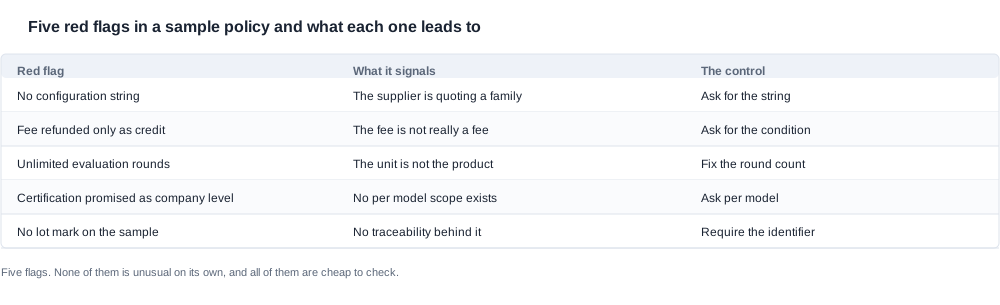
Smart glasses sample policy red flags: five that should stop a programme
The five, and the difference between a flag and a stop
| Red flag | What it signals | The control |
|---|---|---|
| No configuration string | The supplier is quoting a family, not a buildable thing | Ask for the string |
| Fee refunded only as a credit | The fee may not be a fee at all | Ask for the condition |
| Unlimited evaluation rounds | The unit may not be the product | Fix the round count |
| Certification offered at company level only | There is no per-model scope to rely on | Ask for the per-model scope |
| No lot mark on the sample | There is no traceability behind the unit | Require the identifier |
Two of these five are stop conditions on their own, and the reason is that they remove the evidence rather than merely weakening it. A missing lot identifier removes traceability: there is nothing to trace back to. Unlimited rounds remove the boundary between evaluating a product and building a bespoke one, and what arrives at the end of an unbounded process is usually a unit nobody specified.
The other three are carry-forward conditions. They can be resolved by a written answer, and if the answer arrives in a form you can file, the programme continues with the condition attached to the order.
Why the flags appear at all
Most of these flags are not deliberate evasions. They are the natural result of a supplier organisation that has a sample process for its own convenience rather than a sample process for the buyer's evidence. A factory that sends whatever unit is on the shelf is not trying to deceive anybody; it simply never had a reason to do otherwise. A supplier that quotes a model name rather than a configuration string has usually quoted that way for years, because most buyers also used to order by model name.
That is the good news and the bad news. The good news is that a supplier which produces these flags by habit will usually stop producing them when the request is specific, because the habit was never defended. The bad news is that the flags cluster, and a supplier that produces one of them by habit is likely to produce two others by habit as well.
The order to check them in
Check them in the order they appear in the programme, because the earlier a flag is caught the cheaper it is. A flag in the quotation costs an email. A flag in the communication costs a few days. A flag in the shipment costs a round of freight and bench time, and it has already put a unit on a bench that may be the wrong unit.
The one exception is the lot identifier, which is worth checking before the shipment rather than on receipt, because a supplier that cannot tell you where the identifier comes from is a supplier whose units may not carry one at all, and that is worth knowing before you pay the freight.

Flags in the quotation
A price with no configuration attached
The most common flag in this category, and the least damaging if it is caught early. A quotation that names a model and a price, with no case option, no charging method and no artwork requirement, has quoted a product family. It has not quoted a buildable thing, and it cannot be compared with another quotation that did.
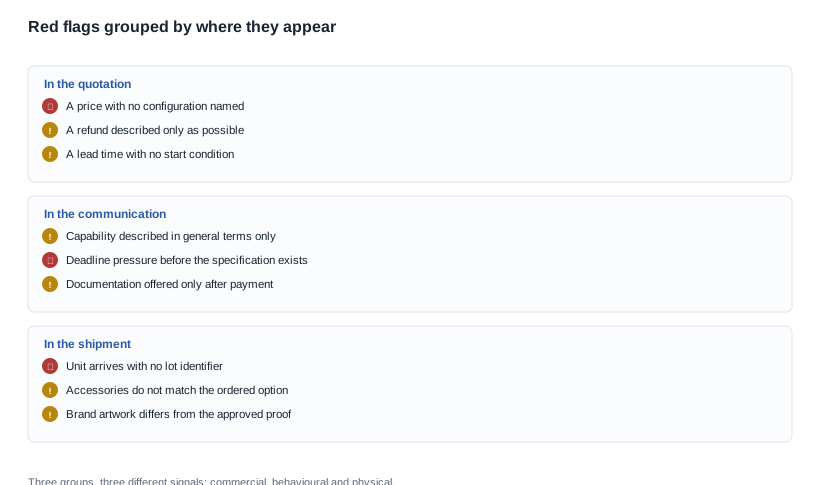
The consequences are concrete in this range. The L2 Utral is published in two case options, 900 mAh and 1400 mAh, so a quotation for "the L2 Utral" has not settled which accessory arrives. The V03 Pro is published with no charging case at all, so a quotation that includes a case for it is wrong on its face. The CY05 and the L1 Pro, and the CY03 are published with a 1400 mAh case, the MT6 with a 1200 mAh folding case, and the KY06 and the MT5 with cases whose capacity is not published at all. A quotation that says "with charging case" is compatible with all of those and with none of them specifically.
The control is one sentence in the enquiry: ask for the configuration string, and ask what the supplier will ship if the buyer does not specify. A supplier that answers both is a supplier that will hold a configuration; a supplier that answers only the second has a process that depends on you.
A refund described as possible rather than stated
A sample charge that is credited against the first order sounds like a discount and behaves like a deferred payment. It is only a discount if the first order happens and the credit condition is honoured, and both of those are outside your control at the time the sample ships.
The questions that close this are specific. What is the condition? Is there a minimum order value? Does the credit survive a split delivery? What happens to it if the programme is cancelled after the sample but before the order? A supplier that answers all five has a credit policy. A supplier that answers "it depends" has a goodwill arrangement, and goodwill is not a commercial term you can put in a margin model.
A lead time with no start condition
A lead time that does not say when it starts is a number rather than a commitment. The two possible starts — from the order confirmation, from the artwork approval, from the unit becoming buildable — produce three different schedules from the same figure, and the difference between the shortest and the longest is usually the length of your own approval cycle.
This is a cheap flag to close and it is one of the few that is genuinely a red flag rather than an omission. A supplier who quotes a lead time without a start condition is quoting from a template, and a template is what a supplier sends when they have not thought about your programme specifically.
Flags in the communication
Capability described in general terms only
The second communication flag is a description of approach in place of a description of a fact. "We have a mature quality management system" is an approach. "Every unit carries a lot identifier and we retain one unit per lot for twelve months" is a fact, and it is checkable.
The completion test is simple and worth applying to every answer: could a buyer use this sentence in a specification without asking for more? If not, it is a description rather than an answer, and it should not be recorded as one.
Deadline pressure before the specification exists
This is the flag that most deserves a second look, because it arrives dressed as helpfulness. A supplier who knows your launch date and starts pressing for a decision before the configuration is written is doing one of two things. Either they have a genuine production window that will close, in which case they will say so and name the date. Or they are creating urgency to get an order before anyone has written down what it is.
The two are easy to tell apart, and the test is whether the supplier will put the deadline in writing together with its basis. A real production window has a basis: another programme finishing on a date, a line becoming free, a material lead time. An invented one has none, and asking for the basis is the cheapest way to find out.
Documentation offered only after payment
The third communication flag is a supplier who offers the technical file, the test report or the certification scope only once the money has moved. It is not necessarily dishonest — some suppliers have commercial reasons for protecting their file — but it means the buyer is being asked to pay for the evidence rather than being allowed to weigh it, which is backwards.
Where a supplier has this policy, the workaround is straightforward and works more often than buyers expect. Ask for the document set at the quotation stage as a condition of being shortlisted, and offer the alternative of a written summary with the document set released on the order. A supplier with a real process can usually produce a summary without releasing its file, and the summary is usually enough to decide whether to continue.

Flags in the shipment
A unit that arrives with no lot identifier
The first shipment flag, and the one that is most expensive to discover late. A unit that cannot be tied to a production window has no traceability behind it, and the first channel complaint you receive about it will be unanswerable.
The control is to require the identifier before the unit is ordered, and to state where it will be found. In this category the identifier may sit on the unit, on the packaging, or on the accompanying paperwork, and the supplier knows which. What a buyer cannot accept is a supplier who cannot say.
Accessories that do not match the ordered option
The second shipment flag. The unit is correct and the accessory is not, which sounds trivial until the programme has three case options in play across a single product line and a shipment arrives with a mix.
It is worth knowing where the options come from, because the published differences are specific. The CY05 and the CY03, and the L1 Pro are published with a 1400 mAh case, the L2 Utral with either 900 mAh or 1400 mAh, and the MT6 with a 1200 mAh folding case. A stock unit of the L2 Utral could arrive with either option, and if the protocol did not record which one was ordered, the result is a legitimate observation that cannot be turned into a finding.
Brand artwork that differs from the approved proof
The third shipment flag. Artwork applied by hand to a single unit does not look identical to artwork applied by a production line to a hundred units, and a buyer who approves the hand-finished version has approved something the line will not reproduce.
The control is to keep the proof and the sample separate and to be explicit about which one is the reference. If the reference is the proof, the tolerance on it needs stating. If the reference is the sample, the sample needs to have been produced by the production method, which is a different and more expensive order than a stock unit.

The decision procedure when a flag appears
Stop, carry, or withdraw
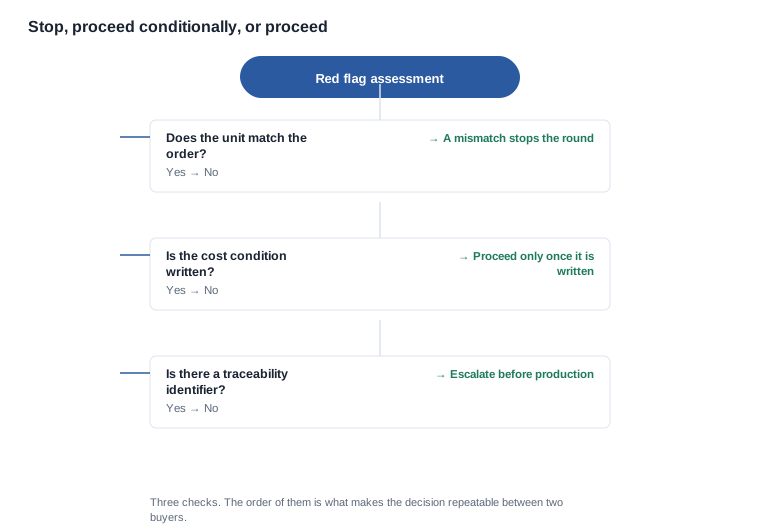
Three decisions, and the order of them matters more than the categories.
Does the unit match the order? If it does not, the round stops, because everything else you would measure belongs to a unit you did not order. This is the first check because it is the only one that invalidates the rest.
Is the cost condition written? If the fee, the credit and the round count are in a document you can file, the programme can carry on, with the condition attached. If they are not, the programme can still continue — a fee that is not documented is a smaller problem than a unit that is wrong — but it should not reach the production order without them.
Is there a traceability identifier? If not, escalate before the production order, not after the first complaint. A programme can proceed without an identifier, but the buyer should know that it has, and the decision to proceed should be recorded as a decision rather than discovered later as an oversight.
The five-step response
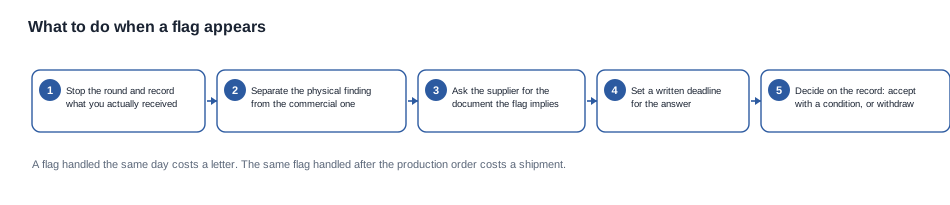
When a flag appears, the response has five steps and each one protects something.
- Stop the round and record what you actually received. Write the observation down before the discussion, because the detail of what arrived is the part that gets remembered inaccurately.
- Separate the physical finding from the commercial one. A wrong accessory is a physical finding; a credit that cannot be evidenced is a commercial one. They have different remedies and they belong to different conversations.
- Ask the supplier for the document the flag implies. The flag about the lot identifier implies a record-keeping procedure. The flag about certification implies a per-model scope document. The flag about the artwork implies a production reference.
- Set a written deadline for the answer. A flag handled this week is a letter; the same flag handled after the production order is a shipment.
- Decide on the record: accept with a condition, or withdraw. Either outcome is acceptable. What is not acceptable is an outcome that exists in someone's memory, because the next programme will inherit it without the context.
The flags you should expect to carry
Two of the five are worth carrying forward with a written condition attached, because they are common and because the remedy is a sentence rather than a change of supplier. The certification scope at company level is one of them, provided the scope you need is not per-model. A lead time without a start condition is the other, provided the start condition gets written down.
The three that should not be carried are the missing configuration string, the unbounded round count and the missing lot identifier. Each of them removes something the programme needs rather than weakening something it has.
A note on how the flags get recorded
A flag that is raised once and left in an email thread has not been dealt with. The observation has to be written into the programme file in a form that a colleague can act on without asking you what happened, which means four things: what was expected, what was actually received, what it changes about the programme, and who is doing something about it.
That fourth item is the one that is missing most often, and it is the reason the same flag appears in three consecutive programmes. A flag recorded without an owner becomes a shared understanding rather than an instruction, and shared understandings do not survive a personnel change.
The other discipline worth setting is a threshold for escalation. If a flag is raised and answered in writing within the round, it is carried. If it is raised and not answered within the round, it becomes a condition on the production order. If it is raised twice in the same programme, the programme is stopped and the supplier is re-qualified from the screen. Deciding this in advance is what stops the escalation decision from being made by whoever is most tired that afternoon.
What we publish, and how we handle a flagged supplier
Where we draw our own line
We can speak with evidence about what our published rows say, and about which of them a physical unit can settle. Everything beyond that is a supplier's own file, and we would rather say so than fill a gap with a plausible figure. The catalogue publishes, model by model, the camera resolution tier, the cell capacity, the rated use, the charge time, the charging method where one exists, the charging case option where one exists, the colour availability, and the ingress marking on the V06 and the S7.
We do not publish frame weight for any model, and where a weight is published, as it is for the MT6 glasses body at 158 g including the 265 mAh cell and the camera and excluding the 1200 mAh folding charging case, we state what the figure includes so that it cannot be misread as a frame weight. We do not publish per-model certification, because the catalogue carries a company-level export certification page and no per-model certification row for any of the twenty-eight models, and its text contains no reference to CE, FCC or RoHS at all. And we do not publish sample fees, credit conditions or round counts, because those are commercial terms of a specific quotation rather than catalogue data.
What happens when you tell us about a flag
Send the models, the quantities and the target market, and we will tell you which configurations exist, which published rows apply to each one, and what a sample would and would not settle. If you are dealing with a supplier whose quotation does not carry a configuration string, we will tell you exactly which published differences it is leaving open, so that the question you put to them is specific rather than general.
If a flag has already been raised with us, the useful question is the one that follows it: whether the answer you can get in writing would close the gap. Send the question and the configuration, and we will say which rows we can confirm, which we cannot, and what document would close the remainder. That is a narrow answer, but it is one a buyer can act on before a unit ships.
Related reading
- Sample policy SOP template — where the flag checks become a standing procedure
- Practical advice for smart glasses buyers — the sequence that catches flags early
- Sample policy myths — the beliefs that produce the flags
- What a sample can and cannot prove — the framework behind the stop conditions
Send the configuration, the quantity and the market, and we will say which flags the published rows can settle for you and which you have to close yourself.


