

Six mistakes account for most of the value lost in a first smart glasses factory audit, and each one is recoverable — if it happens before the purchase order rather than after it. Three are about not looking at the right thing, and three are about accepting an answer that the documentation in this category cannot support.
The distinction matters, because the first group is a sequencing failure and the second is an evidence failure. A sequencing failure wastes a day. An evidence failure is more dangerous, because it produces a decision rather than a delay: the buyer walks away with a conclusion they believe in and no way of knowing it was built on a claim rather than a row.
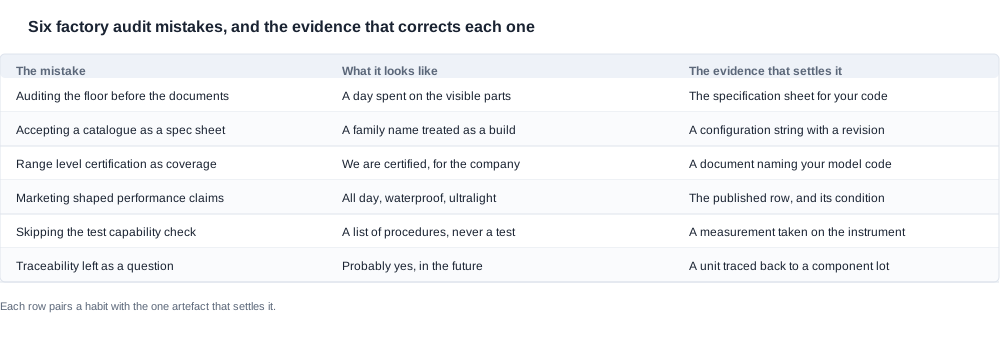
Smart glasses factory audit: the six mistakes made when reading the evidence
The pattern behind all six
Every one of these mistakes shares a mechanism: a sentence that sounds like a specification being accepted in place of one. A supplier says our products are certified, and the buyer records the model as certified. A supplier says the battery lasts all day, and the buyer records an all-day endurance. A supplier says we are flexible on the order mix, and the buyer records a lead time.
In each case the buyer has recorded an assertion in a place where a fact was needed, and the fact was available — in the catalogue, in the document set, or in a record on the floor. The published data in this category is unusually good for closing these gaps, and the mistake is not that the information is unavailable. It is that the information is a row in a table while the assertion is a sentence in a meeting, and sentences win.
A useful test for the buyer
Ask one question of every answer before accepting it: what row would I check this against? If the answer is a row you already hold, check it and move on. If the answer requires a row you do not hold, the answer is a claim until you acquire the row. If there is no row for it at all, then the claim is not verifiable and it belongs in a contract as a representation rather than in an acceptance criterion as a measurement.
That test takes about ten seconds and it eliminates most of the six mistakes before they happen.

Auditing the floor before the documents in a smart glasses factory audit
Why the floor is the least informative part of a first visit
The production floor is the most visible part of a factory and the least informative part of it on a first visit. What you can actually establish — whether incoming inspection exists and is staffed, whether traceability reaches component batches, what happens when a component becomes unavailable — takes a morning rather than a day, and much of it is confirmed by document beforehand.
There is a second reason the order matters, which is about what the visit then settles. A factory that has been asked for documents before the visit has already shown that it has a documentation habit, and everything seen on the floor is read against that prior. A factory that has not been asked for documents forces you to infer the documentation from what you can see on a bench, which is inference, and inference is what a buyer should be trying to eliminate.
The document set to request first
- The specification sheet for your exact model code. A catalogue describes a range; a specification sheet describes a build.
- The conformity documentation, with numbers, issuing bodies and validity dates, or an honest statement that they are not yet issued for your configuration.
- The lithium battery test summary. This is the most diagnostic of the three, because it is per battery configuration rather than per company, and a supplier with mature per-configuration documentation is a supplier who will handle your compliance file well.
All three can be requested in a single email, and all three can be read before you travel. There is no reason to spend a day on a floor to establish facts that arrive by attachment.
What the documents tell you that the floor cannot
There is one category of finding that the floor actively obscures, and it is the reason the order is not merely a convenience. When a factory has poor incoming inspection, the floor still looks correct. The cells are still in the right place, the bench is still staffed, the line is still running. What has changed is the probability that the unit in your box was made from a component that was checked against nothing.
The only place that shows up is in the records, and the records are precisely what a floor walk does not produce. A buyer who walks first and reads later has to reconstruct the inspection history from memory and from what people tell them in a meeting, which is the softest possible material to build a rejection rule on.
There is a practical version of this that applies to every category. Before you visit, decide which two stations would settle your open questions if everything else went badly. For most buyers those two are incoming inspection and the test bench, because those are the stations where the specification either holds or does not. If the day goes well and both are covered, you have your answer. If the day goes badly and neither is covered, you have learned that without having spent the day.
Treating a catalogue as a specification sheet in a smart glasses factory audit
The gap between a range and a build
A catalogue describes a range. A specification sheet describes a model code. The difference matters because designations drift — and this range contains a live example, an entry published as the L2 Utral carrying an additional label alongside it, with a name that appears to be a typographical rendering of another.
Ask for the specification sheet for your code and ask them to reconcile it against the manufacturer's published catalogue. Where the two differ, the reason is the interesting part. A supplier who reconciles it is showing you how they will handle your next data conflict, and a supplier who cannot is telling you something about their document control that you would rather learn from a reply than from a delivery.
What a configuration has to settle
The rows that matter for quotability in this category are specific. For the eleven camera models we publish the resolution tier, the cell capacity, the charging time, the rated endurance, and the charging case capacity where one exists. Eight of the camera models are published at 8 MP and three at 13 MP. The charging cases are 1400 mAh for L1 Pro and CY05, and CY03, 900 mAh or 1400 mAh for L2 Utral, and a 1200 mAh folding case for MT6.
The charging method is the row that catches people out, because it is published on twenty-four of the twenty-eight models and absent on four — MT6 and CY03, and CY05 and L1 Pro. A catalogue read carelessly will hand you a charging method for a model that does not publish one, and that value will travel into a purchase order and then into a goods-in check.

The performance claims a smart glasses factory audit has to test
Five claims that are common here and unsupported by published material
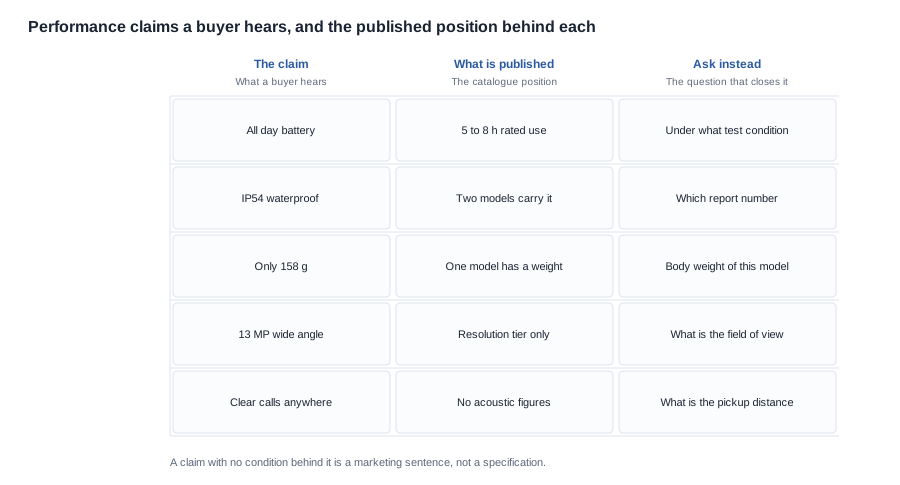
"All day battery." Published runtimes across this range carry no test condition — no load, no volume, no temperature — and no rating supports an all-day claim. The camera models are published at roughly five to eight hours or around seven hours depending on the model, and the audio tier spans roughly six to eight hours. A buyer who writes "all day" into an acceptance criterion has written a criterion that can never fail and therefore never checks anything.
"IP54 waterproof." IP54 is a designation, and it covers splashing water rather than immersion or sustained rain. In our own catalogue the marking appears on two models only, the V06 and the S7, as a catalogue marking with no third-party test report number attached. It is a legitimate marking; it is not a test result.
"Lightweight, only N grams." Exactly one weight is published in the entire catalogue, and it belongs to one model: the MT6 glasses body at 158 g, which includes its 265 mAh cell and its camera and excludes the 1200 mAh folding charging case, whose own weight is not published. Any other figure offered for a different model is not from published material, and a weight quoted for a frame rather than for a complete unit is a different quantity from the one that is published.
"13 MP wide angle." Resolution is published for the camera models. Field of view, video specification, stabilisation and low-light performance are not published for any camera model. The claim therefore has one published half and one unverifiable half.
"Clear calls in any environment." Microphone pickup distance, noise reduction method and wind performance are not published across the range, so this claim has no published half at all.
None of this implies a bad factory. It indicates that the marketing and the engineering are maintained separately, which is worth knowing before you order — because it tells you which documents you will be able to rely on and which conversations you will have to have.
The pattern behind all five claims
The five claims share a structure: a published row, widened by an adjective that the row does not support. "All day" widens a rated figure. "Waterproof" widens a designation. "Lightweight" widens a single figure into a range. "Wide angle" widens a resolution tier. "In any environment" widens an unstated acoustic performance.
That structure is what makes them easy to test. For each one, ask what the published row actually says, and the gap between the row and the claim becomes the question to put in the purchase order.
What to write instead of the claim
Each claim has a contractual form that is honest and enforceable, and it is worth having all five written down before you need them:
- Instead of "all day battery", an endurance criterion with a stated condition — the load, the volume, the temperature and the duty cycle — expressed so that two parties can independently measure it and agree on the result.
- Instead of "IP54 waterproof", the model's ingress marking as a catalogue fact, with the note that no third-party test report number is published, and a statement of what the buyer is and is not entitled to claim downstream from it.
- Instead of "lightweight", a body weight measured on the unit as supplied, or an explicit statement that the figure is not published and must be requested for the configuration in question.
- Instead of "13 MP wide angle", the published resolution tier alone, with field of view, video format, stabilisation and low-light performance recorded as unpublished and therefore excluded from the specification.
- Instead of "clear calls in any environment", an acoustic test method — pickup distance, noise rejection method, wind condition — or an explicit exclusion of the claim from the specification.
None of these five clauses is demanding. Each one simply says what the evidence supports, which is a far easier position to defend than a claim that cannot be measured at all.

The two checks a smart glasses factory audit cannot skip
Skipping the test capability check
Ask to see a unit being tested rather than reading a list of test procedures. The question that matters is whether the published specifications are verifiable in house — resolution, cell capacity, charging time — or whether verification is outsourced, and at what latency.
The reason this check is skipped is that it is slow. It requires standing at a bench and waiting, which is the least efficient way to spend an hour in a factory, and it is therefore the check most often dropped when the day runs late. It is also the check that determines whether the buyer's own incoming inspection has anything to compare against.

In a category where defect rate and yield are not published, your receiving inspection is effectively the primary quality gate, and it is worth knowing whether the factory agrees with your measurement method before a shipment arrives. If their method and yours differ, the first shipment will tell you which one is right, and it will do so through a returns claim rather than through a conversation.
Leaving traceability as a question rather than a check
Ask whether a unit on the line can be traced to a component batch. This determines whether a quality pattern is diagnosable or whether it becomes a series of unrelated complaints that cannot be attributed to anything.
The reason this one gets left as a question is that it is easy to ask and easy to answer wrongly. "Yes, we can trace everything" is not a check. The check is to have somebody pick a unit and produce a lot reference while you watch, ideally without going to a computer. Traceability that requires a system to demonstrate rather than a person to retrieve is a system that will be unavailable on the day it is needed.
Follow it up with change control: ask what happens when a component becomes unavailable. That is the single most informative question in a factory audit, because the answer determines whether a published specification will quietly change — and component substitution is the mechanism behind most batch-to-batch inconsistency.
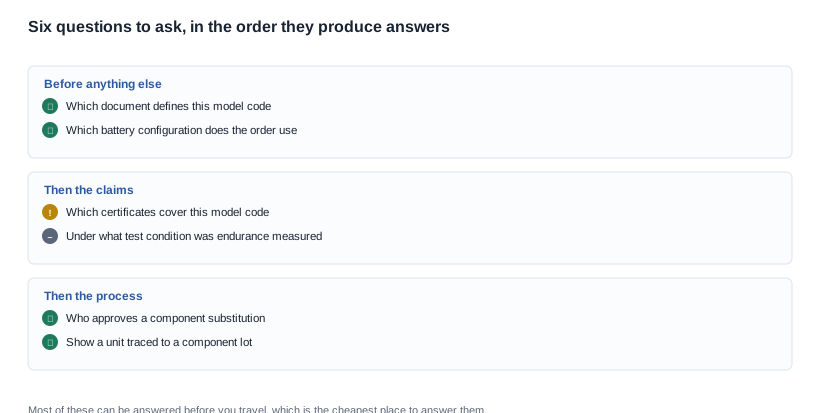
The six questions, in order
Pulled together, the six mistakes reduce to six questions, and they are ordered by how much they cost to ask and how much they settle:
- Which document defines this model code, and can I see it before I travel?
- Which battery configuration does this order use, and which test summary covers it?
- Which certificates cover this model code, and what do they actually name?
- Under what test condition was the endurance figure measured?
- Who approves a component substitution, and in what document is that written?
- Can somebody show me a unit traced back to a component lot?
Most of them can be answered before you travel, which is the cheapest place to answer them and the place where an honest answer is most likely.
The one that is worth a whole day
If you can only run one of these properly, run the sixth. Traceability is the only check on the list that keeps working after everyone involved has moved on, and it is the one that decides whether a future problem is solvable at all.
The reason to give it a day rather than a minute is that a complete trace crosses the whole factory rather than one station. A cell arrives with a delivery note and is accepted against criteria. It is drawn from a rack and goes to a line. The line assembles a unit, and the unit is packed into a case, and the case goes into a carton, and the carton is labelled with a lot mark. If every step in that chain carries a reference, a failure can be traced to a population rather than to a suspicion. If any step does not, the population cannot be defined and every subsequent investigation starts from zero.
That chain is also the one thing a factory cannot fake cheaply, because faking it requires labels, records and a system that agree with each other. Everything else on the list can be answered well by a competent factory in a short meeting. This one is answered by the building.
Asking for papers is not an accusation
The working rule we apply: questions about documentation are a normal part of a first engagement and not an accusation. We will send the specification sheet for your model code, state which certification documents exist and which are not published, and supply the lithium test summary that applies to the battery configuration in question.
Where a figure does not exist in published material we will say so — including weight for all but one model, every camera specification beyond the resolution tier, every acoustic metric, and ingress test report numbers. That is not a gap in our documentation; it is the position of the category, and an audit that cannot see it clearly is an audit that will miss something later.
Unit prices, production lead times and minimum order quantities are confirmed per enquiry rather than published as fixed numbers. We do not publish factory size, headcount, floor area, line count, capacity figures or defect rates, and we would rather say so than present an estimate that a buyer would later treat as a measurement.
There is one asymmetry worth naming. We publish more of the electrical and configuration data than most factories in this category do, and we hold back the commercial and the quality figures. That is deliberate, and the reason is that the first set is checkable against a document that a buyer can hold and re-check, while the second set changes with every enquiry and every production run. A figure that changes is not a specification, and publishing it invites a buyer to plan against a number that will not hold.
The practical version of this, for anyone reading our catalogue while preparing an audit, is that the published rows tell you what to ask about and the unpublished rows tell you where the audit has to do the work. The camera resolution tier is published for all eleven camera models, so it needs no audit. The camera field of view is published for none of them, so it can only be settled by a sample or by a written answer from the supplier.
For the document list in full, the certification checklist is the reference. For what to do with a supplier's answers once you have them, sample policy red flags covers the habits worth checking early. The factory audit overview covers the wider process.
If you tell us the model codes and the destination markets you are evaluating, we will send the specification sheet and state which documents exist for them and which are not yet issued.


