
The question behind most smart glasses for content creation audio for narration enquiries is simple enough: can the device the supplier is quoting actually carry a voiceover workflow, or is it going to disappoint the first time a creator puts it on and hits record? The catalogue we publish answers part of that question and leaves the rest open, and the honest position is that the open part is where the real decisions live. This article walks through what our catalogue actually publishes about audio, why an open-ear speaker on a frame is a fundamentally different proposition from a lavalier microphone, what the noise environment of a narration session does to a device worn on the face, and which questions to put to a supplier in writing before you commit a device to a creator programme.
Smart glasses audio: what the catalogue publishes
Our catalogue publishes audio capability as a set of hard rows, and it is worth being precise about which rows exist and which do not, because a great deal of procurement confusion comes from assuming a feature is standard when the catalogue simply never states it.
The catalogue covers 28 models across three groups: eight audio models (D12 and G07, K01 and YK12, K02 and D11, and LC-105-2 and LC-105-1), three sport models (YKC02, D17, ZH12), and eleven camera models (S7 and KY06, L2 Utral and MT6, V03 and MT5, V03 Pro and CY05, V06 and L1 Pro, and CY03), plus three entries that carry no model number at all (AR glasses, electrochromic, bone conduction). The audio-group and sport-group models publish no camera row of any kind. That single fact does most of the work in this article: a device from those groups cannot be assumed to record anything visually, so a narration programme built on them is a narration-only programme, and any creator-facing copy that implies capture has to be built on a camera model instead. The three entries without a model number are worth flagging separately in a quotation, because a buyer cannot reference them by SKU, and a line item without a model number is a line item that has to be pinned down before it becomes a purchase order.
What the catalogue does publish for the audio and sport groups is cell capacity and runtime, and these are stated per model rather than generically. The K01 and K02 each carry two 90 mAh cells and publish a runtime of about 8 hours. The D11 and D12 each carry a 100 mAh cell and publish about 7 hours. The LC-105-1 and LC-105-2 each carry two 55 mAh cells and publish about 8 hours. The G07 and YK12 each carry two 55 mAh cells and publish about 6 hours. On the sport side, the YKC02 carries two 70 mAh cells and publishes about 8 hours, the D17 carries a 115 mAh cell and publishes about 7 hours, and the ZH12 carries a 100 mAh cell and publishes about 8 hours. Note that the published runtime figures are banded or approximate, not laboratory-measured values quoted to a single minute, and the cell configurations are not directly comparable across models because two small cells and one larger cell behave differently under a real load. Two cells in series or two cells side by side behave differently under load, differently in charge time, and differently in what happens when one cell degrades, so the cell configuration is a real engineering choice rather than a packaging detail. Our guidance on cell and runtime rows lives in more detail on /tech/battery-life, and the camera-side capacity rows are set out in /tech/camera-imaging for readers who need to compare across the two halves of the catalogue.
Charging is published in three columns: charging method, charge time, and whether a charging case exists. Across the whole catalogue the charging method breaks down as magnetic on 17 models, Type C on 7 models, and not published on 4 models (L1 Pro and CY03, and CY05 and MT6). Charge time is published as "2 hours or less" for 26 models, which is an upper bound rather than a measured figure, and only the D17 and the ZH12 publish "about one hour". The distinction matters: "2 hours or less" tells you that a full charge does not consume an overnight, but it does not tell you that the device is half-charged in an hour, and it does not tell you what happens after two hundred charge cycles. A creator programme that runs on a strict turnaround has to plan around the slowest case in the pack, not the fastest one in the catalogue. The charging-case situation is more fragmented than any other row: five models publish a case capacity (L1 Pro and CY05, and CY03 — each at 1400 mAh; L2 Utral with both 900 and 1400 options; the MT6 with a 1200 mAh folding case), two models have a case but publish no capacity for it (KY06 and MT5), and three camera models have no case at all (S7 and V06, and V03), with the V03 Pro explicitly stating that it has no case. If a narration programme assumes "charge it once and shoot all day", the case row is the row that decides it, and for the audio and sport groups the case question needs to be asked rather than read off a datasheet. Because the case question is unanswered for most of the audio and sport models, we will ask it in writing on the quotation, and we will treat a missing answer as a missing feature rather than as an omission.
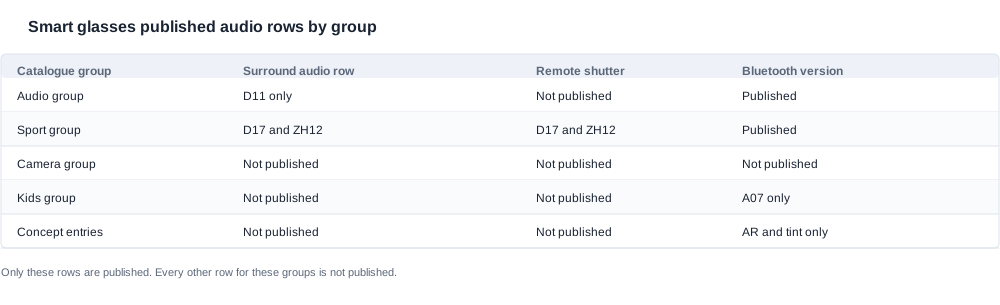
On surround sound the catalogue is almost silent. Only the D11 publishes a surround-sound row, only the D17 publishes a surround-sound row, and only the ZH12 publishes a stereo surround-sound row. The YKC02 publishes no feature row beyond the shared ones. Everything else in the audio and sport groups has no surround-sound row at all. What that means in practice is that open-ear output cannot be assumed to be stereo, cannot be assumed to be spatially mixed, and cannot be assumed to isolate anything. Remote-control shutter is published only on the D17 and the ZH12, which again means that for an audio or sport model the physical shutter button on the frame is the only capture control you can rely on, if the device captures at all. A programme that trains creators to start and stop takes by touching a frame without looking down needs to know whether that control is reachable, whether it is published, and whether it works with gloves on.
One last row matters for how a device is demonstrated: Bluetooth version is published for 14 models and is not published for the eleven camera models, for A05 and A06, and for the bone-conduction entry. So the pairing behaviour of a given camera model is not something you can read from the catalogue, and it needs to be written into the questions you ask the supplier. This is also why the demo and the sample have to be produced against the phone or laptop that the customer actually uses, rather than against a reference device chosen by the supplier.
Why a worn speaker is not a narration microphone
This is the distinction that most often gets skipped in a smart glasses for content creation audio for narration conversation, and it is the one that decides whether a device belongs in the programme at all.
An open-ear speaker mounted on a temple of a frame is an output device. Its job is to put sound at the wearer's ears so the wearer can hear a call, a prompt, or playback. It is aimed at the ear canal on the same head. A lavalier microphone is an input device. Its job is to capture a voice cleanly and reject the rest of the room. Even a directional lavalier is a different physical proposition from a speaker radiating into the space around the wearer's head, because the acoustic path in one case goes out of the device and in the other case goes into the device. The two are often discussed in the same sentence in a product brief, and in a purchase order they are two different line items with two different test criteria.
That means a frame with an open-ear speaker and no published microphone row is not, on the published evidence, a narration recorder. You cannot read a microphone specification for it. The published rows for those models are cell, runtime, charging, and the occasional surround-sound or remote-shutter entry. There is no published sensitivity, no published frequency response, no published signal-to-noise figure, no published sample rate, and no published channel count for a capture path. If the supplier quotes a model for narration, the quoted capability is going to come from outside the catalogue, and that is exactly the point where you need a written answer and a physical test rather than an assumption.
The second reason the distinction matters is feedback. A device that both listens and plays on the same frame will put the speaker output straight back into whatever is capturing. In a quiet room with a headset in the mix, that can be tolerable. In a street or a retail environment, the ratio of wanted voice to unwanted room sound and speaker leakage determines whether the take is usable at all, and nobody can predict that ratio from a datasheet because it depends on the room, the distance to the nearest reflective surface, the wearer's own speaking level, and where the frame sits on the head. A creator who monitors a take through the frame's own speaker is monitoring a signal that the frame itself has to fight.
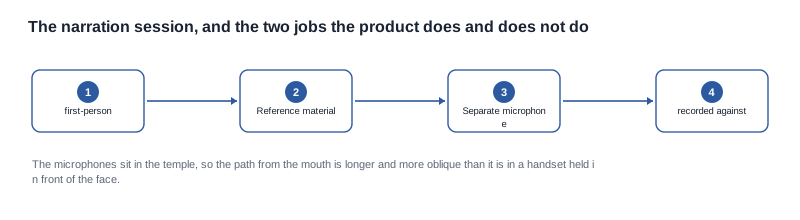
There is a third, subtler reason, and it is about the wearer's voice rather than the device. A microphone placed on the chest or clipped near the mouth receives the wearer's voice with a consistent relationship to the mouth, which is why the sound of a voiceover is largely independent of which side of the room the camera is on. A frame's audio hardware has to work through the acoustic path of the head, and that path is not the same thing as a mouth-to-microphone distance. Whether a given frame produces an acceptable voice level and acceptable isolation, in a given room, is an empirical question. It is decided by a test on the actual sample, in the actual recording environment, with the actual program material. It cannot be settled from a spec sheet, and it cannot be settled by a supplier's marketing language. It also cannot be settled by a quiet-room demo shot, which is the format most suppliers and most marketplaces default to.
The practical upshot is that we will not treat an open-ear speaker as a capture path in any supplier-facing claim. Where a supplier asserts a microphone is present, we will treat that as an unverified claim until it is confirmed in writing and demonstrated on the golden sample, and we will recommend that any creator-facing copy avoid implying capture quality that the published catalogue does not support. The catalogue does publish camera models in detail, including the camera rows discussed in /products/ai-camera-glasses, and if a programme genuinely needs capture plus narration, the sensible starting point is a camera-group model with the microphone question answered in writing, rather than an audio-group model with an assumed microphone. The recurring questions we see from buyers on exactly this point are collected in /blog/cy03-smart-glasses-common-questions.

The noise environment decides the test
A narration session has two environments, and they are not variations of the same environment. They are separate test conditions, and a device that passes one will not necessarily pass the other.
The quiet indoor room is the controlled condition: a small carpeted or furnished space, a door that shuts, the wearer's own voice clearly louder than anything else in the room. In that condition, the relevant questions are about signal level, whether the wearer's voice sits comfortably above the noise floor, whether the recording can be cleaned up, and whether the frame stays put for the length of a take. A frame that is comfortable and stable in a quiet room tells you very little about what happens when the environment changes, because the environment was carrying the workload.
The street is the uncontrolled condition: traffic, wind, construction, birds, passers-by, and the wearer's own footfall and clothing movement transmitted up the temples of the frame. Here the relevant questions are different, and they are about rejection rather than capture. Can the operator's voice still be understood in the mix? Does clothing movement translate into artefacts? What does wind do to the frame-mounted hardware? Is there a physical control on the frame that the wearer can reach without breaking eyeline, and is that control published for the model in question, since remote-control shutter is published only on the D17 and the ZH12?
Because a device is worn on the face, the body becomes part of the microphone system in a way it is not for a camera on a tripod. Every head turn is a change in the relationship between the source and the frame. Every step is a change in the mechanical noise floor. Hair, a hood, a collar, a mask, and the fit of the temple all change the acoustic path, and they change it in ways that differ from wearer to wearer and from shot to shot. This is precisely why a golden sample test for narration has to be structured around controlled repetitions of the same take rather than around a single demonstration.
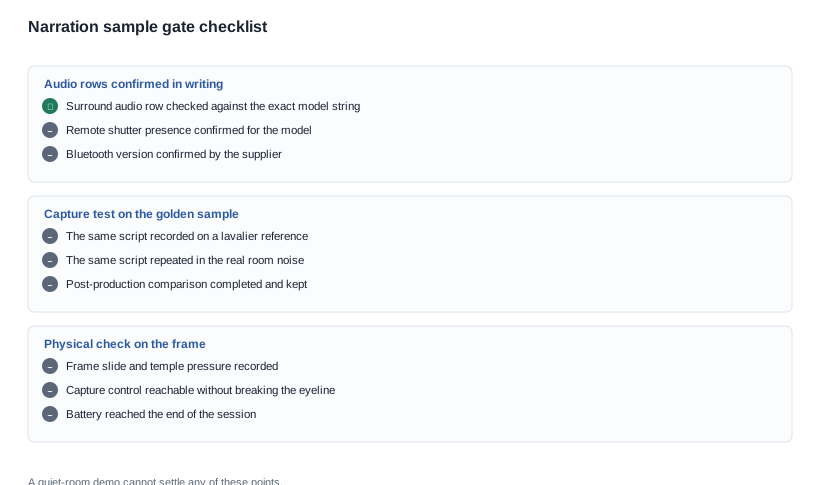
We will structure a narration sample test as a fixed matrix rather than a demonstration, and because the whole point is comparability we will hold everything else constant — script, pace, operator, mounting position, and the room — so that we will always be able to say which variable caused a difference in the result. It runs in five steps:
- Fix the reference. Record the same script with a lavalier microphone as a reference track, so every later take has something to be judged against rather than an opinion.
- Repeat the quiet-room take three times. Same script, same pace, same operator, same mounting position, in a small room with the door shut. This establishes the ceiling for the device.
- Repeat the street take three times. Same script, same operator, outdoors in a normal urban location, with the wind and traffic conditions that the creator will actually meet.
- Swap the operator. Repeat the quiet-room take with a second wearer of a different build and a different voice, because the acoustic path through the head differs and comfort differs with it.
- Log the practical outcomes. Not only the audio, but the physical ones: does the frame slide, does the temple press, does the wearer keep wearing it for the length of a real take, and does the battery reach the end of the session on the published runtime band.
The purpose of this structure is not to produce a good take. The purpose is to measure whether the differences between conditions are differences a post-production team can live with, and to see whether the frame introduces mechanical noise that a lavalier would not have introduced at all. The comparison that matters is against the lavalier reference, because the honest question is not whether the frame is good in the abstract but whether it is good enough for this programme compared with the alternative a creator would otherwise use. If it is not, then the right answer is a frame used for capture and monitoring with a separate microphone for the voice, and that is a configuration question to settle with the supplier in writing rather than a quality question to hope away.
Questions to ask before committing a device
Before any quotation turns into a pilot order, the items below need written answers. They are the questions that the published catalogue does not answer, and they are the questions where a supplier's response quality tells you how a programme will actually run.
- What to ask the supplier: Does this model have a microphone at all, and if so what is the published capture path — microphone type, channel count, sample rate, and the encoding of the recorded file? The catalogue publishes no such row for the audio or sport groups, so a written answer is required.
- What to ask the supplier: Can the device be used with an external microphone? If a creator's standard workflow depends on a lavalier or a shotgun microphone, you need to know whether the frame can host it, whether an adapter or cable is involved, and whether that changes the MOQ, the tooling, or the packaging.
- What to ask the supplier: What is the pairing behaviour, and what does it depend on? Bluetooth version is published for 14 models and not published for the eleven camera models, A05, A06, or the bone-conduction entry, so pairing needs to be described rather than assumed.
- What to ask the supplier: Will you supply the battery-transport document for a device shipping a lithium cell? Every model in the audio and sport groups ships cells, so the transport paperwork has to exist for the exact cell configuration, including the two-cell models and the single-cell models.
- What to ask the supplier: What does the charging path look like in the field — magnetic, Type C, or a charging case — and which of the published charge-time statements applies to the cell configuration you are ordering? Charge time is published as "2 hours or less" for most models and "about one hour" for the D17 and ZH12, and the charging method is not published for four camera models.
- What to ask the supplier: What are the quoted MOQ, the lead time, and the incoterms, and how do they change if the programme moves from a pilot order to a repeat purchase order? Quote these in writing on the quotation itself.
- What to ask the supplier: What is the warranty position for the cell and the charge port, and what spare parts are you willing to hold against failure — cells, cases, temples, or ear tips — and in what packaging?
- What to ask the supplier: What certification evidence can you actually provide for this model, with the certificate numbers, the issuing body, and the scope of the certificate? No certification status appears in our published catalogue, so any claim must arrive as documentary evidence rather than as an assurance in a message.
- What to ask the supplier: Is a custom firmware or app variant part of the programme, and who owns it? If your creator workflow depends on a specific capture flow or a specific export format, that has to be scoped as tooling rather than assumed to come with the hardware.
- What to ask the supplier: What does the packaging contain exactly — device, cells in the device or in the case, charging cable, case, spare tips, printed material — and which of those are present in the sample you send? The charging-case row is published for some models only, and the pack list is where that row either matches reality or does not.
- What to ask the supplier: What is the failure and replacement path for a pilot order that does not clear the sample gate? Agreeing the exit before the pilot starts protects both sides and is the single most useful line in a pilot agreement.
- What to ask the supplier: How will you handle a mix of models in one purchase order, with different charging methods, different case configurations, and different runtime bands, in one carton and one shipment? A mixed pack is normal for a channel buyer and awkward for a supplier who has not planned for it.
Those questions set up the commercial conversation rather than replacing it. The published catalogue tells a buyer which cell configuration and runtime band they are buying, which charging method and charge time apply, whether a charging case is in the package, and which models publish any surround-sound row. It does not tell a buyer what a take will sound like, what a shipment needs, or what a factory will commit to. We will keep those two categories apart: published rows for configuration and capacity, written answers and a physical sample test for everything else.
There is one negotiation point worth naming early, because it is where most narration programmes are decided before a single sample is filmed. The trade-off between a frame that carries its own microphone and a frame that hosts an external one is a trade-off between a simpler creator experience and a better voice. A built-in microphone that lives on the temple is one less cable and one less thing to lose on a shoot day, and it is what makes a genuinely hands-free workflow possible. An external microphone gives a result that a broadcaster or a serious creator will accept without a second thought. Buyers who try to get both from a single catalogue row are usually disappointed, because the catalogue row does not exist. The honest negotiation is to pick the configuration the programme actually needs, to ask for the microphone question in writing, and to negotiate the commercial terms — MOQ, lead time, incoterms, tooling, packaging, spares, warranty — on the configuration that has been settled rather than on the one that sounds best in a summary.
The last discipline is to keep the promise tight. A creator-facing listing for a narration programme should state what the device does, which the published rows support: a cell configuration, a runtime band, a charging method, a charge-time bound, whether a case is included, and the fact that a shutter control exists on the D17 and the ZH12. It should not state a certification status, a per-model price, a weight for any model other than the one model where weight is published, a capacitive-touch capability, a translation capability, or any named assistant. Those are the claims that create the gap between what a creator expects and what a device delivers, and we will keep the listing and the hardware aligned rather than the listing and the competitor's copy.


