
A creator who buys a wearable camera is buying an image, and a buyer who specifies one is specifying an image without being able to see it. Smart glasses camera performance is exactly that kind of row: the specification exists, and the consequence of it appears nowhere on the page. Our camera tier publishes two resolution tiers and the electrical rows around them. Everything that decides whether the resulting footage is usable — the field of view, the frame rate, the low-light behaviour, the stabilisation, the storage behaviour — is not published for a single model.
So this is an article about what is published, what is missing, and how a buyer converts the missing part into a measured result before a purchase order is placed. It is written for a brand, a distributor or a channel partner who has to put a camera claim in a listing and defend it afterwards.
Smart glasses camera: two published tiers and the rows between them
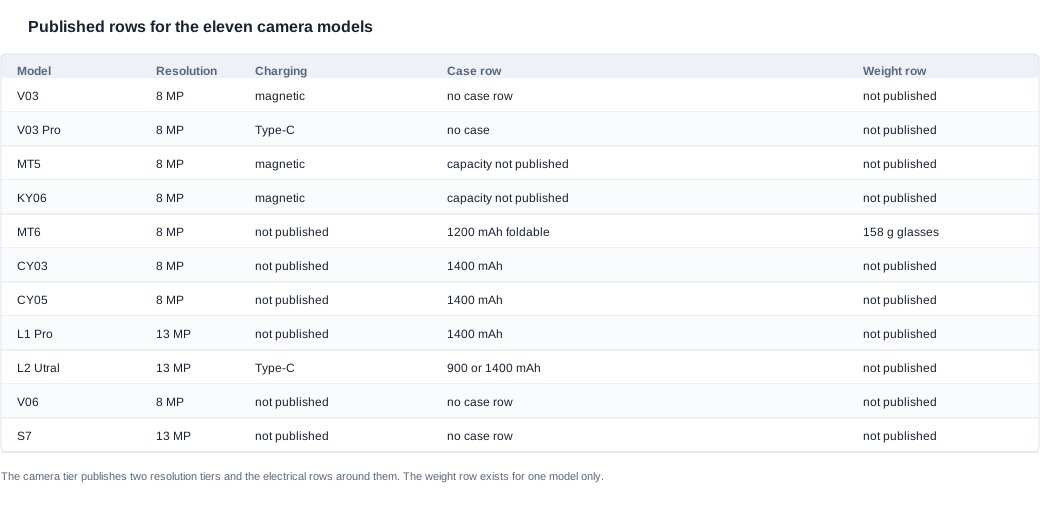
Eleven models in our range carry a camera. Eight publish 8 MP and three publish 13 MP. Those two numbers are the entire imaging specification available from the catalogue, and everything else about the capture chain is either an electrical row or an absence.
| Model | Resolution tier | Charging interface | Case row | Weight row |
|---|---|---|---|---|
| V03 | 8 MP | magnetic | no case row | not published |
| V03 Pro | 8 MP | Type-C | no case | not published |
| MT5 | 8 MP | magnetic | capacity not published | not published |
| KY06 | 8 MP | magnetic | capacity not published | not published |
| MT6 | 8 MP | not published | 1200 mAh, foldable | 158 g, glasses only |
| CY03 | 8 MP | not published | 1400 mAh | not published |
| CY05 | 8 MP | not published | 1400 mAh | not published |
| L1 Pro | 13 MP | not published | 1400 mAh | not published |
| L2 Utral | 13 MP | Type-C | 900 or 1400 mAh | not published |
| V06 | 8 MP | not published | no case row | not published |
| S7 | 13 MP | not published | no case row | not published |
Two structural points follow immediately from that table.
The naming of the range does not sort by use case. The V06 and the S7 carry names that read as sport, and they belong to the camera tier, which means they carry a camera and a resolution row whether or not a buyer expects them to. The YKC02 is the opposite case: it is a sport model with a published 2 × 70 mAh cell configuration and no camera, and it must never be presented as one of the eleven camera models. A buyer assembling a range under a "sport" heading and a "camera" heading can get this wrong in both directions, which is a reason to fix the model list at the start of a programme rather than at the artwork stage.
The interesting differences between models are not imaging differences. The V03 Pro carries a photochromic lens and three colour options and is the only camera model in the catalogue with that lens. The V06 publishes four colours. The MT6 is the only model anywhere in our catalogue with a published weight, at 158 g for the glasses alone, explicitly excluding its foldable case. The L1 Pro and the L2 Utral are the only two at 13 MP. None of those is a change to the capture chain, and none of them tells a buyer whether the footage is good.
That is the published position. A buyer who wants more than that needs it established on a sample.
Why smart glasses resolution does not predict the picture
The instinct is to read 8 MP and 13 MP as a quality ladder and treat the step between them as an upgrade. That instinct is wrong, and the reason is physical rather than commercial.
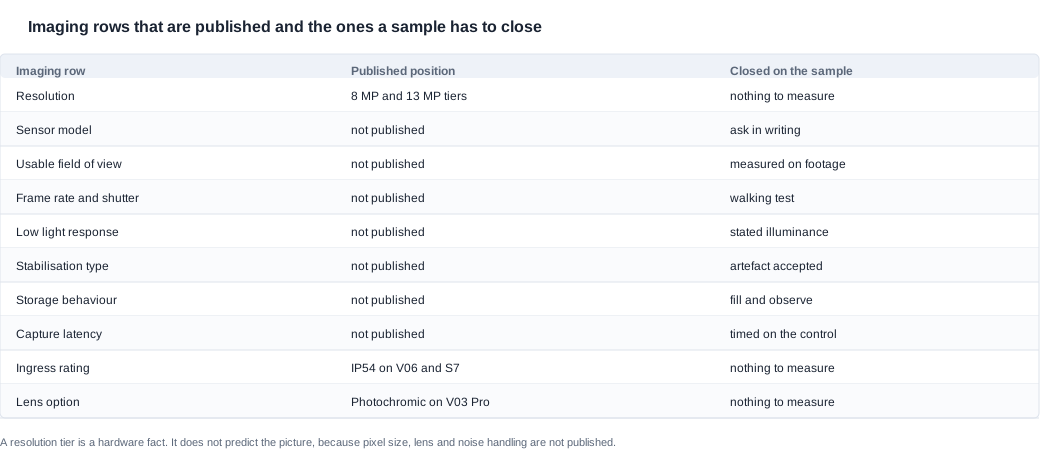
A sensor's image quality in low light is driven by how much light each pixel gathers. Two sensors with different pixel counts built on the same process can have very different pixel sizes, and a 13 MP module with smaller pixels can gather less light per pixel than an 8 MP module with larger ones. Resolution tells a buyer the pixel count. It does not tell them the pixel size, the lens, the aperture, the image signal processor configuration, or the way the firmware handles noise. None of those is published for any model in this range, which means the resolution step is a real step in the hardware and an unverifiable step in the result.
Four further rows decide the picture and are all absent.
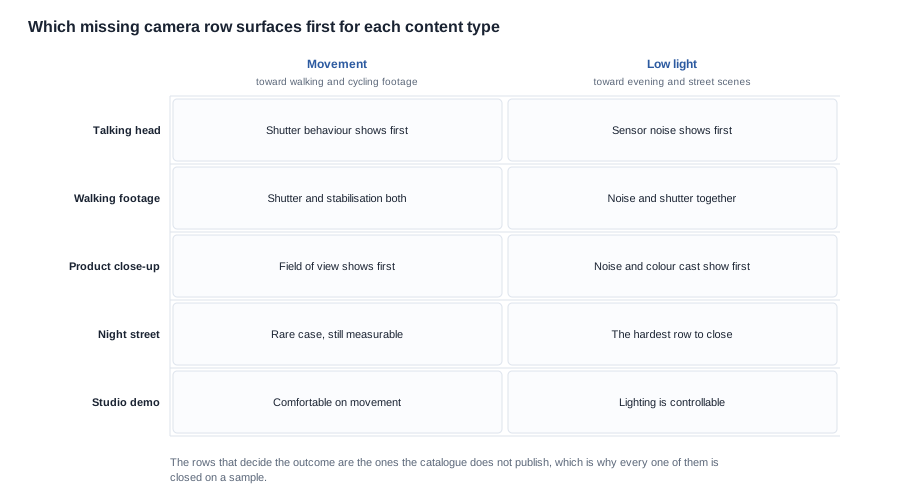
Field of view. The most consequential of them. The published row a buyer wants is the usable horizontal or diagonal angle in a stated convention, because a horizontal figure and a diagonal figure are not comparable numbers. There is a second effect that a datasheet never mentions: the frame geometry itself occludes part of the scene, so the usable field of view is a property of the product as assembled rather than a property of the lens alone. A wide sensor behind a narrow frame produces footage with the edges cropped away, and no resolution row reveals that.
Frame rate and shutter behaviour. A wearable camera is nearly always moving. The frame rate sets whether motion is captured as distinct frames or as a smear, and the shutter behaviour determines how much of that motion is frozen. The catalogue publishes neither, for any of the eleven models.
Low-light behaviour. This is where the resolution tier is least predictive, for the reason described above. A defined illuminance and a defined acceptance criterion turn this from an opinion into a measurement.
Stabilisation. Optical, electronic and software stabilisation are three different implementations with three different artefacts. On a head-mounted camera the head moves in ways a phone camera does not, so software stabilisation is doing more of the work, and software stabilisation typically introduces a crop and a processing latency. None of the three is published.
Storage and capture latency. Whether the unit overwrites the oldest material when the storage fills, whether it stops recording instead, how much it holds in total, and how long the delay is between pressing the control and the frame being recorded — none of that is published either.
One more published-adjacent item belongs in this section. The camera tier names an AI voice assistant as a key technology, and the catalogue contains no per-model row stating which models support it, whether the processing happens on the device or in a service, whether an account or a subscription is required, or where the material is stored. The catalogue contains no live translation row for any model at all, and no capacitive-touch row for any model at all, so we will not describe any unit in this range as touch-controlled or as translating on the fly. The AI feature options article covers the AI position in detail.
The measurements a smart glasses sample has to establish
The following is the measurement list we would expect a buyer to close before the specification is frozen. It is deliberately written as a table of measurements rather than as a table of marketing features, because each line has to end in a number that somebody logged.
| Measurement | Why it decides the outcome | What to record | A defensible pass |
|---|---|---|---|
| Usable field of view | Frame geometry crops the sensor | Angle in a stated convention, measured on the footage | A stated angle the buyer can brief a creator against |
| Frame rate and shutter | Motion smears without it | Supported rates, and the look of a walking frame | Frames stay distinct at the normal walking pace |
| Low-light response | Resolution tier does not predict it | Footage at a stated illuminance, side by side | A defined criterion met at a defined light level |
| Stabilisation type and artefact | Three implementations, three artefacts | The type, and what it does to the frame | Artefact accepted by the buyer in writing |
| Storage behaviour | A silent second ceiling | Capacity, format, overwrite or stop | A session limit the workflow can plan around |
| Capture latency | The first thing a creator notices | Delay between the control and the frame | Delay short enough not to interrupt a take |
| Continuous-capture runtime | The camera is the dominant load | Elapsed time to stop, and how it stopped | A figure that matches the shot list |
Each measurement has a specific reason for being on the list and a specific way it fails when it is skipped.
Field of view fails quietly, because a buyer who never measures it will not know that the edges of the frame are being eaten by the frame. Frame rate and shutter fail on the first walking shot and only on the first walking shot, which is why a test that stays on a desk never finds them. Low light fails at the end of a shoot day rather than the start of one. Stabilisation artefact shows up as a crop that a buyer has to accept or reject, and a crop changes the effective field of view, which means the two measurements interact. Storage behaviour is the failure that looks like a battery fault and is not one, so it has to be logged separately. Capture latency is a confidence issue rather than a quality issue, and it undermines every other measurement if the operator cannot tell whether the control registered.
Those seven rows are measurements until somebody owns the acceptance criteria. The distinction matters more than it sounds. A measurement with no acceptance criteria attached is an observation, and an observation is negotiated rather than enforced: it becomes a discussion at the point where a commercial relationship is already under strain. An acceptance criterion turns the same measurement into a condition that can be written into a purchase order, checked on delivery, and used to open a discrepancy without anybody having to argue about whose recollection is correct. Writing one sentence per row — what result confirms the configuration and what result disqualifies it — costs an hour at the start of a programme and saves a dispute at the end of one.
There is a second reason to measure rather than argue, and it is the one a finance reader will ask about. The camera rows are the cheap half of a content programme. The expensive half is the rework: a listing that has to be withdrawn, a batch that has to be re-shot, a creator who returns the product and says the footage was not what the page promised. That is a total cost of ownership problem, and it is the only one of the two that the published specification can influence at all.
The camera key specifications article sets out how the imaging rows are usually written, and the advanced considerations article covers the comparisons that the catalogue rows cannot support on their own.
Writing a smart glasses camera test that returns usable data
A camera test that is not designed before the sample arrives produces a folder of clips and an opinion. The design matters more than the equipment.
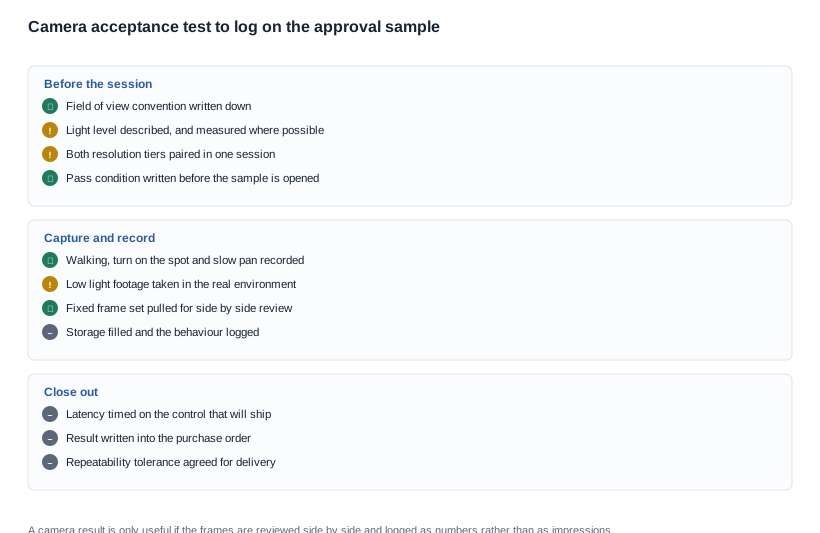
Pair the units. If the decision between 8 MP and 13 MP is live, test both tiers in the same session, in the same location, with the same subject, the same lighting and the same movement. A comparison captured at different times is not a comparison. If the decision is only between two models at the same tier, then the comparison is about form factor and capture behaviour rather than about resolution, and it should be described that way in the report.
Control the light rather than avoid it. A dark room is the easiest low-light test to run and the least representative one. If the creator segment works in evening streets or in retail interiors, the test belongs in an evening street and in a retail interior, at a light level you write down. Record the illuminance if you can measure it; if you cannot, write down the lighting description instead of a number you are not sure of.
Use movement, not a tripod. A walking test at a normal pace, a turn on the spot, and a slow pan are the three movements that expose the shutter and the stabilisation. Record them from a fixed position so the frame can be reviewed for crop as well as for smear.
Review the frames, not the feeling. Take a fixed set of frames from each unit, at the same point in the test, and lay them side by side. A written record of what each frame shows is more useful than a description of how the footage felt, and it is the version that survives a disagreement with the supplier six months later.
Log the capture control as it is used. A creator triggers the camera the way a creator triggers it, which may be a physical button on the temple and may be a remote. The latency measurement only means something if it is taken on the control the buyer will actually ship.
Write the tolerance before you look. State what result would confirm the configuration and what result would disqualify it, and do it before the sample is opened. Otherwise the test result is negotiated rather than measured.
Turn the result into a delivery condition. The acceptance criteria that closed the sample have to be carried forward to the first production delivery, because a unit built in a different week is not the unit you tested. Decide which of the seven measurements are re-checked on delivery and which are covered by the production record, and write that split into the purchase order rather than assuming it.
The commercial frame around the test is where the same discipline applies. The sample cost, the sample lead time, the minimum order quantity for a first order, the unit price at the quantity you intend to run, the warranty position and the delivery term are all confirmed per enquiry rather than published, because each depends on configuration, quantity, documentation and the current schedule. If the programme needs a bracket or a mount that is not part of the standard configuration, that is a tooling conversation, and tooling cost, tooling ownership and the amortisation across your volumes belong in the quotation as separate lines. The sample acceptance guide covers how to receive the unit, log it against the written list, and raise a discrepancy with the supplier in a form that can be closed.

There is one more commercial point specific to a camera product, and it is about what happens after the sample passes. The evaluation is usually run against a small number of units and a single production batch is not identical to them. A camera claim written against a sample needs a repeatability clause, so agree the tolerance on the camera rows, the tolerance on the runtime, and the procedure for raising a discrepancy, before the purchase order rather than after the first shipment.
What a smart glasses camera claim may say in a listing
A listing has to say something about the camera, and the safest claims are not the ones that sound most confident. They are the ones that survive a reviewer asking where the number came from.
A resolution claim is safe. "8 MP camera" and "13 MP camera" are published rows and can be stated directly against the exact model string.
A runtime claim is safe only with its condition attached. "Rated runtime of about 7 hours; continuous-capture duration measured on the approval sample for this configuration" is defensible. "Up to 8 hours of video" is not, because the catalogue publishes no test condition and no continuous-capture figure.
An ingress claim is safe on two models only. The V06 and the S7 publish an IP54 marking. No other model in the range publishes any ingress rating, so no other model may carry one in a listing, a leaflet or a marketplace attribute.
A weight claim is safe on one model only. The MT6 at 158 g, for the glasses alone and explicitly excluding the foldable case. A listing that says "158 g" for a different model is wrong, and a listing that says "158 g including case" is also wrong.
A lens claim is safe on one model only. The V03 Pro carries the photochromic lens with three colour options. Nothing else in the camera tier publishes a lens option.
A feature claim is safe only if a per-model row exists. The catalogue names an AI voice assistant as a key technology for the camera tier, but publishes no row stating which models carry it, so a named assistant cannot be attached to a model in a listing without written confirmation.
A certification claim needs evidence that is not in the catalogue. There is no per-model certification row anywhere in our range, and the catalogue body names no certification mark for any model. A listing that asserts a certification for a specific model is asserting something the catalogue does not support.
The AI camera glasses range carries the per-model rows for all eleven camera models, and the content creation solution page shows how a camera model sits inside a creator programme once the imaging question has been answered.
There is a version of this that is worth more to a buyer than a longer list of prohibitions. A brand that publishes its own measured results — the field of view its creator programme accepts, the low-light criterion it holds the product to, the runtime its creator measured with the case — is making a claim that a competitor cannot copy from a datasheet and that a customer can verify. That is the difference between selling the specification and selling the result, and it only works if the measurement is written down and signed off by the buyer who will defend it.
Before you order, it is worth asking the supplier for the same thing in reverse: which of these camera rows do they consider settled for this model, and which ones do they also consider to be established only on a sample. A supplier that answers that question precisely is telling you where the risk sits, and a supplier that answers it vaguely is telling you something else. The cost of finding out after the first production batch is a total cost of ownership question rather than a specification question, and it is always more expensive than the answer would have been.
The last practical point concerns the criteria themselves. Write the acceptance criteria in the language of the business rather than the language of the engineering team. "Field of view of at least the angle a creator needs to frame a two-person conversation without turning their head" is a criterion a sales team can apply and a creator can picture. "Horizontal FOV not less than 100 degrees" is a number that only an engineer can interpret, and it will be interpreted differently by every person who reads it. Both forms are legitimate, but the first one survives contact with a channel partner, and it is the form that makes a buyer decision criteria rather than a reference to a number.
Tell us the content you intend to produce, the environment it is shot in and the length of the session, and we will narrow the camera models to the ones whose published rows fit, and tell you exactly which measurements you still need to close on a sample.
Related reading
- Smart Glasses for content creation
- Camera key specifications
- Camera advanced considerations
- AI camera glasses range
Tell us the content, the environment and the session length, and we will narrow the range and list the measurements still to close.


