
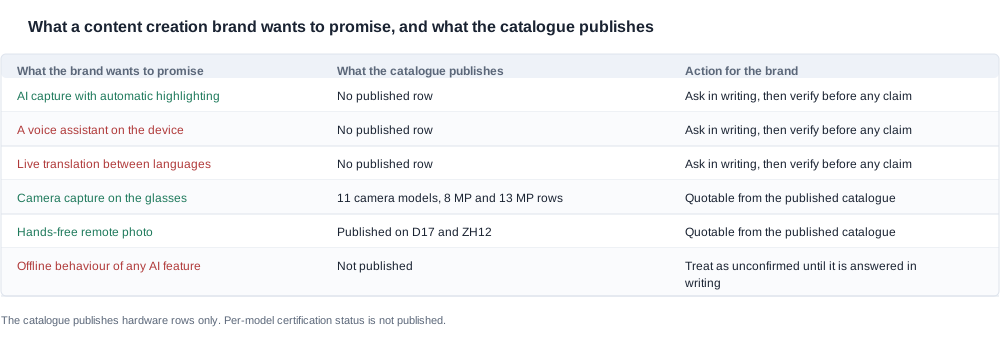
A content-creation brand writing a smart-glasses brief usually arrives with a list of AI features in mind: capture on the glasses, a voice assistant, live translation, automatic highlighting of what is being recorded. The published supplier catalogue does not answer that list, and the reason is not that the catalogue is thin on the topic. It is that the catalogue body publishes no row for any of those named AI capabilities. There is no AI assistant row, no voice assistant row, no live translation row and no AI capture row anywhere in the published material. What the catalogue does publish is the hardware substrate an AI feature would sit on — cameras and their resolution, microphones and speakers, wireless connectivity, ingress marking, charging behaviour, colour and lens options — and a set of explicit omissions that tell the buyer exactly which questions to ask.
That distinction matters more in this category than in any other, because AI features are the easiest thing in consumer electronics to imply and the hardest to deliver. A marketing sentence can be written in an afternoon; a feature that has to work offline, must not drop frames on a crowded street, and must behave predictably on a phone with no signal is an engineering programme with real cost attached to it. The trade-off a content brand faces is not between a good feature and a bad feature. It is between a capability that has been engineered, tested and written down, and a label that has been assumed.
This article sets out what is published, what is not, how to tell the difference in a supplier conversation, and how to write an AI feature request that survives the requirements gate instead of being quietly dropped at feasibility. Read it with AI camera glasses for content creation for the camera-side framing, does the AI feature need internet for the connectivity question in detail, smart glasses AI features and cost factors for the commercial side, and how smart glasses AI compares to alternatives before committing to a positioning. The AI content creation solution page describes the same decision framework from the programme side.
Smart glasses AI features: what the catalogue publishes
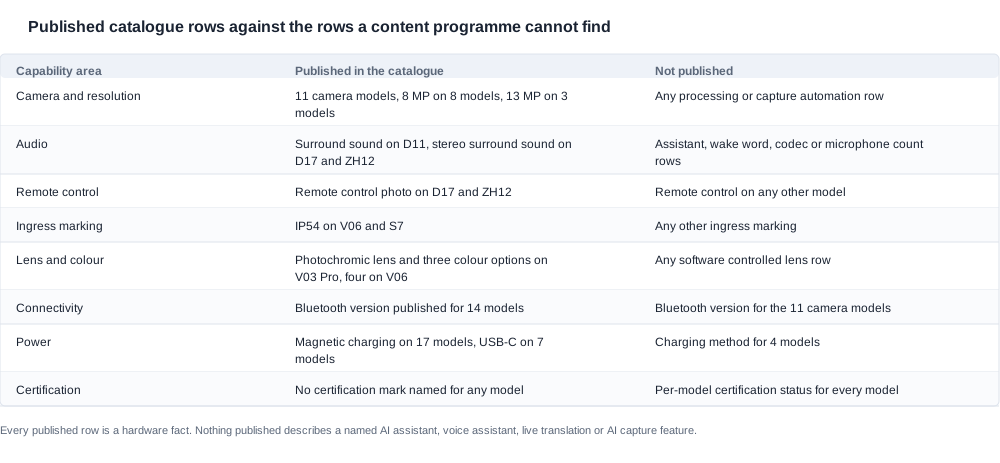
We will start with the published rows, because everything else follows from them, and we will keep returning to the distinction between a published hardware row and an unstated software behaviour. The catalogue covers 28 models: eight audio models, three sport models, eleven camera models, three kids models, and three further models published without a model number, covering AR glasses, electrochromic and bone conduction. Across that range, the rows that bear on an AI feature decision are hardware rows. They tell a content-creation buyer what the device can physically do, and they leave the intelligence layer entirely open. That is a deliberate feature of the published material, and a buyer who reads it as an omission of detail will draw the wrong conclusion.
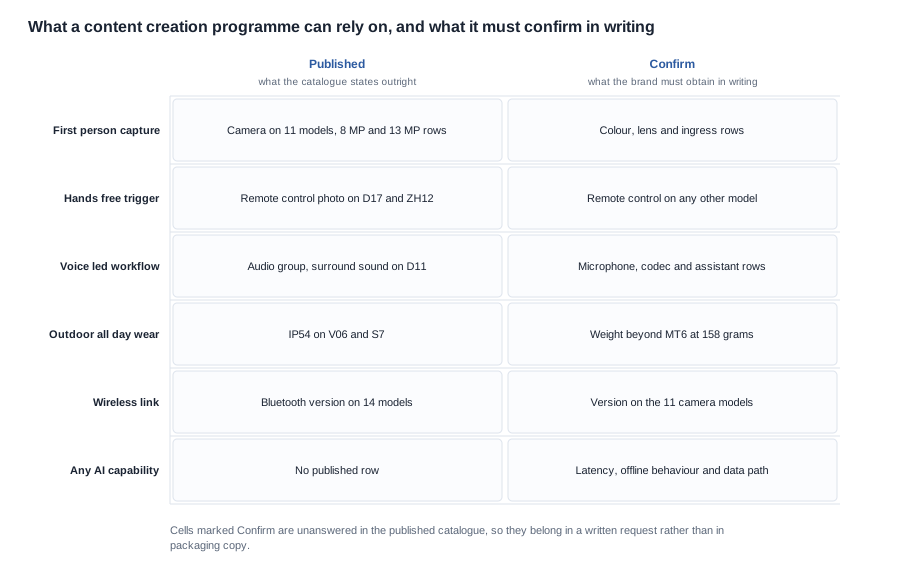
Camera and resolution. Camera presence and sensor resolution are published, and resolution is published for a subset of models only: 8 MP appears on eight models, and 13 MP appears on three models — L2 Utral and S7, and L1 Pro. This is the row set that determines whether a capture-led content workflow has raw material to work with, and it is the closest the catalogue comes to an AI-capture story. It is still a sensor row, not a processing row. Resolution does not tell a buyer whether footage is stabilised, whether it is processed on the device, whether anything is extracted from it automatically, or whether a person still has to review the result before it is published.
Audio. The audio rows are published narrowly and precisely. Surround sound is published on D11. Stereo surround sound, together with remote control photo, is published on D17 and ZH12. Remote control shutter is published only on D17 and ZH12, which makes those two models the natural reference point for a hands-free content workflow. The remaining audio-group models are described as audio models; the catalogue publishes no microphone-count row, no voice-activity row and no audio-codec row for them. For a voice-led feature, that is where the published evidence stops.
Ingress, lens and colour. IP54 is published on V06 and S7. V03 Pro is the only camera model with a photochromic lens, and it is published with three colour options; V06 publishes four colour options. For a content programme these are the rows that decide whether the device can live on a face outdoors and all day, and they are rows a buyer can verify rather than argue about.
Power. Charging method is published across the catalogue as magnetic on seventeen models and Type C on seven, with four models — CY05 and L1 Pro, and MT6 and CY03 — publishing no charging method at all. Charging time is published for 26 models at a two-hour-or-less ceiling, with only D17 and ZH12 published at about one hour. These are device specifications on a published catalogue, and they are worth quoting precisely because they are the only power rows a brand can point to. They must not be read as programme timings: stage durations and lead times for an OEM programme are not published, and no relationship exists between a device charging time and a programme schedule.
Connectivity. The wireless link is where the AI question becomes concrete, and the catalogue's treatment of it is asymmetric. The Bluetooth version is published for 14 models and is not published for the eleven camera models, nor for A05, A06, or the bone-conduction entry. In other words, the models a content-creation programme would most likely build around are exactly the models for which the wireless standard is not stated. That is not a contradiction. It is a strong signal about where the questions belong.
Weight. The only public weight in the catalogue is MT6 at 158 grams for the glasses body, excluding the 1200 mAh folding case. It is the only weight a buyer can quote, and a brand building an all-day wear programme should plan around that single data point rather than assume the camera group sits at the same figure.
What is absent. No row in the catalogue body describes an AI assistant, a voice assistant, a live translation function, an AI capture feature, a capacitive-touch function, or a translation function. The catalogue body names no certification mark at all — CE, FCC, RoHS, RED and EN 18031 do not appear in it — so per-model certification status is not published either. We will not treat any of these omissions as a soft refusal. They are unanswered, and the practical response to an unanswered question inside a programme is to write it down and ask — which is exactly what the next sections cover.
The published rows a content programme can rely on are summarised below. Notice that every line is a hardware fact, and that the two rows closest to an AI story — resolution and remote control photo — describe what the device captures and how the capture is triggered, not what happens to the result.
Which models carry a camera
We will separate the catalogue into the group that carries a camera and the groups that do not, because for a content-creation programme this is the first structural fact and it decides which questions are answerable from the catalogue and which have to be asked. The split is clean, and it is published, so we will treat it as a structural map rather than an estimate.
The eleven camera models. CY05 and V03, V06 and V03 Pro, S7 and L2 Utral, KY06 and MT5, MT6 and CY03, and L1 Pro. Every one of them carries a camera, and the published differences inside the group are meaningful for content work. The 13 MP rows sit on L1 Pro and L2 Utral, and S7, while the 8 MP rows sit on eight models. IP54 is published on V06 and S7. V03 Pro carries the photochromic lens and three colour options, which makes it the only camera model in the catalogue that changes with ambient light. V06 publishes four colour options. S7 appears on both the 13 MP row and the IP54 row, which makes it the single best-specified camera model in the published set — best specified in terms of physical and hardware rows, that is. Nothing in its published rows describes an AI function.
The audio group. K01 and D12, LC-105-1 and YK12, G07 and K02, and LC-105-2 and D11. These models carry no camera. D11 publishes surround sound, which makes it the audio-group model whose published audio row is most specific. For a content-creation programme built on audio rather than imagery, this is where a voice-led feature would have to live, and the boundary is worth stating plainly: no published row in this group describes an assistant, a wake behaviour, a command grammar, a language set, or any processing capability. The audio group gives a buyer a microphone and a speaker. What runs on them is unstated.
The sport group. YKC02, D17 and ZH12. D17 and ZH12 are the two models in the entire catalogue that publish both stereo surround sound and remote control photo, with remote control shutter published only on these two. For hands-free capture they are the closest published approximation to a content device, and they are also the two models published with the shorter charging time and with no camera. YKC02 sits in the group without either of those rows. A buyer who wants remote capture has two models to work with, and that is a constraint worth planning around rather than discovering later.
The kids group and the unnumbered models. A05, A06 and A07 form the kids group, and the Bluetooth version is not published for A05 or A06. Three models are published without a model number — AR glasses, electrochromic and bone conduction — and the Bluetooth version is not published for bone conduction. Electrochromic is the row that speaks to light control on lenses, which is a capture-adjacent concern rather than an AI one. A content-creation brand will rarely build its programme here, but it should know these entries exist so that a category map drawn from the catalogue is complete and so that a competitor's claim about a new form factor can be placed in context.
The grouping tells the buyer something practical. If the content workflow needs imagery, the choice set is the eleven camera models, and the published detail across that group is uneven — a few models have ingress, lens and colour rows, most do not, and the wireless version is unpublished across the whole group. If the workflow is voice-led, the choice set is the audio group, where the published audio rows are narrow and no processing row exists anywhere. In both cases the intelligence layer is the part that is missing from the catalogue, and it is the part the brand has to specify, price and defend.
What to ask before promising an AI capability
We will treat any promised AI capability as a written specification with a named owner, because a claim without an owner is a claim the brand will be asked about after it has been printed on the box, and we will not let it reach print on a verbal assurance. Before any AI wording goes into a packaging proof, a product listing or a channel brief, the brand needs written answers to five questions. We will put them in the order that catches problems earliest.
- Does it work offline? The question is not whether the device can be used without a network. It is whether the specific capability named in the claim still functions when the phone is out of signal, when the companion application has not been opened, and when the user is abroad on a local network. A device that degrades gracefully is a different product from a device that stops, and only the second one is a claim problem.
- What is the latency behaviour? A capture feature that produces its result after the moment has passed is not a capture feature; it is an upload feature with extra steps. The brand needs to know the acceptable delay, and whether the delay is fixed, variable under load, or dependent on the network. Latency figures are not published for any capability in the catalogue, so this is a written answer the brand must request.
- What is the data path? What leaves the device, in what form, to which destination, under whose control, and how long is it retained. If the answer involves a third-party service, the brand is about to enter a commercial relationship it has not negotiated, and the privacy wording on the packaging depends on it.
- Does it need an account, an application or a network? The onboarding requirement is the part that kills more content programmes than the technology does. An account means friction at first use; an application means a software product; a network means the capability is not a property of the glasses at all. Each has a support and warranty consequence the brand inherits.
- What happens when it is unavailable? A user in the field needs a defined behaviour: a silent fallback to plain recording, a visible indicator, a failed action, or a queue. The brand needs this written down because it becomes the behaviour of the product whether or not anyone designed it, and because support and warranty terms for the brand depend on it.
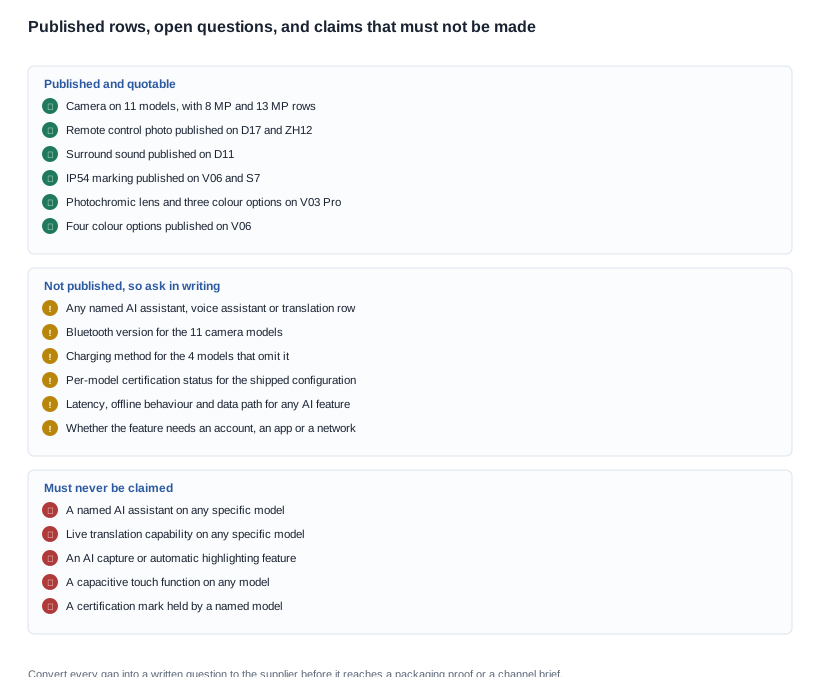
These five answers are also the minimum a supplier can give that is worth putting into a requirements document. We will ask for them in writing against a specific model string, because the catalogue publishes nothing at model level for the intelligence layer and a general answer about "the platform" is not evidence for a shipping configuration. The answers should land as part of the feasibility review, in the same document that records what can and cannot be met, so that an unmet answer becomes a documented limitation rather than a surprise.
The commercial layer follows from the technical one, and it is where the AI question becomes expensive. We will ask the supplier what to ask the supplier about in writing: whether an AI capability changes the MOQ, whether it changes the tooling, whether it adds anything to the packaging such as a printed card, a licence code or an accessory, whether it changes the spares list, whether the pilot order is sufficient to exercise it, and what the purchase order has to reference. Stage durations and lead times are not published, so any timetable the brand builds must be derived from the gate sequence rather than assumed from a device specification.
The warranty question deserves particular care in this category, because a service that can fail is not the same as a device that can fail. We will ask what to ask the supplier about the boundary: which parts of the feature sit inside the warranty the brand resells, which sit with a third-party service operator, and what evidence the brand needs from the supplier to describe the limitation accurately in its own channel material. Certification evidence has the same shape — per-model status is not published, so the brand obtains it in writing for the exact configuration it will ship, and it does not describe the feature as certified unless the evidence supports that description.

Writing an AI feature request that survives the gate
We will write the request as an acceptance test, not as a feature name, because the six-gate framework only works if each requirement line can be dispositioned, and we will number the parts so a deviation can be pointed at precisely. The gates run in order — requirements frozen, feasibility reviewed, engineering and tooling, samples built and verified, compliance file closed, pilot run before mass production — and each gate closes on a document. A requirement written as a product name cannot be closed; it can only be argued about. A requirement written as a trigger, an input, an expected output, an environment and a failure mode can be dispositioned line by line, and that is the difference between a request that survives feasibility and one that gets dropped there.
A workable request for a content-creation programme contains these parts:
- The trigger. What starts the capability — a button, a voice command, a remote action, a timed action, or an automatic condition such as motion.
- The input. What the capability consumes — a camera frame, a microphone signal, a sensor reading, or a combination.
- The expected output. What the user receives, in a form that can be checked against a stated result rather than a feeling.
- The environment. Where it has to work — indoors and out, walking or stationary, with or without a paired phone, in which language or languages.
- The failure mode. What happens when it cannot complete, and what the user sees.
- The offline expectation. Whether the capability must work with no network at all, or may depend on one, stated explicitly either way.
- The data path. What leaves the device and to whom, or a statement that nothing leaves the device.
- The owner. Which party is responsible for the behaviour, the support and the warranty of the capability.
We will number these parts in the requirement line so that a deviation recorded at the samples gate points at a specific part. That is what makes a deviation acceptable: "the offline expectation in clause three was not met, and the accepted substitute is X" is a decision the brand can take. "The AI feature did not work well enough" is not, and it will be resolved by whoever shouts loudest.
Two habits decide whether a request survives. The first is to separate what must be true from what would be nice. A requirement marked as essential gets a feasibility answer of met, not met, or a documented substitute; a requirement marked as desirable gets a discussion. Mixing the two is how a programme ends up with an open engineering path nobody scoped. The second is to attach the claim to the requirement. If the packaging is going to say something, then a requirement line exists for it, and if no requirement line exists for it, the wording cannot be used. That single discipline prevents most of the AI claims this category has to live down.
The same discipline applies to the commercial terms attached to the request, because an AI capability is often where a programme's real cost hides. We will ask for the quotation to cover the capability as a named line rather than folding it into a model price, so that the MOQ, the incoterms, the tooling, the samples, the packaging, the spares and the pilot order can each be judged on their own. The purchase order should then reference the same scope, and the warranty position should be written against the same feature boundary. Nothing published describes any of these values, which means the brand negotiates them rather than reads them — and it means a supplier that cannot separate an AI capability from the base model is telling the brand something important about the engineering path.
The last point is the cheapest one to act on and the most often missed. A capability that feasibility reports as unavailable is not a crisis when it is discovered at the requirements freeze, because nothing has been committed and the claim set can still be written around it. The same capability discovered after tooling is a crisis, because the tooling, the packaging, the compliance file and the retail copy all already assume it exists. We will therefore insist that every AI feature request is dispositioned at the requirements freeze and again at the feasibility review, and that a request nobody can answer in writing is removed from the claim set rather than carried forward on hope.
For the wider view of the commercial side, see smart glasses AI features and cost factors and how smart glasses AI compares to alternatives, and use the AI content creation solution page to put this request format into the wider programme context. The camera-side framing sits in AI camera glasses for content creation, and the connectivity dependency is covered in does the AI feature need internet.


