
Only two camera rows in our catalogue carry a number, and both of them count pixels rather than measure an image. That makes the list of camera specifications that actually decides this category a list of things that are mostly Not published, and that is the most useful thing a buyer can learn before opening a quotation. A specification hierarchy is only useful if it is ordered by what each row settles, and in this category the row that is published settles less than the rows that are not.
The eight rows below are ordered by consequence rather than by convenience of measurement. The published rows are the resolution tier and the electrical block; everything above them in the hierarchy is a question for the supplier and a measurement on a sample. The camera spec sheet explained page covers the same rows from the reader's side, the camera datasheet reading method page covers how to read a supplier sheet, and the camera supplier verification page covers the supplier-side check.
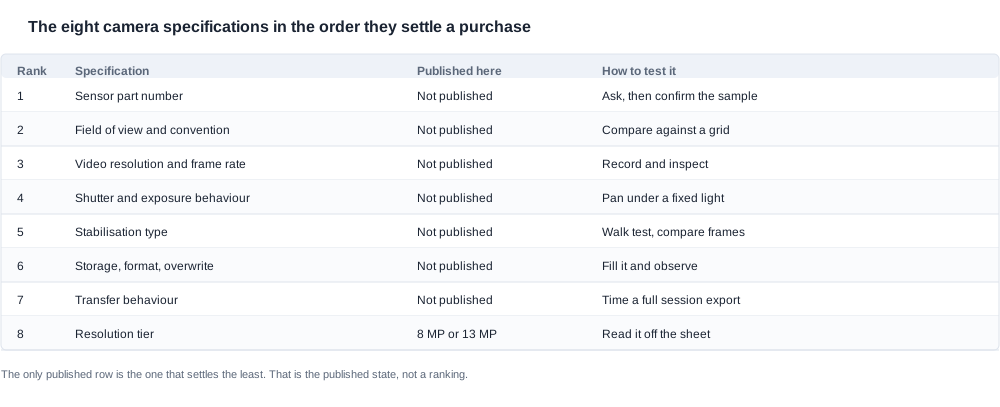
Smart glasses camera technology: eight specifications ordered by what they settle
1. The sensor part number. Not published for any model in our range. This is the row that determines how much light each pixel gathers, because it determines the pixel size and the generation, and it is therefore the row that decides the low-light behaviour before any processing runs. It is also a single part number, which makes it the cheapest row to obtain and the most expensive to be without: a supplier who has it also has the measurement infrastructure behind it, and a supplier who does not is quoting a tier rather than a camera.
2. The field of view, with its convention. Not published. It decides whether the product works for first-person video at all, and it has to be stated as diagonal, horizontal or vertical because the three are not interchangeable — a horizontal 90 degrees is a diagonal of roughly 110 degrees, so a figure without a convention cannot be compared with another figure, including one from the same manufacturer. It also has to be a product figure rather than a component figure, because the frame's own geometry occludes part of the scene.
3. The video resolution and the frame rate. Not published. A camera-glasses product that records only stills is a different product from one that records video, and the megapixel row describes the still path. This is the most common disappointment in the category, and it is entirely invisible in a catalogue. The frame rate is the half that matters most in first-person footage, because a moving camera and a low frame rate turn ordinary movement into a stutter.
4. The shutter and exposure behaviour. Not published. A camera in glasses is nearly always moving, and how the sensor reads a frame determines whether motion smears. Exposure is the other half of the same problem: whether the product is fixed or automatic, and how long it takes to adapt when a operator walks from daylight into a shop, decides whether a customer experiences it as a normal behaviour or as a fault.
5. The stabilisation method. Not published. Optical, electronic and software stabilisation are three different implementations with three different artefacts, and they behave differently against head movement, which is larger in amplitude and slower in rhythm than hand movement. The specification is three words long and it changes what the buyer should expect from the footage.
6. The storage capacity, the format and the overwrite rule. Not published. This row decides whether the product can be a customer's primary capture device rather than an occasional one, and it decides what a customer sees at the moment the storage fills, which is where a large share of the returns in this category begin.
7. The transfer behaviour. Not published. The difference between a device that hands the footage to a phone quickly and one that makes the customer wait is the difference between a camera and an accessory, and it is the row a creator notices first in use.
8. The resolution tier. Published, at eight and thirteen megapixels. It is the least informative of the eight, and it is the one every product page leads with.
The published camera rows and how to read them without over-reading them
Eight megapixels on eight models, thirteen on three
The published camera position covers eleven models. The eight-megapixel tier carries the CY03 and the V06, the MT6 and the V03 Pro, and the V03 and the MT5, and the KY06 and the CY05. The thirteen-megapixel tier carries the S7 and the L2 Utral, and the L1 Pro. Two tiers across a range is a useful commercial fact, because it lets a brand build a price ladder on one platform without changing supplier, and it is a legitimate reason to prefer a range over a catalogue of one-offs.
What a tier does and does not entitle a buyer to conclude
A pixel count states how many pixels the sensor can record. It does not state how much light each one gathers, and it cannot be converted into an image quality ranking without the pixel size, which is exactly the figure that is not published. The correct use of the tier is to describe the generation of the platform and to structure the price ladder. The incorrect use is to treat it as the deciding specification, and the moment that happens the buyer has a decision that a customer can overturn with a unit in their hand.
Why the published rows stop exactly where they stop
There is no agreed method for publishing an image quality figure for a camera worn on the head, and the absence of a method is why the quantity survives while the measurements do not. A number that cannot be reproduced is a description. Our catalogue publishes the tier and the electrical block and marks the imaging rows as open, because publishing an unverifiable figure would be worse than publishing nothing at all.
The electrical rows that travel with every camera model
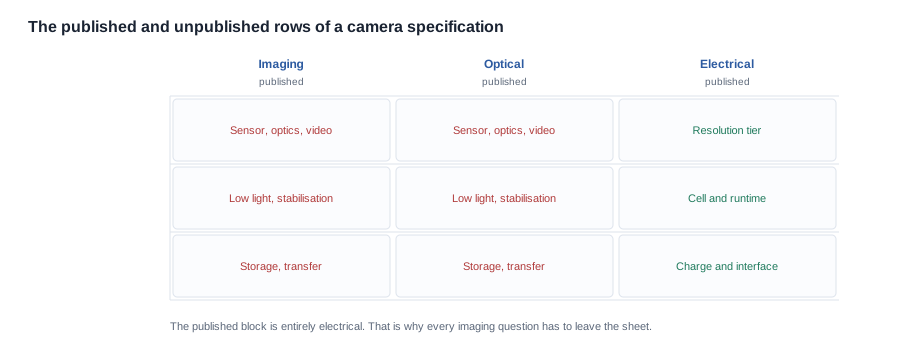
The electrical block is the part of the camera specification a buyer can rely on completely, and it is worth using it properly rather than treating it as filler under the imaging rows.
The cell configurations across the camera tier
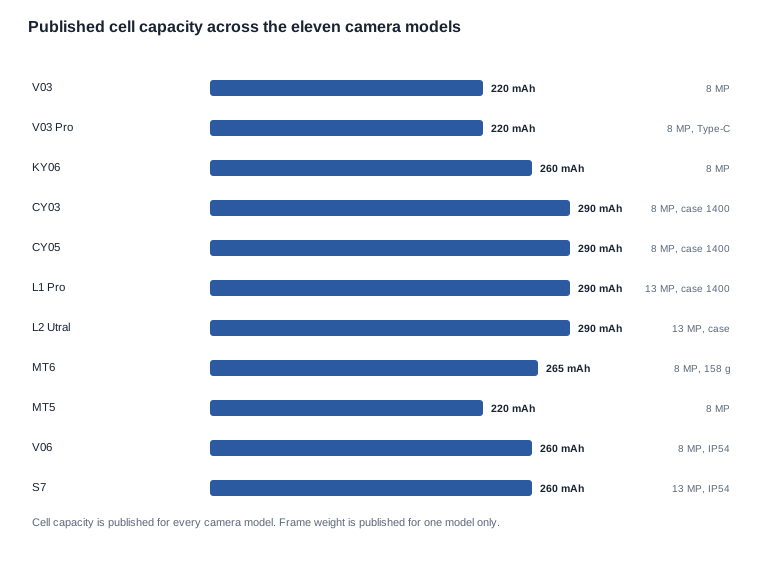
The published cell capacities run in four bands. The MT5 and the V03, and the V03 Pro carry 220 mAh. The S7 and the KY06, and the V06 carry 260 mAh. The MT6 carries 265 mAh. The CY03 and the L1 Pro, and the CY05 and the L2 Utral carry 290 mAh. The rated runtimes follow a different pattern from the capacities, which is the first sign that capacity alone does not set the runtime: five to eight hours on the V06 and the V03, and the V03 Pro and the S7; six to eight hours on the KY06 and the MT5; and roughly seven hours on the CY05 and the L2 Utral, and the L1 Pro and the MT6, and the CY03.
The case configurations and why they belong in a camera specification
The case is a cell, and therefore it appears in the camera tier's specification rather than in an accessories list. The CY05 and the L1 Pro, and the CY03 pair with a 1400 mAh case. The L2 Utral is offered with a 900 or a 1400 mAh case, which makes the same product two session lengths depending on the configuration. The MT6 pairs with a 1200 mAh foldable case. The KY06 and the MT5 sit with a case whose capacity is not published. A buyer comparing two models on cell capacity alone is comparing half of the configuration, and the half they are comparing is the half that sits in the product.
The charge time, and why the condition matters
The charge time is published at two hours or less for every camera model in the range. What the published figure does not carry is the starting state of charge or the termination criterion, so it cannot be converted into the length of a mid-shift interruption, and it is not a case turnaround figure. This is a specification row a buyer can rely on as a number and cannot rely on as a schedule, and the distinction is worth keeping in mind when a programme plan treats two hours as a fixed block.
The charging interface is a configuration choice, not a convenience
Most of the camera tier charges magnetically, and the V03 Pro charges over Type-C. The L2 Utral also carries a Type-C charging interface among its configuration options. The interface matters commercially for three reasons: it decides what the buyer has to put in the box, it interacts with the certification route for that configuration, and it is one of the few places where a packaging decision changes the electronics. A buyer who compares two models on cell capacity and runtime while ignoring the interface will discover the difference when the case in the box does not match the warehouse's charging station.
A hypothetical datasheet review of two candidate models
This is a hypothetical case rather than a client project, and it shows the order in which the hierarchy gets used.
A buyer has two candidate camera-glasses platforms on a shortlist and one supplier datasheet for each. The first move is to read both sheets against the hierarchy and to mark every row the supplier has not answered. In practice the marks land in rows one to seven every time, and the sheets differ from each other almost entirely in the electrical block, which is the block both suppliers publish accurately.
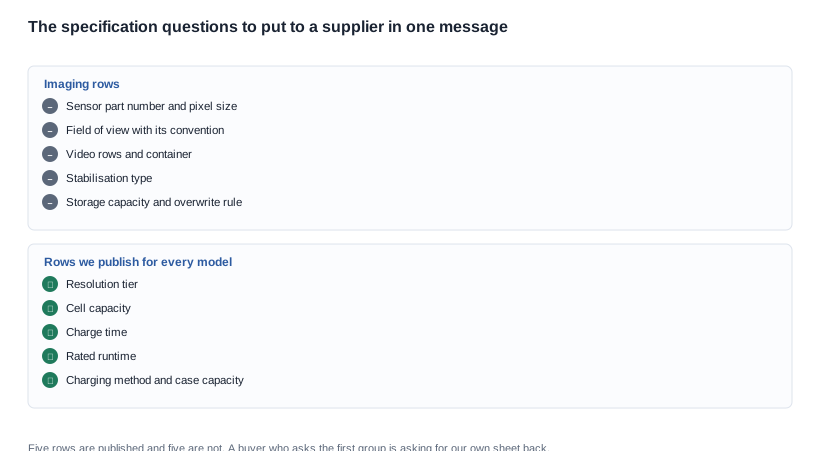
The second move is to send one message requesting the missing rows for both models in the same format, so that the answers are comparable. That message asks for the sensor part number and the pixel size, the field of view with its convention and the focal length, the video resolutions and frame rates with the container, the stabilisation type, the storage capacity with the format and the overwrite rule, the transfer method, and the exposure behaviour. The suppliers who answer it are the ones with a camera programme; the ones who answer with a tier again have a marketing sheet.
The third move is to apply the criteria to the answers. A field of view without a convention is not usable and goes back. A resolution stated without a video row leaves the still path confirmed and the video path open. A storage rule that differs between the two models is not a problem at all as long as it is written down, because it changes the session length and therefore the case configuration.
The fourth move is to build the price ladder on the published tiers, which is the one place the sheet's own numbers legitimately decide something. The fifth is to plan the sample test against the rows that remain open, using the categories that the sample can actually settle: the angle against a grid, the low-light behaviour, the frame rate while walking, the transfer time for a full session, and the adaptation between light levels.
The outcome is a shortlist with a defensible basis, a list of written answers to close in the agreement, and a test that is scoped to what a test can prove.
The specification claims that cannot be compared
These four claims appear constantly in this category and none of them survives a comparison.
A pixel count presented as a quality statement. The most common, because it is the only camera number most sheets carry, and the one most likely to be repeated by a channel team writing copy from a product page.
An angle quoted without a convention. Diagonal, horizontal and vertical differ enough that an unqualified figure can reverse a ranking, and the conversion the buyer applies may not be the one the manufacturer intended.
"HD" or "Full HD" with no pixel count. The phrase is ambiguous in a way that favours the seller, and in our range it is not one of the published figures at all. It also says nothing about whether the product records video.
"AI enhanced" as an imaging specification. It describes a processing result rather than a capture specification. The images do look different, and the raw capture is what the customer has. Our catalogue names an AI voice assistant as a key technology of the camera tier and publishes nothing about which models run or whether the processing happens on the device, so this claim cannot even be evaluated from the sheet.
A fifth that belongs to the electrical block rather than the imaging block
A published weight read as a light frame. The catalogue publishes a unit weight for one model in the entire range, the MT6 at 158 g, and that is the weight of the glasses body including the battery and the camera and excluding the foldable charging case, whose capacity is published at 1200 mAh and whose weight is not published. For every other model the weight is not published and has to be requested. A buyer who carries the MT6's figure across to the rest of the range has inherited a number that belongs to one product.
The checklist to run against a supplier sheet
- Which rows does the sheet answer with a measurement, and which does it answer with a description.
- Does every imaging number carry its condition, including the convention, the method and the scene.
- Is the figure about the product or about the module, and does the frame's occlusion appear anywhere in it.
- Are the electrical rows consistent with the configuration quoted, including the case capacity and the charging interface.
- Is the weight stated for the model being quoted, and does it say whether it includes the battery, the camera and the case.
- Is the model designation on the sheet the designation that will be shipped, because the electrical and imaging rows are only valid for the configuration they describe.
The specification rows that belong to the product but not to the camera
Four rows decide whether a camera-glasses product works in the field, and none of them is an imaging row. A buyer who reads only the camera block of a datasheet has read the part of the specification that the customer will judge last.
The mass at the end of the temple. A camera module at the front of a temple concentrates mass at the end of a lever and loads the hinge in a way a balanced product does not. It is also the driver of a returns rate that a procurement manager owns. The catalogue publishes a unit weight for one model in the entire range, the MT6 at 158 g, and that is the glasses body including the battery and the camera and excluding the foldable charging case, whose capacity is published at 1200 mAh and whose weight is not published. Every other model needs its figure requested.
The ingress position. Only the V06 and the S7 carry an IP54 marking in our range, and it appears without a published report number. A camera product is sold on that marking or it is not sold on it, and a buyer who wants to use it needs the report behind it and the tested configuration it covers.
The connectivity position. Our catalogue does not publish a Bluetooth version for any of the camera models, and any figure quoted elsewhere for these products is not our published position. A buyer who needs the version for a compatibility claim has to obtain it in writing.
The durability position. No drop rating, no ingress rating other than the two models above, and no frame weight for nine of the eleven camera models. These are the rows that turn a return into a claim, and they are not on the sheet.
Which specifications we publish and which we mark open
The short answer: we publish the rows we hold and mark the ones we do not, and we will not promote either into a statement about how the footage looks, because the sensor and optical data that would rank the two tiers is not published to us.
Ranked by what each row actually settles, the published resolution sits far below the rows we do not hold, which is why we treat the missing sensor part number as the specification to chase and the megapixel count as a description of the generation. We publish the resolution tier, the cell capacity, the rated runtime and the charge time for every camera model, the charging interface for seven of the eleven and the case capacity for five, and the unit weight for the MT6 alone. We will not quote a field of view, a video specification, a stabilisation claim, a storage behaviour or a transfer time for any model in this range.
What we will do is tell you which of these eight rows are decisive for your use case, so that you know which questions to put to the engineering team and which you can let go. In practice that usually means separating the rows into three piles: the ones a supplier answers in a single line and which then go straight into the agreement, the ones that need a sample and an afternoon, and the ones that turn out not to decide anything for the use case and are better left open. Most buyers are surprised by how short the first pile is, and most buyers who have done this once stop treating an unpublished row as a gap in the supplier's honesty and start treating it as a row that has to be asked for.
The imaging rows are set out at camera and imaging, the reading method is at how to read a datasheet, and the supplier-side check is at camera supplier verification.
If you tell us the model and what the camera has to do, we will say which specifications actually decide it, and which of the eight you can safely leave out of the negotiation.
Related reading


