
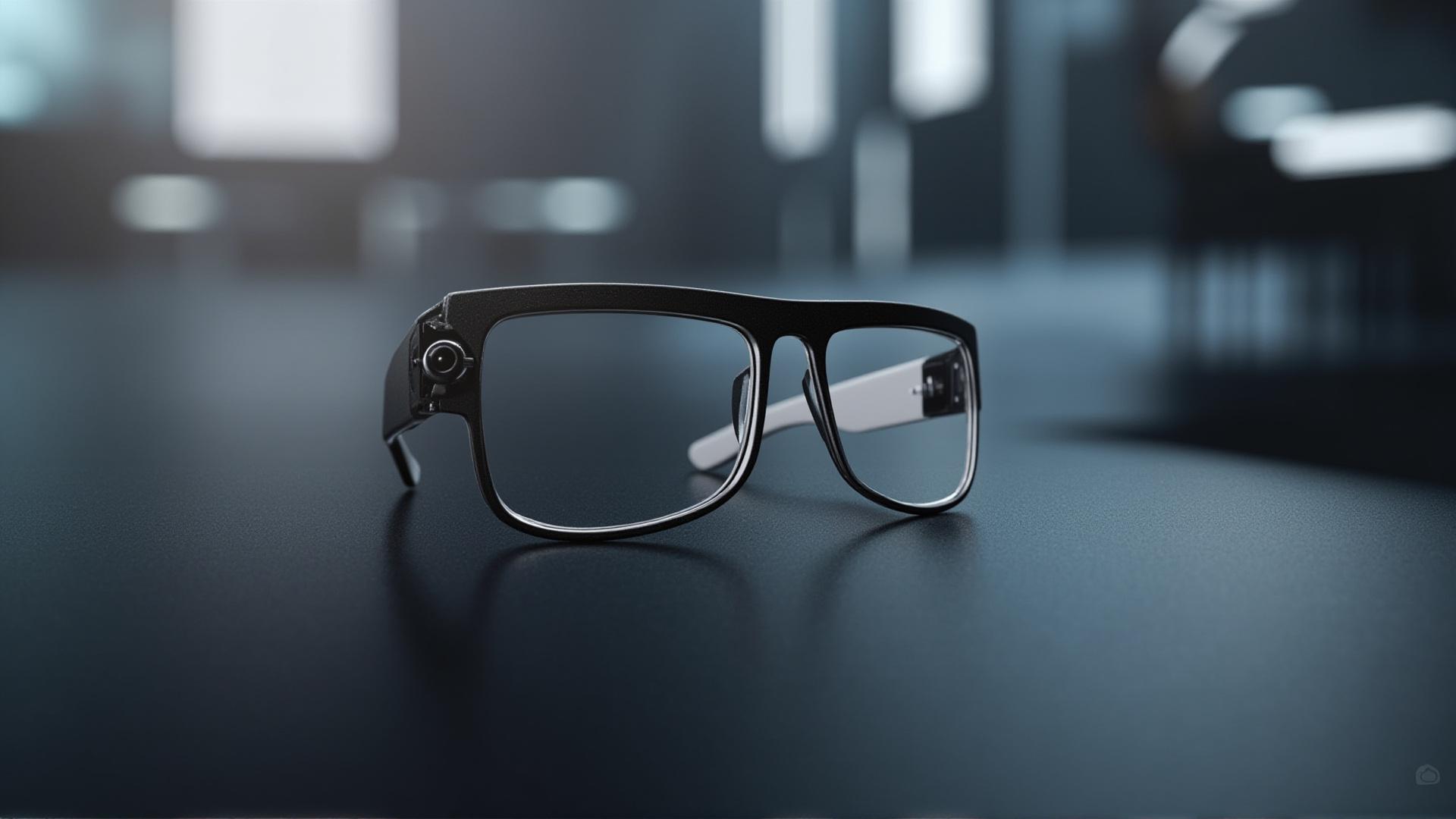
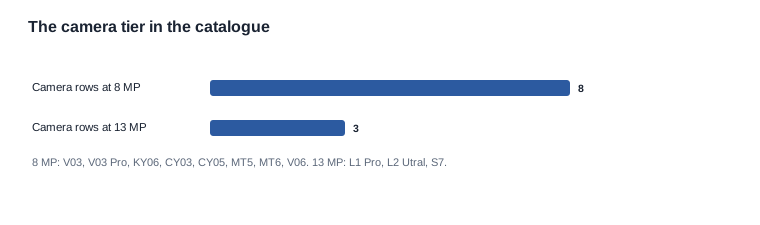
Camera evaluation gets harder the further into a programme you go, because at the beginning you are comparing what the product claims and at the end you are comparing what it does in the customer's hands, and the two diverge in ways no specification sheet flags. The difficulty in this category is that the published camera data is thin to the point of absence. Our catalogue publishes two resolution tiers — 8 MP and 13 MP — and essentially nothing else about the imaging: no sensor model, no field of view, no video resolution or frame rate, no stabilisation, no low-light behaviour, no storage format. The rows printed around the camera describe the product the camera sits in rather than the camera itself, and the two are easily confused by a buyer who reads the table quickly.
This article is about the considerations that only become visible once a sample is in use, and about which of them actually decides a purchase rather than merely occupying a column.
Smart glasses camera technology: where camera meets frame
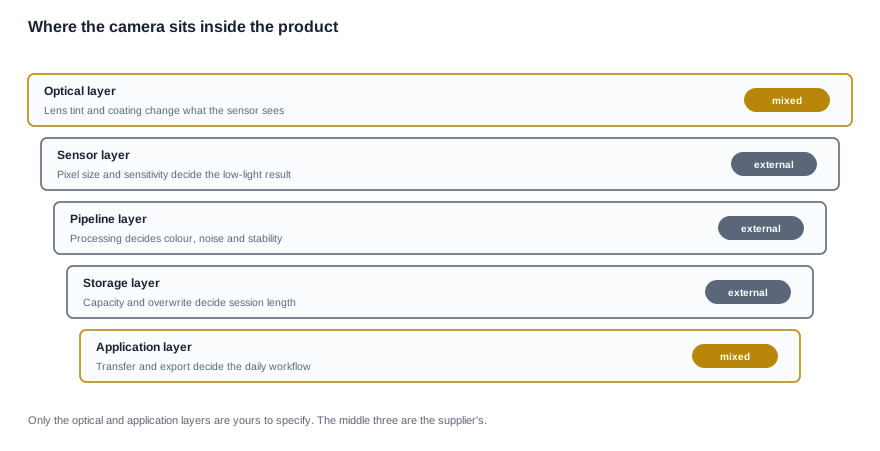
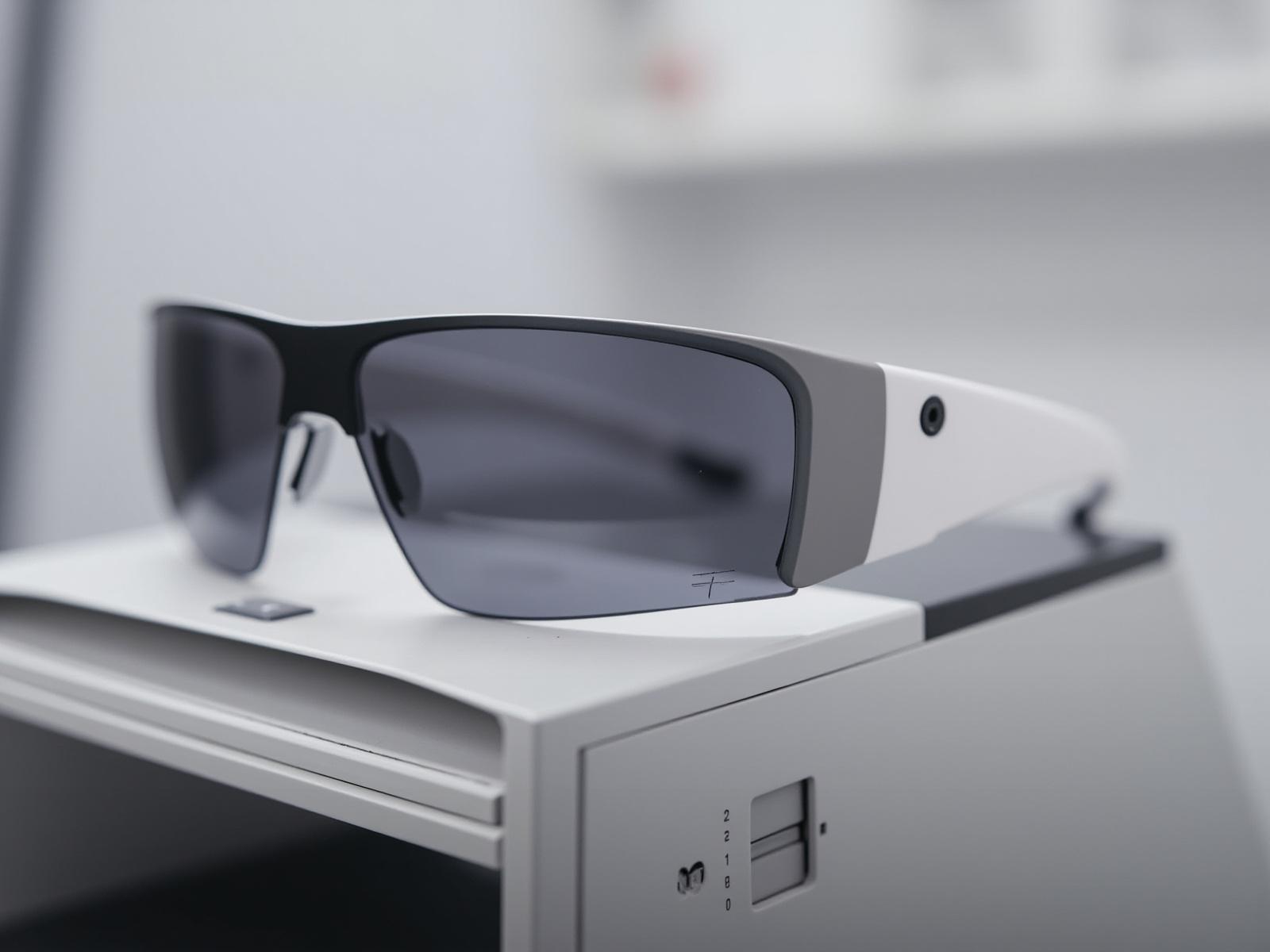
A camera in a temple is not a camera in a case, and the two halves of the product constrain each other in three ways that the camera specification does not describe.
Mass is the first coupling. A camera module at the front of a temple is a mass concentration at the end of a lever, and it changes the retention behaviour, the load on the hinge and the moment felt at the temple when the head turns. In a product sold for content creation, where the head is moving constantly, that is a returns issue rather than a preference issue. It is also the reason the frame specification matters to a camera buyer: the same sensor in a lighter temple and a heavier temple are two different products, and the catalogue does not publish a frame weight for any camera model. The single published weight in the whole catalogue is the MT6, at 158 g for the glasses body including the 265 mAh battery and the camera, excluding the foldable charging case, whose own weight is not published. That figure is useful as an order of magnitude and useless as a specification for any other row.
Optical coverage is the second coupling, and it is the one most often missed. The frame occludes part of the scene in front of the operator. A camera whose field of view does not account for the frame geometry records the edge of the frame's own temple, and a product advertised on the strength of its field of view can therefore be misdescribed by the frame that carries it. This is why the field of view is the row to insist on, why it has to be measured on the assembled product rather than on the module, and why its absence is a genuine blocker for a first-person video product.
The lens is the third coupling. A tinted or electrochromic lens changes the exposure the camera sees, and if the lens changes state during a recording the exposure changes inside the clip. The V03 Pro is published with a photochromic lens configuration, which makes this a live issue in this range rather than a theoretical one: a clip that begins in a bright space and continues into shade will carry a visible exposure change that customers read as a fault and suppliers read as a lighting condition. The commercial question is not whether the exposure shifts, but whether it shifts in a way the pipeline corrects.
These three couplings share a property that matters commercially: none of them appears in the camera specification, and all three are decided by decisions taken in the frame and the optical design. That is why a camera buyer who evaluates only the imaging rows ends up with a product that images well and still does not do the job.
The imaging rows a procurement file has to obtain itself
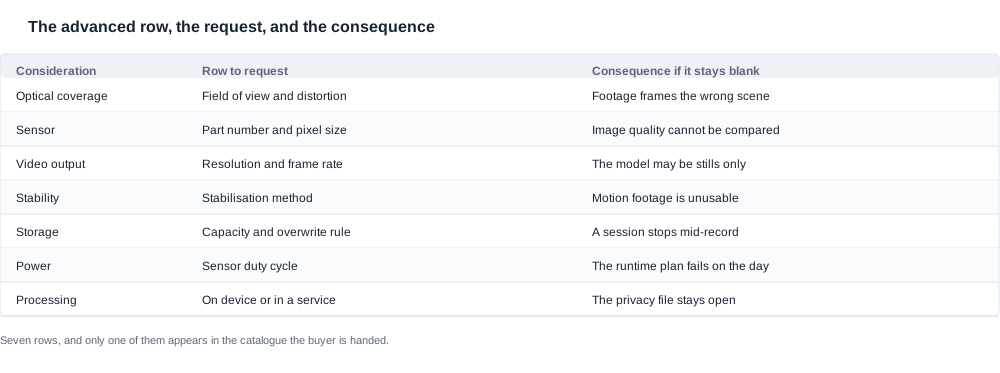
Seven rows have to come from somewhere other than the catalogue, and the table above sets each one against the request that closes it and the commercial consequence of leaving it open. The order of the requests matters, because a part number disqualifies more suppliers per minute of effort than any other question in this category.
The published resolution tier is worth understanding precisely before anything else, because it is the row buyers over-use. Eight MP appears on the CY05 and the MT5, the V06 and the V03 Pro, and the KY06 and the CY03, and the V03 and the MT6. Thirteen MP appears on the L2 Utral and the L1 Pro, and the S7. Resolution is a count of pixels and nothing more: it does not state how large the pixels are, how much light each one gathers, how the camera behaves at dusk, or whether the product records moving images at all. A 13 MP sensor with small pixels can produce a worse image than an 8 MP sensor with large ones, and the published row cannot tell you which you have. Its legitimate use is grouping products into tiers and setting a price structure. Its illegitimate use is predicting image quality, which is how a listing page ends up promising something the product cannot deliver.
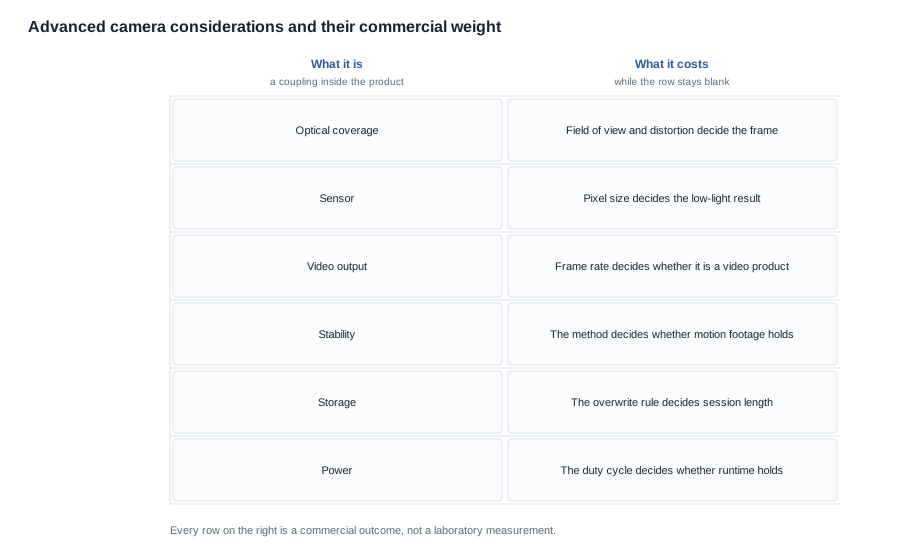
The matrix above sorts the seven rows by two properties that decide how much effort each deserves. A row that is decided by hardware can often be closed by a part number and a datasheet; a row that is decided by firmware can only be closed by a measured behaviour on a sample. A row that is decisive for the use case deserves the whole verification budget, and a row that is incidental deserves a paragraph.
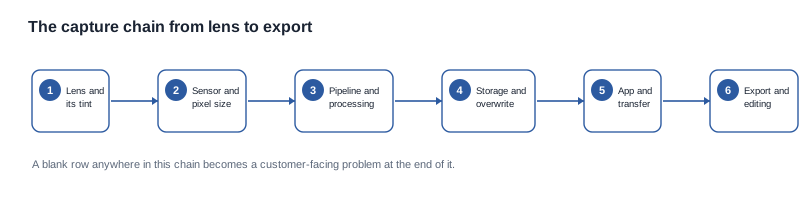
Three of the seven deserve particular attention because they are the ones that change what the product is. The video output row decides whether the model is a video product or a stills product, and the catalogue publishes no video resolution or frame rate for any of the eleven camera models. The storage row decides whether a session can be completed, and capacity, format and overwrite behaviour are all unpublished. The processing row decides where the captured material goes, and for a product with on-device AI features it decides whether the feature works without a connection and whether a subscription is involved.
Two of the seven are frequently underestimated because they appear to be product details rather than technical rows.
How to evaluate a camera candidate while the rows are still open
Most camera evaluations in this category are run before the rows are closed, and the method for handling that is worth stating, because the alternative is to defer the decision until the answers arrive, which is the point at which the schedule has already decided the outcome.
The method is to score the candidates against criteria you can already apply, and to carry the open rows as a separate, named line. The criteria you can apply are the published ones: the resolution tier, the rated runtime, the cell configuration, the charging method and the case configuration. Between two camera models these five separate a price tier, a battery strategy and a packaging decision, and they are the criteria a quotation is actually negotiated against. The open rows — sensor, field of view, video format, stabilisation, storage, duty cycle, processing location — are then ranked by how many of them would be decisive for your use case, and the candidate that leaves the most decisive rows open is the one that should not be shortlisted.
Two disciplines make this work. The first is to write the open rows into the request with a deadline, so that a blank stays a named blank rather than becoming an assumption. The second is to attach a cost to each open row before the sample programme is scheduled, because the total cost of an unresolved camera row includes the engineering time it consumes, the schedule it delays and the afters exposure it creates if it turns out badly — not just the price of the sample.
When to escalate from a request to a rejection is worth deciding in advance rather than in the moment. The workable rule is that a row which is decisive for the use case and stays unanswered after the request is a reason to cut the candidate, while a row which is incidental can be carried into the acceptance criteria of the first production order as a condition to be verified on delivery. The first rule protects the programme from an unmeasurable product; the second protects it from an unnecessarily small shortlist.
The checklist for a camera candidate is therefore short, and it is a working document rather than a form: the five published criteria, the seven open rows, the two that decide the use case, and the request with its deadline. Anything longer than that is diligence rather than information, and it buys nothing that a specific question would not buy more cheaply. The field of view and distortion row decides whether first-person framing works, and a wide lens produces a small subject at the centre with distorted edges, which photographs dramatically and records badly. The sensor duty cycle row decides whether the published runtime figure describes the product you are buying or a product with the camera idle, and it is the row that converts a runtime claim into a usable production plan.

Power, storage and heat as commercial constraints on a camera model
The camera is the dominant load in this tier, and the published runtimes are the visible consequence. The catalogue prints about five to eight hours for the V06 and the S7, and the V03 Pro and the V03, about six to eight hours for the KY06 and the MT5, and about seven hours for the MT6 and the L2 Utral, and the CY03 and the L1 Pro, and the CY05. Those figures sit on four different cell capacities — 220 mAh, 260 mAh, 265 mAh and 290 mAh — and they are results under conditions the catalogue does not state, which means they are only comparable inside a single cell class.
There is a practical trap in reading the catalogue pages for these figures, and a buyer who falls into it will conclude that most camera models publish no runtime at all. The catalogue labels the same kind of figure three different ways across the camera pages: a usage duration label on some models, an endurance label on others, and a charging duration label on the MT5. All eleven camera models publish a runtime figure. A reader who searches for one label will miss the other two and will arrive at the wrong answer, which is the wrong answer about the most commercially important row on the page.
Heat is the constraint that never appears on a sheet. A sensor running continuously in a temple dissipates into a body that is already warm, and a product sold for a full day of capture has to be evaluated for whether the image quality holds as the unit warms. The thermal behaviour is not published for any model, and the only way to obtain it is a sustained capture on the sample, which is why the acceptance criterion for a capture product should be written in terms of minutes of continuous recording rather than hours of battery life.
Storage is the second commercial constraint, and it is the one that generates returns. Capacity, file format and overwrite behaviour are unpublished for every camera model in the range. The three behaviours produce three different products. A product that overwrites the oldest material is usable indefinitely and needs no mention on a listing page. A product that stops when it fills produces a recording that ends mid-session, and the customer experiences that as a fault rather than as a limit. A product with a small fixed capacity and no external transfer is a session product, and it has to be sold as one.
There is a commercial dimension to the power row that sits outside the engineering file. A camera model whose runtime is published without conditions cannot support a retailer claim, cannot support an afters script and cannot support a warranty position on the original battery, because in each case somebody has to know what the product was doing when the figure was produced. The same applies to heat and to storage. The practical consequence is that these rows belong in the acceptance criteria of the first production order rather than in the product description. A buyer who writes the ceiling — minutes of continuous capture, clips per session, hours of runtime under a stated workload — has produced a document that protects the margin. A buyer who copies the catalogue figure into the listing has produced a document that can be returned against. The difference between the two is a sentence long, and it is the sentence that separates a product that can be sold in bulk from one that generates afters.
The question that closes the storage row in a single sentence is: what happens when the storage fills, and how long does a one-minute clip take to reach the phone. A product that records well and transfers badly has a workflow problem rather than an imaging problem, and no amount of resolution testing will find it.
Which advanced consideration is decisive for which use case
The seven advanced considerations do not carry equal weight in every product, and deciding which ones are decisive is the point of evaluating them at all. Five product profiles cover most of the camera tier, and each has a short list of rows that decides it.
- First-person content creation. The decisive rows, in order, are field of view, video output format, stabilisation and storage. Image quality matters, but framing, format and session length determine whether the customer can use the product as their primary capture device. A buyer who shortlists on resolution here is working on the wrong row.
- Enterprise meeting and field recording. The decisive rows are the processing location, the storage behaviour and the retention arrangement, because the question is where the material goes rather than how it appears. A corporate buyer will also ask about the compliance file before the price, since footage handling sits inside the technical file.
- Translation and assistant products. The decisive question is whether a camera is needed at all. If the product is bought for translation, the camera is cost, mass and privacy exposure with no return, and the audio tier is normally the better buy. Making that decision explicitly costs nothing; making it by default costs a price tier.
- Sport and action capture. The decisive rows are stabilisation, the sustained capture ceiling and the thermal behaviour. The IP rating enters the comparison as a commercial fact: only two models in this catalogue carry IP54, the V06 and the S7, both published with a removable inner frame. A buyer whose product is sold into wet environments, or into a market where the customer expects a water-resistance claim, has two rows to choose from in the camera tier, and the absence of the rating on the other nine is not a statement that they cannot survive spray — it is a statement that no claim may be made.
- Inspection and service applications. The decisive rows are field of view, low-light behaviour and the thermal ceiling, and the decisive question in each case is the same one: does the product keep producing a usable image after ten minutes in the environment where it will actually work?
The method for deciding this before a sample arrives is to write the use case as a sentence, list the rows that sentence turns on, and cut the rest of the evaluation budget. A buyer who evaluates all seven rows for a product where only two are decisive is buying diligence rather than information, and the money is better spent on the two that decide the purchase.
The commercial consequence of skipping this step is straightforward and shows up in the wrong place. A camera model selected on resolution and evaluated on resolution will be signed off by people who never asked whether it records video, and the first sign of the problem will be a returns figure rather than a test report. That is the most expensive way to find out, because it arrives after the tooling is committed, the packaging artwork is printed and the first bulk order is already in production.
The boundary we draw around unpublished camera rows
The short answer: we publish the resolution tiers and the electrical rows accurately, and we will not convert an 8 MP or a 13 MP figure into a statement about image quality, because resolution is not a quality metric and the sensor data that would support one is not published to us. We publish no field of view, no video specification, no stabilisation figure, no aperture, no storage behaviour and no low-light data for any camera model, and we will not estimate them from a typical value in the industry. An estimate that turns out to be wrong becomes a defect in the product rather than in the document.
There is a second published position that belongs in the same paragraph. The AI feature details for this range — which models are supported, whether they work without a connection, whether a subscription is involved, where the material is stored — are not published. For a camera product with AI features, that is a question to settle before the listing copy is written rather than after it is published, because the copy has to describe what the customer actually gets.
What we can also do is put the camera rows into a commercial frame. When a buyer sends the model, the annual volume, the destination market and the use case, we can tell them which configurations exist, which of the seven rows are likely to be decisive for that configuration, what has to be requested to close them, and how those requests translate into the quotation and the lead time rather than into a three-week delay. We can also be straight about the commercial terms where they bite. A camera model with a custom enclosure carries tooling and NRE that a standard configuration does not; a private-label route changes who owns the mould, and therefore who can change the product in year two; and a bulk order that fixes a configuration also fixes whatever specification gaps were still open at the time of the order. Those are the points at which a camera sourcing decision is really made, and they belong in the same conversation as the imaging rows.
What we can do is check a completed camera file against the published rows for that model and tell you which findings are consistent with the published configuration and which point at something the product description should be saying. We will also tell you which rows remain open, because an open row that is named as open is manageable and an open row that is invisible is the one that causes the problem. The imaging context sits under camera and imaging, the reading method for the published rows is in how to read a datasheet, the row-by-row explanation of the catalogue is in camera technology spec sheet explained, and the camera models are listed on the ai camera glasses range page.
Send the model and the use case, and we will say which of these considerations are decisive for that use case and which you can leave to the end of the evaluation.


