
Content creation is the clearest use case in our range and also the one where the published specification is thinnest, which produces an awkward position for a buyer who wants to build a product around a capability they cannot read off a page. Smart glasses for content creation how we help is therefore a question about scope rather than about features: what a manufacturer can carry for a content business, what has to be established on a sample, and what nobody can honestly promise. A supplier who blurs those three things costs the buyer more time than a supplier who refuses to answer.
This article draws the boundary explicitly. It covers the five essentials a content programme genuinely needs from the device, the things we can do without new development, the things we will not pretend to, the questions we ask before we quote, and the way an evaluation is run when you work with us.
Smart glasses for a content business: the five essentials we can carry
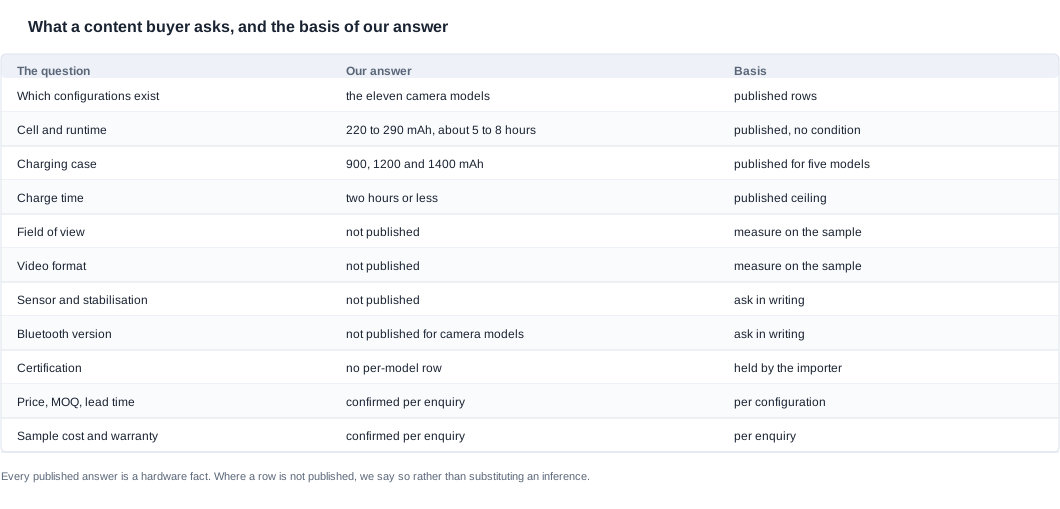
Five things decide whether a wearable camera is usable for content. Each one is a row that a content business has to have an answer to, and each one is a row we either publish, can answer in writing, or have to measure on a sample.
1. A field of view wide enough for the shot. The frame geometry occludes part of the scene, so the usable angle is a property of the assembled product rather than of the lens alone. We publish no field of view for any camera model, which means it is established on a sample against an angle the buyer can brief a creator against.
2. A frame rate and a shutter that survive movement. A head-mounted camera is nearly always moving, and this is the row that decides whether walking footage is watchable. No camera model in the range publishes a frame rate or a shutter behaviour.
3. A storage behaviour the workflow can live with. Whether the unit overwrites the oldest material, whether it stops recording when it is full, and how much it holds in total. We publish no storage capacity, format or overwrite behaviour for any model, and a content business that shoots for hours needs a session limit it can plan around rather than discover.
4. A capture latency short enough not to be noticed. The delay between the control and the frame is the first thing a creator reacts to, and it undermines confidence in every other measurement if the operator cannot tell whether the shot registered.
5. A charging arrangement that survives a shooting day. The camera is the dominant electrical load in this tier, and the published runtimes of roughly five to eight hours reflect it. The published case capacities of 900, 1200 and 1400 mAh are what turn that figure into a working day, and they are the reason the case is a configuration decision rather than an accessory.
The camera key specifications article sets out how these rows are normally written and where the terminology in a datasheet tends to mislead.
Two of the five can be narrowed before a sample is even ordered. The lens and colour options are published for exactly two camera models: the V03 Pro carries a photochromic lens with three colour options and the V06 publishes four colours. The ingress marking is published for exactly two as well: the V06 and the S7 carry an IP54 marking, and nothing in the catalogue carries an ingress rating beyond those two. A buyer whose programme depends on a lens option or on a weather claim can therefore shortlist from the published data in a few minutes, and everything else on the list is a measurement.
There is also a row on this list that no supplier can settle for you, and it is worth naming early: the frame weight. Only the MT6 publishes one, at 158 g for the glasses alone and explicitly excluding its 1200 mAh foldable case. Every other model in the range publishes no weight at all, so for a creator programme where comfort decides whether the device is used at all, the weight is a sample measurement like the rest.
What a smart glasses supplier can do without new development
Most of what a content programme needs can be delivered from configurations that already exist, and a supplier who treats the missing rows as a development project is charging for work that was never necessary.
Narrow the range to the configurations that exist. The published camera tier gives two resolution tiers, cell configurations from 220 mAh to 290 mAh, charge times of two hours or less, magnetic or Type-C charging where it is published, and case capacities at 900, 1200 and 1400 mAh. A first selection can be made from that without a single new development.
State the rows that are missing, model by model, instead of leaving a gap. A buyer planning a product around camera capability needs to know at the outset that the field of view, the video format, the sensor, the stabilisation, the storage behaviour and the capture latency are not published, and that they will be established on samples. That single disclosure is worth more than a feature list, because it converts the evaluation from a discovery process into a design process.
Confirm the unpublished rows in writing, against the exact model string. Where we hold the answer, it can be given to the buyer as a written confirmation rather than as a catalogue line. That is the mechanism the AI feature options article describes for the camera tier's AI position, and it applies equally to the electrical and radio rows.
Support a configuration change inside the published option space. When a creator's real experience on a sample changes the requirement — a case becomes necessary, a lens option becomes relevant, a colour becomes the one the channel wants — that change is usually a configuration change rather than a development. It is also usually the cheapest kind of change to make, because it does not touch the platform.
Supply the documentary inputs the buyer needs. A technical data sheet for the shipped configuration, a written confirmation of the cell configuration for the transport file, a packing list, and a declaration that the goods match the approved sample. These are ordinary manufacturing outputs and they are the ones that get a shipment through a customs system.
Support the sample and evaluation protocol. The sample cost and the sample lead time are confirmed per enquiry, and so is everything else commercial. What does not change is the discipline: a written acceptance criteria for each measurement, a result logged against it, and a tolerance agreed for the first delivery.
Support the brand-side work that does not touch the platform. Logo, colour and packaging sit on the brand side of the line, and the depth of what is available is set out in our customisation options article. Where a programme wants a brand-side change, it is worth keeping separate from the product-side questions: a packaging change is a printing and artwork matter with its own lead time, while a change to the capture behaviour is a measurement exercise. Mixing the two in a single request is the most common reason a sample request comes back with only half of it answered.
What we cannot evidence on smart glasses, and will not claim
The second half of the scope matters as much as the first, because a supplier who draws the line clearly is saving the buyer a procurement dispute.
We cannot supply a field of view, a video specification, a sensor model or a capture latency. None is published to us, and no inference from a resolution tier would be defensible. These are established on a sample.
We cannot supply a claim about content quality. Nothing in our published data supports a statement about how good the footage is, and a resolution figure is not such a statement. A brand that wants to make that claim has to measure it, and then the claim belongs to the brand, with the measurement attached to it.
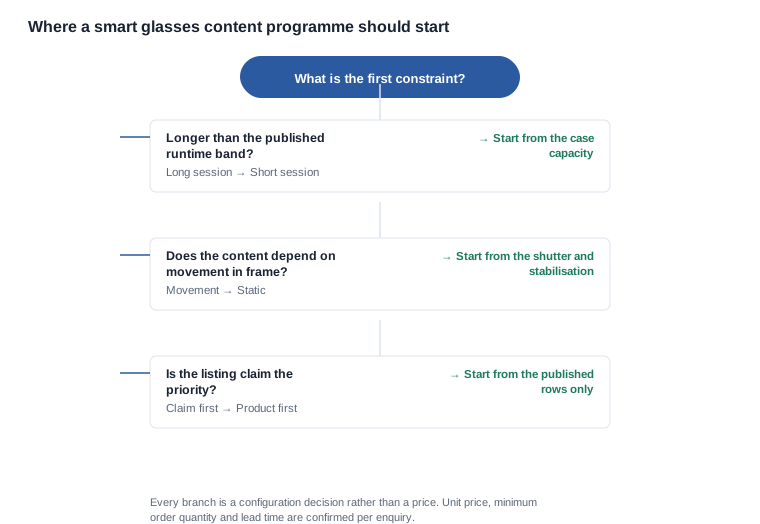
We cannot guarantee a shooting day on one charge. The published runtime carries no stated condition, and the camera's duty cycle is the variable that decides it. We will tell you which published configurations reach your session length and where the case does the work.
We cannot point to a per-model certification row. Our catalogue names no certification mark for any model. The export-certification page is a picture page carrying ten patent certificate images, eight design patents and two utility models, which is evidence of design work rather than a per-model regulatory position. Market approval sits with the party that places the goods on the market in each destination.
We cannot publish a price, a minimum order quantity or a lead time on a page. Each of those depends on configuration, quantity, documentation and the current schedule, so each is confirmed per enquiry.
We cannot claim a translation or a touch capability. Our catalogue contains no translation row for any model and no capacitive-touch row for any model, so we will not describe any unit in this range as translating on the fly or as touch-controlled.
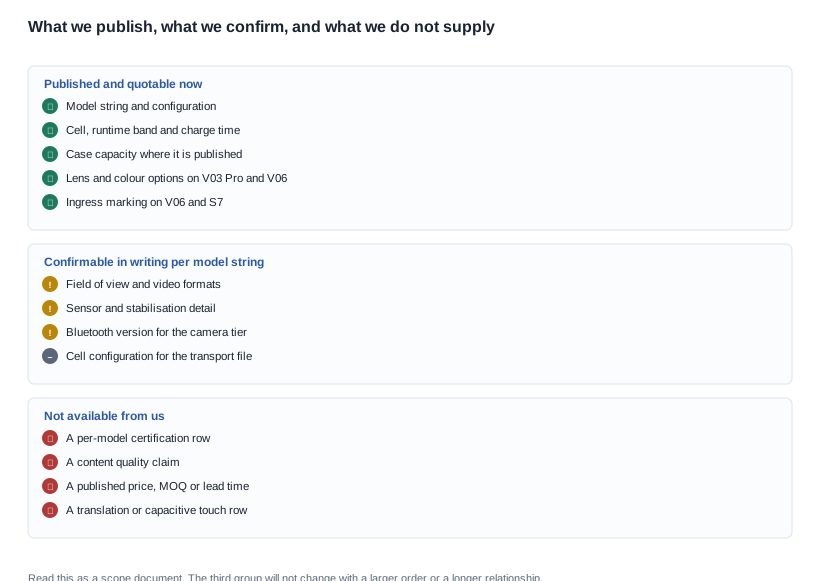
Read that list as a scope document rather than as a list of refusals. Everything in the first group is quotable today. Everything in the second group is obtainable in writing against a model string. Everything in the third group will not be produced by us under any circumstances, and a programme that depends on one of those has a structural problem that no amount of supplier goodwill will fix.
The reasons behind the third group are worth explaining, because they are not a negotiating position. A published row that we cannot evidence is a row that a regulator, a marketplace reviewer, a channel partner or an end customer may one day ask us to defend, and we would rather leave the row empty than fill it with an estimate. An estimate that turns out to be wrong costs more than an empty row, because the buyer has already built a listing on top of it. Where a row is genuinely unavailable, the honest response is to say so early, while the specification is still cheap to change, rather than to leave a buyer to discover the absence during a compliance review.
There is one more group that belongs on this list even though it is not a refusal: the rows that depend on a specific market. A certification position, a Declaration of Conformity, a GPSR file and a local-language label are not ours to produce for a market we are not placing goods in. They are not refused, they are simply located on the other side of the line, and naming which side they sit on is the most useful thing we can do before an order is placed.
The questions we ask a smart glasses content buyer first
Five questions, asked before a quotation rather than after one, because each of them changes the answer.
- What is the content, and where is it shot? A creator in a controlled studio and a creator on a street need different things, and the second is where the shutter and the low-light behaviour decide the product.
- How long is a shooting session, and what is the gap between sessions? This decides whether the charging case is a convenience or a requirement, and it is the single question that most often changes the configuration.
- How is the footage used, and how long is it kept? This decides whether the storage behaviour and the format matter, and whether the data path of any processing is a question for your legal team rather than for ours.
- Is the product for your own use or for resale? The first is a business tool and the second is a product with a documentation burden, a warranty exposure and a packaging obligation. The two programmes are entirely different and should not share a specification.
- What is the proposition, in one sentence? This is the question that decides the model, and it is worth answering before any specification is written.
It is worth saying what the answers do, because that is the part a buyer can check us on. The first question removes most of the range before any measurement is planned, because a creator who shoots in a controlled studio and a creator who shoots on a street at night need different things and are not choosing between models so much as between problem sets. The second question usually decides whether a charging case is in the configuration at all, and a case changes the carton, the freight and the listing. The third question decides whether the storage behaviour matters enough to be a pass or fail condition. The fourth decides the whole shape of the programme, because a product for resale carries a documentation burden, a warranty exposure and a packaging obligation that a product for internal use does not. And the fifth decides the model.
The reason for asking all five before quoting is simple. Each answer changes the configuration, and the configuration changes the price, the minimum order quantity, the lead time, the sample cost, the warranty and the documentation. A quotation issued against an unformed brief is a quotation for one configuration that may not be the one the buyer ends up buying.
The five questions a buyer should ask us are the mirror image, and they are worth writing down before the first call: which configurations exist with their published rows, what is not published about the camera, what the case and charging options are and what the runtime looks like with a case, what the documentation position is for the exact variant, and what you may say in your own listing and what you may not.
How to run a smart glasses evaluation with us
The evaluation has a shape, and running it in order is what keeps it from becoming an argument about samples.

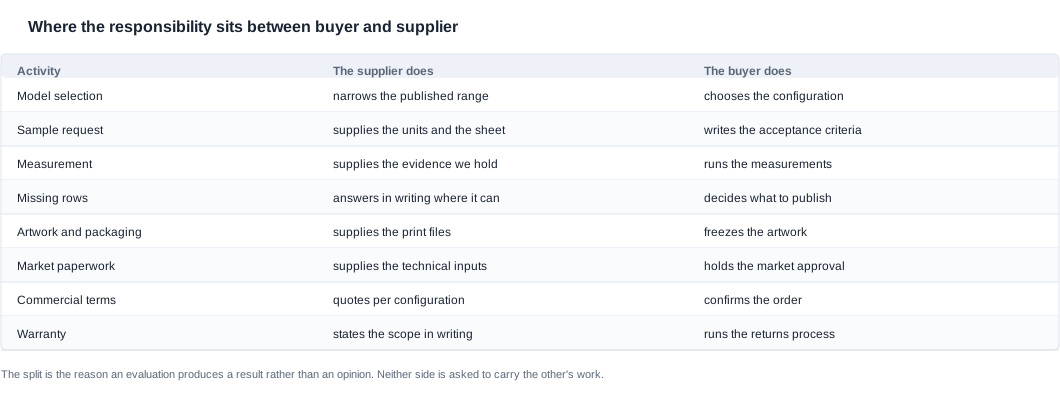
Step one is a short brief, not a request for a price. Content type, environment, longest continuous capture, number of units, and the destination markets. That is enough for us to narrow the range and to tell you which published configurations reach it.
Step two is a written scope of what will and will not be established. The rows that are published, the rows we will confirm in writing, and the rows that will be measured on a sample. This becomes the acceptance criteria for the evaluation and, later, the acceptance criteria for the delivery.
Step three is the sample. The sample cost, the sample lead time and the shipping arrangement are confirmed per enquiry, as are the unit price, the minimum order quantity, the lead time, the warranty scope and any tooling the configuration needs. A sample that arrives without the written scope produces impressions rather than results, so the two travel together.
Step four is the measurement, run by you. Field of view on the footage, shutter behaviour while walking, low-light response at a stated illuminance, storage behaviour when filled, latency on the control that will ship, and runtime with the case. We are not going to run this for you, because the result is only meaningful if it was produced in the conditions you actually work in.
Step five is the order with the criteria attached. The purchase order should carry the configuration, the published rows, the measured results, the tolerance you will accept on the first delivery, and the documents the shipment requires. A first delivery checked against that list is a routine event; a first delivery checked against a memory is a dispute.
Step six is a pilot before the volume order, if the programme is large enough to justify one. A pilot exercises the same documentary path and the same production process at a size where a problem is still cheap.
The cost side of this is straightforward and worth stating plainly. The measurement work, the samples, the pilot and the artwork are all visible costs that a buyer can plan for; what is not visible is the rework that follows a specification that was closed on an opinion. That rework is the reason the acceptance criteria are written down, and it is the part of the total cost that an evaluation is designed to remove.
What happens after the first delivery is part of the same design. A repeat order is a new batch rather than a new delivery of the same goods, so the acceptance criteria that closed the sample have to be carried forward, and it is worth deciding in advance which of the measurements are re-checked on the first delivery and which are covered by the production record. That decision is much cheaper to make while the criteria are being written than while a batch is waiting at the port.
The support structure around the product matters too, particularly for a distributor who holds stock rather than for a brand who ships direct. Spare units, the replacement process, the documentation a returns case needs and the warranty scope are all part of what a channel partner asks about before they stock anything. Our warranty position, the spare-parts position and the returns process are set out in the catalogue, and the specific terms that apply to a configuration are confirmed per enquiry and written into the quotation rather than left to be agreed case by case.
The AI camera glasses range carries the per-model published rows for the eleven camera models, and the content creation solution page shows how a camera model fits into a creator programme once the imaging and the power questions are settled. Tell us the content, the shooting environment, the session length and the destination markets, and we will narrow the range, mark the rows that have to be measured, and put the rest of it in a quotation.
Related reading
- Smart Glasses for content creation
- AI camera glasses range
- Camera key specifications
- AI content creation feature options
Tell us the content, the environment, the session length and the markets, and we will narrow the range and mark what still has to be measured.


