
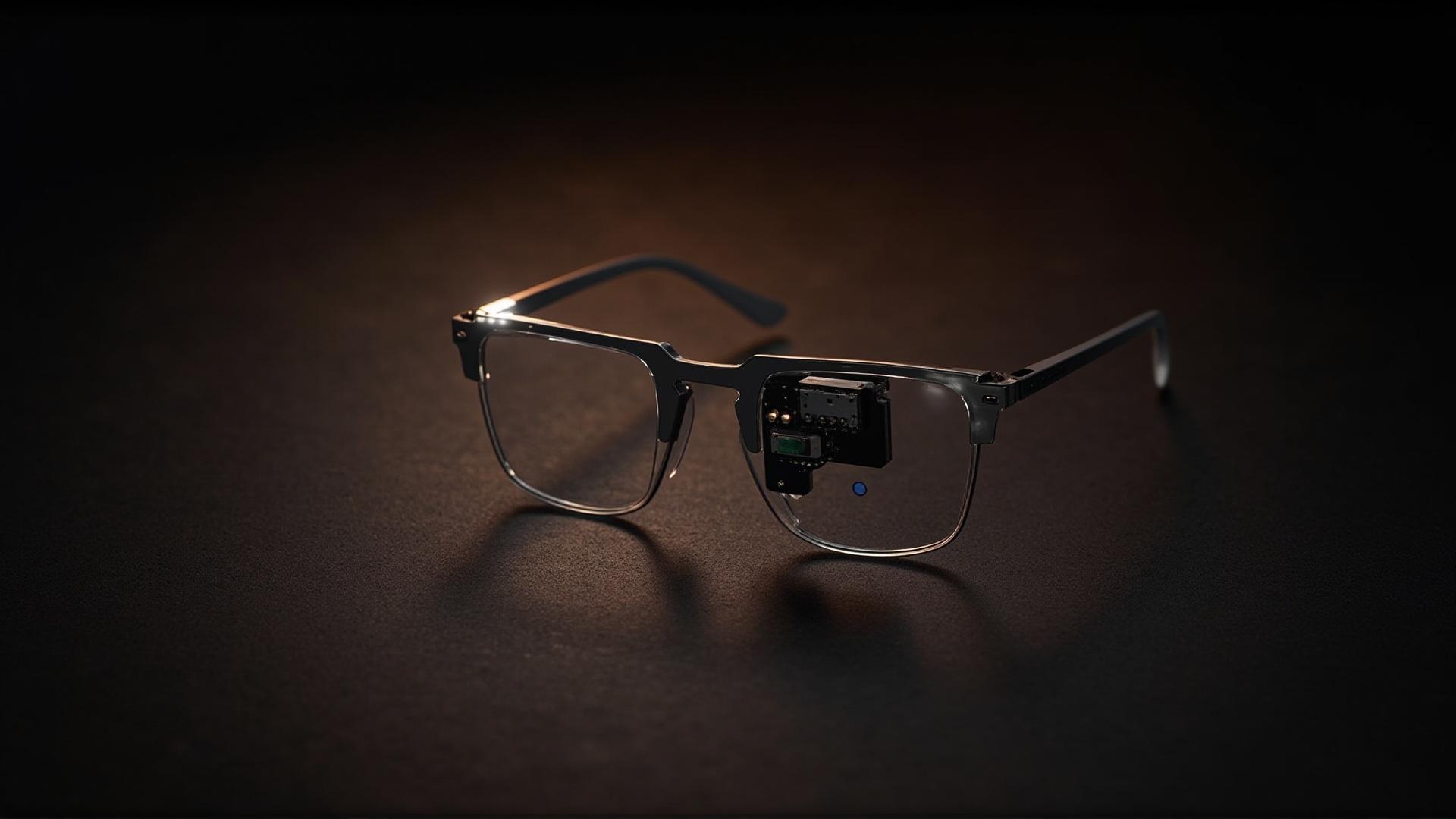
AI camera glasses customization options are the part of a supplier relationship where the published sheet and the commercial reality diverge most sharply. A catalogue can tell a buyer that a platform supports a customisation; it cannot tell the buyer whether that customisation is available on the model they are ordering, at the volume they are ordering, within the programme they have planned, or with the documentation their market requires. Those four qualifiers are where the cost lives, and none of them is visible on a product page.
This article takes the opposite approach to the usual one. Instead of listing what can be customised, it lists what has to be asked — item by item — and where the answer belongs once it arrives: in the quotation, in the artwork approval, in the purchase order or in the compliance file. We do not quote customisation charges, tooling costs, NRE, sample fees, certification handling fees, minimum orders or lead times anywhere in this article, because our catalogue publishes none of them, and a number we cannot evidence is worse than an open question that a factory will answer properly.
Our camera range covers eleven models — the V03 and the MT5, the V03 Pro and the V06, the L2 Utral and the CY03, the S7 and the CY05, the KY06 and the MT6, and the L1 Pro — and the customisation discussion below is framed around those eleven and the published rows that belong to them.
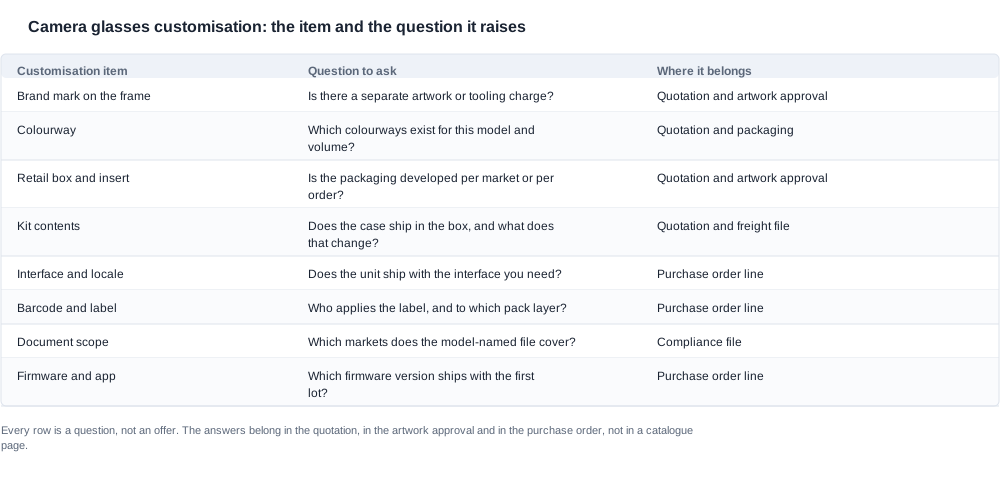
AI camera glasses customization options: eight items to ask about
Eight items cover almost every customisation enquiry we see in this category. They are listed below not because they are a checklist of features, but because each one has a different failure mode and a different document that eventually has to carry it.
One, the brand mark on the frame. The constraint here is not willingness, it is moulding. The printable area, the position and the finish options are set by the tooling rather than by the design, and a mark that has to be repositioned because of the mould is a tooling event, not a graphic-design event. The OEM ready brand guidelines cover the mapping step where the hardware pushes back on the identity, and the practical sequence is to get the mould constraints in writing before the artwork is approved.
Two, the colourway. A colourway is a production dimension rather than a decoration, because it changes the unit, the box, the label and often the master carton. The product photography piece covers the consequence for the listing, and the sizing notes cover the frame dimensions that a colour change has to sit inside.
Three, the retail box and the insert. Packaging is the largest single tooling commitment in most camera glasses programmes, and it is the item most often developed before anyone has settled what goes in the box. The packaging design reference and the AI camera glasses packaging options piece cover the structure of that decision, and the order of the two questions matters: what is in the box, then what the box looks like.
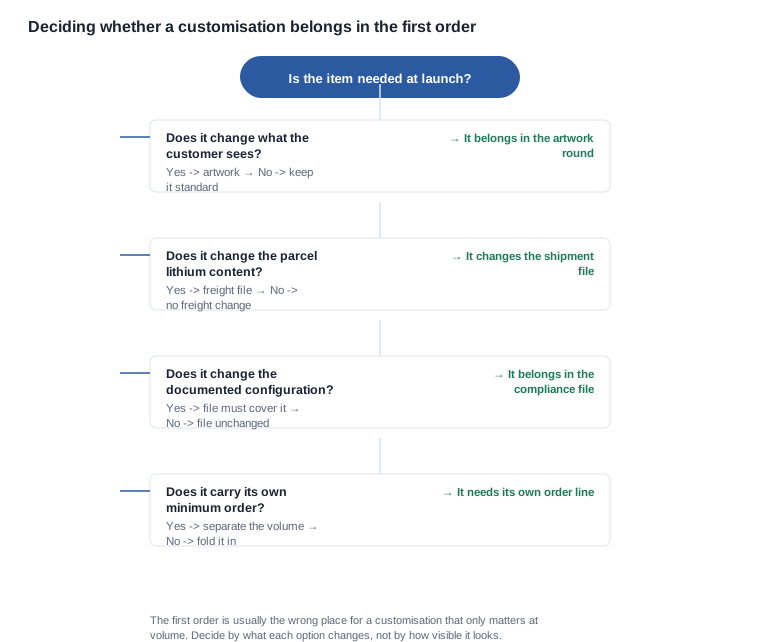
Four, the kit contents. Whether a charging case ships in the box is a decision with a freight consequence, because a case is a second lithium item. Five of our eleven camera models publish a case capacity, two ship a case whose capacity is not published, and four have no case row at all, so a custom programme built on the catalogue has to carry the case position for those four as an open item. A customisation that changes the kit contents therefore changes the transport documentation, the parcel and the freight class at the same time.
Five, the interface and the locale. The charging method is published for seven of the eleven camera models and not for the other four — the CY03, the CY05, the L1 Pro and the MT6. A programme that ships into a market with a different socket standard is making an interface decision at the same time as it is making a compliance decision, and both need to be in the order rather than in a later change request.
Six, the barcode and the label. Who applies the label, to which layer of the pack, and whether it is applied by the factory or by the buyer's own fulfilment centre changes the packing instructions, the carton artwork and the timing of the first shipment.
Seven, the documentation scope. A customisation that changes the documented configuration — and several of the items above do — can move a unit outside the coverage of an existing document. The export documentation checklist covers the retention side of that, and the point to raise early is which markets the file has to cover rather than which models it names.
Eight, the firmware and the app. Which firmware version ships with the first lot, and whether a software feature can be presented as part of the proposition, is a question about what the customer receives rather than what the factory builds. It is on the list because it is frequently answered late, and because a listing built on a feature that is not in the shipped version is a returns problem rather than a marketing problem.
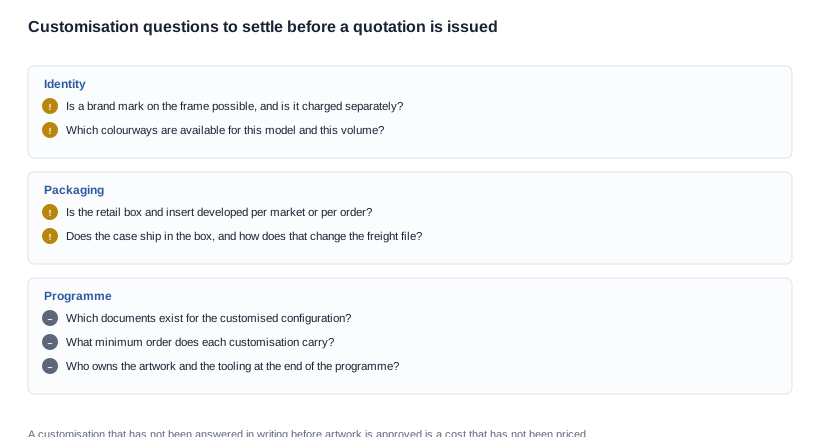
What a platform-level customisation claim actually tells you
The phrase "customisation options by platform and model" describes a real distinction, and buyers who do not separate the two ends up comparing a platform capability against a model-level need.
A platform-level statement means the platform supports the customisation in some form, on some model, at some volume. It is a statement about a hardware and software design, not about an order. It does not say which models in the platform carry the option, whether the option is available in the configuration you are ordering, whether it carries its own minimum order, what it costs relative to the standard configuration, or how long it adds to the programme.
A model-level statement means the specific model in the specific configuration supports it. That is the statement a purchase order needs, and it is the one that has to be produced in writing. On our own range the gap between the two is visible in the published rows. The case capacity, for example, is published at platform level for some models and absent for others, and a programme that planned around "a case" without checking which model carries one would be planning against a platform statement.
Three consequences follow, and they are worth stating before any question is sent.
The first is that the model list has to be part of the answer. A customisation claim that arrives without the list of models it applies to has not been answered. The OEM ready model readiness overview is the internal map of where platform sharing is documented, and it is worth reading alongside any platform-level claim, because it shows which parts of a range genuinely share and which only appear to.
The second is that volume changes the answer. Customisation is the area of a camera glasses programme where the economics change most sharply with scale, and the change is not linear. Below a certain quantity, a customisation costs more than the margin it adds, because the tooling and artwork are one-off costs and the unit saving is not. Above it, the same customisation is close to free at the unit level. This is why the question "what minimum does this option carry" is not a detail to be skipped: it is the question that decides whether a customisation is viable for your programme at all. It is also a question a factory answers precisely, because it knows the answer, and it is on the list in the private label minimum order discussion.
The third is that a customisation can outlive the programme it was created for. If the artwork, the tooling and the packaging route are specific to your brand, then ending the programme raises a question about who owns them and what happens to the remaining stock. That question is rarely asked at the start, and it is much harder to answer after the relationship has ended. The OEM ready scaling up piece covers how a programme changes shape as volume grows, and ownership of the assets is one of the things that changes with it.
There is a fourth point, which is not a commercial one but which causes more trouble than any of the three. A customisation changes what the documentation has to cover. A different colourway, a different kit, a different interface or a different label can all move the finished unit outside the configuration that was tested or documented. That is why item seven above is on the list at all, and why it belongs in the purchase order rather than in a marketing conversation.
The questions to put in the enquiry, item by item
The value of a question is in how precisely it can be answered. A question with a number attached gets a number back; a question about possibilities gets a paragraph back, and a paragraph cannot be put in an order. Here is the form that works.
What is the charge for this option, and is it one-off or per unit? One-off charges and per-unit charges are both legitimate and they are usually presented in the same sentence, which is why the question has to separate them. A tooling charge, a mould charge and an artwork charge are one-off and belong in the quotation as capital items; a per-unit charge belongs in the unit price and belongs in a total-cost calculation. A buyer who does not separate them cannot compute a landed cost, which is the number the whole programme is decided on.
What minimum does this option carry, and does it differ from the minimum on the standard configuration? This is the question that decides viability, and it is also the question that tells a buyer something about how the supplier has structured the programme.
How long does this option add to the schedule, and where does it sit in the sequence? A useful answer separates the artwork stage, the tooling stage, the production stage and the delivery stage. An answer that gives a single combined number cannot be used to plan, because it tells the buyer nothing about which part of the programme they could shorten by changing something else.
Which documents cover the customised configuration, and for which markets? The answer should name the document and the market, not the supplier's general capability. The OEM ready platforms pricing tiers piece covers the related question of how a configuration sits in a supplier's commercial structure, and the same principle applies to documentation: a tier is a commercial description, a named document is evidence.
Who owns the artwork, the tooling and the packaging route, and what happens to them if the programme ends? This is a question about the end of the programme and it should be asked at the beginning, because the answer is easier to get before the assets exist and much harder afterwards.
What happens if the specification changes after approval? In practice the interesting sub-question is whether a change to the artwork, the kit contents or the interface invalidates any document already held, and whether the supplier will notify a change of platform or a component substitution. A notice obligation is cheap to agree and expensive to obtain later.

Two conventions make the whole exchange work. Ask one question per line — a numbered list, so the answer can be numbered back and a missing answer is visible. And ask the same list of every supplier, because a supplier who answers seven of eight lines has told you which line is difficult, and that is itself a finding about how they will run the programme.

Turning the answers into quotation lines
An enquiry produces a set of statements; a programme needs a set of commitments. The conversion is where customisation programmes lose their shape, and it is worth doing deliberately.
The first step is to sort every answer into one of four destinations. Answers that carry a cost go into the quotation, with the amount, whether it is one-off or per unit, and the minimum it applies to. Answers that create an artwork or packaging dependency go into the artwork approval, as a named approval with an owner and a date. Answers that describe the unit itself go into the purchase order line, as a specification of what will be delivered. Answers that describe documentation go into the compliance file, as a named document with a market attached.
The second step is to check that the four destinations agree with each other. A quotation that includes a new box, a purchase order that specifies the standard box and an artwork approval for the old box is a programme with three different intentions, and the mismatch surfaces at the packing station rather than in the negotiation. The cross-check is mechanical and it takes an afternoon: line up the customisation list, the quotation lines, the order lines and the artwork proof side by side and read them across.
The third step is to attach the evidence to the commitment. A customisation that is described in an email but not attached to the contract is a preference; the same customisation described in the order with a sample reference is a commitment that can be inspected on receipt. This is the same discipline that applies to inspection criteria: an acceptance criterion needs a protocol and a consequence, and the AI camera glasses buying guide covers how the rest of the purchase order should be structured.
A fourth step is the one that is easiest to skip and most expensive to skip later: write the variants into the change-control clause. A programme that ships a customisation in one colourway in year one and two in year two has not made a small change; it has made a new configuration, and the documentation, the packaging, the artwork and the freight documentation all have to be revisited. Recording the variants in advance, with a rule about which changes are permitted without a new approval, is what keeps that from becoming a negotiation every time the range grows.
The negotiation itself is easier once the answers are sorted this way, because what is left is a short list of trade-offs rather than a bundle. The number of customisation configurations you commit to is the number that carries the one-off costs, and it is negotiable. The artwork round count is negotiable and it is cheap to settle. The minimum on each customisation is a fact rather than a term, and it belongs in the viability calculation rather than in the negotiation. The ownership of the tooling and the artwork is a term, and it is usually settled without difficulty when it is raised early and argued about when it is raised late. A buyer who knows how to evaluate which of these is which — how to compare the options, what to ask, and which questions have a fixed answer — negotiates a shorter list and finishes the programme sooner.
Why we do not quote customisation terms in this article
A customisation question deserves a specific answer from the factory, and a general answer published on a web page helps nobody. So this article publishes the questions and the structure, and it does not publish answers we cannot evidence.
Specifically, we publish no customisation charge, no tooling or mould cost, no NRE, no sample fee, no certification handling fee, no packaging minimum, no customisation minimum order and no lead time for any customised configuration of any of the eleven camera models. We also publish no commitment that a particular customisation is available on a particular model, because availability at a given volume is a property of a programme and not of a catalogue page. The how to customise the L1 Pro and how to customise the CY05 pieces set out the same reasoning for two specific models, and the same answer applies to the other nine.
What we do publish is the structure: the eleven camera models, the frame cell capacity, the charge time, the rated runtime, the resolution tier, the charging method where it is published, the case status in all four of its states, the ingress marking on the V06 and the S7, and the one unit weight in the range at 158 g for the MT6 glasses unit excluding its foldable case. Those are the rows a customisation decision can rest on, and they are the same rows any supplier's sheet should carry.
The commercial terms that belong with a customisation — MOQ, unit price, lead time, payment terms, packaging cost, tooling ownership, warranty, defect responsibility, sample terms and the treatment of NRE — belong in a quotation and in a purchase order, where they are specific, negotiable and enforceable. The AI camera glasses buying guide covers the category decision that has to be made before a quotation is requested, and the range itself is at AI camera glasses.
If you are building a customisation list for this range, send us the models, the quantities, the target markets and the items you want changed. We will tell you which of our published rows constrain the request, which of the eight items above will need a written answer before a quotation is meaningful, and which parts of your requirement remain open until a sample and a factory have both been involved.
Related reading
- The decision on category — AI camera glasses buying guide
- Brand identity constraints — OEM ready platforms brand guidelines
- Packaging structure — customization options packaging design
Send us the models, the quantities and the items you want changed, and we will tell you which published rows constrain the request.


