
Smart glasses for content creation are not one product and one decision. They are six different jobs sharing one hardware platform, and the published data settles the model for four of those jobs while leaving two of them closed until a supplier answers a question no catalogue can answer. If you are a buyer choosing what to put into a content channel, the first useful step is not a model comparison. It is naming what is actually being made, because the same camera platform behaves very differently depending on whether the output is a short first-person clip, a live stream, a meeting record, a voice track with a visual, a translated session, or an unattended capture nobody sits next to.
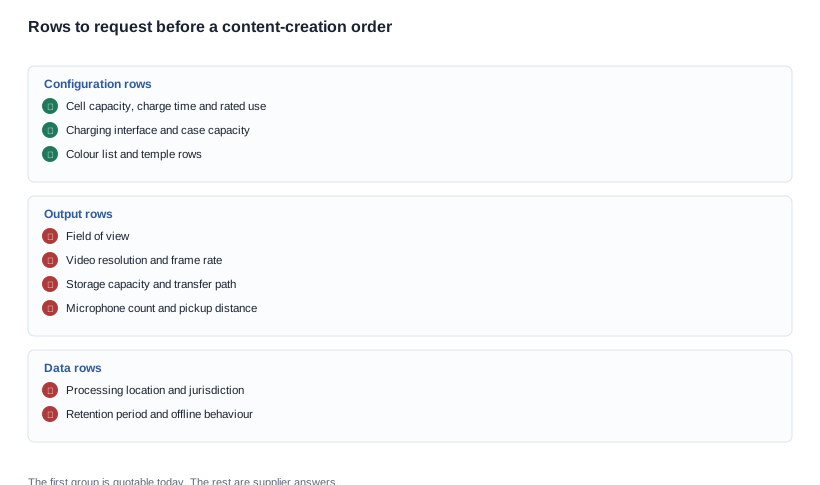
Three things this page settles. First, the published rows that genuinely decide a model: the resolution tier, the cell capacity, the rated runtime, the case capacity, the charging interface and the charge time. Second, the rows nobody publishes — the field of view, the video format, the frame rate, the storage behaviour, the transfer path, the microphone specification and the data position — and therefore the eight questions worth putting in writing before a purchase order. Third, the two content jobs that cannot be deployed at all on the current published position, and what that means for a range you are scoping this quarter.
The smart glasses for content creation page covers the channel itself, the AI camera glasses page lists the configurations and their published rows, and the how to test camera technology page covers the sample protocol.
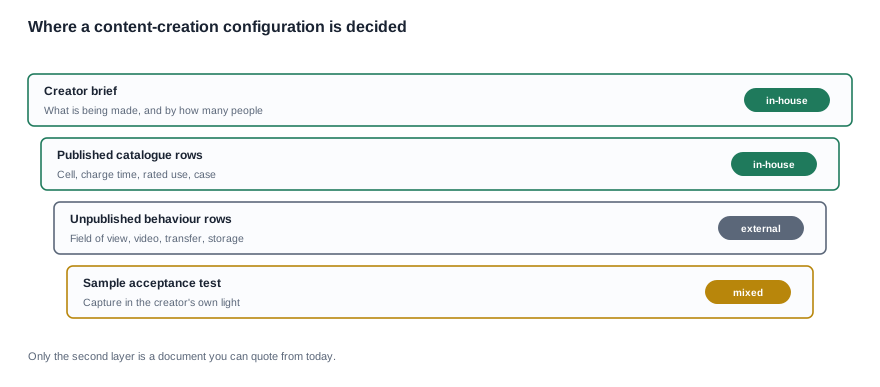
Who this page is written for. A brand owner is defining a content range and needs to know which of the six jobs the published data can support at all, because that number sets the number of stock-keeping units, the number of accessory chains and the size of the support team. A channel buyer is placing the order and needs the published row behind every model in the range, so that the listing copy can be written from the document rather than from a competitor's landing page. A procurement manager is qualifying a supplier and needs to know which questions will be asked during supplier evaluation, because a supplier who cannot answer the eight output and data rows in writing is a supplier who will not answer them at the second order either. The thing each of them is defending is different — a range architecture, a price band, or a schedule — but the checklist behind all three is the same, and it is the list below.
Smart glasses for content creation: the question each of six content jobs poses
A content channel buys a device to do one of six things, and each of those things has a different binding constraint. The mistake most buyers make is treating them as one procurement with six accessories. They are six procurements, and the price of getting that wrong is not a bad unit — it is a range that lists a capability the documentation cannot carry, and a support guide written for a job nobody in the channel actually does.
The published hardware is common to all six. The camera range carries two resolution tiers: 8 megapixels across the CY05 and the MT5, the V03 and the CY03, and the V03 Pro and the MT6, and the KY06 and the V06, and 13 megapixels across the L2 Utral and the S7, and the L1 Pro. Cell capacity runs from 220 mAh to 290 mAh, charge time is published at two hours or less across every model, and rated use falls between five and eight hours depending on the model. The charging interface divides the range three ways — magnetic, Type C, and not published — and the case capacity divides it again, with 1400 mAh on the CY03 and the CY05, and the L1 Pro, a 900 or 1400 mAh configuration choice on the L2 Utral, and a 1200 mAh foldable case on the MT6.
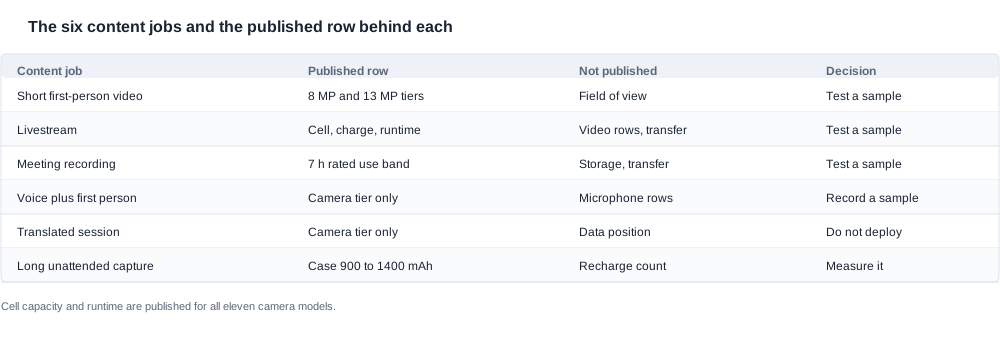
What differs is the constraint, and each job has exactly one binding row:
- Short first-person video is the strongest fit in the range. The cell, the charge time and the case capacity are all published, and the binding constraint is the field of view, because it decides whether the frame captures what the eye sees or a crop of it. No model in the range publishes it. The decision rule is therefore: pick on the published power rows, then confirm the framing on a clip from the creator's own shoot.
- Livestreaming turns on three unpublished rows at once — video resolution, frame rate and the transfer path — plus the thermal behaviour over a long session. The power rows are comfortably sufficient; the output rows are not published at all.
- Meeting recording is a one-hour job that the rated runtime covers with room to spare, and it turns on whether the recording runs unattended and whether the file is retrievable afterwards. That is the storage behaviour and the transfer path, neither of them published.
- Voice content with a first-person clip adds a microphone question that the camera tier does not answer. The microphone count, the pickup distance and the processing mode are not published for any model in the range, and on an open-ear frame the same temple carries the speaker, so a voice track and a loudspeaker share a structure.
- Translated sessions depend on a capability that sends audio to a service, and every model in the range has an unestablished data position: where the audio is processed, which jurisdiction it is stored in, how long it is retained, and whether it works offline.
- Long unattended capture is the one job where the case is the product. Published case capacities run at 900, 1200 and 1400 mAh, but the number that matters is not the capacity on the label — it is the measured recharge count, which is what actually extends a session.
A buyer who walks this list ends up with a shortlist, not a favourite. In practice four of the six jobs point at the camera models with the 290 mAh cell and a published case — the L2 Utral, the L1 Pro and the CY03, and the CY05 — and the remaining two point at nothing until a supplier answers in writing.
The two jobs that cannot be deployed without a data position
Translated sessions and any capability that routes audio to a service are not blocked because the hardware is weak. They are blocked because the published documentation is silent on four specific things: the processing location, the data jurisdiction, the retention period and the offline behaviour.
This is a procurement blocker, not a feature gap, and the distinction changes the commercial conversation. A feature gap means you buy something else. A procurement blocker means you cannot ship into a particular market at all until a document exists. A brand buyer in a regulated European or North American market will ask the question during supplier qualification, and the honest answer today is that the figure is not published for any model in our range. A buyer who discovers that at the border, rather than at the quotation, has already committed tooling, packaging artwork and freight.
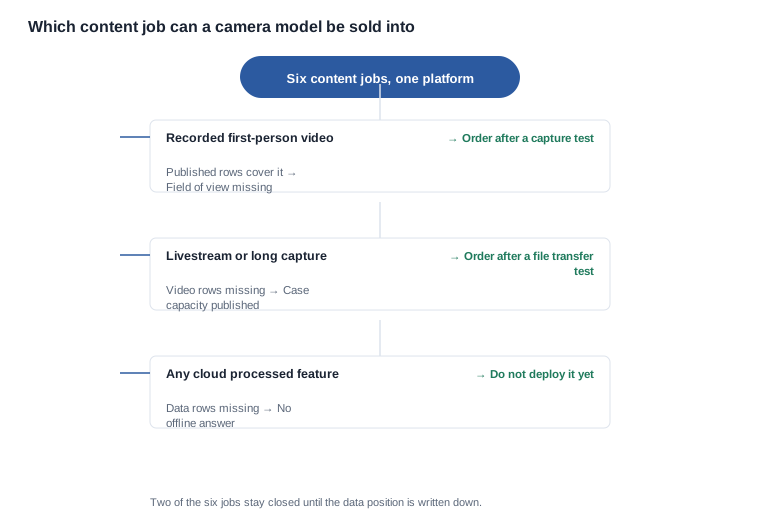
The commercially sensible response has three parts. Plan the range without the capability, so the product architecture does not depend on an answer nobody has given. Ask for the four data rows in the same message as the four output rows, because a supplier who answers one set of gaps and not the other has told you something about the programme. And keep the capability out of the listing copy in every market, because a listing that describes a cloud-processed feature the technical file does not support is a claim your own support team cannot defend.
None of this is a reason to leave the category. It is a reason to plan around a known boundary rather than around an assumption. The AI camera glasses page lists every configuration and its published rows, and a buyer working from that page can already tell which six jobs each configuration can be positioned into.
Which specification rows are settled, and which are not published
Separating the two groups is the single highest-value hour a buyer can spend in this category, because the settled rows can be used in a listing, a comparison table and a quotation, while the open rows can only be used as questions.
Settled, and quotable today. Resolution tier, per model. Cell capacity, from 220 mAh on the V03 and the MT5, and the V03 Pro through to 290 mAh on the CY05 and the CY03, and the L1 Pro and the L2 Utral. Charge time, published for every model. Rated use, from the five to eight hour band on the V03 and the V06, and the V03 Pro and the S7 through to roughly seven hours on the CY03 and the CY05, and the L2 Utral and the L1 Pro, and the MT6. Charging interface, published per model except where the catalogue publishes no such row. Case capacity, where published. Colour lists, temple structures, the remote capture control on the D17 and the ZH12, and the IP54 catalogue marking on the V06 and the S7.
Open, and therefore a question rather than a figure. The field of view on every model. Video resolution and frame rate on every model. Storage capacity and the behaviour when storage fills. The transfer path and the transfer time for a large file. The file format the recording produces. Microphone count and pickup distance. Start-up latency. Thermal behaviour over a long session. The runtime test condition behind every rated use figure. The per-model unit weight, with the single published figure of 158 g for the MT6 — the glasses body including the battery and the camera, excluding the foldable charging case, whose own weight is not published.
Two warnings belong next to that second list. The first is that a resolution tier is not a framing characteristic, so an 8-megapixel figure cannot be quoted as a substitute for the field of view. The second is that a catalogue marking is not a test report: the IP54 attribute published for the V06 and the S7 is a catalogue attribute, and no third-party test report is published behind it.
One further caution belongs in this section rather than at the end of the article. A buyer will ask about CE, FCC and RoHS, and those are the right questions to ask — but the catalogue publishes a company-level export certification page and no per-model certification row, and the full text contains no reference to CE, FCC or RoHS. So the certification scope for a specific model is written material to request, not a fact to repeat from a brochure.
A second caution applies to the charge time, because it is the row buyers misuse most often. The catalogue publishes a charge time for every model in the range — two hours or less across the board, with roughly one hour on the D17 and the ZH12 — and that figure is genuinely useful when you are comparing two configurations of the same model. What it does not say is the state the battery was in when the clock started, or the point at which charging is treated as complete. Without a starting state and an end criterion, a charge time cannot be turned into a shift-interruption figure, and it certainly cannot be used as the turnover time for a charging case. When a buyer asks how long a gap in a creator's day has to be, the honest answer is that this is a question for a sample unit on a timer, not an arithmetic exercise on a published figure.

How a buyer confirms the choice before the purchase order
The verification sequence for this category is short, because most of it is a document request rather than a measurement.
- Request the four output rows in writing, in the same form as the published rows: the sensor model, the field of view, the video resolution and the frame rate. A verbal answer is not a specification, and the four rows are the ones that decide whether the model can be listed.
- Request the four data rows in the same message: the processing location, the data jurisdiction, the retention period and the offline behaviour. Sending them together means one answer closes both gaps, and a supplier who answers only one set has revealed the priority.
- Ask for the configuration string, in full. A case, a colour and a logo are three different orders and three different prices, and "a camera model with a case" is not a configuration.
- Run a capture test in the creator's own light, on the shortlisted models only, and open the resulting file on the editing machine rather than on a phone. The how to test camera technology page sets out the full protocol.
- Measure the case recharge count for any model being sold on a long-session proposition, rather than deriving it from the case capacity printed on the label.
- Write the acceptance criteria before the shipment, not after the first claim. A numeric band agreed in advance is what converts a disagreement about a unit into a record.
A seventh step is optional and usually skipped: reading the model's own published rows side by side with the rows it does not publish, and noticing which of the open rows actually changes a buying decision for the specific job. For a one-hour meeting recording, the field of view barely matters and the storage behaviour matters enormously. For a first-person clip, the reverse is true.
Where a content-creation programme goes wrong commercially
Four failure patterns account for most of the cost in this category, and all four are decided before the order rather than after it.
The content job was chosen after the model. A buyer picks a model because a capability looked attractive on a brochure, then discovers the capability depends on a data position nobody has established. The symptom is a compliance question the brand cannot answer, and in a regulated market it is a withdrawal rather than a delay. The prevention is the six-job list, before the shortlist.
The resolution tier was treated as the field of view. The footage is technically correct and cropped, and the complaint that reaches the channel is that the image is soft. Root cause is a stills figure read as a framing characteristic. The prevention is the field of view row, and a clip from the real shoot rather than a demonstration.
The buffer was derived rather than measured. A creator runs flat in the middle of a session because the case capacity was divided by an assumed session length. The arithmetic is not wrong, it is just not evidence, and the recovery cost lands on the channel as a support escalation and a refund. The prevention is the measured recharge count.
The runtime was quoted without its condition. The catalogue publishes rated use as a band, and the band is a figure rather than a promise. A creator who films all day and expects the top of the band will describe the product as faulty. The prevention is the condition behind the figure, or the measured result, quoted in the listing rather than a bare number.
A fifth pattern is worth naming because it is quieter: a range that tries to serve all six jobs from one model serves none of them well. The accessory chain, the support script and the listing copy are all different for each job, and the range quietly becomes six half-products rather than one good one.
A sixth pattern is the one that hurts most commercially, because it is invisible until the next order. A supplier quotation that answers the output rows with a brochure sentence rather than a specification leaves the buyer with nothing to sign. The trade-off to negotiate is not the unit price at that point; it is whether the supplier will put the rows in writing, attach them to the order and accept the consequence when a unit does not match them. A supplier evaluation that treats a written row as a commercial deliverable rather than a courtesy will tell you within one order which suppliers you can scale with, and the criteria to use for that comparison are the same criteria that decide whether a returned unit is a defect or an expectation gap.
What a factory will and will not commit to in writing
On this category, deliberately narrow. We publish the rows a buyer can order from, and we will not fill the gaps with industry averages or with a figure from a comparable product. For the content-creation range that means the resolution tiers, the cell capacities from 220 mAh to 290 mAh, the charge times, the rated use bands, the charging interface where the catalogue publishes it, the case capacities where they are published, the structural features, the colour counts, and the single published weight of 158 g for the MT6 glasses body, excluding its foldable case.
What we will not publish, and will not estimate: the field of view, the video format, the video resolution, the frame rate, the storage capacity, the transfer path, the microphone count, the pickup distance, the start-up latency, the thermal behaviour, the runtime test condition, the standby draw, the cycle life rating and the operating temperature range. We will also not state that a particular model is tested to IP54, because no test report is published behind that marking, and we will not extend it to the models where no rating is published at all.
What we will do is take the six content jobs, the creator count, the target market and the price band, and tell you which configurations exist for each job, which published rows apply, which rows have to be closed before the order, and which capability cannot be positioned into a regulated market on the current documentation. The smart glasses for content creation page is the channel entry point, the AI camera glasses page lists the configurations and their rows, and the how to test camera technology page covers the sample protocol.
Send us the content types you are selling, the quantities, the target markets and the price band, and we will return the published rows that cover each configuration, the eight rows to request in writing, and the honest list of claims the listing can make without overreaching.


