

Most content-creation buyers start with megapixels and stop there, then discover two months into a programme that the thing limiting the output was storage, or the transfer path, or whether the device could be started fast enough to catch the moment. This checklist is ordered the other way round. It begins from the recording session you actually run, works backwards to the specification row that session requires, and only then moves to commercial terms. Every line is either answerable from published documentation or explicitly marked as the gap it is.

Smart glasses for content creation: a buying checklist that starts at the shoot
The short answer. A buying checklist for this category should be run in three tiers, and the order is the whole point. Tier one is the shoot: how long the recording runs, where the file has to arrive, what happens between takes, and who is in the frame. Tier two is the specification rows those answers imply, and four of them are not published for any model in our range. Tier three is commercial, and it cannot be discussed until tier two has been answered in writing. A price quoted against an unspecified video product is not a price you can compare, and the checklist exists to make that sentence impossible to say.
Why the shoot comes first. Every model in this catalogue records. The published rows distinguish them on camera tier, cell capacity, charge time, charging interface, case capacity and rated use, and the differences between two shortlisted models are frequently smaller than the differences between two shoots. A creator shooting thirty-second clips indoors and a creator walking a trail for three hours have different requirements, and no catalogue row will tell you which of them a given model serves. The shoot is the variable; the model is an output of it.
Who runs the checklist and what it has to produce. A buyer running the list in a supplier call is trying to separate two things: the rows the supplier has measured, and the rows the supplier intends to measure later. A procurement manager running it in writing is building the document that becomes the specification, and needs every gap named rather than assumed. A brand owner running it before opening a material number needs to know how many distinct configurations the segment actually supports, because that number decides the SKU count, the accessory chain and the returns reserve. A channel buyer running it against a sample needs to know which lines the sample can close and which lines need a factory document.
What is already published, so the checklist can skip it. The eleven camera models publish a camera tier of 8 or 13 megapixels, a cell capacity from 220 mAh to 290 mAh, a charge time of two hours or less, a rated use between five and eight hours, and a charging method on seven of the eleven. The charging case is published at 900 mAh, 1200 mAh or 1400 mAh on five models, published as present but unquantified on two, absent as a catalogue row on three and explicitly published as not included on one. The catalogue carries a company-level export certification page with ten appearance-design patent certificate images and no per-model conformity row.
Running the checklist live rather than sending it as an attachment
A checklist sent as an attachment is answered as a spreadsheet, and a spreadsheet is answered with whatever is quickest to type. A checklist run live in a call is answered with what the supplier actually knows, because the pauses are visible.
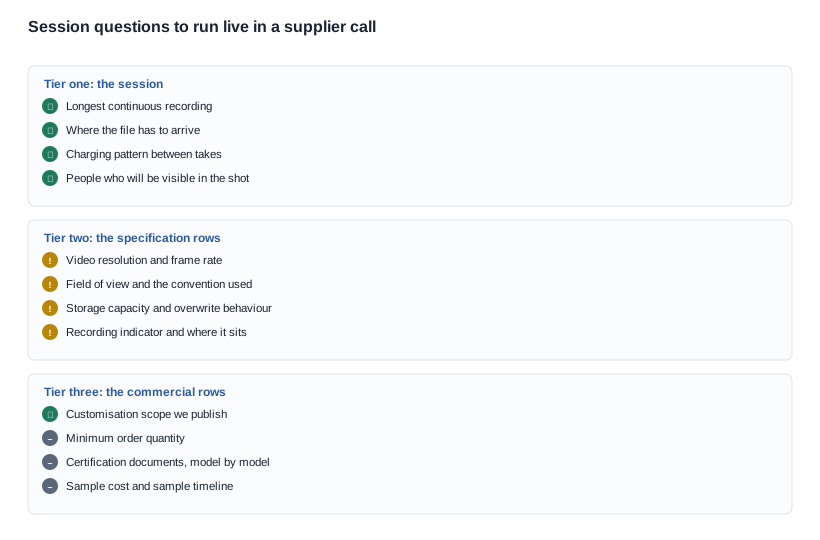
The distinction that makes the call worth having is between an answer and a promise. A row answered immediately, with a number, a convention or a document reference attached, is a row the supplier has measured or holds. A row answered with "we will confirm", "it is the same as the other model" or "that depends on the batch" is a row the supplier has not measured, and for this application there are several such rows that most suppliers have not measured. Write both kinds of answer down, and mark the difference. The date on that record is what turns a conversation into evidence.
The four tier-one questions, and why each one changes the model. The longest continuous recording decides whether endurance is a constraint at all. The destination of the file decides whether the transfer path and the storage behaviour outrank the sensor. The charging pattern between takes decides whether a charging case is an accessory or the reason the product works at all, and the published case capacities of 900, 1200 and 1400 mAh are the numbers to hold in mind while you ask. The number of people in the frame decides whether the recording indicator has to be hardware rather than an application state, because an indicator that only exists while a phone is connected is an indicator that disappears exactly when a bystander asks about it.
Two questions that are not about the device but change the order. Whether the range supports prescription lenses in your market, and who fits them, because a channel that sells to a segment wearing prescription lenses needs that answered before the SKU is chosen rather than after. And whether the footage is published under the brand's own name, because that determines whether the conformity file has to be reissued in your name and therefore whether the documentation route is a line in your budget.
How to phrase the tier-one questions so the answers are usable. A vague question produces a vague answer, and a vague answer in a supplier call becomes an assumption in a purchase order. "How long does it record?" invites a rating. "What is the longest continuous recording you need a creator to complete without a gap, and how many of those happen in a day?" invites a number you can test against. The same applies to the file destination: "where does the footage go" is answered with a workflow diagram, and "which application has to open the file, on which version of which operating system, and how large is the largest file you will move" is answered with a format and a path. Four tier-one questions, each asked with a number attached, take about ten minutes and determine whether the rest of the checklist is worth running at all.
What to do with a tier-one answer that is vague. Write down the vagueness itself, because a vague answer at the shoot stage becomes a specific failure later. "About an hour" for the recording length is an answer that guarantees a complaint in month two, and the fact that the supplier said "about an hour" is exactly what you want in the file when that complaint arrives. Ask for the longest recording the supplier has actually seen completed, not the one they believe is possible. Where no one has run the workflow, say so in the record rather than letting the estimate stand as an answer. A checklist is only as useful as its record of what nobody has yet tested.
What to do at the end of the call. The answers, the answers you did not get, the date, and the name of the person who answered. A buyer who keeps this record can close a return conversation in two sentences six months later, and a buyer who does not have it ends that conversation with an argument about what was said.
Which specification row answers which session question
The middle tier is a mapping, and the mapping is where the real work is.
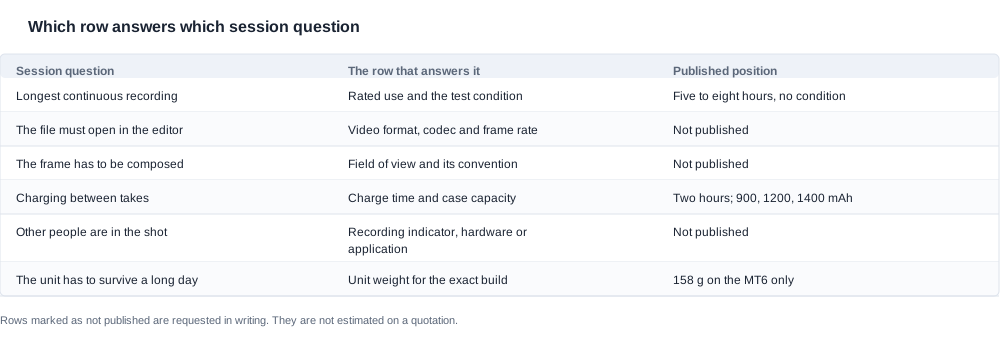
The published answers, so you know where the boundary is. A five-to-eight-hour rated use band on the 220 mAh models and about seven hours on the 290 mAh models answers the endurance question at the level of a category, provided it is quoted with the fact that no test condition is published for it. A two-hour charge time answers the turnaround question. The case capacities answer the reserve question. The camera tier answers the stills question. The charging interface answers the cable and the spare-parts question. Everything else in the table above is a row that has to be requested.
The four rows that are not published for any model, and what each one costs you not knowing. The video format with its codec and frame rate decides whether the editor can open the file, and a device that records a file nobody can open is a return category. The field of view decides whether a frame can be composed or only cropped afterwards, and a field quoted without saying whether it is diagonal, horizontal or vertical is not a usable number. The storage capacity and the overwrite behaviour decide whether a take survives, and a device that stops recording when storage fills is a workflow failure rather than a defect. The transfer path with the application name and version floor decides whether a channel keeps working after an update ships.
The unit weight row is narrower than it looks. The catalogue publishes a weight for exactly one model, the MT6 at 158 g, and that figure is the glasses body including its cell and camera and excluding the foldable charging case. It is not a frame weight, it is not a range average, and it transfers to no other model on a different platform. For every other configuration the weight is not published, which makes weight a row to request and weigh rather than a row to interpolate.
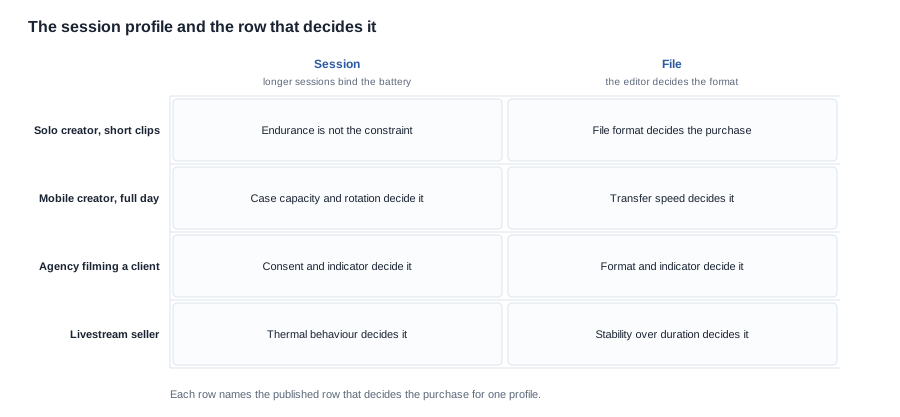
How the profile turns into a shortlist. The matrix names, for four common session profiles, the row that actually decides the purchase. In every one of the four cases the deciding row is one the catalogue leaves open, which is the practical finding of the whole exercise: the rows that decide a content-creation purchase are the rows that have to be measured, and the published rows tell you which model is a candidate, not which one to buy.
How to write the request for the four open rows so the answers are comparable. Put all four in one message, in one format, with a date. The reason for one message is comparability: an answer to the field of view that arrives with a convention attached, and an answer that arrives as a bare number, cannot be set side by side, and the bare number will be the one you use by default. The reason for one format is the same in a different place — it forces each supplier into the same structure, which is what makes two quotations legible against each other later. The date is there so that silence becomes visible: an unanswered row does not stay unanswered, it becomes a written assumption in the contract, and an assumption in a contract is a liability that arrives with the goods.
What a good answer looks like, and what to do with the other kind. A good answer names the model, the configuration and the measurement condition: the field of view in degrees with its convention, the frame rate with the resolution it pairs with, the storage capacity with the file format at the stated bitrate, and the transfer path with the application and its version. The other kind is the answer that describes a product family rather than a buildable configuration, or that names a document without a number and a date. Neither is dishonest, and both are unusable for a specification. The action in each case is the same: ask again with the model and the configuration written into the question, and record the second answer alongside the first.
The commercial rows, and what each one is worth
Customisation scope is the one commercial row we publish. Logo, colourway, temple styling, packaging and system integration are the service lines. Minimum order quantities are not published, because the figures depend on the configuration and on the accessory set, and a single number quoted before the configuration is fixed is a number that will change. Certification position is a company-level page in the catalogue rather than a per-model row, so per-model certificate numbers, issuing bodies and validity dates are not published and will not be invented for a quotation; they are a written request against your exact configuration, and the certification checklist sets out the list.
The rows worth asking for, in this order. Unit price against a stated quantity band. Minimum order quantity, and separately the minimum order quantity on the accessory set, because the accessory minimum is frequently the larger constraint. Production lead time, and whether it is quoted from the order or from the artwork approval. Sample cost and the sample timeline, and whether the sample is charged against the first order. Delivery splitting. Payment terms against inspection rather than against production. The warranty period with a stated response time on a unit that fails during a publishing week, and the return terms for a unit that arrives in a condition the listing did not describe. The minimum order quantity and payment terms pages cover how those two are usually structured.
Two questions whose answers change the total rather than the price. Whether the case is included in the quoted configuration, because the published case capacities of 900, 1200 and 1400 mAh are separate line items with their own minimum order quantities. And whether the packaging file is produced in the target market's language at no extra per-unit cost, because localisation is cheap as a design decision and expensive as a retrofit.
What a pilot order is for, and what it is not for. A pilot order is worth ordering for one purpose: proving that the open rows hold in production rather than in a hand-built unit. It is not worth ordering to discover whether the product works, because that is what a sample is for and it is cheaper. The design of a good pilot order is a small quantity at a higher unit price, delivered on a short schedule, with the same configuration string and the same accessory set as the production order, and with the sample pass lines attached to it as the acceptance criteria. If the pilot fails a pass line, the failure arrives before the tooling, the artwork and the packaging are committed, which is the entire commercial value of running one. The sample evaluation page sets out what a sample can and cannot prove, and the production capacity page covers the question of whether the schedule you were quoted is the schedule the factory can hold.
What belongs in the agreement. The published rows for the configuration ordered. The four open rows once they are supplied, each with the measurement condition attached to it. The pass lines from the sample test. The warranty period with a stated response. Anything else is either a preference or an assumption, and an assumption in a contract is a liability that arrives with the goods.
Where our published data stops on this checklist
It is worth being precise: a checklist is a document, not a conversation, and the value of one is entirely in the distinction it forces between what is published and what is not. We publish the camera tiers, the charge times, the published structural features, the published case capacities, the rated runtimes, the cell capacities and the charging interfaces for each configuration, and we publish the absence of a video format, a frame rate, a field of view, a storage behaviour, a transfer path, an application version, a runtime test condition, a thermal behaviour, a per-model unit weight and any per-model certificate number with the same prominence. We will not fill a gap with a typical value from the industry, and we will not tell you two models are different when they publish the same tier, the same cell and the same case capacity.
What we will do is run the checklist with you. Send the session, the destination of the file, the quantity band and the two configurations you are considering, and we will mark which lines are answered from the catalogue, which have to come from the factory and which have to come from a sample test. The models and their published rows are listed at the AI camera glasses range, and the selection side is covered at choosing between camera models.
What we will not do, and why it matters to your file. We will not mark a line as closed because a figure exists somewhere in the range rather than on the row for your configuration. We will not carry the 158 g published for the MT6 across to a model on a different platform, and we will not carry a case capacity from one model to another that ships with a case of its own. And we will not give you a minimum order quantity or a lead time as a fixed number, because both depend on the configuration and the accessory set, and a number that changes later costs a buyer more time than it saves.
Running the checklist against your own numbers
- The longest continuous recording you run and where the file has to arrive.
- The charging pattern between takes.
- The two configurations you have shortlisted and the quantity band.
- The four open rows, as one request with a date on it.
We will return the checklist marked against those four inputs, so you can see which lines the documentation already closes and which ones your programme has to close by testing.
Related reading
- AI camera glasses range — published camera configurations
- Choosing between camera models — where the trade-offs sit
- Sample evaluation — what a sample can and cannot prove
Tell us the session, the quantity and the configurations, and we will mark the checklist line by line against what the catalogue publishes and what it does not.


