
Smart glasses for content creation are chosen by the delivery pipeline, not by the specification sheet, and the reason is that the catalogue publishes almost no imaging rows to choose from. Across the eleven camera models there are exactly two published resolution classes: eight megapixels on eight models, and thirteen megapixels on three. Everything a content buyer actually argues about — video frame rate, low-light behaviour, stabilisation, capture latency, and what happens when a clip runs past the storage — is not published for any model. So the selection is a two-step move: narrow to a resolution class using the format you deliver, then close the remaining rows with a written request and a production-sample test. This page is written for the brand manager and channel buyer who has to put a camera platform behind a content line, and it treats the format as the constraint and the device as the consequence.
Smart glasses for content creation are chosen by the delivery pipeline
Who is buying, and what they are defending
A brand product manager is building a camera line and has to decide which resolution class the product sits in. The exposure here is a positioning mistake rather than a technical one: a product launched into the higher class without the imaging rows behind it is a product whose specification claims cannot be defended when a customer asks what the video does in low light. The adjacent imaging reference is camera imaging.
A channel buyer supplying a production kit to a media team is choosing between a platform for short vertical clips and a platform for a long session, and the two need different power behaviour. A short-clip workflow finishes the day with a device that has been charged; a long session ends with a device that has been charged twice and a case that has been charged once. The exposure is a returns rate that comes from the workflow rather than from the hardware.
A procurement manager buying production units is also buying repeatability, because a content line needs identical units across a run rather than an acceptable sample. Their exposure is a second delivery that does not behave like the first, which is a supplier conversation rather than a specification.
All three are solving the same underlying problem: the catalogue can tell you which resolution class a model belongs to, and it cannot tell you what the footage does under low light.
Why the resolution class is the weakest discriminator in the range
The eight-megapixel class is published on eight models: the MT6 and the KY06, the V03 Pro and the CY03, and the CY05 and the V03, and the V06 and the MT5. The thirteen-megapixel class is published on three: the L2 Utral and the S7, and the L1 Pro. Eleven camera models, two resolution classes, and every other published difference between them is either a power difference or a physical feature difference.
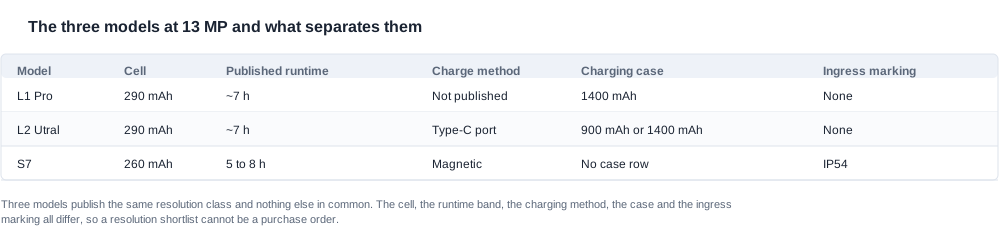
That means a selection made on resolution alone narrows eleven models to either eight or three, and leaves the buyer to decide between eight products on rows that were never about imaging. The three models at thirteen megapixels are the clearest illustration, because they share the resolution class and almost nothing else.
The L1 Pro and the L2 Utral both carry a 290 mAh cell and publish a runtime of around seven hours, but the L2 Utral publishes a Type-C charging port while the L1 Pro publishes no charging method at all. The L1 Pro publishes a 1400 mAh charging case, while the L2 Utral publishes two case sizes at 900 mAh or 1400 mAh. The S7 publishes a 260 mAh cell, a runtime band of 5 to 8 hours, a magnetic charging method, no charging-case row at all, and the only IP54 ingress marking in the whole camera range. Three models, one resolution class, four separate decisions.
The three things a content platform is actually judged on
Format, session length, and the rows behind them
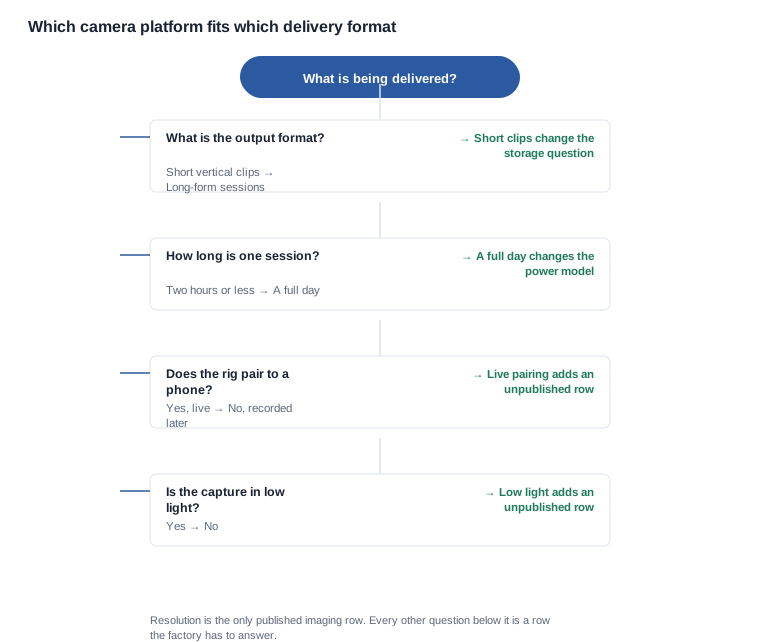
The delivery format is the first filter, because it decides whether the storage question is even a question. A workflow producing short vertical clips is generating many files, and the behaviour that matters is what happens when storage fills — whether the device overwrites the oldest take, refuses new ones, or silently drops them. That behaviour is not published for any of the eleven camera models, and it is the single row that most changes what a content team can do with the product.
Session length is the second filter, and it is where the power rows bite. Every camera model publishes a charge time of two hours or less, so no camera model in the range is limited by how long it takes to recharge. The runtime band is the limit: the CY03 and the L1 Pro, and the MT6 and the L2 Utral, and the CY05 publish around seven hours, the S7 and the V06, and the V03 Pro and the V03 publish 5 to 8 hours, and the KY06 and the MT5 publish 6 to 8 hours. A half-day shoot fits inside almost any of those bands. A full-day shoot does not, unless the kit carries a charging case, and that is where the five published case capacities become the deciding row rather than a convenience.
The third filter is whether the production is live or recorded. A rig that pairs to a phone during a live segment depends on the Bluetooth version, and the catalogue does not publish a Bluetooth version for any of the eleven camera models. The audio models publish theirs — Bluetooth 5.3 on the K01 and the K02, and 5.4 across the rest of the audio tier — but that row stops at the camera models. A live content buyer therefore has a published row for the audio tier and a blank for the camera tier, and the blank is the more consequential of the two.
What the published rows cannot tell you
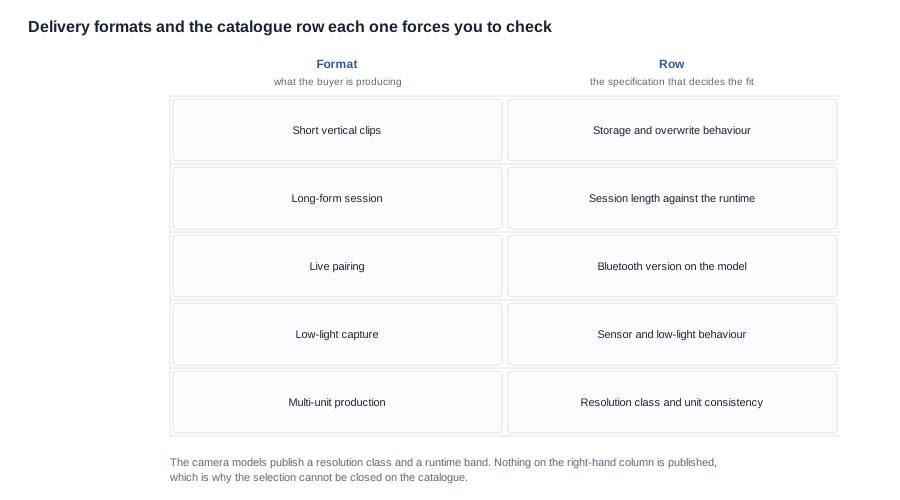
The right-hand column of that matrix is the specification that actually decides the selection, and none of it is published. The video resolution and frame rate, the sensor and the low-light behaviour, the storage and overwrite behaviour, the capture latency, the stabilisation, the field of view and the operating temperature range are all absent from the catalogue. The camera rows that are published are the resolution class, the charge time, the cell configuration, the runtime band, the charging method where one exists, the charging-case row and capacity where one exists, and the ingress marking on the V06 and the S7.
Two consequences follow, and they shape the whole selection. First, a content buyer cannot rank the camera models on imaging quality from published data, so the ranking has to be produced by a test on production units rather than derived from a comparison table. Second, a buyer who is comparing the thirteen-megapixel models needs a different production sample from a buyer who is comparing the eight-megapixel models, because the field of view, the low-light behaviour and the storage behaviour are the variables that will separate them.
How to close the rows the catalogue does not carry
Closing a content-creation selection
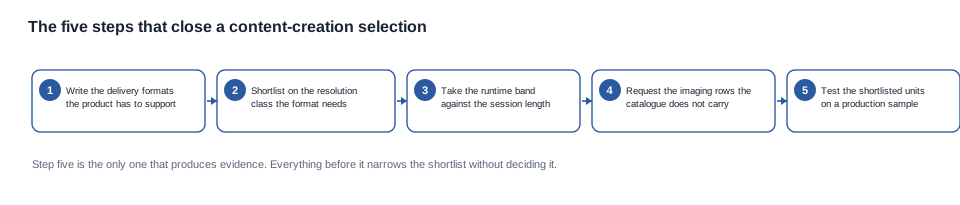
- Write the formats. List the delivery formats the product has to support — short vertical clips, long-form sessions, live segments, multi-unit production — with the session length and the working light for each. The completion standard is a format list, because a shortlist without it is a shortlist of whatever appeared in the catalogue.
- Shortlist on the class. Map each format to a resolution class and take the models in that class. The completion standard is a shortlist in which every model has a written reason tied to a format.
- Take the power rows. Compare the runtime band against the session length for each shortlisted model, and check the charging case row against the shortfall. The completion standard is a written calculation per model, with the case capacity cited where one is published.
- Request the imaging rows. Ask for the video resolution and frame rate, the sensor and low-light behaviour, the storage and overwrite behaviour, the capture latency, the stabilisation, the field of view, the Bluetooth version on the paired model, and the unit weight. The completion standard is a written answer per item.
- Test production units. Shoot the format you actually sell on two units from the same batch, in the light you actually work in, for the session length you actually work to. Two units are needed to separate a design characteristic from a manufacturing inconsistency, because the two have different remedies. The completion standard is a signed sheet with the conditions attached, and a criterion written from it for goods-in.
The rows to request and the criteria to write
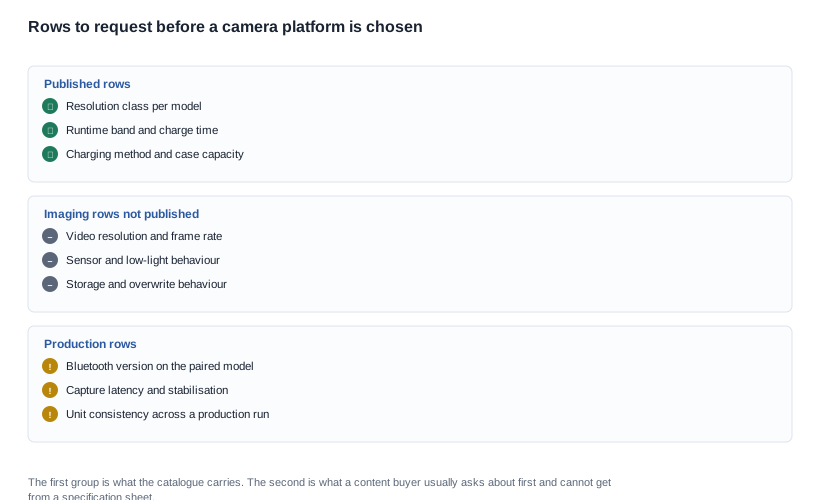
Three groups, and the order matters. The published rows come first so that the specification sheet the content team works from is the catalogue's own wording rather than a reseller's summary — the resolution class, the runtime band, the charge time, the charging method and the case capacity. The unpublished imaging rows come second because they are the ones that change the model choice, and the production rows come third because they are the ones that change the order: the Bluetooth version on the paired model, the capture latency, and the unit consistency across a production run.
The commercial side is set out at pricing, the sample route at samples, the agreement clauses at contract terms, and the certification question at certification checklist. Where the kit includes a case, the transport file has to cover the case cells as well as the device cells, which is set out at battery transport. The recurring production faults are catalogued at content creation common problems, and the endurance question over a long production cycle is at long-term use.

The production day, the case, and the second delivery
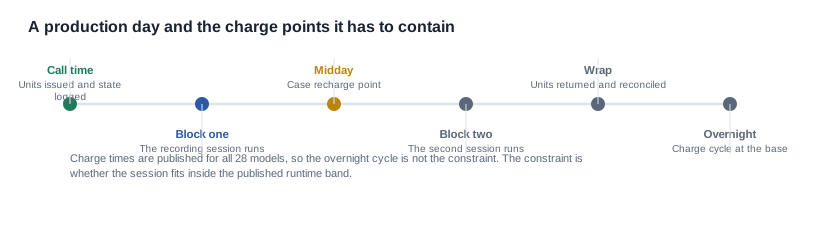
The session-length question resolves into a case question, and the case states are not distributed evenly across the camera range. Seven of the eleven camera models publish a charging-case row, and five of those publish a capacity: the L1 Pro and the CY05, and the CY03 — each at 1400 mAh, the L2 Utral at 900 mAh or 1400 mAh, and the MT6 as a folding 1200 mAh case. The KY06 and the MT5 publish a case row without a capacity, so a production kit built on them cannot be sized from the catalogue. The catalogue publishes no charging-case row for the V03, the V06 or the S7, and it publishes the V03 Pro explicitly without one.
Against a runtime band of around seven hours, a 1400 mAh case against a 290 mAh device cell is roughly five reserves, and a 1200 mAh folding case against the MT6's 265 mAh cell is close to four and a half. Those are comparisons between published figures rather than product claims, and they are why a camera platform with a case can cover a full production day while one without a case cannot.
The awkward part of the range is at the top of the resolution class. The S7 is the only model in the whole camera range that publishes an IP54 ingress marking, and it is one of the three that publish no charging-case row. A production team that wants a marked model for a wet location therefore has to plan its power from the device cell alone, against a runtime band that starts at five hours, and the margin on a full day is thin. The L1 Pro, which does publish a 1400 mAh case, publishes no charging method at all, so the case's own power source is unspecified and has to be requested before the kit is designed. The L2 Utral is the one model at thirteen megapixels where the whole power arrangement is specified: a Type-C port and a case published in two sizes.
The second delivery is the other half of a content selection. A production line needs units that behave the same way, and the only way to establish that is a criterion written from a test on production units rather than from a sample. Two units from the same batch, the same format, the same session length and the same light produce a set of observations that can be turned into goods-in criteria for resolution class consistency, storage behaviour under load, and the runtime actually achieved at the working volume. That criterion set is the document that answers the question a content team asks at the second delivery, and it is the document a buyer without it cannot produce.

Where content-creation selections fail
The platform was chosen on resolution alone. The symptom is a shortlist of eight models that are indistinguishable on the specification sheet. The root cause is that resolution is the only published imaging row, so it is the only thing the comparison can use. Prevention is to write the formats first and let the format select the class.
The 13 MP shortlist was treated as interchangeable. The symptom is an order that mixes models with different charging methods, different case configurations and different runtime bands. The root cause is that the three models at thirteen megapixels were read as one product family. Prevention is to compare the power and case rows per model, as the table above does.
A long session was planned on the runtime band alone. The symptom is a production that stops at hour seven because nobody planned the second charge. The root cause is that the runtime band was compared to the session rather than to the gap. Prevention is to work out the shortfall and match it against the published case capacity.
Storage behaviour was assumed. The symptom is takes that disappear from a long vertical-clip session. The root cause is that overwrite behaviour was never requested. Prevention is to ask for it and to test it on the production sample in step five.
A live segment was planned on an unpublished Bluetooth version. The symptom is a rig that connects inconsistently on stage. The root cause is that the camera models publish no Bluetooth version and the audio tier's version was carried across by assumption. Prevention is to request the version for the exact model and to test the connection on the production units.
A sample was used to close a production decision. The symptom is a second delivery that does not behave like the first. The root cause is that the imaging rows were never compared across two units from the same batch. Prevention is the two-unit rule, and a criterion written from the result.
| Content selection failure | Root cause | Preventive action |
|---|---|---|
| A shortlist of indistinguishable models | Resolution used as the only comparison | Write the formats first |
| Mixed power arrangements in one order | One resolution class read as one family | Compare the power and case rows |
| Production stops at hour seven | Runtime compared to the session | Match the shortfall to the case capacity |
| Takes disappear mid-session | Overwrite behaviour assumed | Request it, test it on the sample |
| The connection fails on stage | Bluetooth version carried across by assumption | Request the version for that model |
| Second delivery behaves differently | One sample used to close the decision | Two units from the same batch |
What we publish about content-creation selection, and what we do not estimate
Concretely, a content platform is selected on the format it has to serve, and the catalogue can only take that selection as far as the resolution class and the power rows. We publish the resolution class for every camera model, the cell configuration, the charge time, the runtime band, the charging method where the catalogue carries one, the charging-case row and capacity where they are published, and the IP54 ingress marking on the two models that carry it. We publish the 158 g whole-unit weight for the MT6 glasses, excluding its folding case, and we will not present it as a weight for any other model or as a frame weight.
What we will not do is publish a video resolution, a frame rate, a sensor, a field of view, a stabilisation, a low-light behaviour, a capture latency, a storage or overwrite behaviour, a Bluetooth version for any camera model, an operating temperature range, a cycle life rating or an assembly weight for any model beyond the MT6. We will not rank the camera models on imaging quality from published rows, because there are not enough rows to rank them, and we will not present a demonstration on an engineering sample as the result of a production unit.
What we will do is take the delivery formats, the session lengths, the working light, the production volume and the target market, and tell you which resolution class the formats point to, which models sit in it, which power rows will decide the session, which rows still have to be closed, and what the criteria for goods-in should say. The product family is at camera and audio smart glasses, the imaging reference is at camera imaging, and the scenario entry point is content creation.
What to send us next. Send the delivery formats, the session length, the working light, the volume and the target market. We will return the format-to-class map, the shortlist with its power rows, the list of rows still open, and the test criteria worth writing into the purchase order.
Related reading
- The family we are placing it in — camera and audio smart glasses
- The imaging reference — camera imaging
- The production checks — testing camera technology
- The recurring faults — content creation common problems
- How to enter the scenario — content creation
Tell us the delivery formats and the session length, and we will tell you which resolution class the formats point to and which rows still have to be closed.


